Small Temple of Abu Simbel: A Rock-Cut Temple to Nefertari and Hathor
Site at a Glance
- Rating
- 4.8
- Popularity
- Low
- Country
- Egypt
- Primary era
- Bronze Age
- Eras represented
- Bronze Age
- Civilizations
- Egyptian
- Site type
- Religious
- Remains
- Temple
On this page12 sections
History
The Small Temple of Abu Simbel is a rock-cut Egyptian temple at Abu Simbel in Egypt, built during the reign of Ramesses II in the Nineteenth Dynasty. Excavated into the sandstone hill of Ibchek, it was dedicated to Hathor of Ibchek and to Nefertari, Ramesses’s great royal wife, whose prominent position within the royal household is reflected in the monument’s design and inscriptions. The temple formed part of the Abu Simbel complex with the Great Temple of Ramesses II.
Construction under Ramesses II
Ramesses II’s long reign was associated with extensive monumental building, and the Small Temple was one of six rock-cut temples constructed during it. Together with the Great Temple, it was intended to impress the enemies of southern Egypt and proclaim the power and grandeur of the kingdom. Its religious purpose was equally important. Hathor was associated with femininity, royal power, music, beauty, and motherhood, while Nefertari was represented in the goddess’s role.
The temple’s name is translated as “Nefertari, for whom the sun shines.” Its royal titles and inscriptions show that the building had been completed and was in use before Nefertari died shortly after regnal year 21, although parts of the monument may still have remained unfinished. One inscription calls it an eternal work belonging to Nefertari-Merienmut, while another describes Ramesses as creating a heavenly dwelling for his beloved royal wife.
Abandonment and rediscovery
After its ancient use ended, the temple remained abandoned for several centuries. J. L. Burckhardt visited it in 1813 and communicated his discovery to Giovanni Belzoni. Belzoni initially failed to enter the monument, but returned in 1817, located the entrance, and removed objects that he was able to transport.
The temple’s position changed in the twentieth century because of the construction of the Aswan High Dam. Beginning in 1964, the Small Temple and the Great Temple were dismantled and rebuilt at a nearby site. The reconstructed temples stand approximately 65 metres higher and about 200 metres farther from their original location. The Small Temple is now part of the Nubian Monuments from Abu Simbel to Philae, which were inscribed on the UNESCO World Heritage List in 1979.
Remains
Facade and statues
Colossal figures of the royal couple
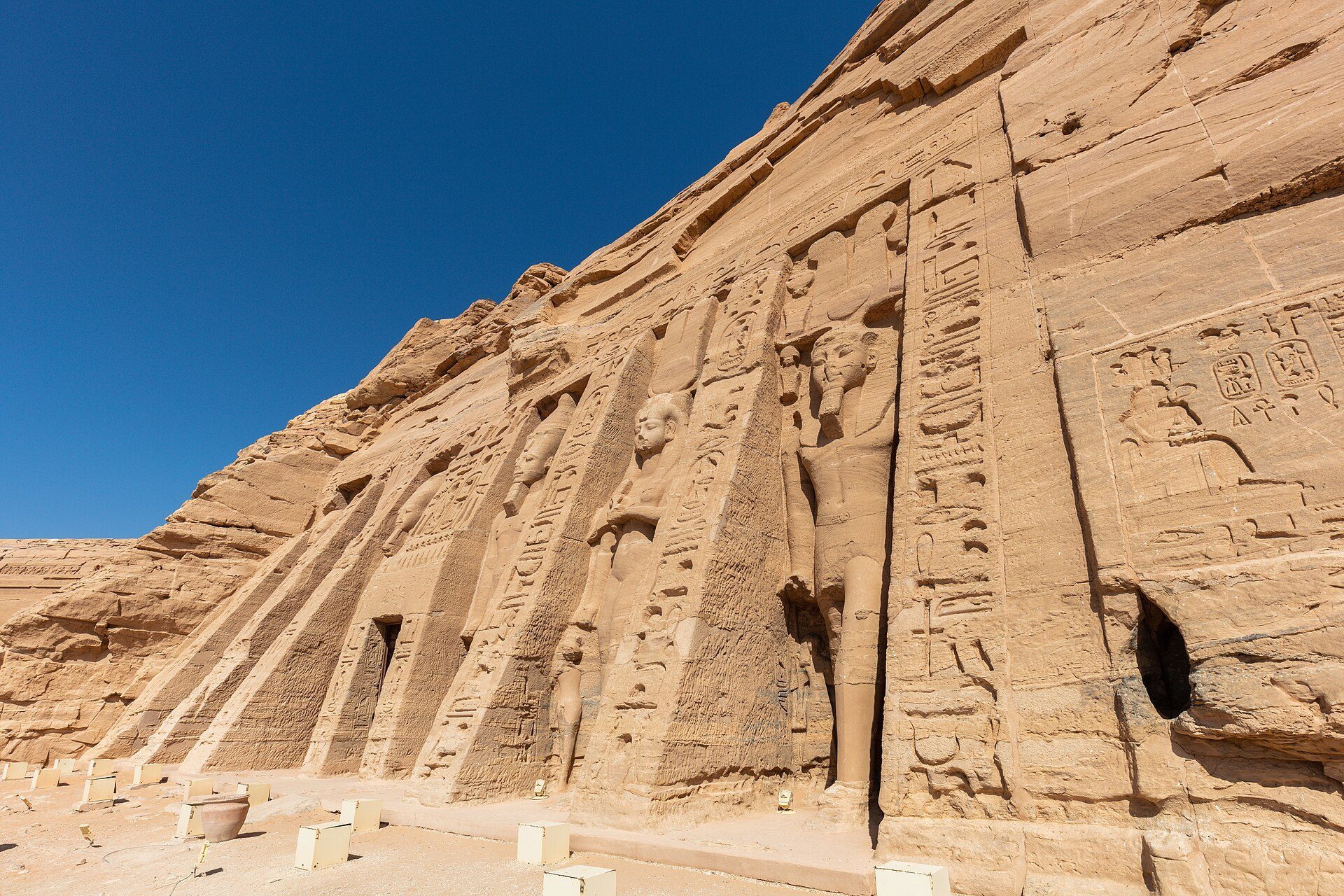
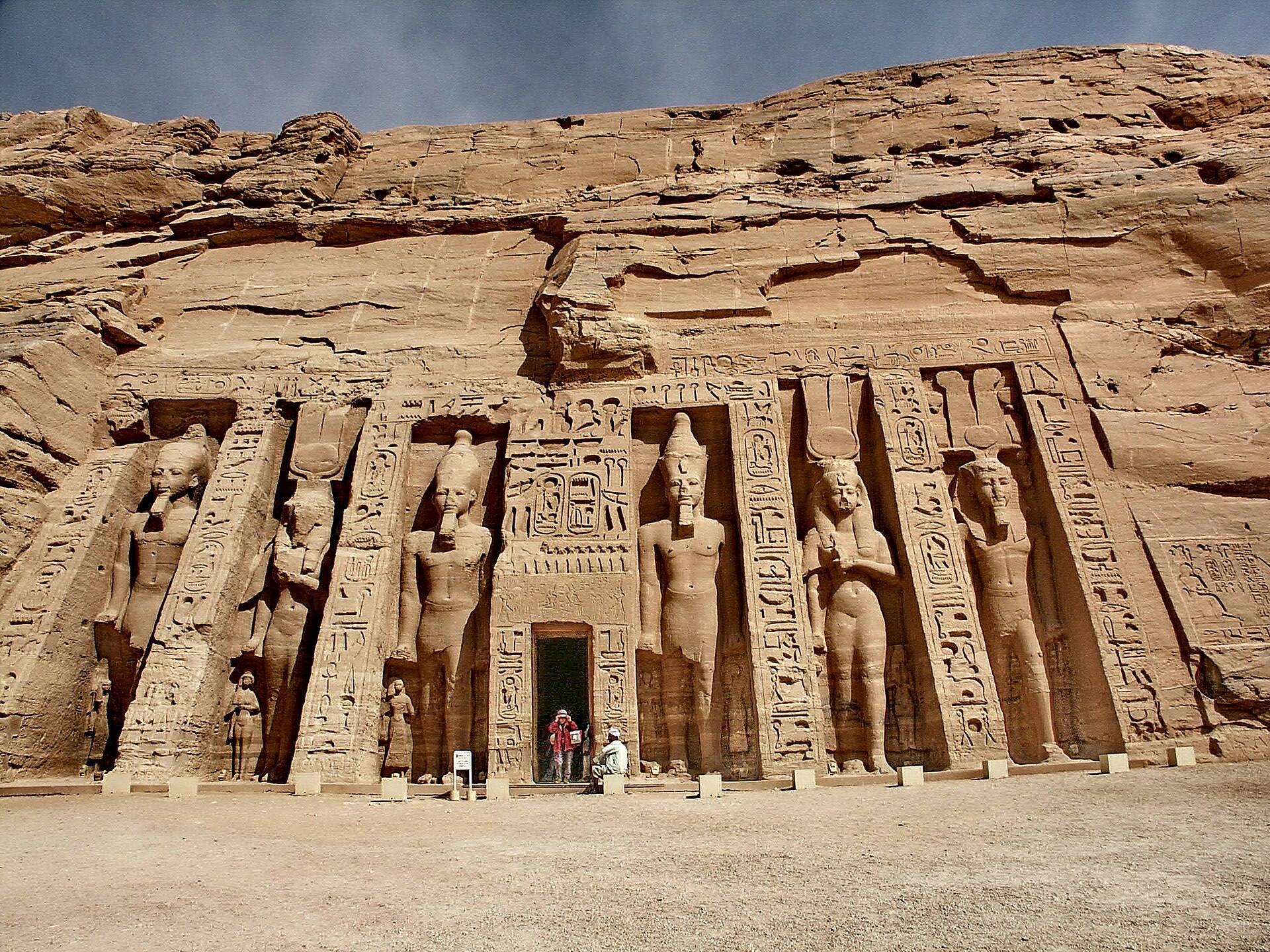
The monument is a speos, a temple excavated directly into a rock face or hill. Its facade contains six colossal standing figures arranged in two groups of three, with pillars covered in finely carved hieroglyphs between them. Four figures portray Ramesses II and two portray Nefertari. Each has the left leg advanced in a walking stance, and all rise more than 10 metres above the ground.
The equal scale of the king and queen is an unusual feature of the facade, since royal wives were generally shown smaller than the king. The two figures of Nefertari wear the solar disk and two tall feathers between Hathor’s horns, and each holds a sistrum, a ritual rattle associated especially with the goddess, against her chest. The statues of Ramesses display several royal crowns. Two carry the White Crown of Upper Egypt, another wears the double crown of the united kingdom, and the fourth wears the horned henu crown with a solar disk and two ostrich feathers. The figures also include false beards where required by the royal imagery.
Royal children and facade decoration
Smaller figures of the royal children stand beside their parents. The princes are Amunherkhepeshef, Pareherunemef, Meryre, and Meryatum, while the princesses are Merytamon and Henuttawy. The facade and entrance were carved from the cliff’s sandstone, whose surfaces also carry reliefs, hieroglyphic inscriptions, royal crowns, and images connected with Hathor and other deities.
Above the entrance, a carved scene lies beneath a frieze of uraei, the rearing cobras associated with royal protection. Ramesses offers wine vessels to Amun-Re in one relief and burns incense before Horus of Meha in another. His cartouches appear above the frieze. Other entrance scenes show the king making offerings to Hathor, mistress of Ibchek, while Nefertari venerates Isis.
Rock-cut interior
First hall
The entrance extends roughly 21 metres into the rock and leads to an interior plan simpler than that of the Great Temple. The first hall, or pronaos, has six pillars and is divided into three aisles by pillars and architraves. The pillars facing the central aisle carry stylized heads of Hathor. Hieroglyphic texts and reliefs describe episodes connected with the lives and religious duties of Ramesses and Nefertari.
The hall’s decoration presents the royal couple before a wide group of Egyptian gods. Ramesses is shown ritually defeating a Nubian before Amun-Re and an Asiatic before Horus of Meha. Other scenes show him before Hathor of Ibchek, receiving a crown from Seth of Ombos, and presenting Ma’at to Amun-Re. Nefertari offers a sistrum and papyri to Anuket of Elephantine. Additional reliefs show Ramesses making offerings to Ptah of Memphis, libating before Heryshef of Heracleopolis Magna, and presenting wine to Re-Horakhty of Heliopolis. Nefertari presents sistra to Hathor of Heliopolis, while further scenes include offerings to Mut and Hathor of Ibchek.
Vestibule
Three doorways lead from the first hall into the vestibule, corresponding to the hall’s three divisions. Nefertari’s name appears on the lintels of the side doors, between protective images of Nekhbet. The reliefs show her receiving crowns from Hathor of Ibchek and Mut, accompanying Ramesses before Taweret, and offering to Hathor in the form of a cow standing in a papyrus boat.
On the rear wall, Ramesses offers to the Horuses of Miam, Baki, and Buhen, as well as to Amun-Re and Re-Horakhty. Nefertari is shown presenting offerings to the triad of Elephantine, Khnum, Satet, and Anuket, and to Hathor of Ibchek and Mut. These scenes combine royal ritual with the worship of deities associated with different Egyptian cult centres.
Sanctuary
The innermost sanctuary contains reliefs of Nefertari presenting a sistrum and an incense burner to Mut and Hathor. Other scenes show Ramesses performing incense and libation rites before an enthroned deified royal couple. The rear wall has a slightly off-centre niche framed by a cobra frieze and Hathoric sistra.
Within the niche, Hathor of Ibchek appears as a sacred cow emerging from a mountain and pushing forward a figure of the king. Hathor’s representation as a cow is a sacred animal form associated with the goddess and with Ibchek, an ancient settlement and cult centre connected with her worship. Nearby, Ramesses offers papyri to the goddess. Columns of hieroglyphs give his royal names and describe him as beloved of Hathor, mistress of Ibchek.
Materials and painted decoration
The facade, colossal figures, halls, side rooms, vestibule, and sanctuary were cut from the sandstone of the cliff. Their surfaces combine sculpture, raised reliefs, painted decoration, hieroglyphic writing, and Hathoric capitals. Natural pigments included red and yellow ochres made from iron oxides, azurite for blue, malachite for green, and charcoal for black. Plaster provided a ground for some paintings, while mortar and stucco served in selected decorative details, repairs, and smoother surfaces. Wood and metal were used for functional elements such as doors and hinges and for secondary structural or decorative components.