Shakh Fazil: A Qarakhanid Mausoleum and Muslim Pilgrimage Complex in Kyrgyzstan


Site at a Glance
- Rating
- 4.7
- Popularity
- Very Low
- Country
- Kyrgyzstan
- Primary era
- Medieval
- Eras represented
- Medieval, Early Modern, Modern
- Civilizations
- Karakhanid
- Site type
- Religious
- Remains
- Tomb
On this page7 sections
History
Shakh Fazil is a sacred historical and architectural complex in Kyrgyzstan, near Safed-Bulan in the Ala-Buka District, centered on an eleventh-century Qarakhanid mausoleum. The Qarakhanids were a Muslim ruling dynasty that governed parts of Central Asia during the medieval period. The complex developed across pre-Islamic and Islamic periods and has remained a pilgrimage destination for Muslims of Central Asia.
Pre-Islamic origins and Islamic traditions
The complex is interpreted as having begun before Islam as a sanctuary associated with a phallic cult at the sacred mountain of Archa Mazar. The name Archa Mazar combines the mountain’s name with mazar, a Muslim shrine or pilgrimage site associated with the grave of a revered person. Islamic monuments were later established around the mountain, and the area became associated with the settlement of Gulistan, about 10 kilometres from Kerben.
Local foundation tradition connects the complex with Shah-Jarir, who is said to have entered the Fergana Valley in the eleventh or twelfth century with 12,000 soldiers at the direction of his grandfather, Muhammad, to spread Islam. After settling in the Ala-Buka area, he reportedly faced resistance from local groups. The tradition says that he married Buayda, the daughter of a local ruler, while the regional ruler Ikhshid and Buayda’s father planned an attack on the Arab missionaries during Friday prayer.
According to the tradition, the attackers entered the mosque and killed the worshippers. A miraculous opening appeared in a wall, allowing Shah-Jarir and several close companions to escape. Shah-Jarir then returned to his homeland with the pregnant Buayda and other Arabs. A servant named Bobolon is said to have gathered and washed the severed heads of approximately 2,700 Arab warriors, a figure also given as 2,772. She buried them beneath a stone-covered mound and was miraculously transformed from black-skinned to white-skinned. Tajiks are said to have called her Safed-Bulan, meaning “White Bobolon.”
The Fazil tradition and medieval mausoleum
The same tradition relates that Shah-Jarir was poisoned and killed, after which Buayda gave birth to their son Fazil. Fazil reportedly learned what had happened to his father at the age of 40, gathered an army, returned to the Fergana region, and established Islamic rule there. He is said to have ordered the bodies of those killed in the earlier massacre to be buried according to Islamic rites, although the tradition holds that they had remained undecayed for 40 years.
Fazil reportedly ruled for 16 years before being poisoned by a local ruler after attending a celebration for his 16-year-old son. A mausoleum was then built for him. The principal Shakh Fazil Mausoleum is generally dated to the eleventh century and was probably constructed around 1050–1060. It is associated with the burial of a ruler of the Qarakhanid state and with the eleventh- and twelfth-century history of the complex.
Later pilgrimage and preservation
The settlement associated with Safed-Bulan came to be called Safedbulan. After her death, her grave became a mazar, while the site connected with the massacre remained part of the sacred landscape. A local belief holds that a green banner of Islam can still be seen in the sky above the place where the innocent Muslims were killed. An annual mass pilgrimage continues at the complex.
Restoration work took place in the 1980s and again in 2003. Shakh Fazil was added to the UNESCO World Heritage Tentative List as an individual cultural entry in 2001. In 2010, that entry was removed when the complex was incorporated into the serial entry “Silk Roads Sites in Kyrgyzstan.”
Remains
Shakh Fazil Mausoleum
The Shakh Fazil Mausoleum has an approximately square plan, with exterior walls measuring about 11 metres on each side and rising to 15.37 metres. Its corners are oriented toward the east and west. The walls incline noticeably upward, and their upper sections carry six-sided corner elements arranged in steps beneath a conical dome. Fired brick forms both the walls and the dome.
A doorway was placed on the south-west side, alongside a window with door openings on both sides. The interior was initially lined with carefully fitted decorative stone. During the twelfth century, it was plastered and richly ornamented with carved ganche, a plaster-like material based traditionally on gypsum or alabaster that can be carved after application. Later rebuilding altered the monument’s original appearance.
Inside, carved geometric compositions accompany Kufic inscriptions, an early angular form of Arabic script often used for monumental religious texts. The religious inscriptions are in Arabic, while the elegiac texts are in Persian. Ganche carving covers the interior with partial illumination in blue, light blue, yellow, and red. The contrast between the austere fired-brick exterior and the richly decorated interior is a defining feature of the mausoleum.
Associated sacred structures
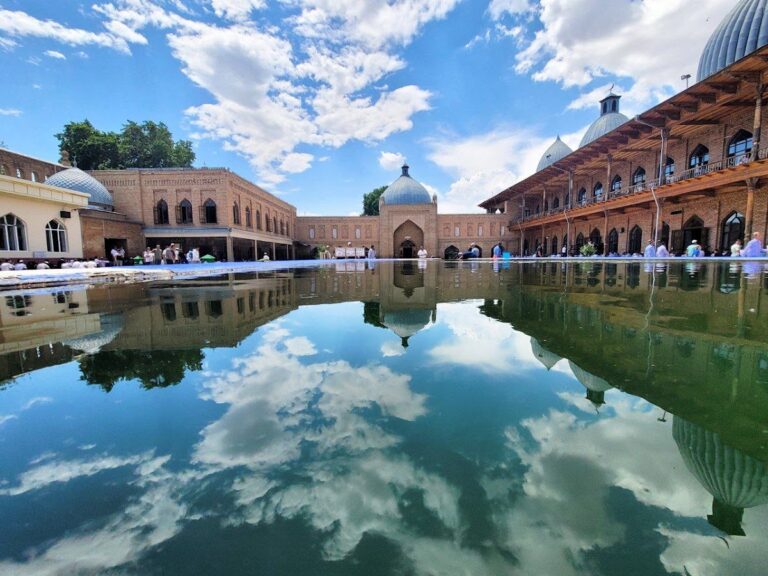
The wider complex includes the nineteenth-century Safed-Bulan Mausoleum and Alamberdar Mausoleum, as well as the sacred mountain of Archa Mazar. Other features include a cave associated with a holy hermit, an eighteenth- or nineteenth-century mosque, the site linked with the execution of approximately 2,700 to 2,772 Arab warrior-martyrs, and a vertically erected stone with a phallic shape. Together, these structures and sacred places form the physical setting for the complex’s pre-Islamic associations, Islamic traditions, and continuing pilgrimage.