Seeon Abbey: A Benedictine Monastery and Cultural Center in Germany
Site at a Glance
- Popularity
- High
- Country
- Germany
- Primary era
- Medieval
- Eras represented
- Medieval, Early Modern, Modern
- Civilizations
- Duchy of Bavaria, Electorate of Bavaria, Holy Roman Empire
- Site type
- Religious
- Remains
- Monastery
On this page14 sections
History
Seeon Abbey is a former Benedictine monastery on an island in Klostersee, Germany. Founded in 994 by Count Palatine Aribo I, a senior noble with court and regional authority, and his wife Adala, it became an important center of manuscript production and later of music and learning. The surviving complex is predominantly Baroque in style, a later European artistic tradition.
Foundation and imperial status
The monastery was established at a place then called Burgili, where Benedictine monks from St. Emmeram Abbey in Regensburg settled. Seeon followed the Lorraine–Gorze reform, a movement to renew Benedictine religious life, and began as a double monastery, housing communities of both men and women within one institution. The women’s community later disappeared.
In 999, Emperor Otto III took the abbey under his protection and made it an imperial abbey, placing it under imperial authority. That status ended in 1201, when King Philip of Swabia transferred Seeon to Eberhard, Archbishop of Salzburg.
Manuscripts and medieval development
From the 10th century, Seeon’s scriptorium, a workshop for copying and producing manuscripts, supplied books to the abbey and to other monasteries and churches. Emperor Henry II was its leading patron. He gave some Seeon manuscripts to the Bishopric of Bamberg, which he had founded. The abbey also managed outlying administrative centers at Mühldorf, Kling, Sinning, and Trostberg.
The abbey underwent a Romanesque rebuilding, an earlier medieval architectural style, toward the end of the 11th century. Around 1180, a new church replaced its predecessor, and further rebuilding in the Late Gothic style took place from 1428 to 1433. In 1412, the abbot received permission to use pontifical insignia, ceremonial symbols associated with bishops.
Reform and cultural activity
After the monastery fell into severe decline under Abbot Wolfgang Finauer, he resigned in 1575. Martin II Kötterlein, a reforming abbot who had previously been a monk at Tegernsee, took over the following year. Appointed by the Archbishop of Salzburg at the initiative of Duke Albrecht V of Bavaria, Kötterlein led Seeon until 1590 and carried out extensive religious and economic reforms. He became known as the abbey’s “second founder.”
Abbot Honoratus Kolb, who led Seeon from 1634 into the early 1650s, promoted Baroque art. His support helped shape the abbey’s later reputation for literature and music. Seeon remained a cultural and educational center until the Electorate of Bavaria dissolved the monastery in 1803.
Joseph Haydn visited the abbey, and Wolfgang Amadeus Mozart was active there from 1767 to 1769. Mozart composed Scande coeli limina (KV 34) for Seeon in 1769 and Inter natos Mulierum (KV 72) in 1771. His offertories, sacred pieces for the offertory portion of church services, were performed at the abbey as late as 1771.
Dissolution and changing uses
After the abbey’s dissolution in 1803, its property was auctioned. Munich baker Franz Xaver Distler acquired most of the buildings, and the former monastery became a castle. Its later uses included a brewery, a medicinal spa, a convalescent home, and barracks. St. Lambert’s Church became the parish church for nearby (Nieder-)Seeon. The infirmary and library were demolished, and a causeway was built to the mainland. The abbey’s former pilgrimage church of Maria Eck passed to Traunstein brewer Felix Obermair in 1810, following disputes with local people.
Amélie of Leuchtenberg, formerly Empress of Brazil, bought the former abbey buildings in 1852. The Dukes of Leuchtenberg retained them until 1934, when industrialist Max Wiskott bought the complex at auction. He leased it to the Nazi Party for an SA school and training facilities for the National Labour Service, a state labor organization.
Twentieth-century uses and restoration
From 1945, the buildings served first as a military hospital and then as a refugee camp. A West German border-security force used them as a school from 1958 to 1978; the Bavarian riot police later occupied the site as barracks. The Archdiocese of Munich and Freising acquired the complex in 1979 to prevent a rumored purchase by the religious movement associated with Bhagwan Shree Rajneesh, but did not convert the deteriorated buildings.
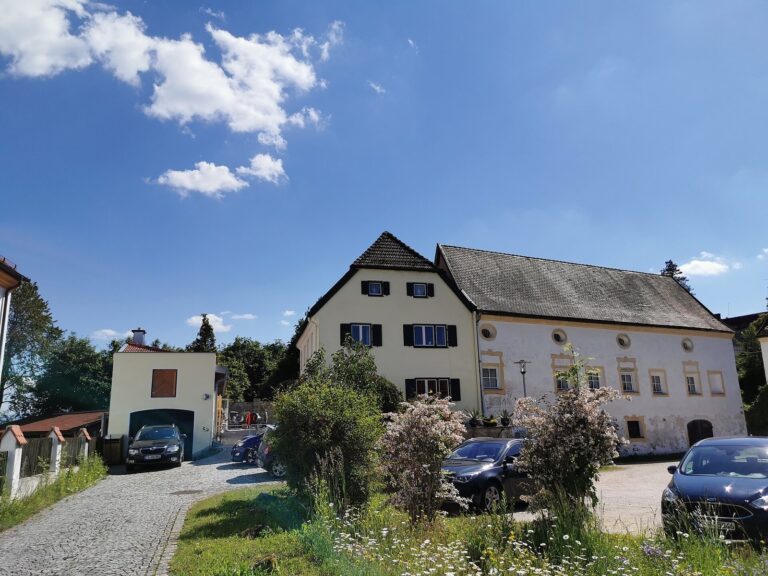
The District of Upper Bavaria acquired Seeon in 1986. Following renovation and modernization, the complex reopened in 1993 as a cultural and educational center with a conference hotel.
Remains
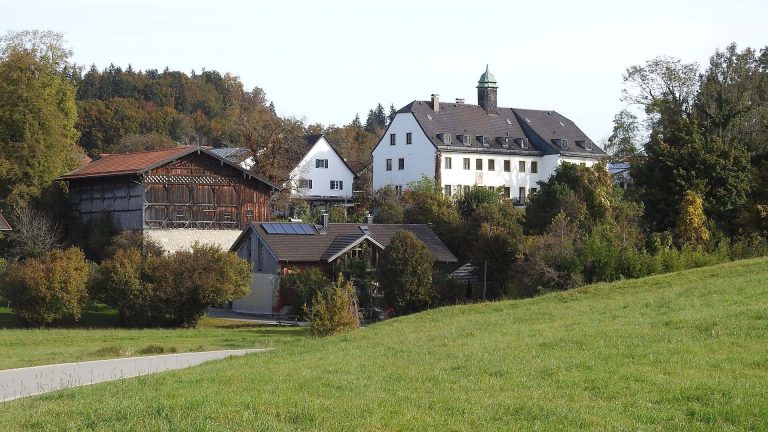
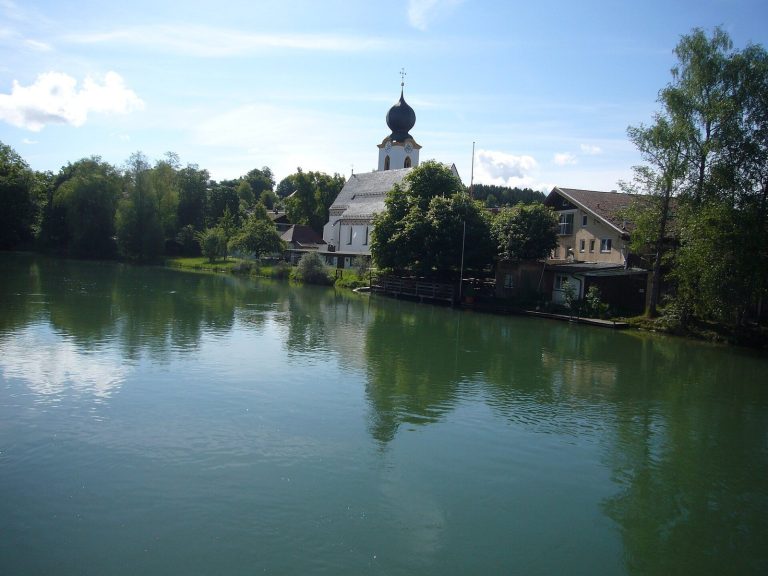
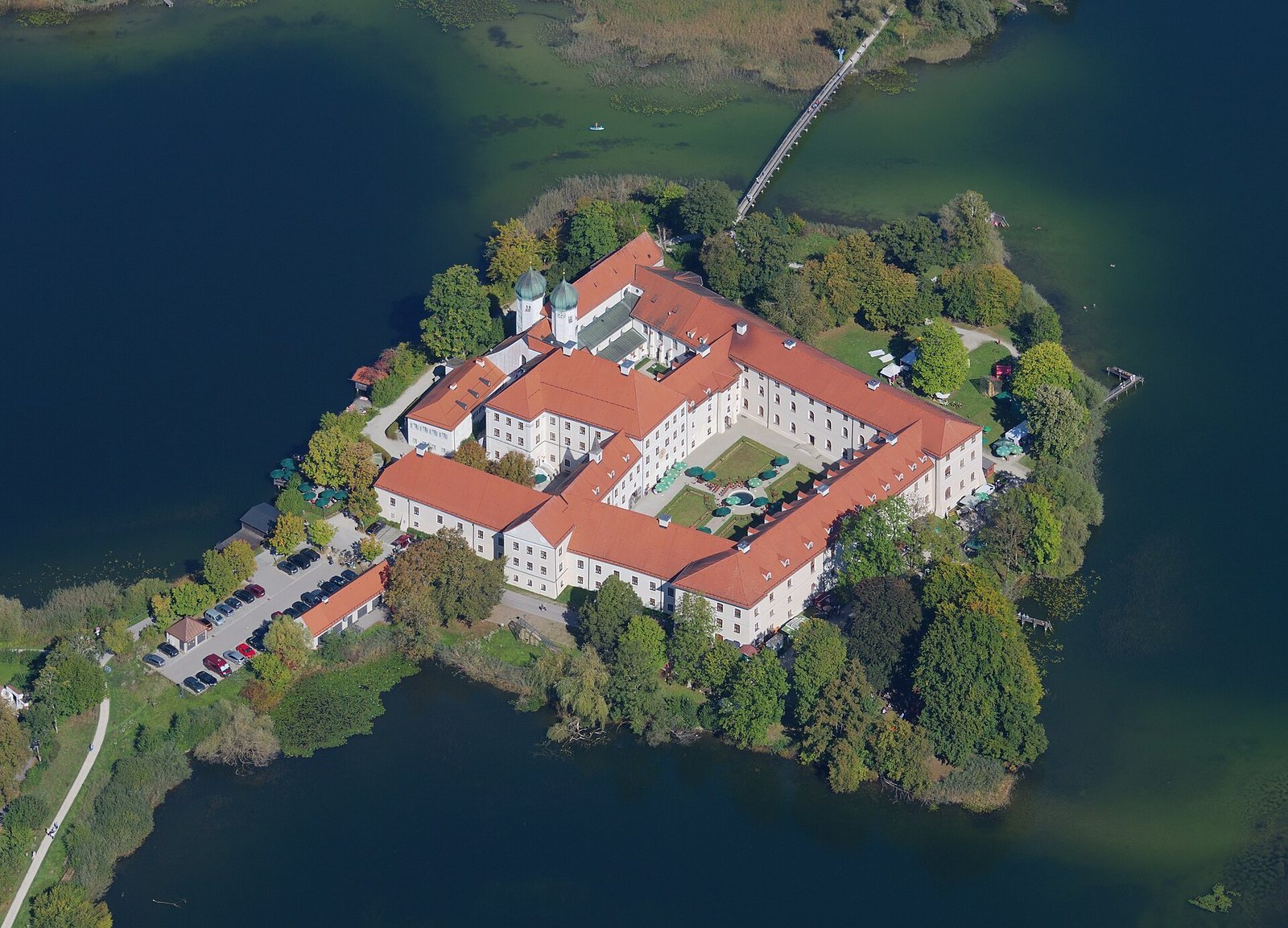
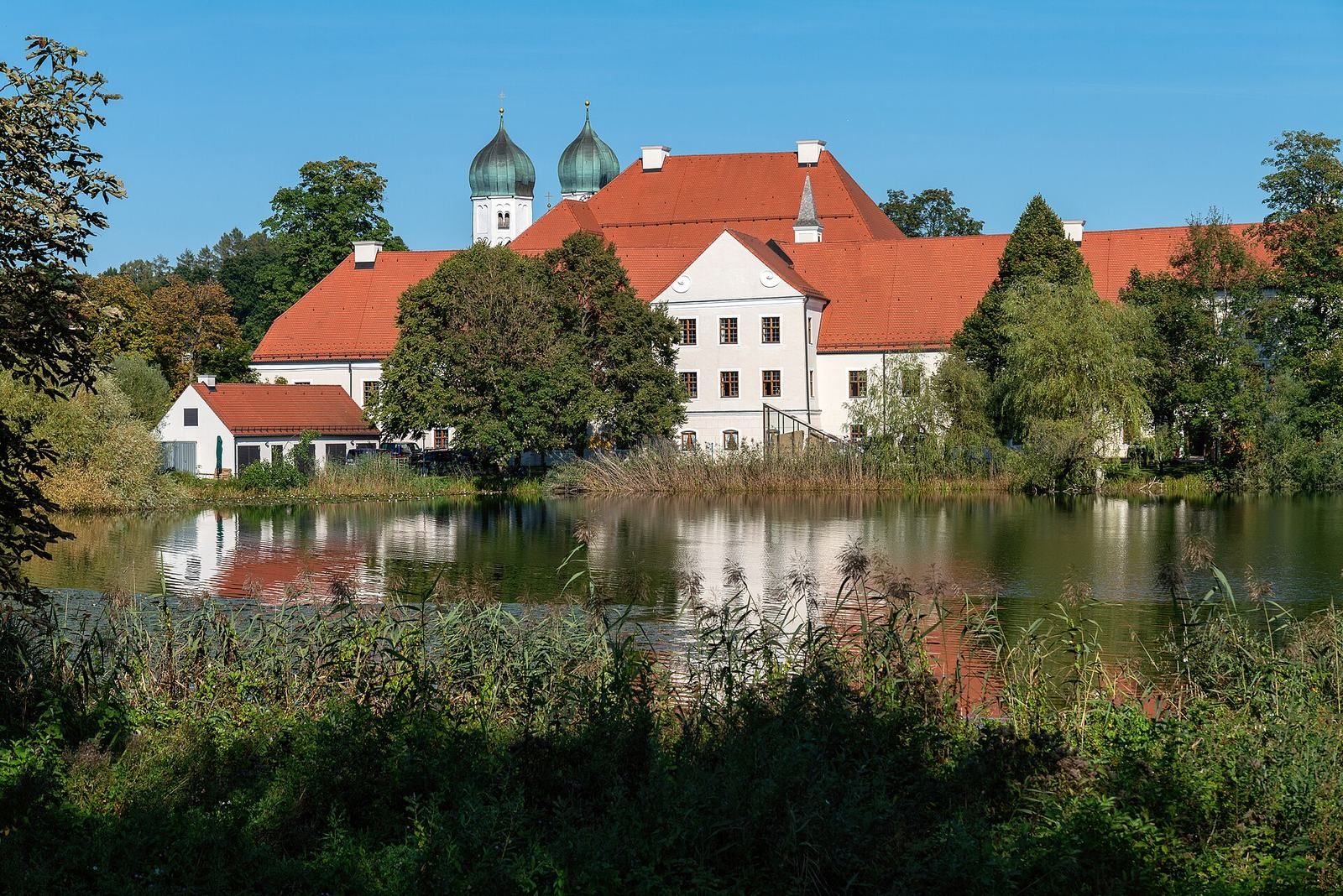
The former abbey occupies an island in Klostersee, also known as Seeoner See, a few kilometers north of Lake Chiemsee. The village of Seeon is situated on the island, which is now linked to the mainland by a causeway. St. Lambert’s Church forms the center of the complex and remains the parish church.
Church of St. Lambert
Plan and construction
The church’s Romanesque form includes a columned basilica, a long church divided into aisles. It was later given vaulting and a new choir. At its eastern end, the building terminates in an apse, a projecting, often rounded end of a church. The church was replaced around 1180, and its form was altered again during the abbey’s later rebuilding campaigns.
Towers and bells
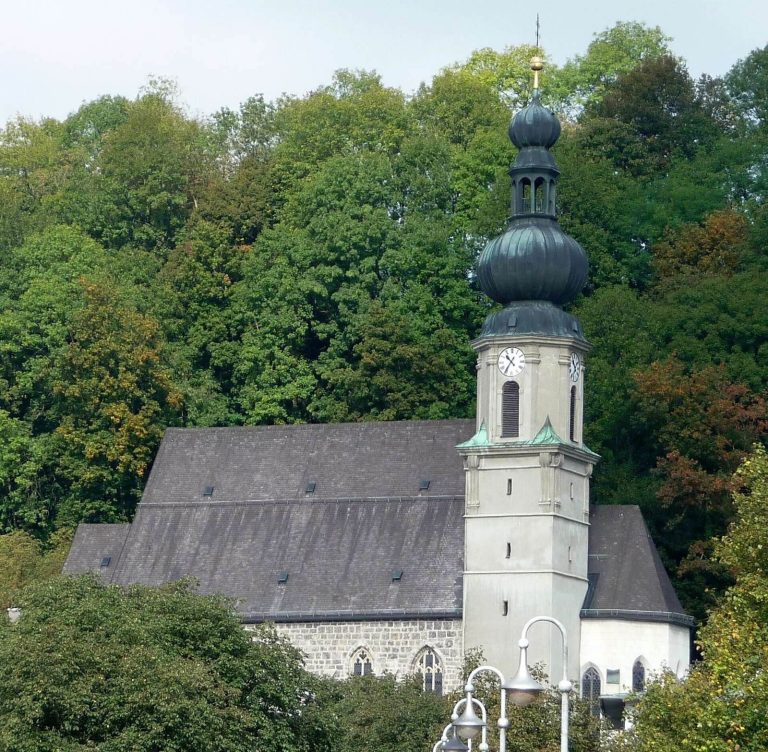
The church originally had a single tower on its north side, modeled on the tower at Frauenchiemsee Abbey. A second tower was added toward the end of the 12th century. Both Romanesque towers have copper onion-shaped cupolas, added after a fire in 1561. The north tower holds a set of four historically important bronze bells, whose tones are f1, a1, c2, and d2. The bells were cast in 1558, 1561, and 1989.
Chapels and paintings
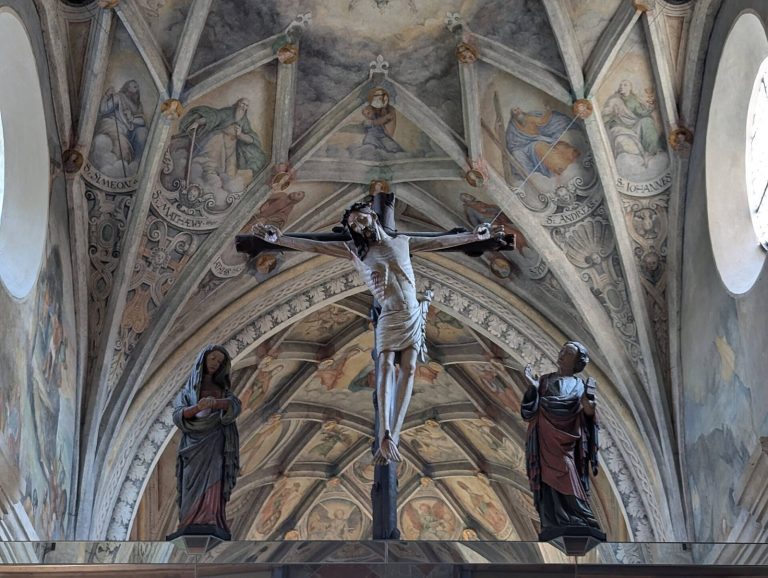
Between 1657 and 1670, additions included a sacristy in the Lady Chapel, a prayer choir, and a crypt, a chamber beneath a church or chapel, below St. Barbara’s Chapel. Renaissance frescoes from 1579 depict episodes from the lives of Christ and the Virgin Mary, the patron saints Benedict and Lambert, and the founders Aribo and Adala.
Tombs and memorials
A red-marble gravestone commemorates Abbot Honoratus Kolb. In the castle chapel, gravestones of abbots from the 15th and 16th centuries line the walls. A tomb for founder Aribo I, made by Hans Heider around 1400, stands in the middle of the room.
Madonna images
The anonymous artist known as the Master of Seeon made a Madonna and Child in 1433. The original has been in the Bavarian National Museum in Munich since 1855; a copy has stood on the church’s high altar since 1947. A separate Madonna, dating to about 1380, is kept in the church sacristy.
Cloister and lakeside oak
The monastery cloister has been restored. Beside the lake grows an oak associated by local tradition with Mozart, who was said to have liked to sit beneath it.