Schloss Wolfegg: Renaissance Castle and Ancestral Seat in Germany


Site at a Glance
- Rating
- 4.6
- Popularity
- Very Low
- Country
- Germany
- Primary era
- Early Modern
- Eras represented
- Early Modern, Modern
- Civilizations
- German, Holy Roman Empire
- Site type
- Domestic
- Remains
- Castle
On this page9 sections
History
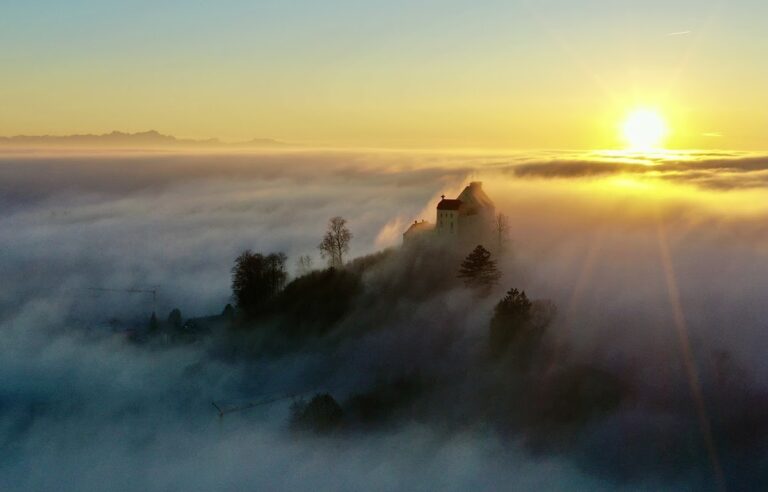
Schloss Wolfegg is a Renaissance castle in Germany, the ancestral seat of the Waldburg-Wolfegg noble family and a landmark regarded as the western boundary of the Allgäu. The present complex took shape in the late sixteenth century, when Truchsess Jakob II of Waldburg and his wife, Johanna, commissioned a new residence after an older building was destroyed by a chimney fire in 1578. A Truchsess was a high-ranking court official, commonly serving as a steward or seneschal.
Renaissance rebuilding and wartime destruction
The rebuilding under Jakob II and Johanna established the castle’s external form and its rectangular plan with four corner towers. The residence later suffered severe damage during the Thirty Years’ War, a European conflict fought mainly between 1618 and 1648 amid religious, dynastic, and political struggles in the Holy Roman Empire. In 1646, Swedish troops commanded by General Carl Gustaf Wrangel plundered the castle and burned parts of it.
Maximilian Willibald of Waldburg-Wolfegg lacked the money to begin repairs immediately, so reconstruction did not start until 1651. The recovered complex subsequently acquired interiors shaped by changing artistic tastes. Between 1691 and 1700, Balthasar Krimmer of Wangen redesigned rooms used for official and representative purposes. During the eighteenth century, some of these interiors were further fitted out in the Rococo style, known for lighter and more ornamental decoration.
Nineteenth- and twentieth-century history
Major renovations took place again in the late nineteenth century. The dining rooms were adapted to contemporary taste, while the castle chapel was remodeled in the Neo-Gothic style, a nineteenth-century revival of medieval Gothic forms.
Schloss Wolfegg also became associated with an important episode in the history of cartography. In 1901, the Jesuit priest, historian, and cartographer Joseph Fischer discovered a 1516 reprint of a world map first printed in 1507 by Martin Waldseemüller and Matthias Ringmann. The map used the name America for the newly identified continent. It had previously belonged to Johannes Schöner, an astronomer, geographer, and cartographer of the Free Imperial City of Nuremberg. The Waldburg-Wolfegg family later acquired it, and it remained in the family archives for more than 250 years before being sold to the United States Library of Congress in 2001 for ten million dollars.
During the First World War, the castle housed the Schloss Wolfegg military hospital operated by the German Red Cross, from 28 August 1914 to 31 March 1919. In 1978, a major burglary resulted in the theft of part of the castle’s valuable arms collection. The Waldburg-Wolfegg family still owns the castle, and family members continue to occupy it. In May 2016, the Baden-Württemberg Monument Foundation, an organization devoted to preserving historic monuments in the German state, designated the Rittersaal its Monument of the Month.
Remains
Main complex
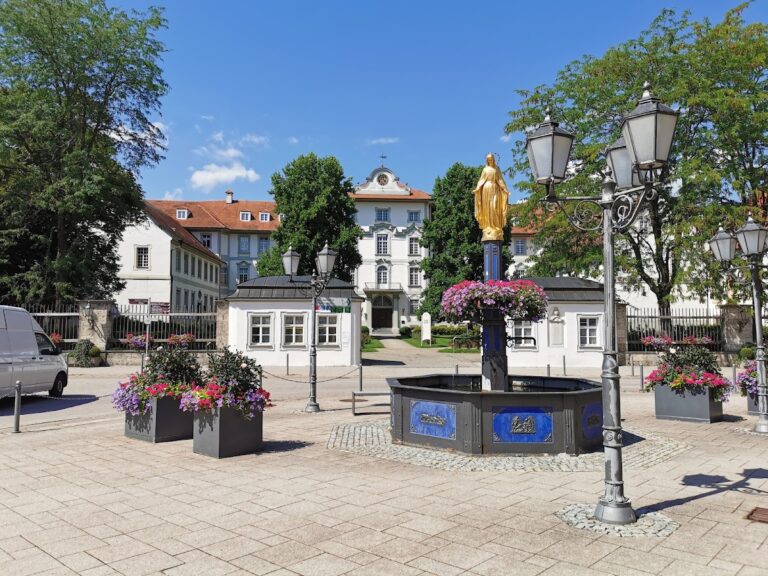
The main building is arranged as four wings forming a rectangle, with a tower at each corner. This overall layout and the Renaissance exterior belong to the late-sixteenth-century rebuilding commissioned by Jakob II of Waldburg and Johanna. The arrangement presents the castle as a unified residential complex whose principal form has survived from that rebuilding phase.
Baroque ceremonial interior
The Rittersaal, or knights’ hall, is a large Baroque ceremonial room used for representative functions. Its decoration includes 24 life-sized wooden sculptures and a large ceiling mirror. The room is regarded as one of the most original designs of the Baroque period in Germany, a style associated with dramatic decoration, sculpture, and spatial effects.
Castle chapel
The castle chapel has its present Neo-Gothic appearance because of the remodeling carried out during the late nineteenth-century renovations. Its form therefore reflects a later phase of the complex rather than the Renaissance exterior established by the sixteenth-century rebuilding.
Library and art collection
The castle houses the Wolfegger Kabinett, a collection of graphic art dating from the late Middle Ages and the Renaissance. The castle library is associated with the collection and was the place where Joseph Fischer found the 1516 reprint of the Waldseemüller and Ringmann world map. The map measured approximately 2.4 metres in width and 1.4 metres in height and survived in very good condition within a bound volume containing other maps.
Ancillary buildings
An automobile museum occupies an ancillary building of the castle. Schloss Wolfegg’s interiors are normally closed to the public, although concerts and occasional guided tours provide limited access to some rooms.
Nearby sites