Santimamiñe Cave: A Prehistoric Site with Paleolithic Art
Site at a Glance
- Country
- Spain
- Primary era
- Stone Age
- Eras represented
- Stone Age
- Civilizations
- Unclassified
- Site type
- Civic
- Remains
- Rock Art
On this page14 sections
History
Santimamiñe Cave is a prehistoric cave in Kortezubi, Spain, near Gernika. It is one of Biscay’s principal prehistoric sites and an important archaeological site in the Basque Country. Its near-complete archaeological sequence extends from the Middle Paleolithic to the Iron Age. Finds from the entrance range from the Upper Paleolithic to the Roman period, while other, unclassified remains belong to the Neolithic, Chalcolithic, Bronze Age, and Iron Age. These are successive archaeological periods, though their dates vary by region. The Magdalenian, a late Upper Paleolithic culture of western Europe, is especially associated with the cave’s art.
Discovery and archaeological research
Children exploring the cave in January 1916 broke large stalactites and found a passage leading to charcoal drawings. They did not initially recognize the images as cave paintings. On August 7, José F. Bengoechea told Basque composer Jesús Guridi about the discovery. Guridi returned with Bengoechea and the children on August 11 and identified the images as paintings.
Guridi reported the find to Manuel Losada, a member of Biscay’s Monuments Commission. At a meeting on May 15, 1917, the commission accepted the discovery as genuine and arranged to inform the provincial council president. French prehistorian Henri Breuil inspected the cave on September 16, 1917, and formally confirmed the paintings’ antiquity.
The principal investigation took place in 1917–18. Telesforo de Aranzadi, José Miguel de Barandiarán, and Enrique Eguren excavated the entrance deposits and studied the entrance and main chamber. J. M. Apellániz carried out further work in 1960, and Xabier Gorrotxategi later studied the cave for his doctoral thesis.
Conservation and heritage protection
Studies during the final two decades of the twentieth century identified damage to the paintings and the need to protect the cave’s microclimate. Protective measures followed in 1997, with further conservation work in 2006.
Since July 17, 1984, Santimamiñe has been protected as a Spanish Cultural Heritage Monument. It became part of the UNESCO World Heritage property “Cave of Altamira and Paleolithic Cave Art of Northern Spain” when the property was extended in 2008.
Remains
Cave setting and structure
Passages and chambers
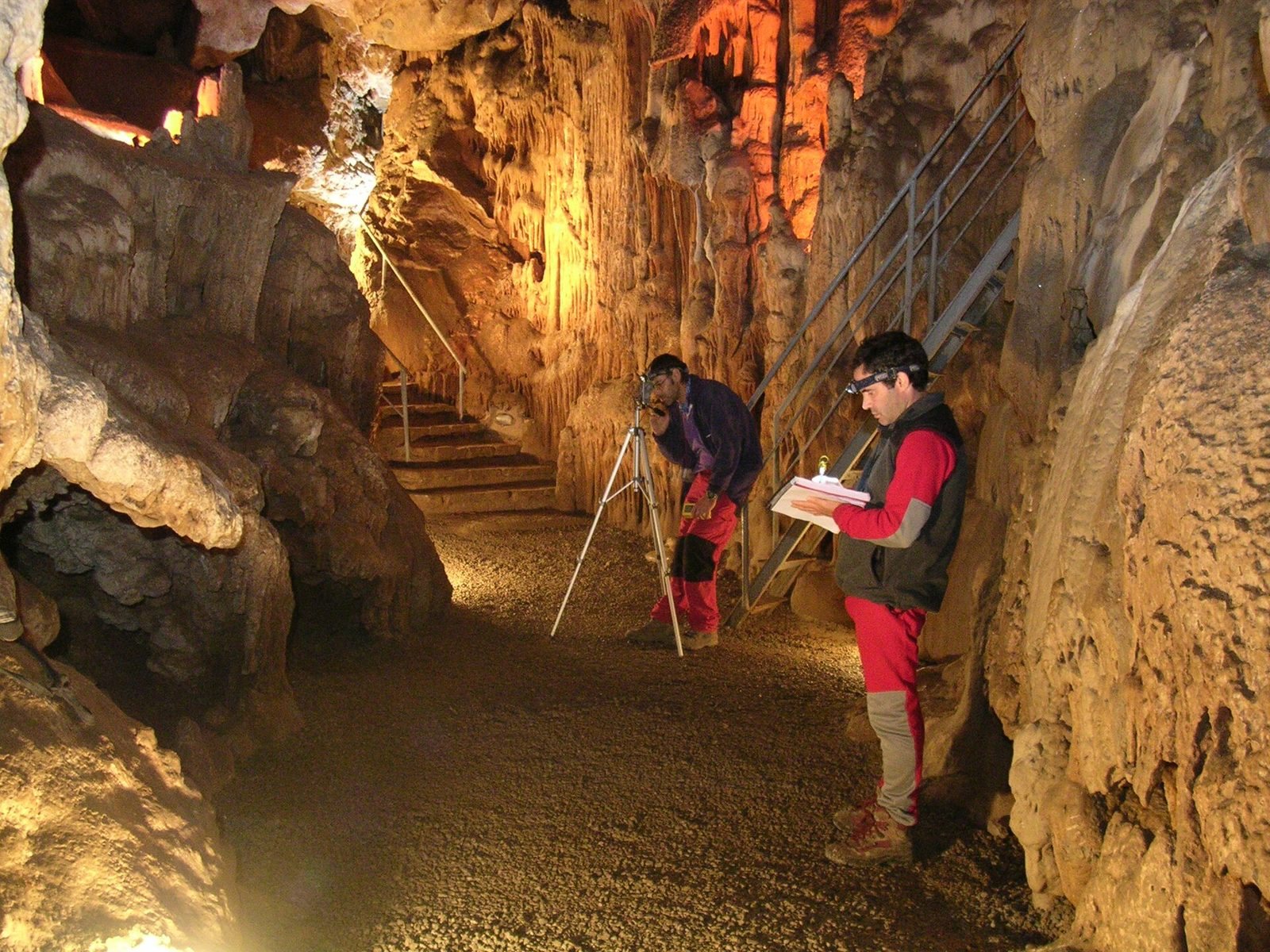
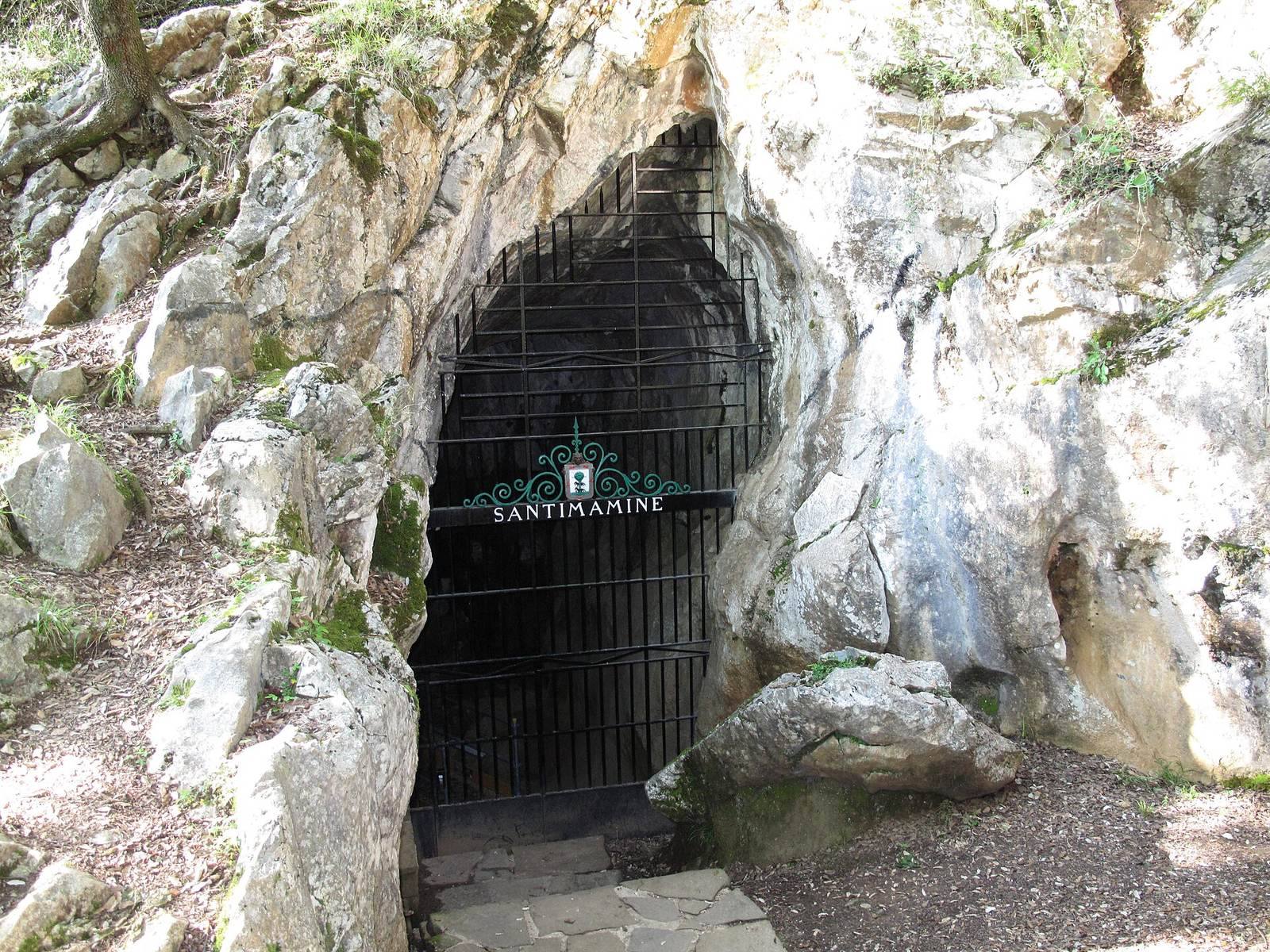
The natural limestone cave extends for 365 m. It lies in the Basondo neighborhood of Kortezubi, in the Urdaibai area, near Gernika. The cave is about 150 m above sea level, at the foot of Mount Ereñozar, whose summit reaches 448 m, and faces the Oma forest. Nearby is the San Mamés hermitage, from which the cave takes its present name. It was first known as Basondo Cave and was also sometimes called Cortézubi Cave. About 60 m from the entrance, a narrow passage opens on the upper left and broadens into an antechamber and the main chamber. The latter is roughly rectangular, measuring 4 m long, 3 m wide, and 3.5 m high.
Limestone formations
Stalactites, mineral formations hanging from the ceiling, and stalagmites, formations rising from the floor, occur throughout the cave. Calcium-carbonate sheets resembling curtains are colored by oxides carried in water.
Entrance deposit
The entrance deposit includes a shell midden, an accumulation of discarded shells that reflects the importance of shellfish in the prehistoric diet.
Painted and engraved art
Image collection
The cave contains 47 animal images: 32 bison, seven animals from the goat-and-sheep group, six horses, one deer, and one bear. The paintings are black and made with charcoal; some bison were both engraved and painted. Images occur roughly 10 m beyond the entrance area.
Antechamber
A large group in the antechamber is badly deteriorated, particularly the images of horses and bison.
Main chamber
Engraved and painted bison appear at the entrance to the main chamber. The principal panel, above and to the right of a conical stalagmite associated with the preceding figures, contains eight bison, a horse, and an arched line.
Deep-zone images
About 100 m from the entrance, a group in the deeper part of the cave includes a bison and a horse.
Conservation effects
Artificial lighting encouraged microorganisms and vegetation in continuously lit areas and affected the cave’s temperature. Metal structures oxidized and produced condensation, while visitors raised carbon dioxide levels, brought in dirt, and stirred up dust. During the 2006 conservation work, lighting installations were removed, leaving the deeper cave dark.