San Martino: The Historic Parish Church of Toirano, Italy
Site at a Glance
- Rating
- 4.6
- Popularity
- Very Low
- Country
- Italy
- Primary era
- Early Modern
- Eras represented
- Medieval, Early Modern, Modern
- Civilizations
- Genoese, Italian
- Site type
- Religious
- Remains
- Church
On this page26 sections
History
San Martino is a Catholic parish church in Toirano, Italy, dedicated to Martin of Tours and built in its present Baroque form between 1608 and 1609. It stands in the town’s historic center and remains the parish seat, continuing a religious role associated with a medieval church that probably served as the principal church of the Varatella valley.
The medieval parish church
The first direct reference to the church at Toirano dates to 3 September 1235, when an act mentioned the ecclesia Sancti Martini. A letter of 10 December 1232 already referred to an archpriest of Toirano, indicating that San Martino was probably an archpriest church at the beginning of the thirteenth century. Another reference appears in 1308.
Medieval evidence places San Martino within a changing network of churches and territorial jurisdictions. Its relationships with the churches of Loa and Prea, and with an earlier religious center at Loano, overlapped. The principal church may initially have been at Loano before its abandonment during Saracen attacks and the later refoundation of the settlement. San Martino may then have inherited the position of mother church in the valley.
During the thirteenth and fourteenth centuries, the archpriesthood of Toirano was involved in disputes connected with the Abbey of San Pietro, within whose territory it lay. In 1282, Pagan, an illegitimate abbot, was threatened with excommunication after announcing an excommunication against the people of Toirano. A parish assessment made between 1343 and 1345 by Boniface Baamonte, a native of Toirano serving at Albenga Cathedral, assigned San Martino an extraordinary levy of 30 francs. The churches of Prea and Loano were assessed at 8 and 16 francs respectively.
Rebuilding in the seventeenth century
By the episcopal visitation of 1585–1586, the medieval church was in poor condition. Bishop Nicolò Mascardi, bishop of Mariana and Accia, described an east–west building with four naves and several side chapels. He called for the repainting of Saint Martin’s image on the facade, the demolition of the wall between the choir and altar, and repairs to tombs inside the church. Episcopal visitations formed part of the Counter-Reformation, the Catholic program of reform and renewal that examined parish buildings, worship, and religious discipline.
The community consequently decided to demolish the medieval parish church and replace it. Fundraising preparations began in 1596, when Toirano petitioned the Senate of Genoa and the Bishop of Albenga for financial concessions and extensions to the building deadlines. Some work had been paid for by 1599, but construction had not properly begun.
In 1603, a municipal official sought architectural opinions on the proposed design, which was intended to be 72 Genoese palms long. The proportions were criticized, and Giovanni Battista Cantone and Battista Peggi were consulted for a definitive project. Cantone presented his report to the community on 13 June 1604. Work then accelerated after ducal permission allowed several houses and three village gates to be demolished and rebuilt elsewhere.
The new church was completed between 1608 and 1609. Bishop Luca Fieschi of Albenga consecrated it on 1 August 1609, although the consecration date is also given as 1610. The parish was further altered on 11 November 1592, when Bishop Fieschi had established Santa Maria Maddalena in Boissano as an independent parish, separating it from San Martino.
Later changes and continuity
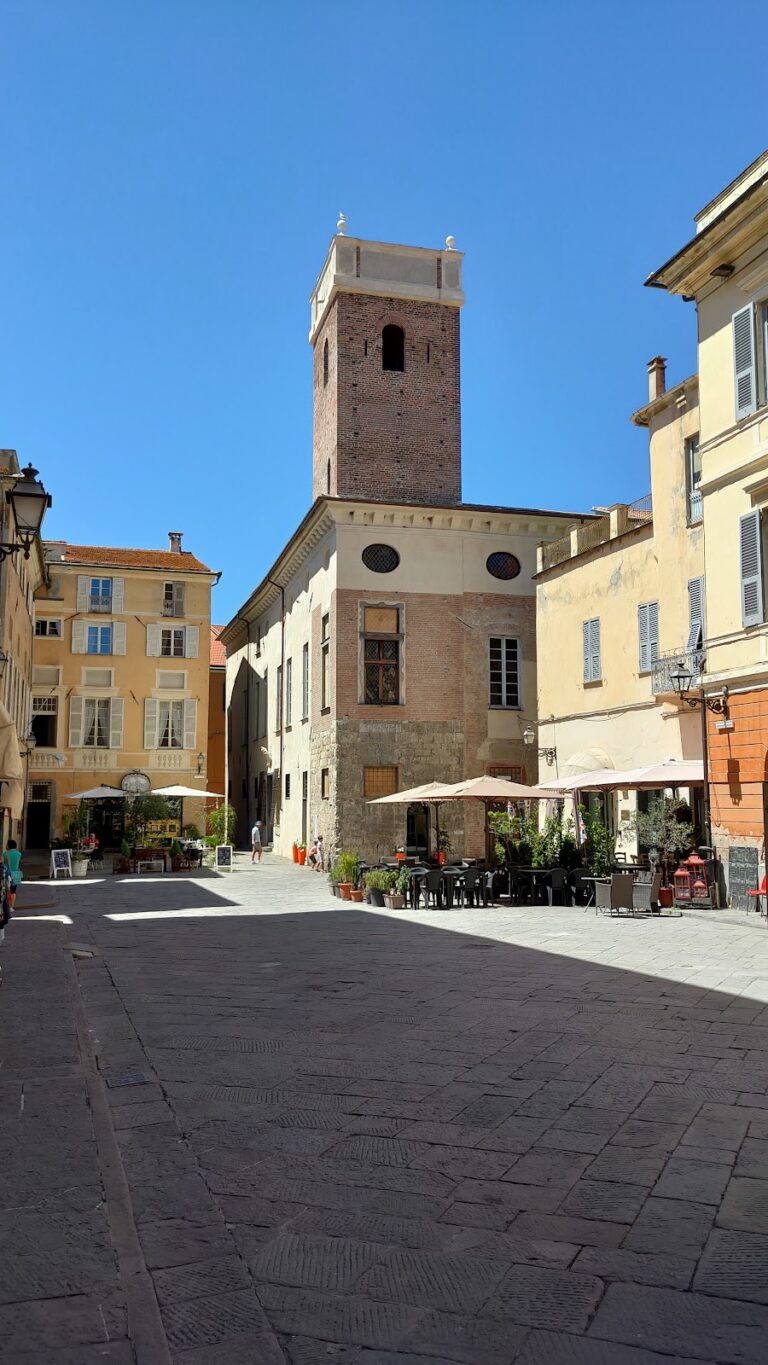
The basic structure changed little after the seventeenth-century rebuilding, while eighteenth- and nineteenth-century work enriched the interior and added chapels. The bell tower was restored in 1963, and further work on the walls and paintings took place between 2011 and 2014. San Martino remains an important surviving element of Toirano’s historic settlement, and its bell tower is the sole tower in the historic center to have survived into the present.
Remains
Exterior and medieval tower
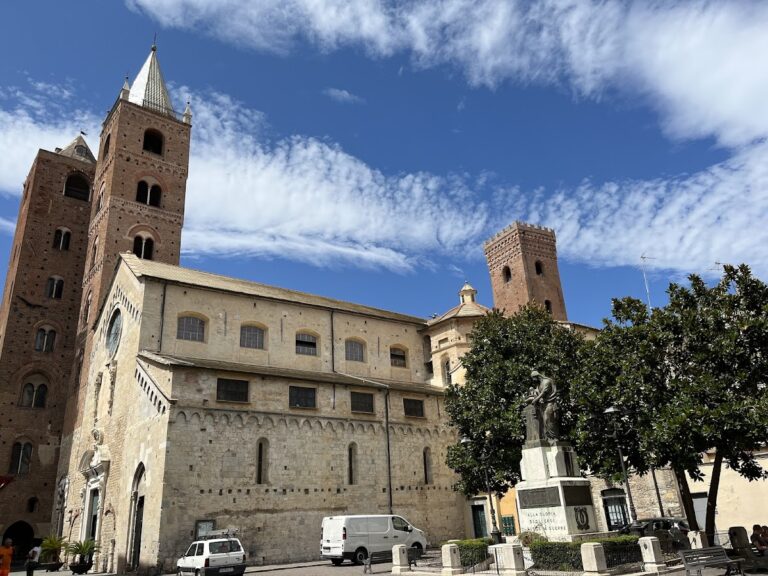
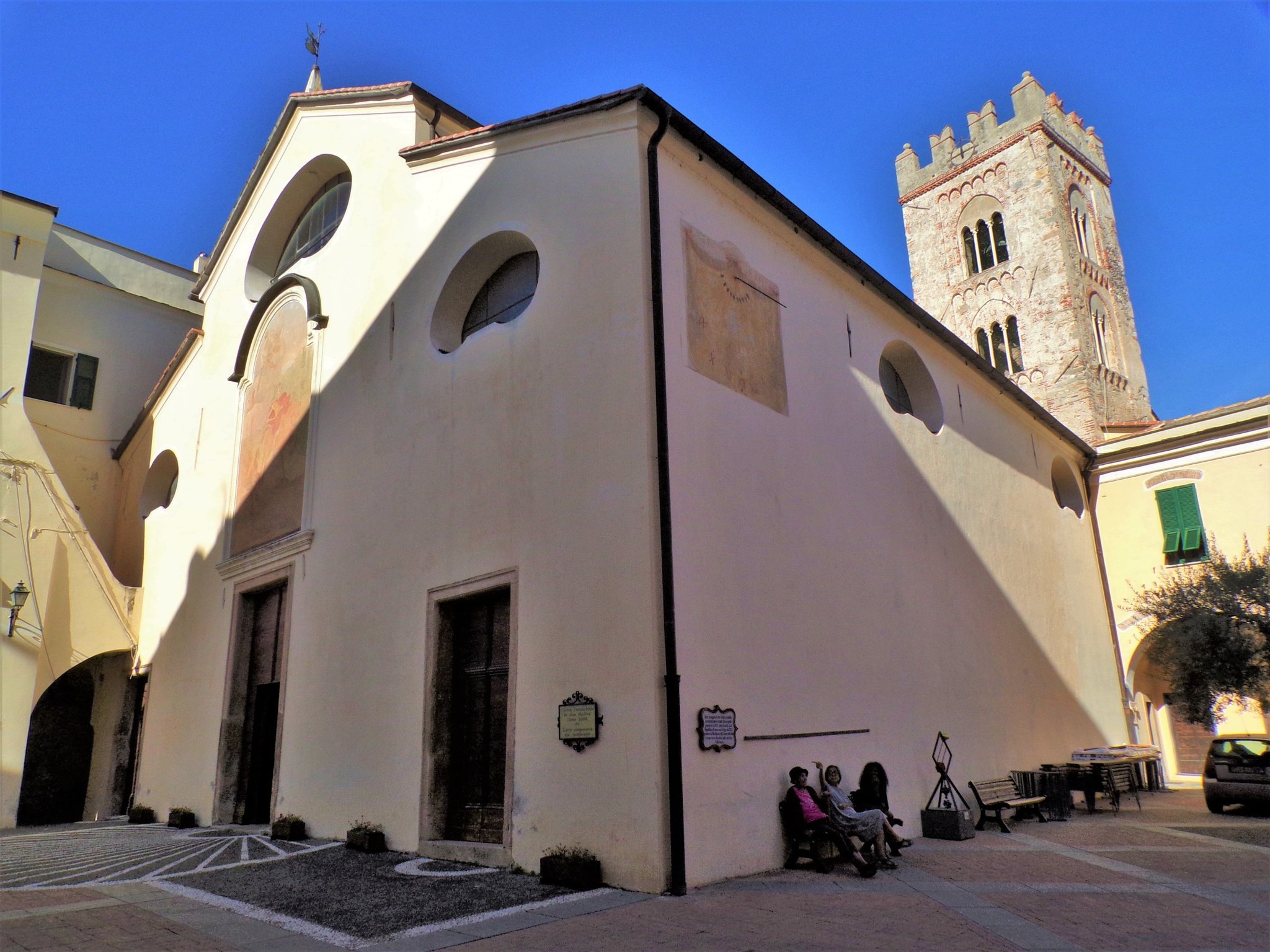
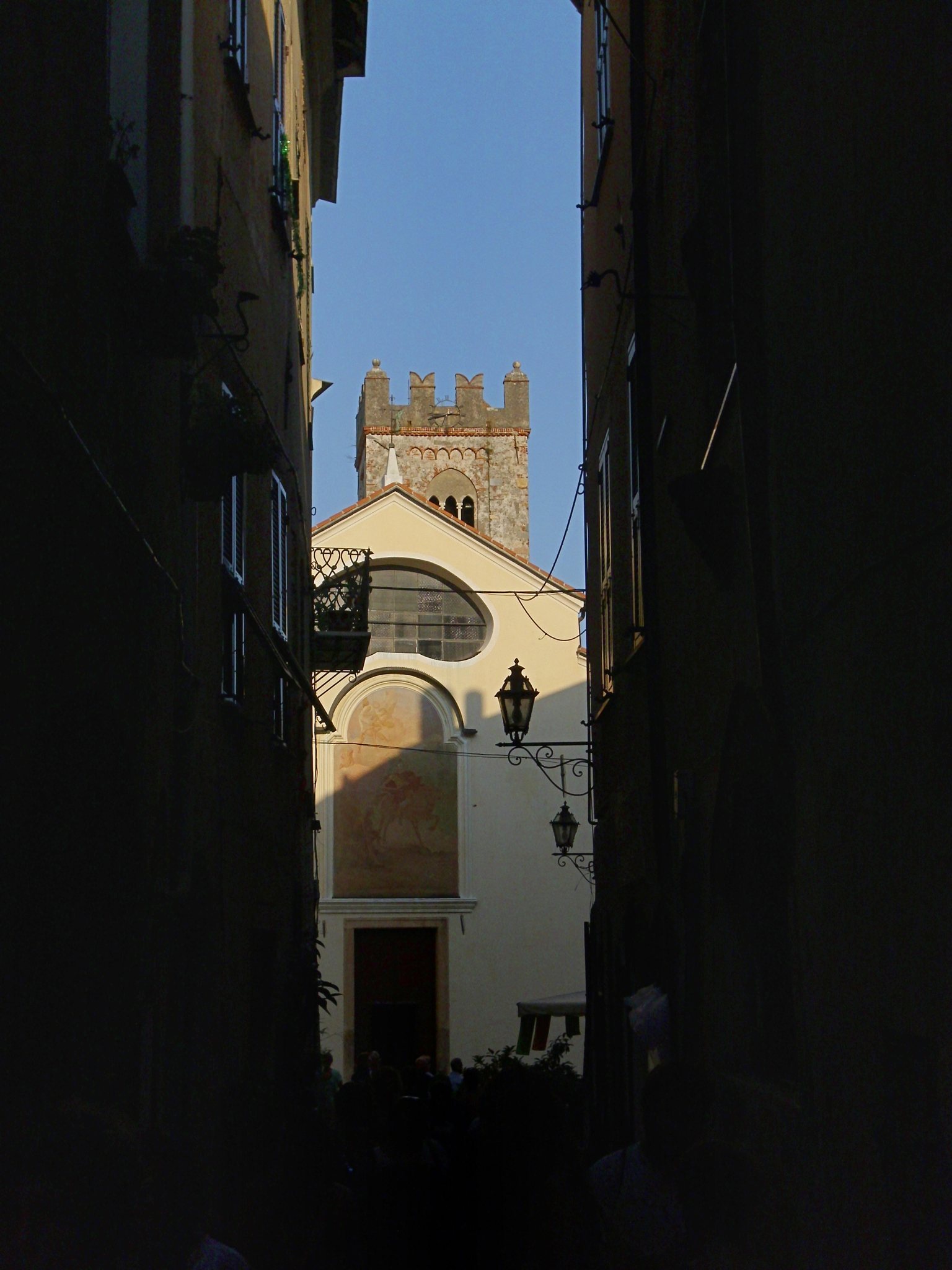
San Martino has a simple Baroque exterior with a gabled roof arranged over two levels. The largely rendered facade contains three entrances, one for each nave, with portals made from pink stone quarried at Verezzi. Rounded-arched windows with lobed side openings correspond to the portals on the facade and to the individual side chapels along the lateral walls. In front of the church, part of the paving in Piazza San Martino forms a simple radial geometric pattern.
Facade painting and civic measures
The central facade painting shows Saint Martin on horseback cutting his cloak to share it with a poor man. Gerolamo Graffigna painted it in 1892–1893 after the parish commissioned a preparatory sketch in 1892; the sketch is preserved in the church’s deposits. The subject recalls the fourth-century bishop’s traditional act of charity and is the principal iconographic expression of the church’s dedication.
A nineteenth-century sundial survives on the right-hand exterior wall. Nearby is an iron bar used to measure cloth according to Genoese palms. This unit of measurement was officially defined by a law of 1532 and standardized throughout the Republic of Genoa by a decree of 1632.
Oratory portico
The right wall contains the entrance portico of the Oratory of the Disciplinati. Two columns made of Finà stone support it, each with a simplified Ionic capital. The columns were reportedly reused from the medieval parish church, linking the present building physically with its predecessor.
Bell tower
The square bell tower dates from the fourteenth century and predates the present church. Its openings have pointed arches arranged in groups of three within recessed wall fields, while a band of brickwork decorates the exterior. Small Carrara marble columns divide the openings. The upper level may originally have contained further divisions for the bells, allowing their sound to carry beyond the tower.
A brick cornice crowns the tower, together with a later Ghibelline-style battlement whose merlons have a swallowtail profile. The 1963 restoration removed later additions and recovered the tower’s earlier appearance.
Nave structure and decoration
The interior has three naves divided by two rows of four pink Verezzi stone columns. The columns are now exposed, although Giovanni Nobile painted them in 1811 to imitate marble. A later restoration removed the imitation finish. Nobile also decorated the capitals in a Corinthian style, using acanthus-leaf forms and partial gilding. In 1893, Bartolomeo Gilardoni repaired the stucco cornice, and further gilding was added by an artist identified as Perasso.
The central nave is covered by a barrel vault, a continuous curved ceiling, while the side naves have groin vaults formed by the intersection of two vaults. Around 1893, Gerolamo Graffigna painted the central vault with scenes from the life of Saint Martin. The cycle includes the saint’s dream, the miracle of the Mass at Tours, the resurrection of a child, and Saint Martin in glory above the high altar.
The surrounding decoration includes medallions of the cardinal virtues, the Evangelists, and other biblical figures. Round paintings of angels occupy the side naves. Graffigna also decorated the presbytery, the area around the high altar reserved for the clergy, with scenes and figures including the Assumption, Saint Joseph, Saint Sebastian, the Transfiguration, Saint Roch, Saint Barbara, and the theological virtues.
High altar and apse
The center of the apse, the curved end of the church, contains an eighteenth-century statue of Saint Martin by an unknown sculptor. The niche was opened between 1800 and 1811 and replaced a large painting of Saint Martin by Gregorio De Ferrari, which disappeared after removal for the new arrangement.
A Rococo choir of walnut wood occupies the apse. The Garassini family donated it before 1766. In front of it stands an early eighteenth-century Baroque high altar shaped like a boat and made of white Carrara marble. Its rich inlays use red Levanto marble and black Portoro marble, and the altar is associated with Carlo Giuseppe Stella’s Genoese workshop.
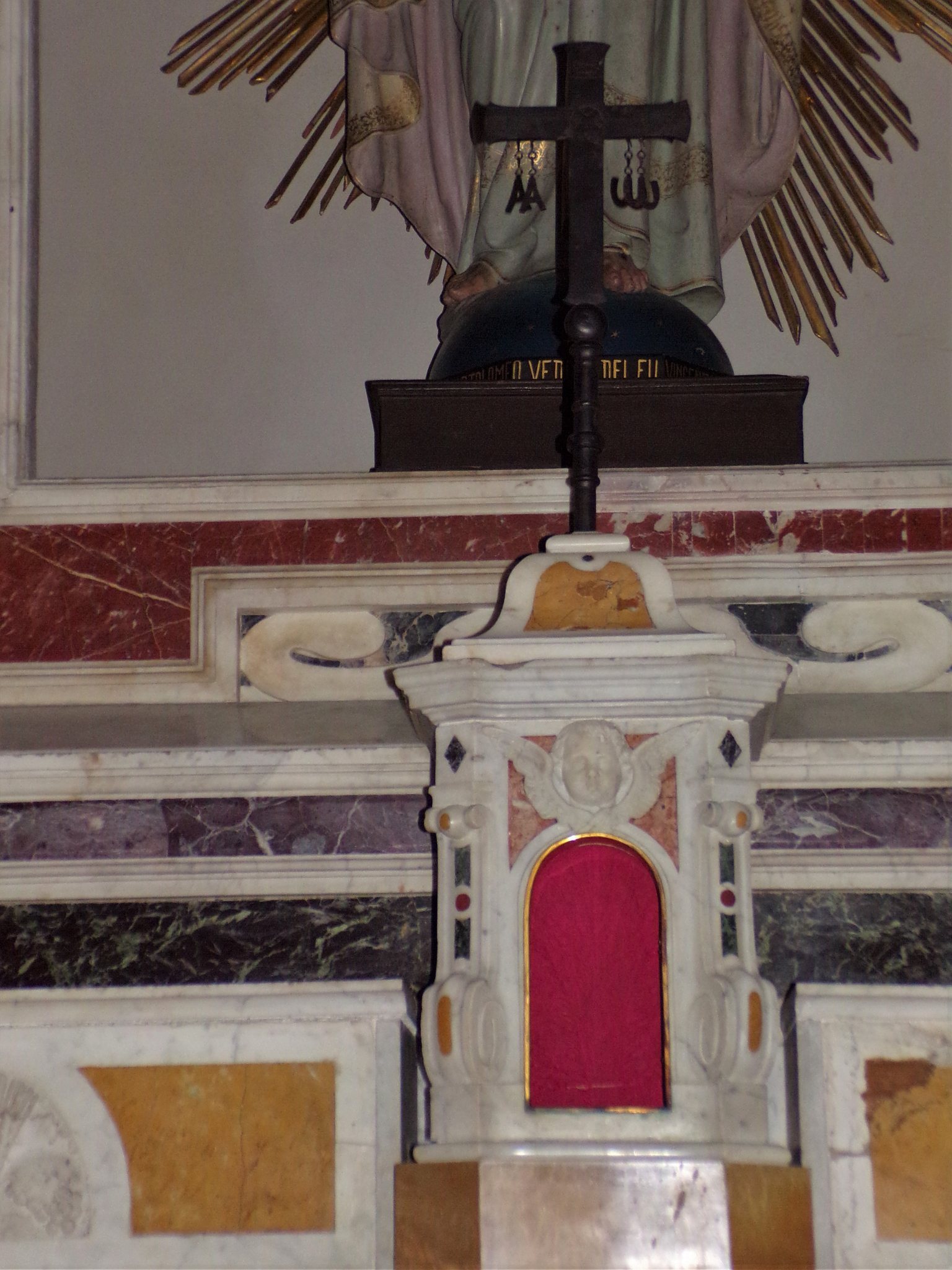
The upper part of the altar is divided into three sections by the tabernacle and contains further red and black marble inlays. The small temple-shaped tabernacle has a dove in its pediment and a shell finial. Its silver door, made in Genoa in the eighteenth century, bears an image of Saint Martin. A processional crucifix on the altar is attributed to the Genoese sculptor Giovanni Battista Bissone, known as “the Venetian.”
Pulpit and organ loft
A marble pulpit dated 1755 is attached to the final column on the left. A richly inlaid marble column supports it, and the date is carved into the structure. Three bas-relief panels form the parapet. The central panel shows Saint Martin sharing his cloak with the poor man, while the side panels display episcopal symbols, including a mitre and a crozier. A marble inlaid staircase was added in 1764; a wooden canopy once associated with the pulpit was later removed.
The entrance area contains an organ loft made of wood, iron, and stucco. It was constructed in 1881 for a new organ by Luigi Agati of Pistoia, and the organ remains in use. A memorial plaque commemorates Giuseppe Colatto of Toirano, who lived in Cadiz and made substantial donations to the church.
Chapels in the right nave
Chapel of Our Lady of Mount Carmel
The former niche for a holy-water font now contains a 1932 statue of Our Lady of Mount Carmel.
Baptismal chapel
The baptismal chapel was originally dedicated to Saint Charles. Its eighteenth-century baptismal font was installed in 1938, together with neighboring columns taken from the demolished church of Santa Sabina in Genoa. Behind the font is a 1950 oil painting on slate showing the Baptism of Christ.
Chapel of the Saints
The Chapel of the Saints was arranged between 1937 and 1938 with seventeenth- and eighteenth-century marble from Santa Sabina. Its 1939 painting shows the Virgin and Child with Saint Anne, Saint John the Baptist, Saint Charles, Saint Roch, and Saint Barbara. The chapel preserves relics of the martyrs Paulinus, Abundius, Cassian, Fortunatus, Alban, Cornelius, and Primisian, together with silk ribbons and silver medallions.
Chapel of Our Lady of the Rosary
The Chapel of Our Lady of the Rosary contains a large sixteenth-century altarpiece that served as the high-altarpiece of the church of Our Lady at Braia until 1983. Its central panel depicts the Virgin and Child, while the surrounding panels show Dominican saints, the fifteen mysteries of the Rosary, and Christ above. The Rosary is a Catholic devotion based on repeated prayers and meditation on episodes from the lives of Christ and the Virgin Mary.
The chapel occupies the site of an older chapel dedicated to Saint John the Baptist. Founded on 29 August 1426, that chapel was administered by the municipality of Toirano through donations from local inhabitants. It was remodeled in 1769, and stucco decoration from that work remains around the altarpiece.
Statue of the Assumption
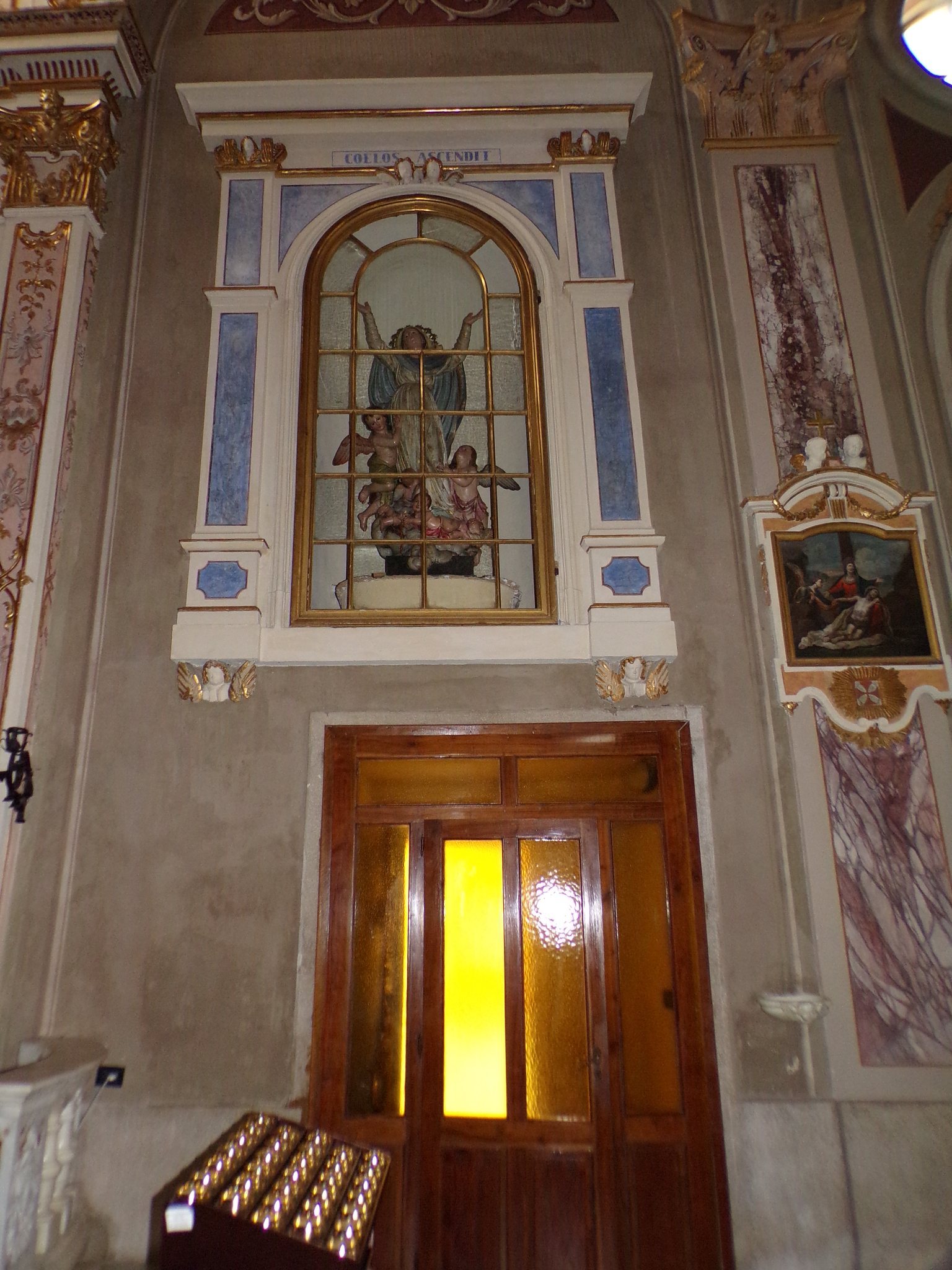
A niche beside the lateral entrance contains a statue of the Assumption made by the Genoese sculptor Giovanni Battista Drago between 1858 and 1860. The Opera Pia commissioned the work.
Chapel of the Assumption
The large Chapel of the Assumption occupies the rear of the right nave and is cared for by the Opera Pia. Its altar dates from 1758 and was consecrated on 8 September 1759. It replaced a sixteenth-century structure that extended between the walls of the bell tower.
The chapel contains an anonymous seventeenth-century statue of Our Lady of the Vine and a painting of the Assumption commissioned among other gifts by Giuseppe Colatto. Two balustrades carved with images of the Virgin delimit the chapel, which also contains several smaller paintings.
Chapels in the left nave
Chapel of the Virgin
The first chapel originally held a holy-water font. It now contains a statue of the Virgin, accompanied by a statue of Saint Sebastian.
Chapel of Saint Charles
The Chapel of Saint Charles contains a seventeenth-century painting of the Crucifixion with Saint Charles. The painting originally stood in the first chapel of the right nave, founded by Ludovico Vara in 1632. That chapel was demolished between 1932 and 1935, after which the painting was moved to its present location.
Chapel of the Holy Spirit
The Chapel of the Holy Spirit preserves the oldest altar in the church. Its chaplaincy was founded in 1597 through donations from Agostino Garassini. The chapel contains a Pentecost painting by the Genoese painter Giovanni Carlone, son of the sculptor Taddeo Carlone.
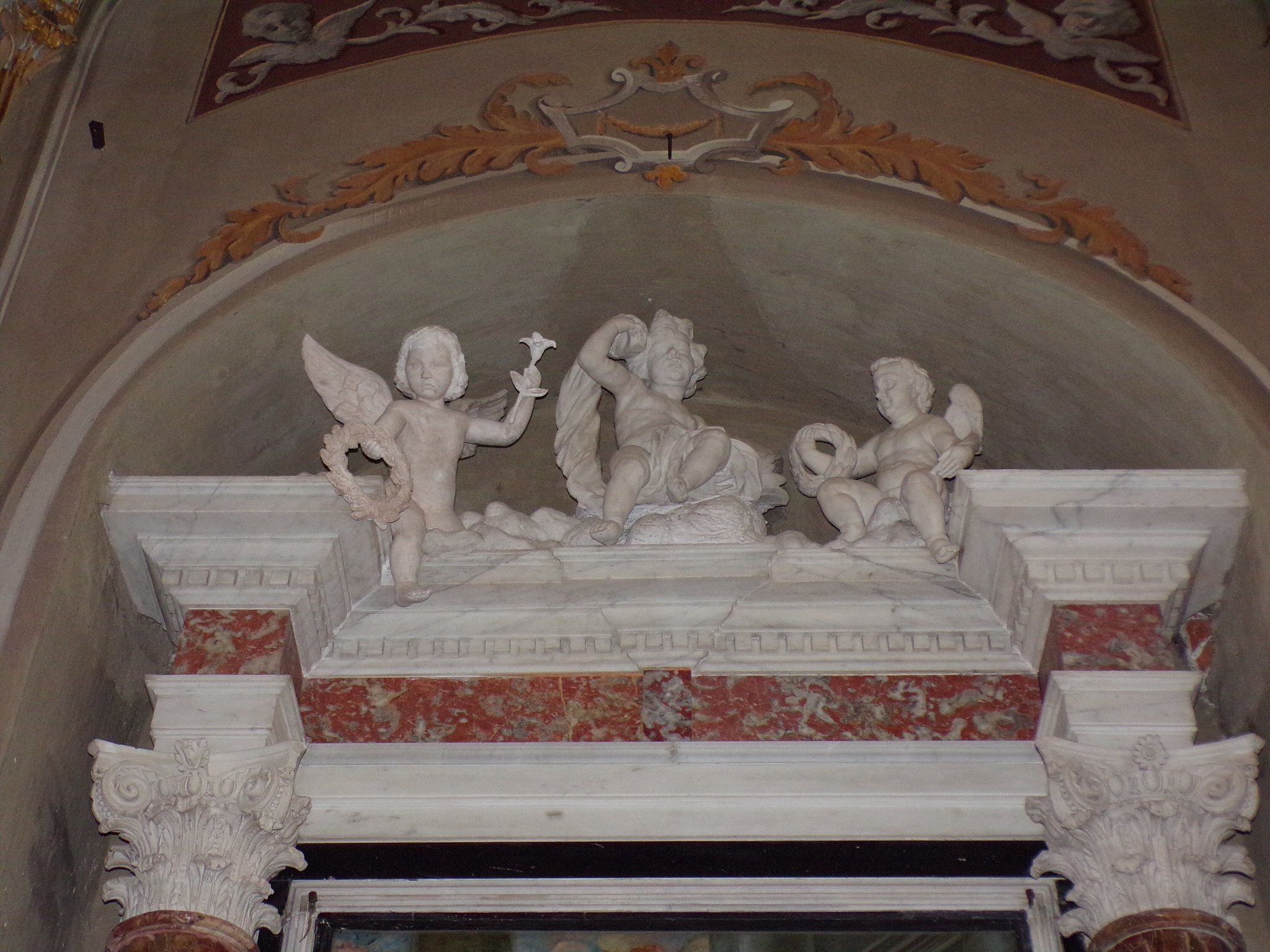
A stucco frame surrounds the painting. Late-Mannerist stucco statues of Saint Hyacinth and Saint Augustine stand on either side, with another stucco sculpture of Christ above them. Two foundation plaques occupy the spaces below the side statues.
Chapel with the painting of the Virgin and Child
A chapel now without an altar contains an early seventeenth-century painting of the Virgin and Child with Saints Peter, Nicholas of Tolentino, and Bridget. The work is attributed to the Genoese painter Cesare Corte. The chapel also houses a processional statue of Saint Martin by Paolo Olivari. Weighing approximately 300 kilograms, the statue is carried through the village streets during the patronal feast.
Chapel of Saint Joseph
The large Rococo Chapel of Saint Joseph replaced the former sixteenth-century sacristy. Giacomo Durante, a native of Toirano living in the “City of Angels in the Indies,” made a major donation for its construction and also paid for a new sacristy.
In 1764, Durante sent the chapel a statue of Saint Joseph with the Child made by a Spanish workshop. He also sent eight small paintings of saints and the Virgin of Guadalupe, reportedly intended to come from a workshop in the West Indies.
Chapel of the Sacred Heart
The Chapel of the Sacred Heart occupies the rear of the left nave, in the niche that formerly contained the statue of Saint Martin. Its present arrangement dates from work in the 1930s and uses materials recovered from the demolition of Santa Sabina in Genoa.
The chapel contains a Sacred Heart statue donated to the parish in 1926 and made by the Ladin sculptor Ferdinand Stuflesser. Two paintings from the Oratory of the Disciplinati flank it. Dating from the first years of the eighteenth century, they depict the Guardian Angel and Saints Agatha, Apollonia, and Libya.