San Biagio (Mamiano): A Roman Catholic Church in Italy
Site at a Glance
- Popularity
- Very Low
- Country
- Italy
- Primary era
- Early Modern
- Eras represented
- Medieval, Early Modern, Modern
- Civilizations
- Duchy of Parma and Piacenza, Habsburg, Holy Roman Empire, Italian
- Site type
- Religious
- Remains
- Church
On this page13 sections
History
Origins and medieval ownership
San Biagio (Mamiano) is a Roman Catholic church in Italy, dedicated to Saint Blaise and probably built in the eleventh century. The founders were the arimanni, a class of free men in early medieval Italy with military and public duties. The church was consecrated late in that century.
On 23 August 1094, a priest named Alberto left the church to the canons of Parma Cathedral. The arimanni had previously transferred it to him in return for its consecration and a promise of protection. In 1230, it was listed among the chapels belonging to the cathedral chapter, the clergy attached to the cathedral, although the church stood within the district served by the parish church of Basilicanova.
Parish and Baroque enlargement
In 1520, the church was assigned to the Benedictine nuns of Parma’s Monastery of Saint Quentin. By 1564 it had become an independent parish, though the nuns retained the right to appoint its curate, a priest serving the parish.
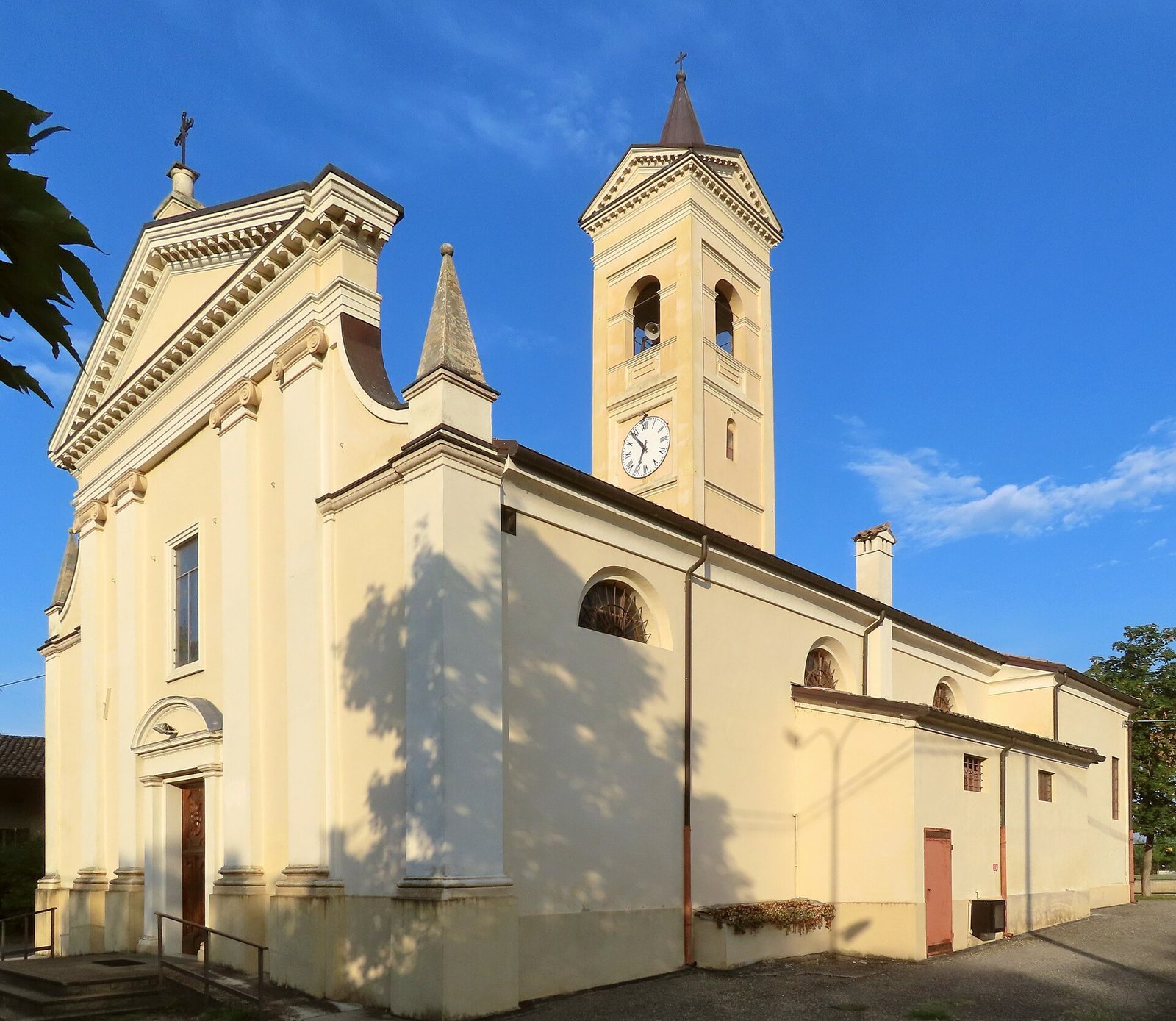
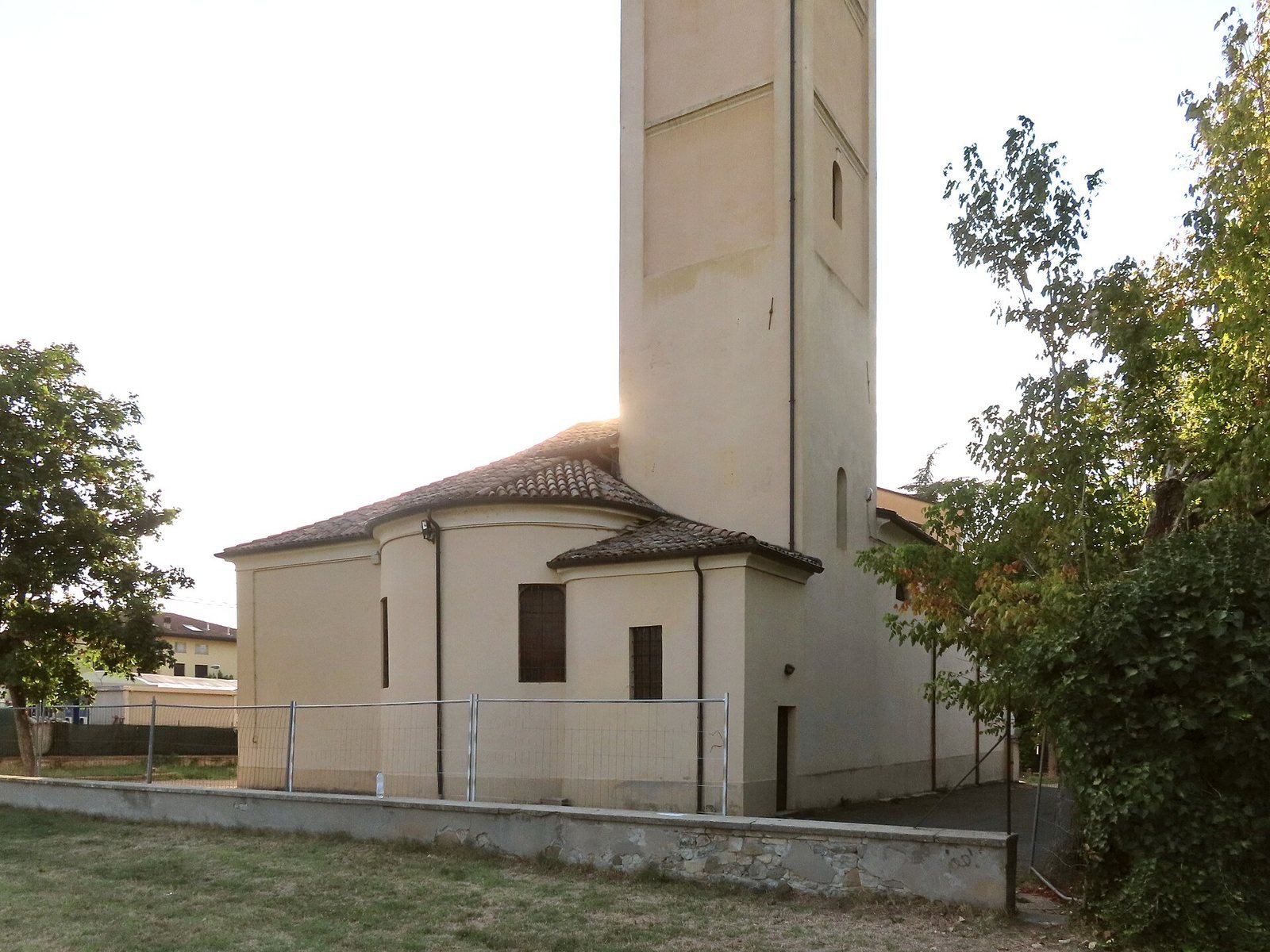
Between 1699 and 1737, the older building underwent extensive enlargement and remodelling in the Baroque style. The work rebuilt the presbytery, the area around the main altar, and the apse, the rounded end of the church. It also added a sacristy, a room for preparing worship and keeping liturgical objects, and three chapels on the right. The façade was remodelled, and the bell tower was incorporated into the building.
Damage, restoration, and later changes
Earthquakes in 1831 and 1832 badly damaged the church. Restoration followed, along with new interior frescoes. In 1900, renovation raised the bell tower and altered interior and exterior doorways. Painter Dino Mora decorated the façade and parts of the interior. The tower’s spire was removed in 1935 because it was considered unsafe. Three years later, the central façade window was replaced with a two-light window, meaning one divided into two openings. Exposure to the weather faded decorations that included painted niches with figures of Saints Fabian and Sebastian.
A major restoration in 1961 removed six chapels and made two side aisles in their place. It also redecorated the interior, closed the two-light window and the two secondary façade entrances, and created a forecourt. In 1974, workers installed a window at the centre of the façade and restored the tower’s spire.
An earthquake on 23 December 2008 caused collapses and severe structural damage, leaving the church unusable. Repairs to the whole building were completed three years later, and the church reopened on 8 December 2011. The bell tower was restored in 2017. San Biagio belongs to the Diocese of Parma and serves as the seat of a parish in the Pedemontana pastoral area.
Remains
The church has three naves, with its entrance at the west end and a long presbytery terminating in an apse to the east. Its symmetrical exterior is plastered, while the interior combines vaulted ceilings, painted decoration, altars, and preserved furnishings.
Exterior
Façade
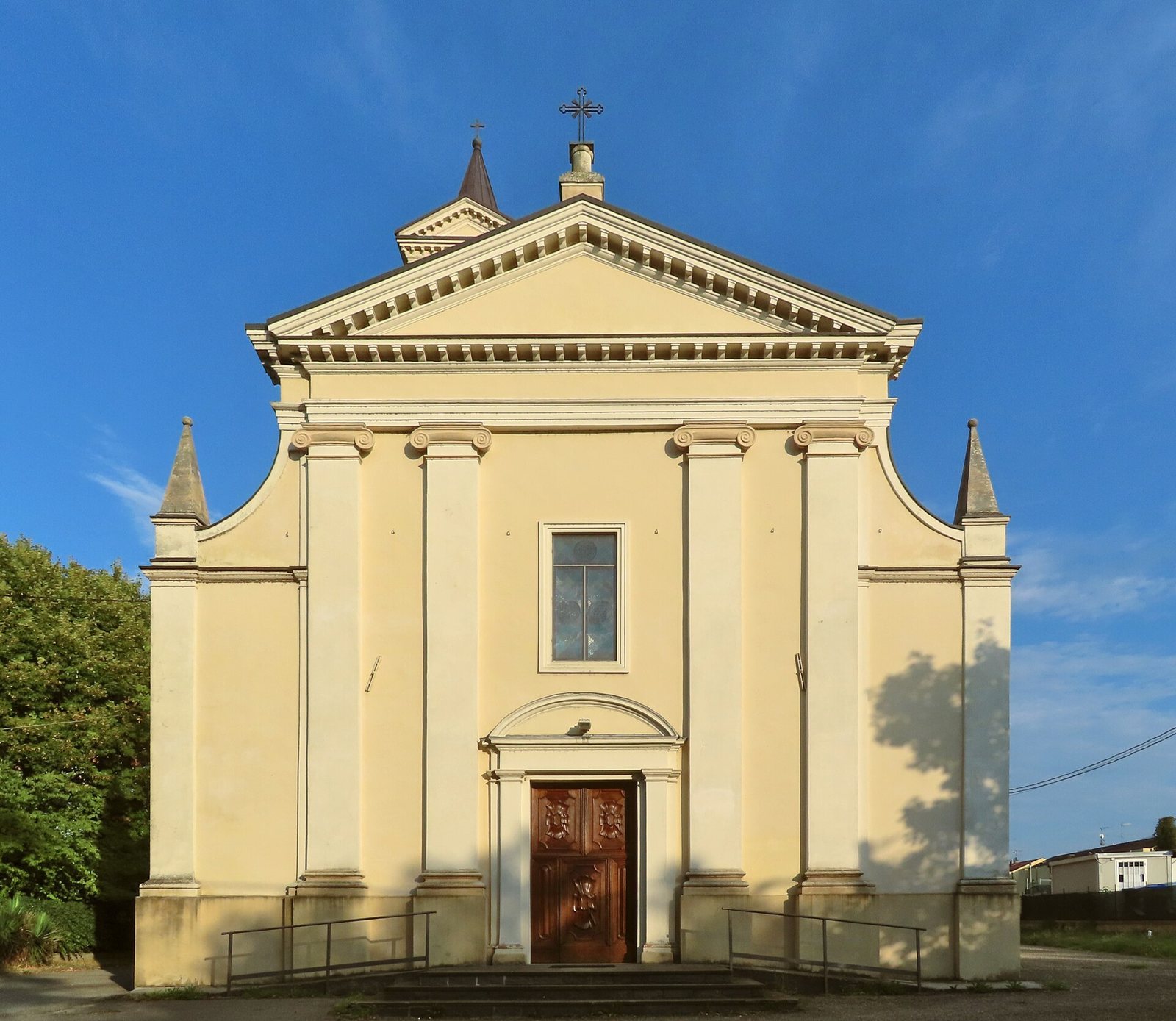
Six pilasters, shallow vertical elements attached to a wall, divide the façade. The four taller central pilasters have Ionic capitals, a column-top style with scroll forms, and support a horizontal entablature and a broad triangular pediment, the upper section of a façade. The central doorway, with a door dating to 1736, is framed by paired pilasters with Doric capitals, a simpler classical column-top style. Above the entrance is a large rectangular window. Curved scroll-shaped forms connect the main pediment to the shorter outer pilasters, which end in pyramidal ornaments.
Bell tower
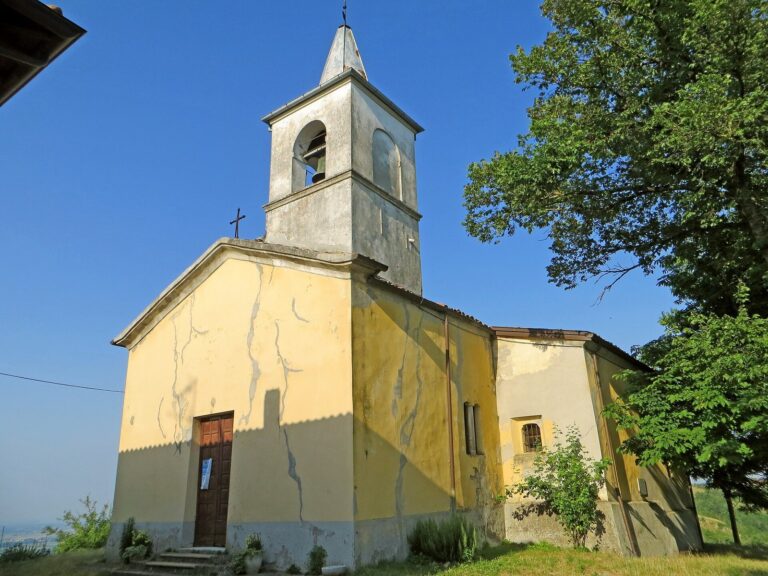
The bell tower stands beside the apse at the church’s northeast corner and rises more than 31 metres. Pilasters and horizontal bands mark its shaft. Round-arched openings form the bell chamber, with a moulded triangular pediment above each of the tower’s four sides. Its copper conical spire is five metres high.
Interior
Nave and side aisles
The central nave has a sequence of painted cross vaults, ceilings formed where two barrel vaults intersect. The side aisles have barrel vaults, continuous curved ceilings. Broad round arches separate them from the nave; massive piers with Doric pilasters carry the arches and support a moulded cornice running around the interior.
At the beginning of the right aisle is The Souls in Purgatory Imploring the Eucharist, an early eighteenth-century painting possibly by Clemente Ruta, an Italian painter active in that century. The left aisle contains a seventeenth-century wooden confessional decorated with the Farnese lilies, the emblem of the Farnese dynasty, and carved in a late Renaissance style. Nearby are a seventeenth-century Holy Family painting with a floral crown and a polychrome wooden altar dating to 1704. The altar supports a seventeenth-century painting of the Madonna and Child with saints and the Mamiani family coat of arms.
Presbytery
A broad triumphal arch marks the entrance to the slightly raised presbytery. Early eighteenth-century frescoes on the arch include a cartouche dedicated to Saint Blaise. Fluted stucco pilasters with Corinthian capitals, a classical column-top style, stand on either side. The presbytery’s barrel-vaulted ceiling has nineteenth-century frescoes, and its marble high altar takes the form of an altar table.
Seventeenth-century paintings on the presbytery walls depict the Madonna and Child with Saints Michael and John the Evangelist on the right, and the Madonna and Child with Saints Sebastian, Fabian, Nicholas of Tolentino, and Roch on the left.
Apse
The semicircular apse is lit by two large round-arched windows with coloured glass. Its semi-dome bears a fresco of the Coronation of Saint Blaise. At the far end, an altarpiece depicts Saint Blaise performing a miracle. Francesco Pescatori painted it in 1847, and Maria Luigia, Duchess of Parma, donated it.
Sacristy and sculpture
The sacristy has a vaulted ceiling with an eighteenth-century fresco of angels and a cross. Its furnishings include a carved sideboard whose upper section dates to 1760, an early eighteenth-century kneeler, and a repoussé silver monstrance. Repoussé is a technique for raising a design by hammering metal from the reverse. The church also preserves a marble relief of the Madonna and Child with a goldfinch, made by the Italian sculptor Alceo Dossena.