San Biagio Church: A Medieval Parish Church in Talignano, Italy
Site at a Glance
- Popularity
- Very Low
- Country
- Italy
- Primary era
- Medieval
- Eras represented
- Medieval, Early Modern, Modern
- Civilizations
- Holy Roman Empire, Italian
- Site type
- Religious
- Remains
- Church
On this page14 sections
History
San Biagio Church, also known as the Talignano parish church, is a medieval Romanesque church in Talignano, within Sala Baganza, Italy. Cistercian monks from the Abbey of Chaise-Dieu in France built it beside a branch of the Via Francigena, a medieval pilgrimage route leading toward Rome, and founded a hospice alongside it. The Cistercians were a Catholic monastic order that developed from the Benedictine tradition. The church depended directly on the monks of Chaise-Dieu, though its precise beginnings are uncertain: proposed dates range from the late 11th century to the early 12th century, or to the late 12th or early 13th century.
Medieval church and changing jurisdiction
In 1230, San Biagio was listed among Chaise-Dieu Abbey’s dependencies, despite lying within the territory administered by the parish church of Collecchio. In the 14th century, jurisdiction over the chapel passed to Collecchio.
Parish status and alterations
The church became an independent parish in 1564, and patronage was granted to the noble Lalatta family in 1568. Between the 16th and 18th centuries, it gained Baroque and Neoclassical decoration, and a sacristy was built beside it. In 1877, the nave was raised and given a barrel-shaped vault with lunettes in place of its original timber roof supports. A chapel was added on each side of the nave, and a window replaced the upper paired window in the facade. The sacristy collapsed in 1912.
Restoration and later history
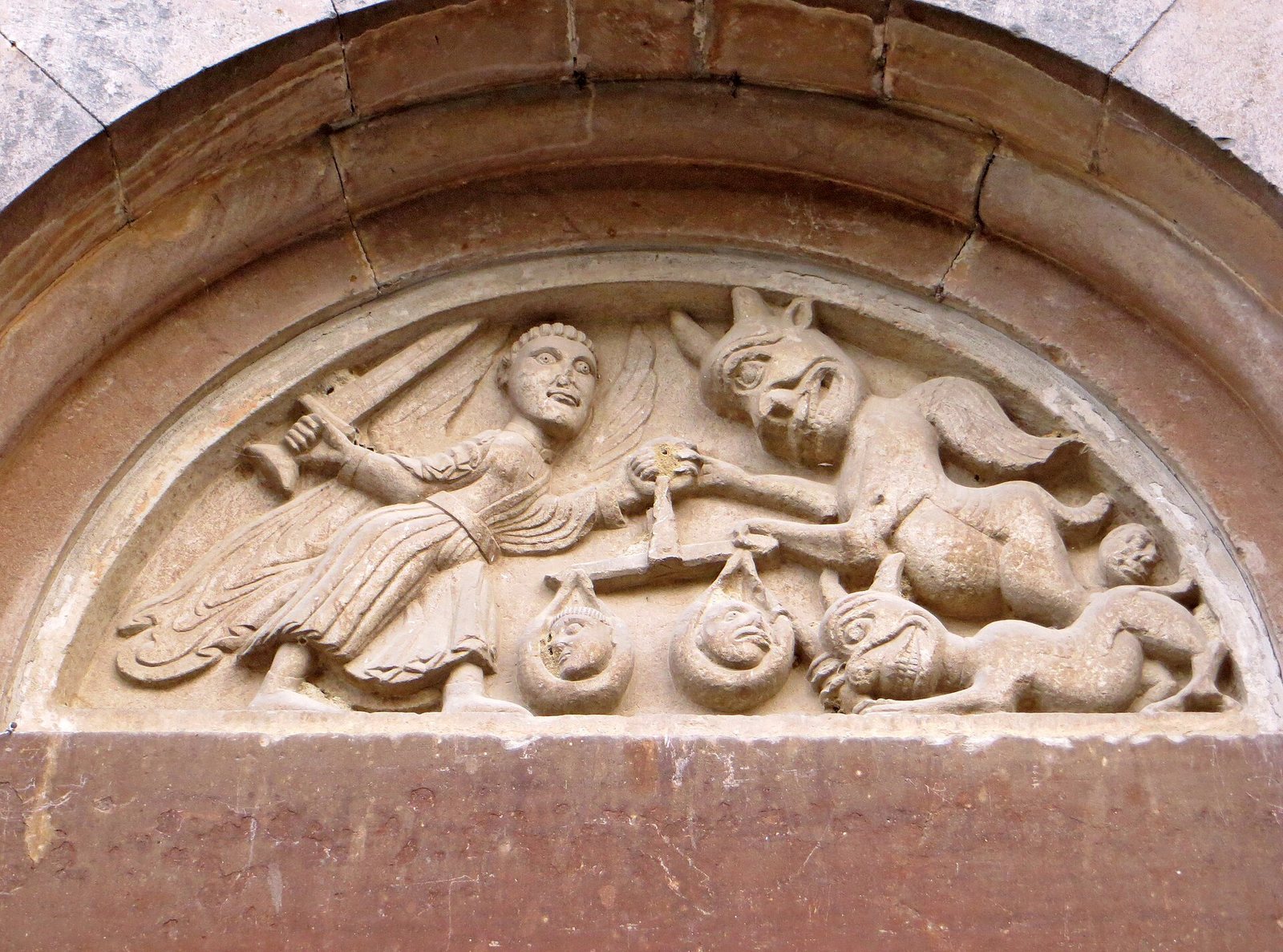
A major campaign from 1935 to 1939 sought to recover the church’s Romanesque appearance. Plaster was stripped from most of the exterior, earlier decorative features were reconstructed, part of the attached rectory was demolished, and single-light windows were opened in the apse. The 13th-century relief above the entrance was returned to its arched recess. Tradition holds that it had been removed by the 16th century and set in front of an oven.
An earthquake on 15 July 1971 damaged the bell tower, which was restored in 1974–75. The roof was renewed in 2015. San Biagio remains a Roman Catholic parish dedicated to Saint Blaise.
Remains
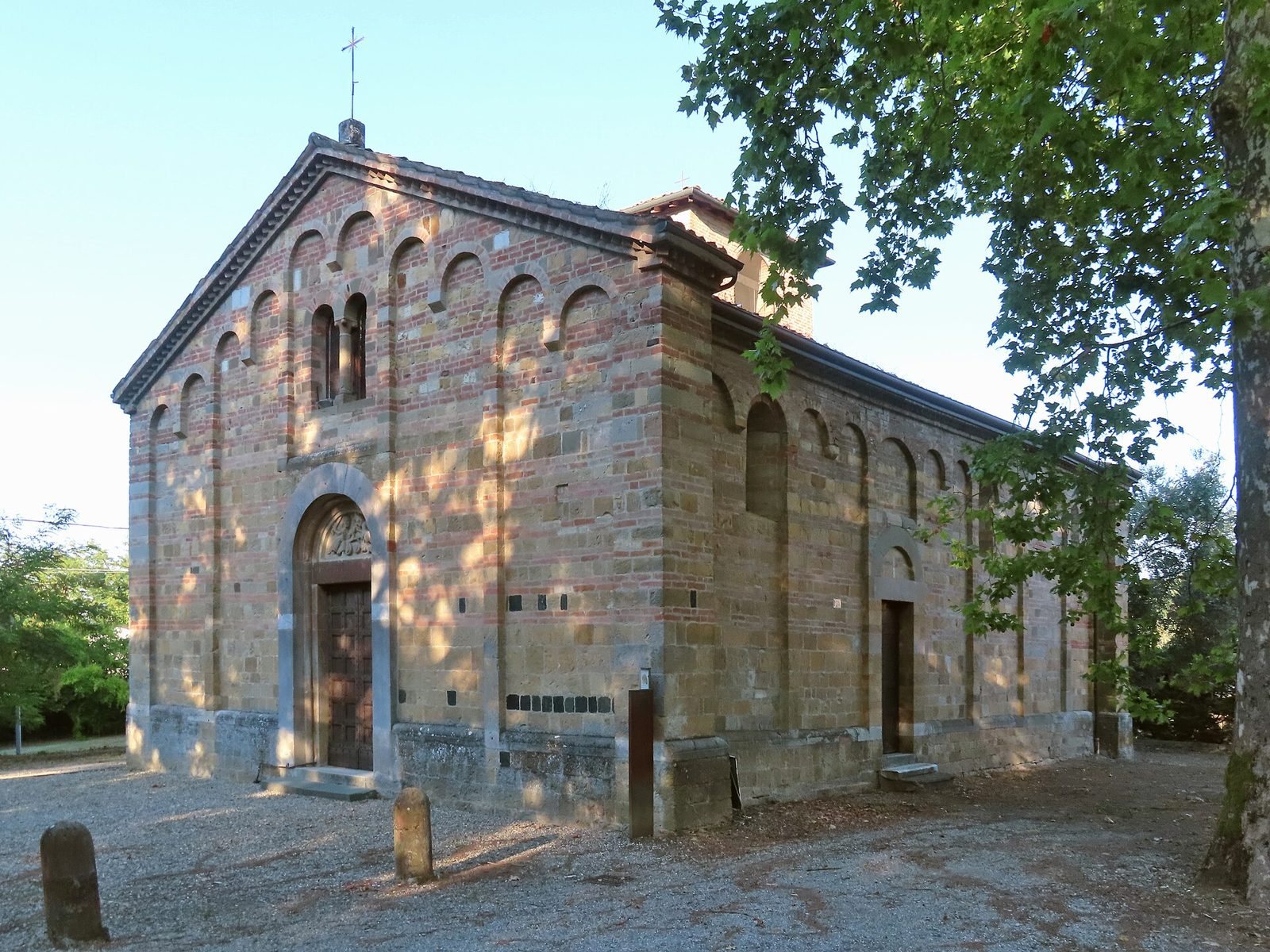
The church has a single nave with a chapel on either side, an entrance at the west end, and an apse-ended presbytery to the east. Its exterior combines stone and brick, often in alternating horizontal bands, while the interior retains the nave vault and a range of paintings and sculptural features.
Exterior
Facade and relief
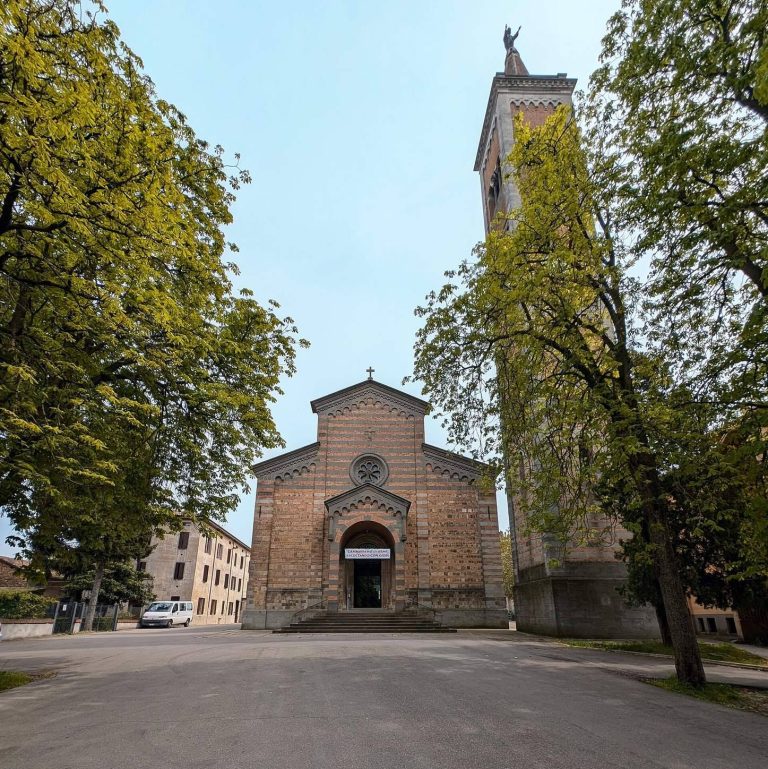
The symmetrical, gabled facade is divided into five vertical sections by six shallow supports and faced with alternating bands of stone and brick. A round-headed arch frames the central doorway. Above it, an arched recess holds an early-13th-century stone relief showing the weighing of souls, a Christian image of judgment after death. The Archangel Michael steadies the balance and raises a drawn sword, while a demon tries to tip the scales to seize a soul; a second demon, holding a hook near his feet, assists him. A paired window with a central stone column sits above the relief, and small projecting arches follow the roof slopes. The subject is unusual in Italian churches of this period. A related image appears in a fresco at Saint Thomas Becket Church in Cabriolo, while the theme was more common in medieval religious buildings along the Way of Saint James, the pilgrimage route to Santiago de Compostela, in France and Spain.
Side walls and bell tower
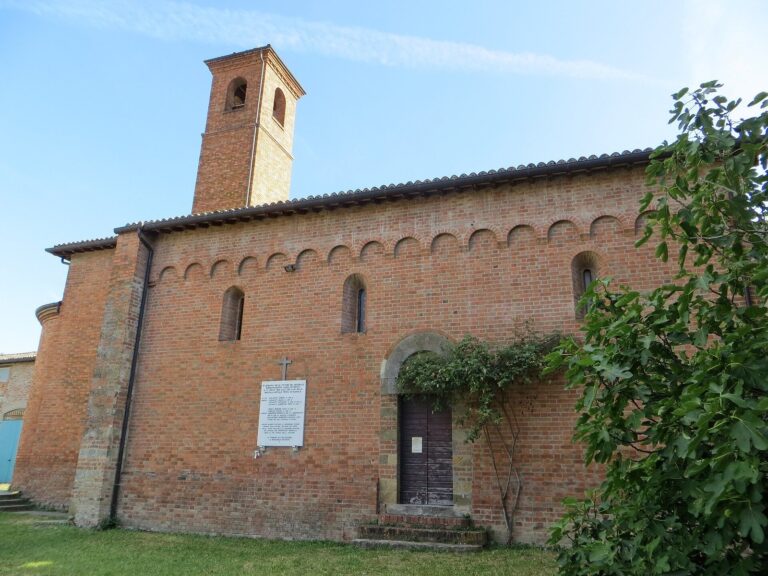
The side walls continue the facade’s alternating stone-and-brick decoration, and each has a secondary entrance at its centre. At the northeast corner, on the church’s left side, the massive medieval bell tower projects slightly from the building. It has a stone base and brick facing above. Broad, round-headed single-light openings pierce each side of the bell chamber.
Apse
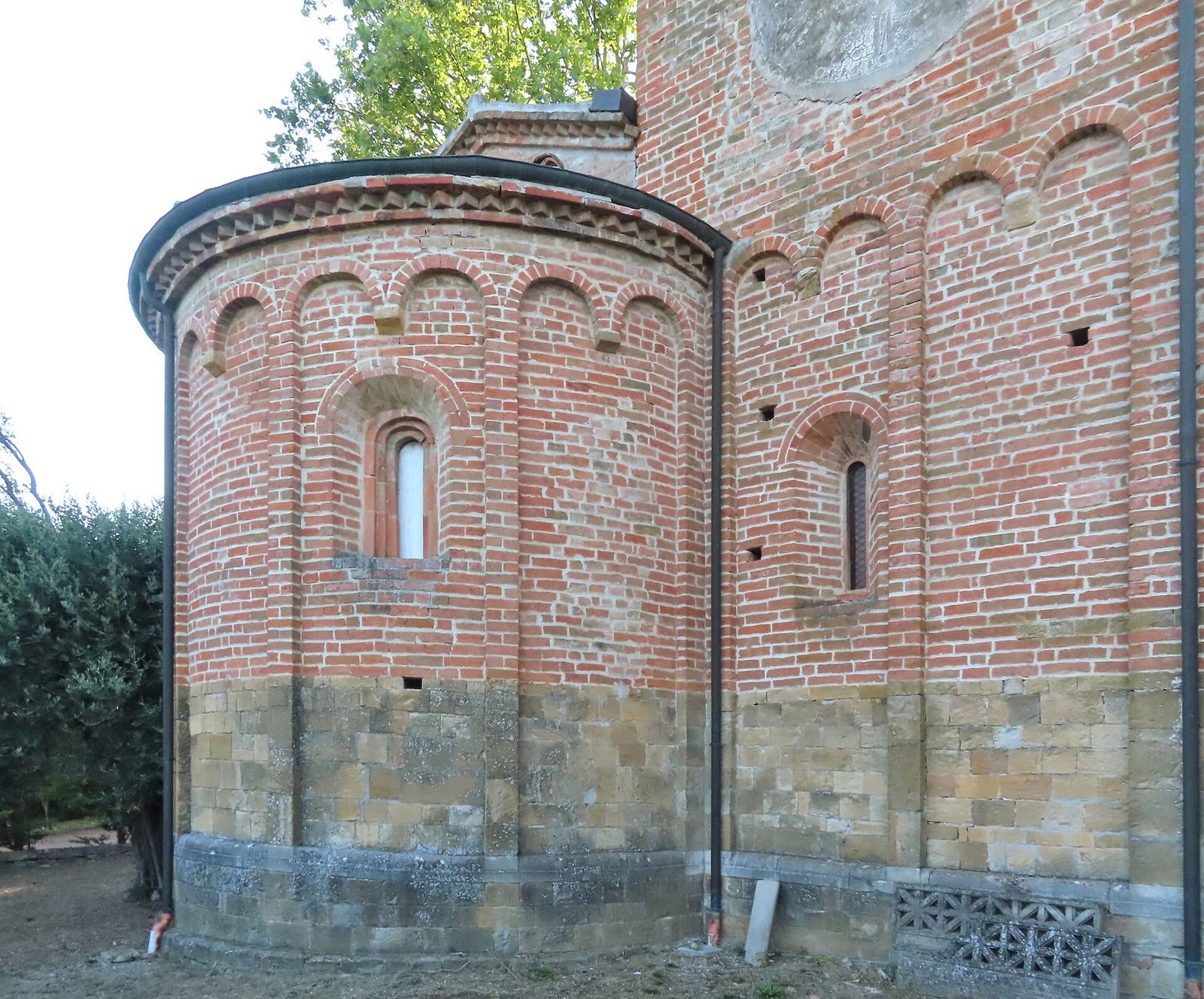
The apse rises from a medieval stone base and is built of brick. Shallow supports divide its exterior vertically, and two splayed, round-headed single-light windows open on its sides. Small projecting arches form a decorative band along the top.
Interior
Nave and entrance furnishings
The nave has a barrel-shaped ceiling with lunettes, and its side walls repeat the alternating horizontal bands of stone and brick. Two 15th-century capitals beside the entrance have been reused as basins for holy water. Two paintings hang on the inner facade: a mid-17th-century Madonna and Child with Saints Apollonia, Charles Borromeo, and Catherine of Alexandria, and an image of Christ the Redeemer with Saints Blaise and Basilides from the first half of the 18th century.
Presbytery
A round-headed arch leads into the slightly raised presbytery, whose ceiling is supported by intersecting vaults. Niches beside the arch contain statues of saints, including an 18th-century Madonna and Child. The sandstone table altar was added around 1970. The presbytery also contains a painting of the Sorrowful Virgin, a representation of Mary grieving over Christ’s suffering, made by Giovan Battista Borghesi between 1835 and 1841.
Chapel beside the presbytery
A small chapel to the left of the presbytery, at the foot of the bell tower, contains a fresco of the Madonna and Child with a bishop saint and Saint Anthony Abbot. The painting dates to the late 15th or early 16th century. Other 19th-century paintings in the arch soffit may also be by Borghesi.
Other paintings and furnishings
The church also holds two 18th-century oil paintings, one depicting the Virgin with saints and the other Saint Anthony, as well as a chest from the same century.