Salinas Pueblo Missions National Monument: Spanish Mission and Pueblo Ruins in New Mexico
Site at a Glance
- Rating
- 4.8
- Popularity
- Low
- Country
- United States
- Primary era
- Early Modern
- External website
- Open
- Eras represented
- Medieval, Early Modern
- Civilizations
- Spanish
- Site type
- Religious
- Remains
- Church
On this page17 sections
History
Salinas Pueblo Missions National Monument preserves three Spanish mission and Pueblo settlement complexes in central New Mexico, United States. Abó, Quarai, and Gran Quivira developed through Indigenous Pueblo occupation and Spanish colonial mission building, with mission construction broadly dating from 1622 to 1635. Together, the sites trace a long history in the Salinas Basin, from early permanent settlement to Spanish colonization, seventeenth-century crisis, abandonment, and modern archaeological preservation.
Indigenous settlements in the Salinas Basin
Human activity in the basin extends to about 6000 BC. Permanent settlements appeared by approximately AD 700, when people lived in pit houses, and Pueblo construction emerged by the twelfth century. By the early fourteenth century, an established Pueblo cultural tradition connected the basin with communities in the Four Corners region.
Nine settlements in the Estancia Basin became important during Spanish colonization. Quarai, Chililí, and Tajique were associated with Southern Tiwa, an Indigenous language of the northern Salinas settlements. Abó, Tabirá, and Gran Quivira were associated with Tompiro, a language of the southern communities.
Abó is the oldest of the three preserved pueblos, with origins around AD 1100. It expanded repeatedly between approximately 1200 and 1500, although only its eastern section near the stream appears to have remained occupied by about 1600. Quarai began around 1300. Its early settlement may have followed a circular plan, but by about 1500 this had been replaced by linear structures. The settlement was probably known as Cuarac before its Spanish-derived name became established.
Gran Quivira began developing around 1300 as two settlements arranged around circular plazas. By about 1400, most circular structures had been replaced by elongated pueblos, although one circular settlement may still have been in use during the mid-sixteenth century. During the Spanish colonial period, it was called Pueblo de las Humanas, Las Humanas, or Jumano Pueblo. Its people were Tompiro, and the settlement may have been called Cueloze in their language.
Gran Quivira was the largest Tompiro settlement, with an estimated population of about 3,000. It became a center of salt exchange with nomadic Jumano groups near the Concho and Rio Grande Rivers and possibly along the Pecos River and southern Plains. The modern name became associated with the legendary Quivira, a supposed wealthy kingdom sought by Spanish explorers, although the name’s origin remains uncertain and surrounded by competing traditions.
Spanish exploration and mission building
Francisco Vasquez de Coronado explored the Rio Grande region from 1540 to 1542 while seeking the legendary wealth of El Dorado and Quivira, but he did not reach the Salinas Basin. Francisco Sanchez Chamuscado and Agustín Rodriguez entered the region from the north during the winter of 1581 to 1582 and visited pueblos below the Manzano Mountains.
In 1598, Juan de Oñate established the first permanent Spanish settlement in New Mexico. Through a formal submission agreement, he claimed the region for the Spanish Crown and the Viceroyalty of New Spain, the Spanish colonial administration governing Mexico and much of the present-day southwestern United States. Franciscan friars, members of a Catholic religious order, accompanied him. The agreement’s significance to the Pueblo communities remains uncertain.
Franciscan missionaries reached the Salinas Basin in 1610, the year Santa Fe was founded as the capital of New Mexico. By 1626, they had established five missions in the basin, while priests served other pueblos through regular visits. Abó’s mission was established in 1625 by Fray Francisco Fonte. At Gran Quivira, a provisional mission begun in the 1630s was later reduced to a visita, a mission served by a priest from a neighboring convent.
Spanish colonization introduced farming practices and the cultivation of food crops and cotton, while also imposing the encomienda system of tribute and repartimiento labor obligations. The civil, military, and religious authorities exercised overlapping powers. Poor climate and limited agricultural productivity restricted the success of Spanish farms.
Crisis and abandonment
During the 1660s, Franciscan authorities expanded several churches and convents as expressions of ecclesiastical authority. At Gran Quivira, the San Buenaventura convent was developed beside the earlier San Isidro church. The convent expanded through 1667, although its church was never completed.
A prolonged drought beginning in the mid-1660s caused food shortages and intensified conflict. Apache raids, Pueblo resistance, declining agricultural production, and inadequate military protection weakened the settlements. The church distributed food in 1671 and 1672, while a military post at Abó protected the supplies and the settlement.
Apache attackers partially burned Gran Quivira in 1670, and the settlement was not rebuilt. Abó remained occupied until 1673. Quarai was abandoned around the turn of 1676 and 1677, and its Christian population moved to Tajique. Tajique was abandoned several months later when relief supplies from Mexico City failed to arrive. Another resettlement attempt in 1678 ended by 1679 or during the Pueblo Revolt of 1680, an uprising that ended Spanish control across much of New Mexico.
Between 1676 and 1680, the governor of New Mexico and the Franciscan friar Francisco de Ayeta organized three supply expeditions for the starving province, but military assistance and further relief eventually ceased. By 1680, the missions and Spanish settlements in the Salinas Basin had been abandoned, and New Mexico’s administrative structures had collapsed until they were restored on a reduced basis in 1692.
Later settlement and preservation
Pueblo populations declined substantially after the abandonment, although some agricultural methods and tools introduced by the Spanish continued in use. Spanish activity remained limited during the eighteenth century, apart from a small military post that operated in the southern part of the region from 1762 to 1776.
Spanish settlement resumed around 1800, particularly at Abó and Quarai, where springs and sheltered positions near the mountains offered advantages. Continued attacks from the Plains made these settlements difficult to maintain, while Gran Quivira’s distance from reliable water discouraged renewed settlement. Abó was briefly resettled by a farming family in 1865, but the three mission-pueblo complexes largely remained in ruins.
After New Mexico became part of the United States in 1848, settlers, traders, soldiers, and travelers circulated through the region. Photographs of the ruins appeared by the end of the nineteenth century. Gran Quivira became a national monument on November 1, 1909, while Abó and Quarai were protected as New Mexico state monuments in the 1930s, when extensive archaeological investigation and stabilization also began.
The federal government incorporated Abó and Quarai into the national monument in 1980 and 1981. The enlarged site was renamed Salinas Pueblo Missions National Monument on October 28, 1988. It had been listed on the National Register of Historic Places on October 15, 1966, and its protected area covers approximately 435.8 hectares.
Remains
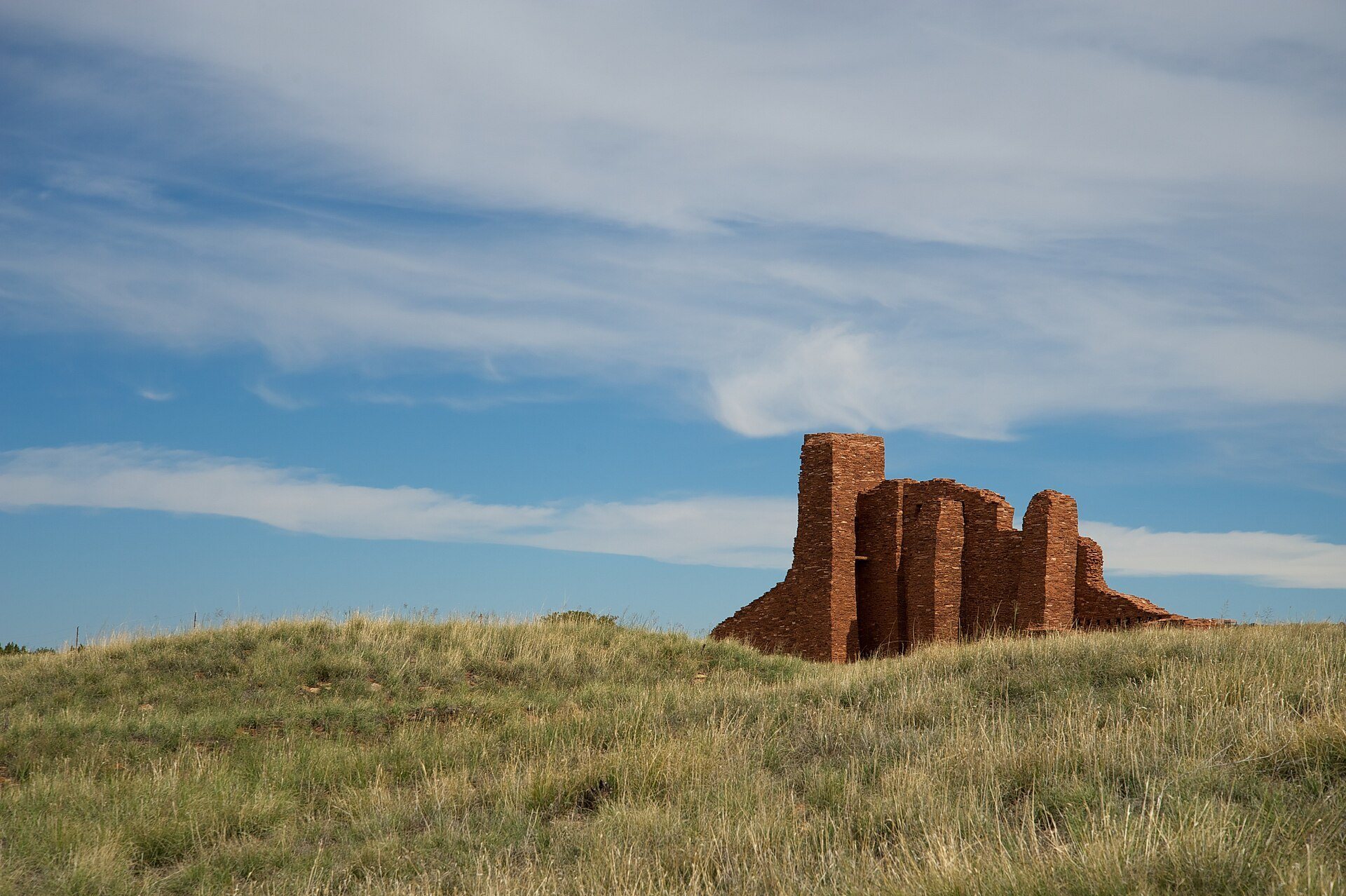
The monument lies on the eastern flank of the Manzano Mountains, about 40 kilometers east of the Rio Grande, around the enclosed Estancia Basin whose salt lakes gave the region its name. Abó and Quarai stand near the mountain foothills and water sources, while Gran Quivira occupies the open southern side of the basin toward the prairies. Each complex combines a Spanish mission church and convent ruins with partially excavated Pueblo buildings, kivas, and other settlement structures.
Abó
Abó Pueblo
Abó Pueblo occupies ground beside a mountain-fed stream. Several springs once rose near the village, and one is described as still flowing. The settlement expanded repeatedly between approximately 1200 and 1500. Its eastern section, near the stream, was the portion that remained occupied around 1600. The settlement’s surviving remains form part of the broader Pueblo building complex associated with the mission.
San Gregorio mission
The Abó mission church, San Gregorio, was enlarged with an adjoining Franciscan convent during the seventeenth century. The earlier nave measured about 20 meters in length, and the convent cloister, an open courtyard surrounded by covered passages, measured approximately 15 by 15 meters. The choir was later extended, bringing the nave to nearly 35 meters. Two side altars and a spacious sacristy were added, while a later building phase almost doubled the convent’s area and largely enclosed its former side courtyard.
Quarai
Quarai Pueblo
Quarai lies north of Abó at the foot of the Manzano Mountains, in an area with year-round water sources. Its earliest settlement may have had a circular ground plan. By about 1500, that arrangement had been replaced by linear three-part buildings, which formed part of the Pueblo settlement served by the mission.
Mission of the Immaculate Conception
The Quarai mission was dedicated to the Immaculate Conception. Its friars’ cells were placed in a separate block with their own corridor rather than opening all rooms onto the cloister. Alterations during the 1660s were limited. Auxiliary rooms were added in the outer courtyard, and the sacristy was slightly remodeled.
Gran Quivira
Pueblo settlements
Gran Quivira, also called Las Humanas or Pueblo de las Humanas, is the southernmost of the three preserved settlements. Its partially excavated Pueblo includes two early communities organized around circular plazas, later elongated structures, and associated kivas. Excavations in 1965 through 1968 also identified a third, smaller church within the Pueblo ruins. The monument’s archaeological work has additionally identified early pit houses dating from the period when permanent settlement began in the basin.
San Isidro church
The first Gran Quivira mission church, now identified as San Isidro, was a small building associated with the initial visita. Its plan followed the general arrangement of a Spanish mission but was reversed because of local conditions. The church was never completed.
San Buenaventura convent and church
The later Gran Quivira mission included the San Buenaventura convent, built beside San Isidro and enlarged in several phases through 1667. Its associated church remained unfinished. The mission complex, convent, and Pueblo were partially burned in 1670 and subsequently abandoned, leaving a group of ruined churches, convent buildings, and settlement remains.
Third church
A third and smaller church at Gran Quivira was probably used only briefly. Its remains were identified within the Pueblo ruins during the 1965 through 1968 excavations. The incomplete Gran Quivira mission church is described as the largest ruin of a Christian temple in the United States.