Salinas da Fonte da Bica: Historic Inland Saltworks in Portugal
Site at a Glance
- Popularity
- Medium
- Country
- Portugal
- Primary era
- Modern
- Eras represented
- Modern
- Civilizations
- Portuguese
- Site type
- Economic
- Remains
- Production Complex
On this page10 sections
History
Origins and medieval records
Salinas da Fonte da Bica, also known as the Saltworks of Rio Maior, are inland saltworks in Rio Maior, Portugal, where salt has been produced from a brine spring since the 12th century. They are among the few saltworks in Portugal to use spring brine rather than seawater. The name Fonte da Bica comes from a nearby property whose owners were associated with the works in deeds and other records.
A local tradition tells that a girl tending livestock tasted salty water at a spring or pool and alerted her parents. Her father and other villagers then dug a well there and began making salt. The spring may have been used in Roman times and later under Muslim rule, before the Reconquista, the gradual Christian conquest of Iberian territories formerly under Muslim rule. The dates and scale of any earlier salt-making remain uncertain.
Salt production was underway in the late 12th century. A former well may have stood farther north at Marinha Velha and supplied six pans in the 12th or early 13th century. It is thought to have dried after the present well was dug, but the scale of the early operation is not known.
The earliest known written record is a deed from 1177. In it, Pero d’Aragão and his wife, Sancha Soares, sold the Templars, a medieval religious-military order, their one-fifth share in the well and saltworks. The deed, now held at Torre do Tombo, Portugal’s national archive in Lisbon, is the oldest known document concerning Rio Maior. The transaction came after Afonso Henriques, later recognized as Afonso I of Portugal, captured Lisbon and Santarém, and before the pope recognized him as king in 1179.
Royal and noble ownership
The Templars held a share of the saltworks until their order was dissolved in 1312. Their property passed to the Crown, and in 1319 King Dinis transferred former Templar holdings to the Order of Christ, a Portuguese order that received Templar property. A 15th-century document lists King Alfonso V as owner of five pans, but it is unclear whether the Crown had acquired them or they remained royal property through the earlier transfer.
During the 17th century, in the reign of João IV, salt pans belonging to the royal estate were sold to the Count of Vimioso, a Portuguese noble titleholder. The saltworks may have remained with the House of Braganza, Portugal’s royal dynasty, until that sale, and the count’s heirs may later have passed them to other owners. The precise chain of ownership is uncertain.
Seasonal work and modern management
Salt production takes place from May to September. Each season, one of the 84 owners is selected to manage and maintain the installation. In earlier times, this work included keeping the brine-raising equipment running through the night, a strenuous and dangerous task. The other owners paid the manager with a share of the salt. Harvesting generally began seven days after the pans were filled, though very favorable midsummer weather could shorten the wait to 24 hours.
Wooden houses served as taverns during the working season. Tavern keepers tracked workers’ drinks and payments on wooden slats about 1.5 metres long and 10 to 15 centimetres wide, using conventional marks and hanging the slats on the walls. The hard labor and cold, damp nights contributed to heavy drinking; the visible tallies helped customers follow their debts and tavern keepers collect them. Salt was used to pay both tavern purchases and workers.
In 1979, the owners established the Agricultural Cooperative of Rio Maior Salt Producers to support extraction and marketing. The saltworks became a Property of Public Interest, a Portuguese heritage-protection category, in 1997, and production has continued under heritage requirements. Since 2025, the salt and flower of salt have been marketed under protected designations of origin, which tie every stage of production to a defined area, as Sal de Rio Maior and Flor de Sal de Rio Maior.
Remains
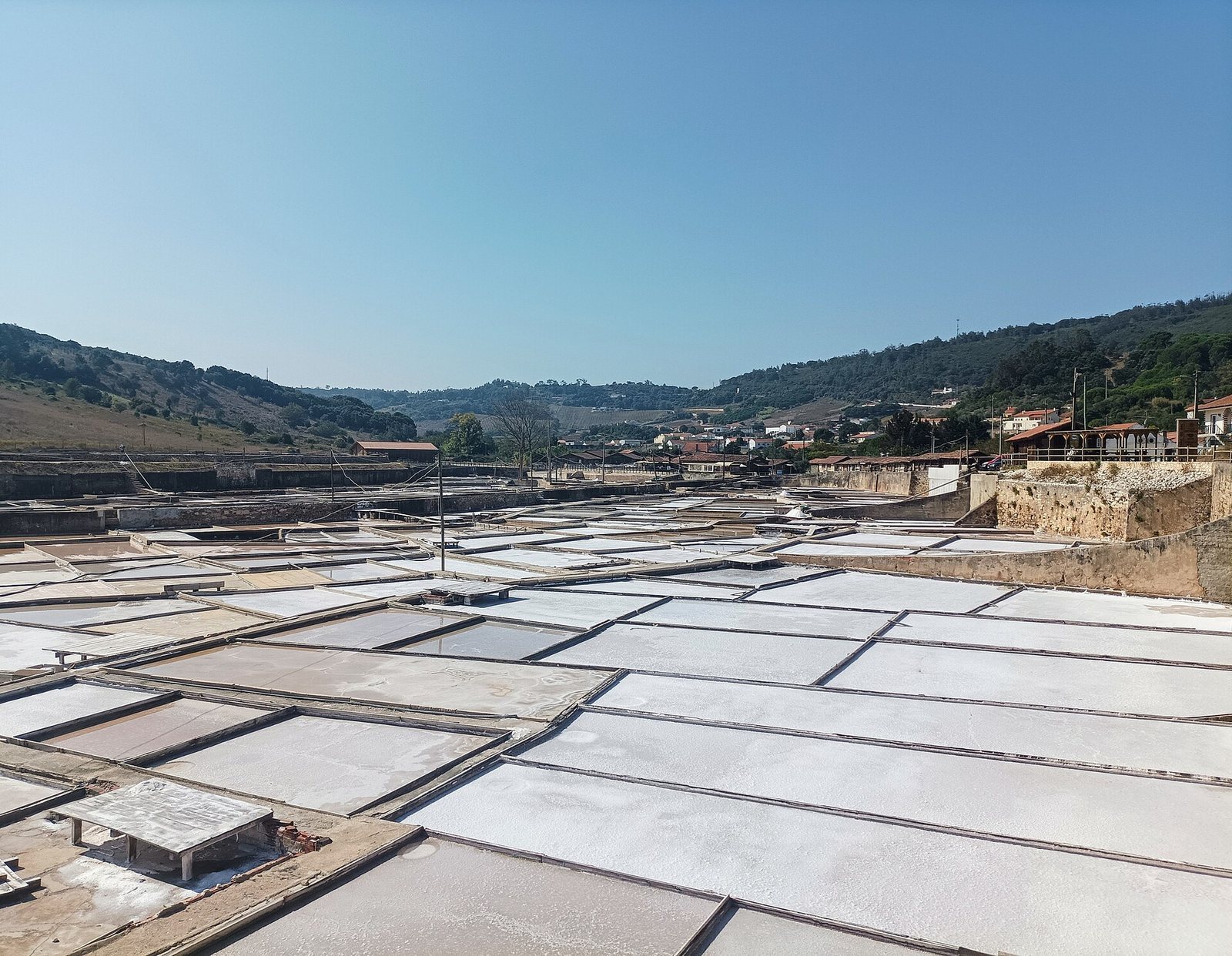
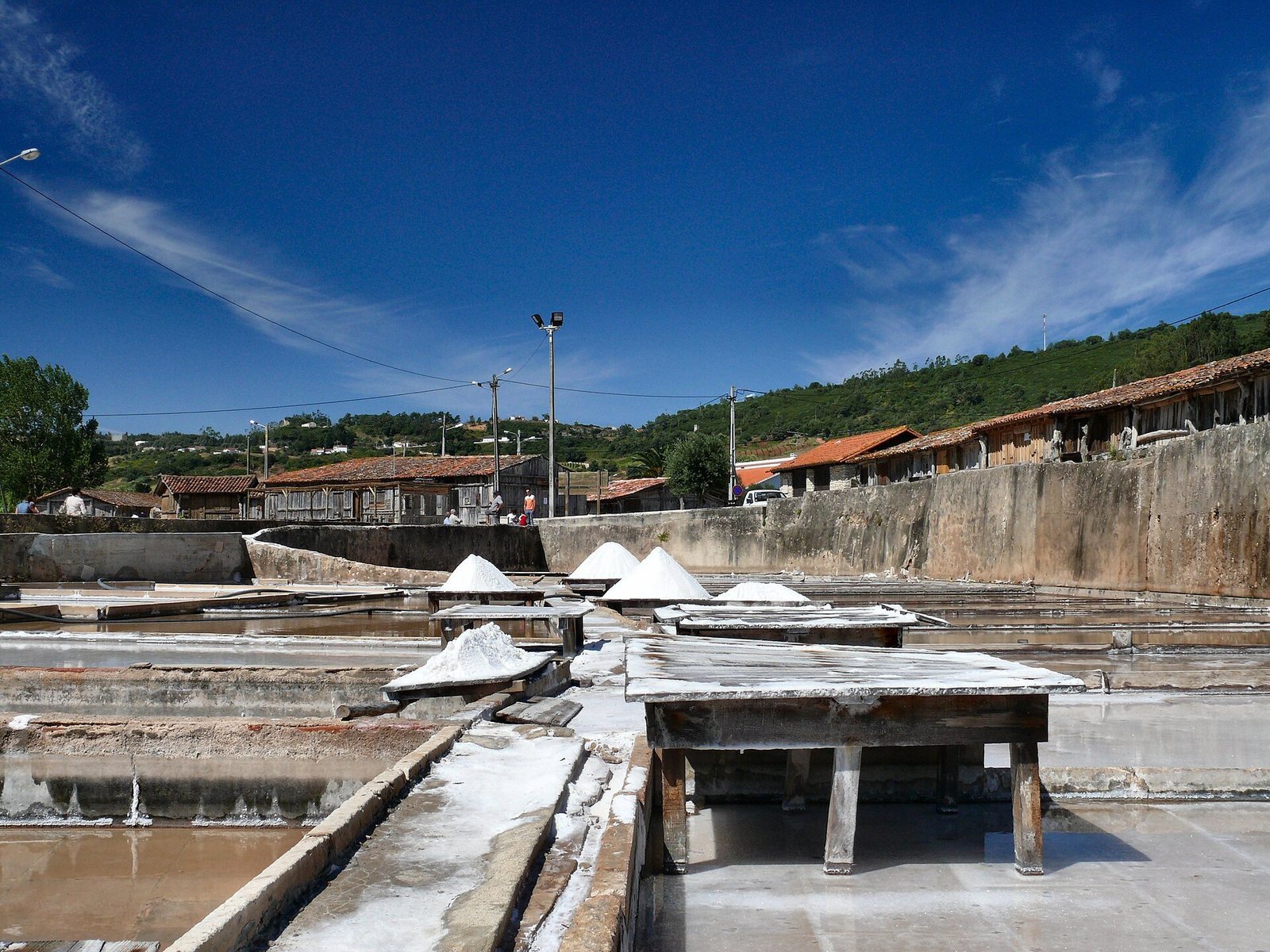
The saltworks lie about three kilometres north of Rio Maior, in a geological valley at the foot of the Serra dos Candeeiros. The valley sits between two ridges in the southwestern foothills of the Serras de Aire e Candeeiros, about 30 kilometres from the Atlantic and within the Estremenho Limestone Massif. The complex is arranged around a brine well and roughly 470 pans covering about 22,000 square metres, with the salt-workers’ village to their northwest and west.
The brine well and water supply
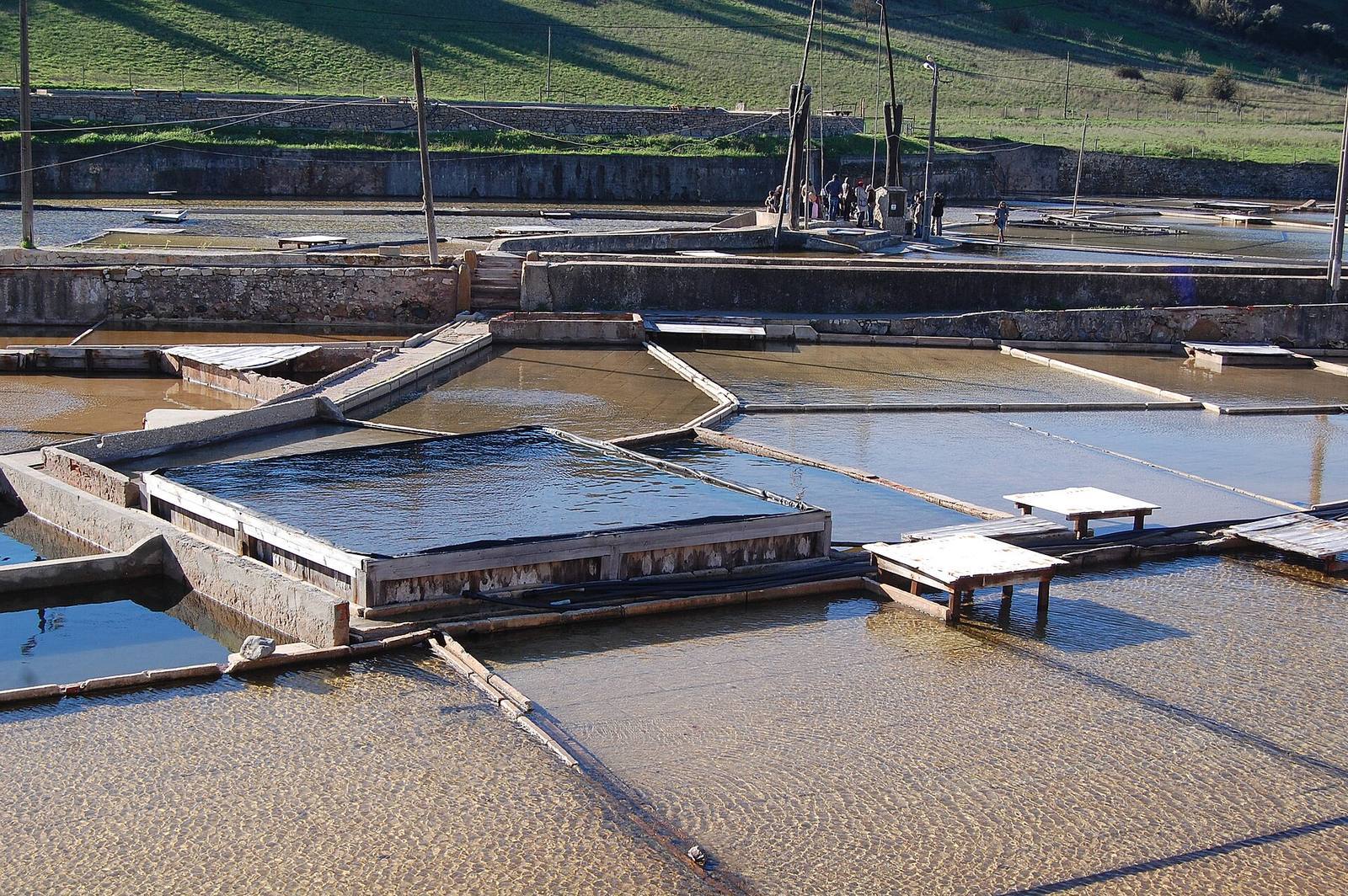
The present well is about 3.75 metres wide and 9 metres deep. Underground watercourses pass through the limestone, dissolving a salt deposit formed during the Early Jurassic before reaching the surface as brine. Its salt concentration is about 220 grams per litre, roughly seven times that of seawater. Until the 1980s, two manually operated pivoting beams raised the brine; a motor pump has since replaced them. The beams are attributed to Arab models.
The salt-pan complex
Storage and evaporation pans
About 70 larger pans store brine before it is distributed among roughly 400 smaller pans. The shallow pans are rectangular or trapezoidal, average about 7 by 5 metres, and are built of stone or, in more recent examples, cement. A shallow depression in each pan’s centre lets impurities settle during evaporation. A separate reservoir pan at the perimeter is about 1.5 metres deep. Channels connect the well with the pans, while a renewed storage system and modern PVC pipes distribute the brine.
Walkways and drying platforms
Wooden boards once edged the walkways separating the pans; bricks and stones are also used today. Rectangular wooden platforms, raised on four posts, stand in corners of some pans. Salt from one or more adjoining pans is dried and bleached on these platforms before being carried to the village storehouses.
Sun and wind evaporate water from the brine, leaving salt on the pan bottoms. Workers rake it out with wooden tools, then dry and bleach it on the raised platforms. The resulting piles are pyramidal, a shape also used on Rio Maior’s coat of arms. In a harvest pan, a thin layer of small, leaf-shaped crystals forms at the surface when the brine reaches the required saturation; this is flower of salt, or fleur de sel. The salt is then taken to nearby storehouses for breaking, cleaning and preparation for sale.
The dried salt is white and glossy, with crystals measuring 1 to 4 millimetres and moisture content no higher than 4 percent. The salt and flower of salt have the same stated composition: 97 to 99 percent sodium chloride, less than 0.02 percent magnesium and less than 0.1 milligrams per kilogram of selenium. They are sold as crystals or ground, and also in mixtures flavored with herbs or spices.
The salt-workers’ village
The village’s simple residential and storage buildings have rectangular plans and are made and furnished entirely of wood. Even their locks are wooden, limiting corrosion from the salt. Many buildings now serve the sale of local salt products, while others house craft businesses and cafés or restaurants.