Church of Saint Zeno: Historic Parish Church of Lonato, Italy
Site at a Glance
- Popularity
- Very Low
- Country
- Italy
- Primary era
- Medieval
- Eras represented
- Classical, Medieval, Early Modern, Modern
- Civilizations
- Holy Roman Empire, Italian, Venetian
- Site type
- Religious
- Remains
- Church
On this page14 sections
History
The Church of Saint Zeno is a Catholic church on a hill in Lonato, Italy, where the town’s earliest settlement developed. A Christian church stood here by the fifth century, and its twelfth-century rebuilding was in Romanesque style, a medieval European form characterized by rounded arches and substantial masonry. Dedicated to Zeno of Verona, the church served as Lonato’s parish church before that title passed to a church of Saint John the Baptist. It is now a subsidiary church of that parish in the Diocese of Verona.
Roman settlement and the early church
Roman settlement preceded the church. A residential complex at nearby Colombare delle Pozze, discovered in the 1960s and dated from the first through fourth centuries, became part of Lonato’s early settlement. Its identification with the Roman stopping station Ad Flexum remains disputed, as does the route of the Via Gallica, a Roman road, through Lonato.
As Christianity spread, parish churches gradually replaced villas as religious centers. At Pozze, the earliest evidence of a religious building dates to the fifth century. It stood closer to the hill than the Roman settlement and remained until the tenth century, when a Hungarian invasion destroyed it.
The location of the first parish church has also been debated. Local historian Giacomo Attilio Cenedella argued that a church dedicated to Saint Zeno had stood about 500 metres south of the present building, at the later church of San Martino, in the fourth or fifth century. The proposed location is uncertain: San Martino’s earliest construction is often placed in the seventh or eighth century, while excavations near Pozze found traces of an ancient basilica on the plain below the hill, possibly not at San Martino’s exact site.
The medieval parish and fortified settlement
The church at Pozze was rebuilt in the twelfth century and enlarged, probably with three aisles. Earthquakes at Verona in 1117 and Brescia in 1222 may also have damaged it. The earliest written references to Lonato are uncertain. Documents dated 774 and 887 use the name Lionam, whose identification with Lonato is disputed; a record from 977 uses the name Leunado.
A charter dated 909, now regarded as false, purports to record Berengar’s authorization of new fortifications after the Hungarian destruction. It calls the church Saint Zeno and Saint John the Baptist and mentions another fortified settlement, probably the Citadella. That settlement is securely mentioned only from the twelfth century. The charter may have been written not long after its stated date or fashioned from an authentic document.
In 1145, Pope Eugene III confirmed the parish church, its chapels, and a castle to Bishop Tebaldo. Pope Anastasius IV confirmed those possessions again in 1154. A decree issued by Pope Lucius III in 1184, addressed to Archpriest Ricardo, lists the parish church and its old castle among the church’s properties, along with nearby churches and lands. It also confirms liberties granted by the bishops of Verona and the right to bury the dead freely.
The description of an old castle implies that a newer fortification already existed. Historians identify another suburb mentioned in the 1184 decree with the Citadella, while the newer castle is thought to have been the present Rocca, which defended it. That same year, Emperor Frederick Barbarossa issued a privilege to Lonato’s two consuls, who sought recognition of their rights. The document points to possible tension between the town’s civil and religious authorities, perhaps over ownership of the old castle.
Destruction and rebuilding
In 1339, mercenary troops led by Lodrisio Visconti destroyed almost all of Lonato while he fought his nephew Azzone, lord of Brescia since 1337. The troops razed the twelfth-century church and its surrounding castle. The surviving population moved south to an already fortified settlement, where the present town center developed. The church was rebuilt in 1339–1340 on a smaller scale, using stones from the earlier building. Its parish title passed to a new church of Saint John the Baptist outside the Citadella walls; that church was later rebuilt twice.
Later use and conservation
In 1530, Bishop Gian Matteo Giberti referred to Saint Zeno as the ancient parish church. The church’s interior took its present form during the seventeenth century. After the building had deteriorated, Alberto Piazzi proposed its restoration in 1980, and the work was completed in 1981. The local Alpini, Italy’s mountain troops, also renewed the small approach road, installed a plaque honoring those killed in wars, and erected a flagpole on the hilltop. The local Alpini group continues to manage the church.
Remains
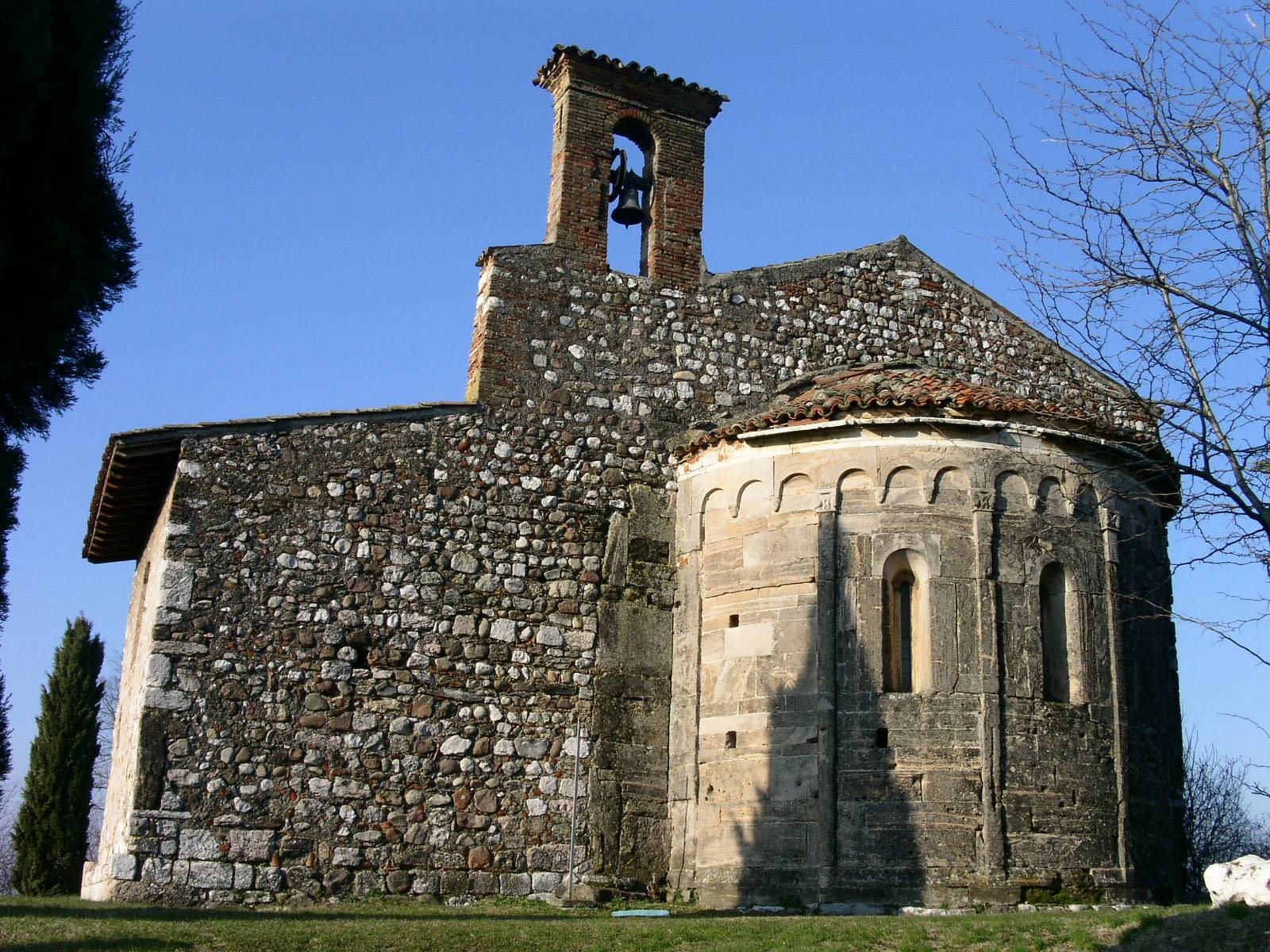
The church is laid out on an east–west axis, with a single nave, the main interior space, and a semicircular apse, a rounded recess at the end of a church. It measures 26.5 metres long and 8.5 metres wide. Its walls use a mixture of stone, pebbles, and fired brick, while the apse is built from dressed sandstone.
Exterior
Plan and masonry
Older masonry suggests that a building here measured about 8.5 by 13 metres in the eleventh century, then was enlarged during the twelfth century to approximately the present dimensions. Several building phases can be seen in the central part of the north wall, although it is uncertain whether the oldest masonry belonged to the first parish church. The walls combine rubble, white Botticino stone, red Verona stone, pebbles, and fired bricks, with many materials reused from earlier buildings.
Front and south side
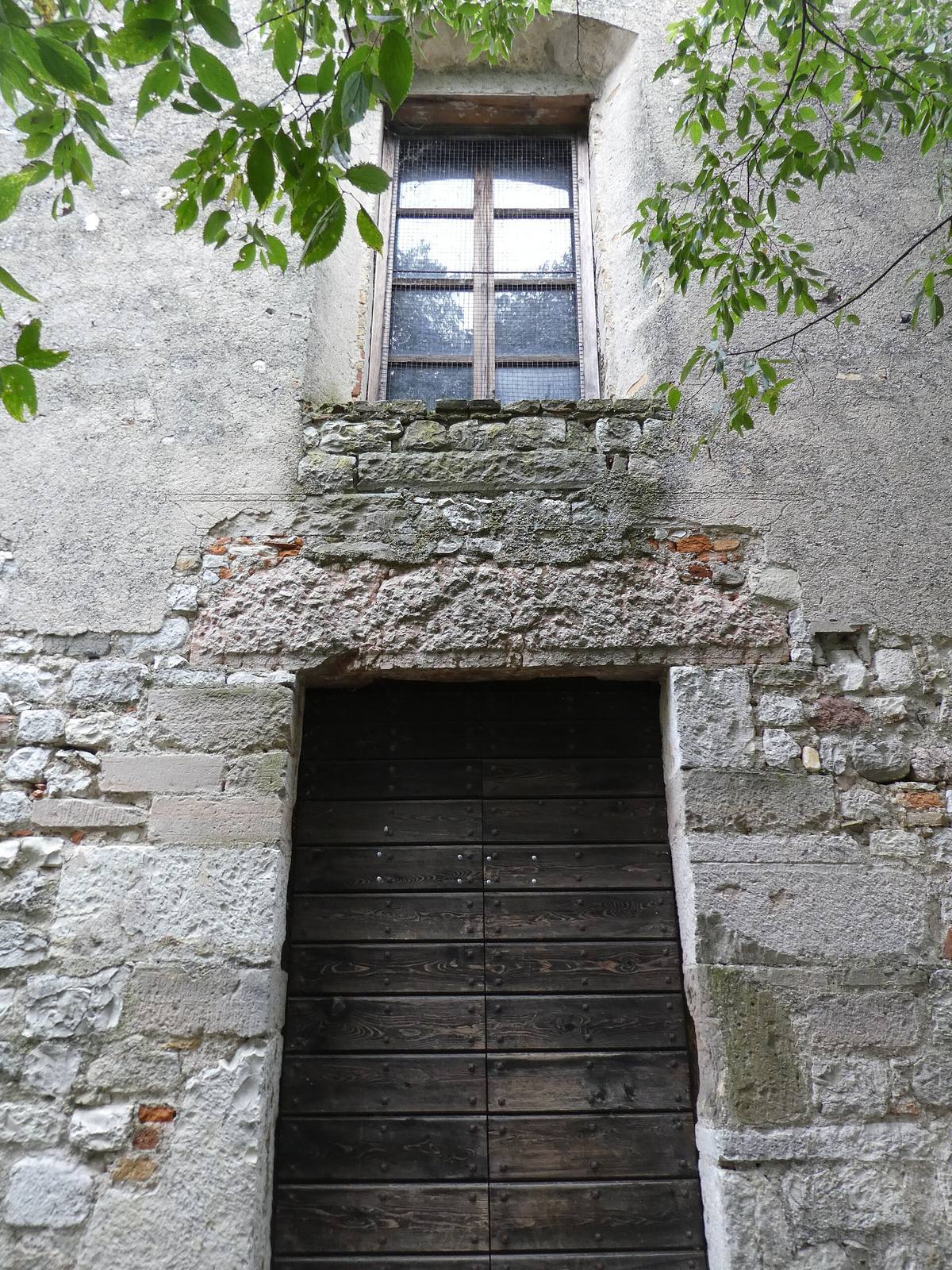
The Romanesque front has a gabled outline and is built of irregular limestone blocks, partly covered with lime plaster. A rectangular doorway stands at its center, with a large window above it to light the interior. On the south side, a sacristy, a room for church furnishings and vestments, has a single sloping roof. A large blocked arch there contains a secondary entrance and traces of frescoes. The arch once gave access to another room, possibly a baptistery.
Apse and measuring unit
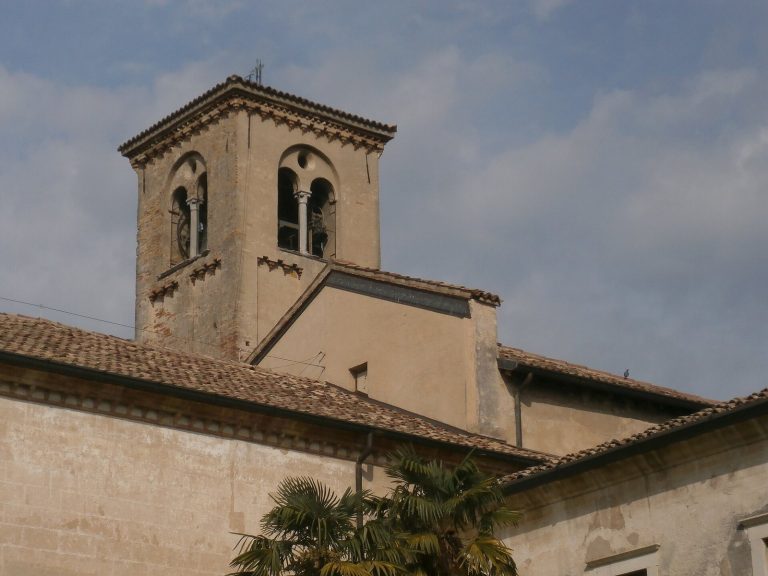
The semicircular apse is the only surviving part of the twelfth-century church and remains almost entirely intact. Four pilasters, shallow supports attached to a wall, divide its exterior. Their tops carry animal and human figures drawing on Celtic artistic traditions. Each of the three central sections has a single-opening window and is topped by three small hanging arches. A bell-cote, a small structure that houses a bell, stands on the apse roof.
The second pilaster from the left holds a Lonato cubit, a traditional unit of length based on the forearm. The measure is 48 centimetres long and divided into twelve sections of four centimetres each. It predates the apse and dates to the fourth or fifth century. Merchants probably used it at a market held near the church.
Interior and furnishings
Roof and paintings
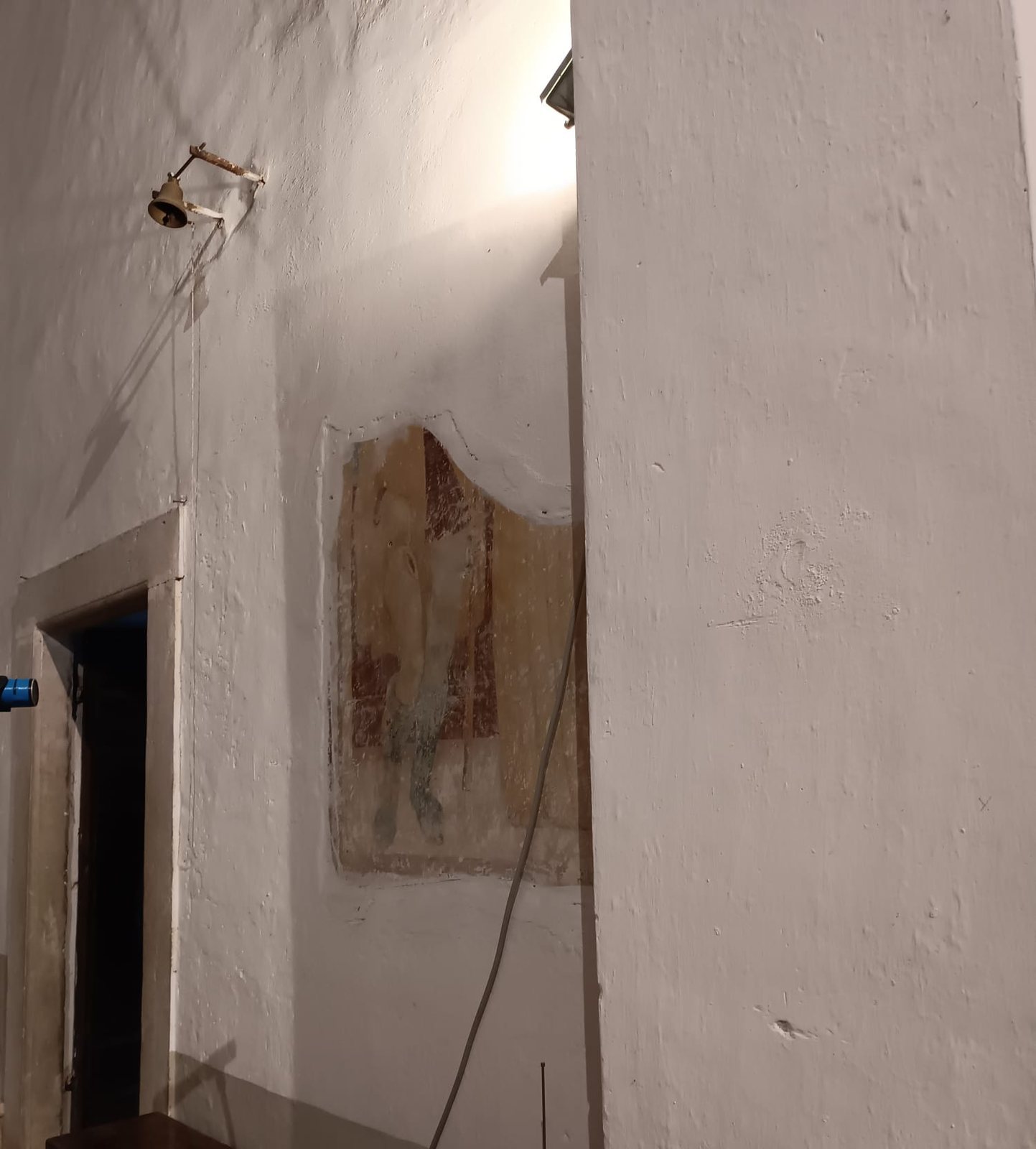
Terracotta tiles cover the two-sloped roof, whose lengthwise timber beams are supported by three arches resting on half-pillars. The interior walls have white plaster. Traces of fresco decoration from the fifteenth and sixteenth centuries remain. Fragments around the altar and apse date to the fourteenth century and include images of Saint Zeno, the Madonna and Child, and Saint Roch.
Altar and devotional image
A painted wooden altar from the seventeenth century stands at the center of the presbytery, the area around the main altar, beneath a canopy. It was transferred here in 1787 from the sanctuary of Madonna di San Martino, where a marble altar had replaced it. A wall holds an image of the Madonna of Czestochowa, a devotional image associated with Poland’s Jasna Gora shrine. Pope John Paul II donated it to the local Alpini for the church’s restoration.
Castle remains
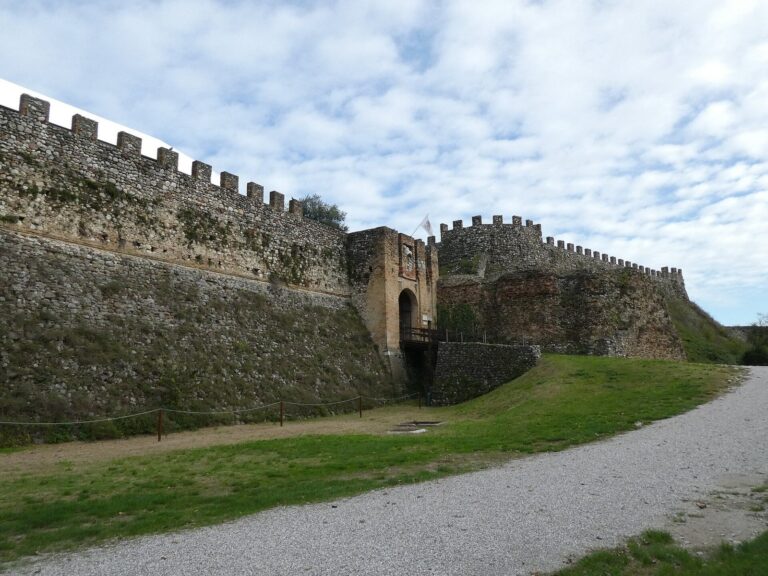
Scattered remains of the castle associated with the church can still be seen.