Saint Jovan Bigorski Monastery: An Orthodox Monastic Complex in North Macedonia
Site at a Glance
- Popularity
- High
- Country
- North Macedonia
- Primary era
- Modern
- Eras represented
- Modern
- Civilizations
- Ottoman, Serbian
- Site type
- Religious
- Remains
- Fortified Monastery
On this page17 sections
History
Saint Jovan Bigorski Monastery is an Orthodox monastery near Radostusha in North Macedonia, on the slopes of Mount Bistra beside the Radika River. Its foundation is traditionally dated to 1020, although its early history remains disputed. The present church was built in 1800, and the monastery underwent major expansion in the early nineteenth century. It has long served as a pilgrimage place for people from the surrounding villages.
Foundation traditions and destruction
The monastery’s chronicles, its Great Memorial Book, and an inscription associated with its miraculous icon connect its foundation with 1020 and a monk called John Debranin. A chronicle copied in 1833 identifies John as John I of Ohrid, traditionally regarded as an early archbishop of Ohrid. Historian Ivan Snegarov questioned the 1020 date and accepted evidence that the monastery existed by the sixteenth century.
Later traditions proposed other founders. The nineteenth-century educator and writer Jordan Hadži Konstantinov-Džinot credited Tsar Samuil, a ruler of the medieval First Bulgarian Empire, and linked him to John Debranin; historian G. Trajchev considered that family connection unsubstantiated. Another tradition assigned the monastery’s construction and decoration to King John Vladimir of Zeta in the eleventh century. A Serbian tradition described it as a royal foundation of the Nemanjić dynasty and associated Serbian rulers with gifts to the monastery.
Ottoman authorities destroyed the monastery in the sixteenth century. It may have been burned during the reign of Sultan Selim II. The circumstances and timing of its abandonment remain uncertain, while a local legend connects the destruction with a campaign of forced conversion.
Rebuilding and expansion
Hieromonk Ilarion rebuilt the monastery in 1743 with assistance from local communities, including villagers from Galičnik. He became the first abbot of its later period. The work included monastic living quarters and a large communal dining hall, and people from the Reka and Debar regions continued to take part in building and restoration. Abbot Mitrofan oversaw construction of the present church in 1800.
Under Abbot Arseniy, the monastery expanded substantially between 1812 and 1825. A building on the north side was erected in 1814, followed by a refectory in 1825. Arseniy had begun the church’s interior decoration in 1810 and engaged painters and woodcarvers. In the 1830s, the monastery commissioned a carved icon screen and a large reliquary, works that remain among its most notable religious objects.
Religious life and political tensions
The monastery was associated with the Ohrid Archbishopric, a senior church jurisdiction, and later with the Bulgarian Exarchate, an Orthodox church institution established in the nineteenth century. It now belongs to the Macedonian Orthodox Church–Ohrid Archbishopric and the Debar-Kičevo Diocese, a regional church district. Christian pilgrims came from surrounding villages, including Torbeš communities, a name used for Muslim communities in parts of the region. A Serbian school operated at the monastery later in the nineteenth century.
In 1889, Abbot Archimandrite Hariton described the monastery as serving as a church, hospital, and theological school. More than 20 monks lived there, alongside many poor and sick people. In 1891, adherents of the Bulgarian Exarchate sought to turn the Old Monastic Quarters into a school boarding house. Hariton refused, and a confrontation ended when local residents drove the group away. Clashes between Serbs and Bulgarian Exarchists also took place during the monastery feast in 1904.
On 17 May 1913, as Serbian rule was being established in the region, Serbian Bishop Varnava gathered 37 Bulgarian priests at the monastery. With help from the authorities, he compelled them to sign an oath of allegiance. In 1918, Hieromonk Parteniy Bigorski was tortured and killed after refusing to declare that the monastery was Serbian.
Twentieth-century damage and renewal
A fire in autumn 1912 had already destroyed about half of the monastery buildings. During the First World War, Bulgarian forces took the silver they found there. The monastery sought help for repairs in 1925 and received major restoration in 1927. Neglect followed in the 1930s, although renovation was underway in 1939.
Monastic life resumed in 1995 under Abbot Bishop Parteniy, who restored a regular cycle of daily, weekly, and annual Orthodox services. The community follows shared monastic rules associated with Mount Athos, a major center of Orthodox monasticism in Greece. A fire on 30 September 2009 destroyed the Old Monastic Quarters, the Upper Palace, two refectories, a guest room, the kitchen, the library, and monks’ residences.
The brotherhood numbers about 30 monks. The Mijak, a regional community associated with the Reka area, traditionally provide a ceremonial guard in local dress. The monastery’s principal annual feast commemorates the beheading of John the Baptist on 11 September; other major observances include his birth on 7 July, the feast of the icon “It Is Truly Meet” on 24 June, the Dormition of the Mother of God on 28 August, Christmas, and Easter. Its affiliated religious houses include those dedicated to St George the Victorious at Rajčica, St Achilles of Larissa at Trebište, the Archangel Gabriel north of Modrič and Drenok, and St John the Baptist at Nebregovo. Smaller monastic communities are dedicated to St Seraphim of Sarov in the monastery orchard and Saints Cyril and Methodius at Bituše.
Remains
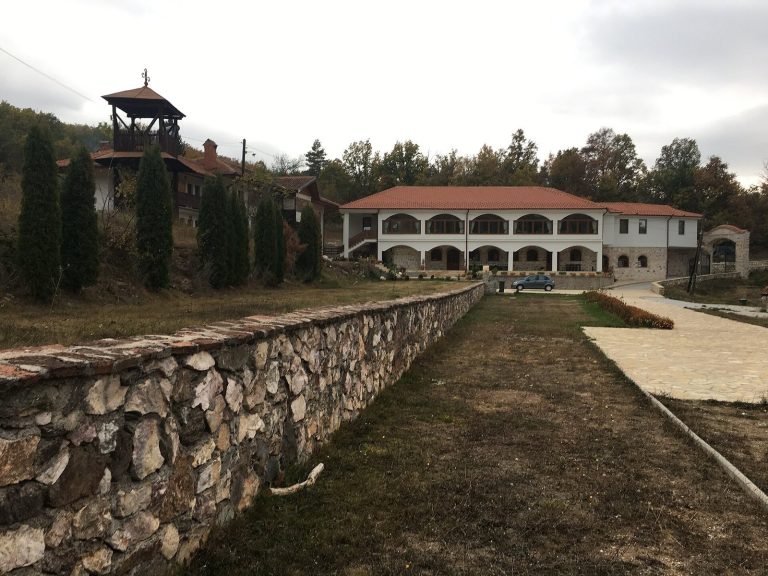
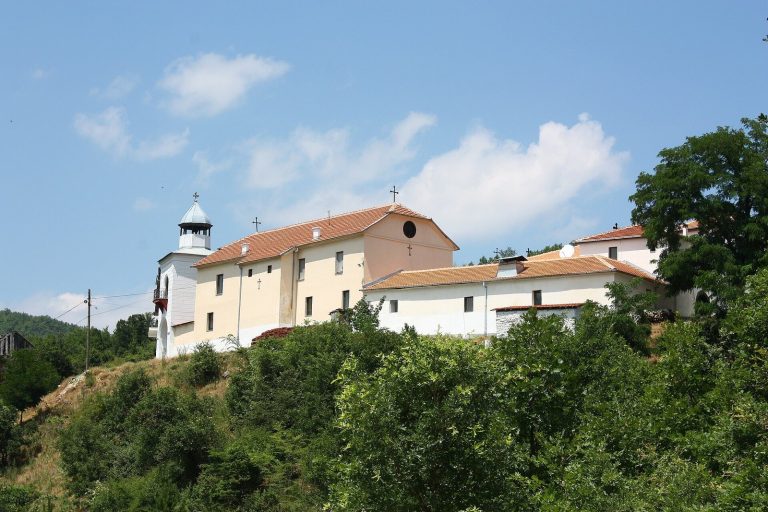
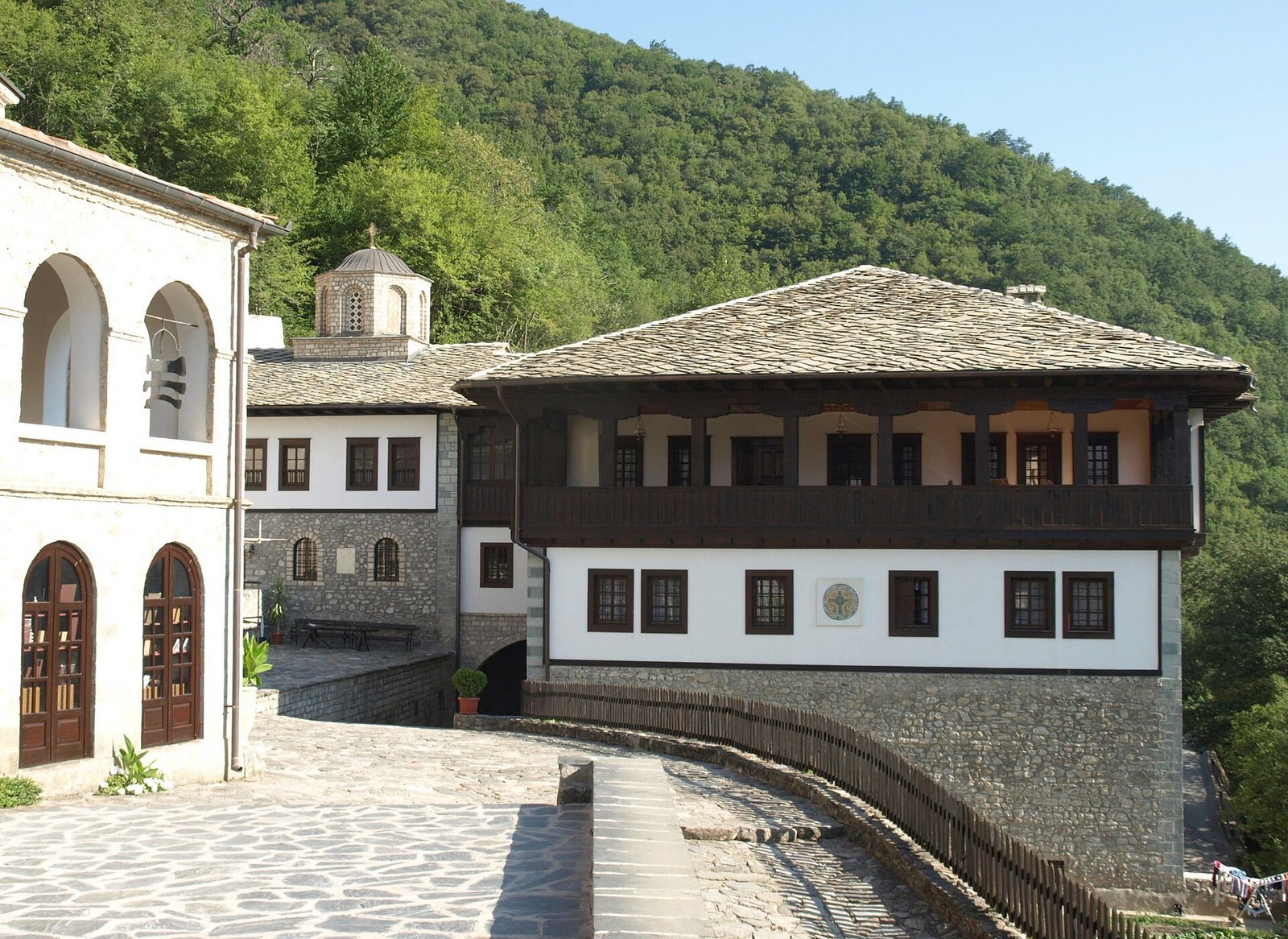
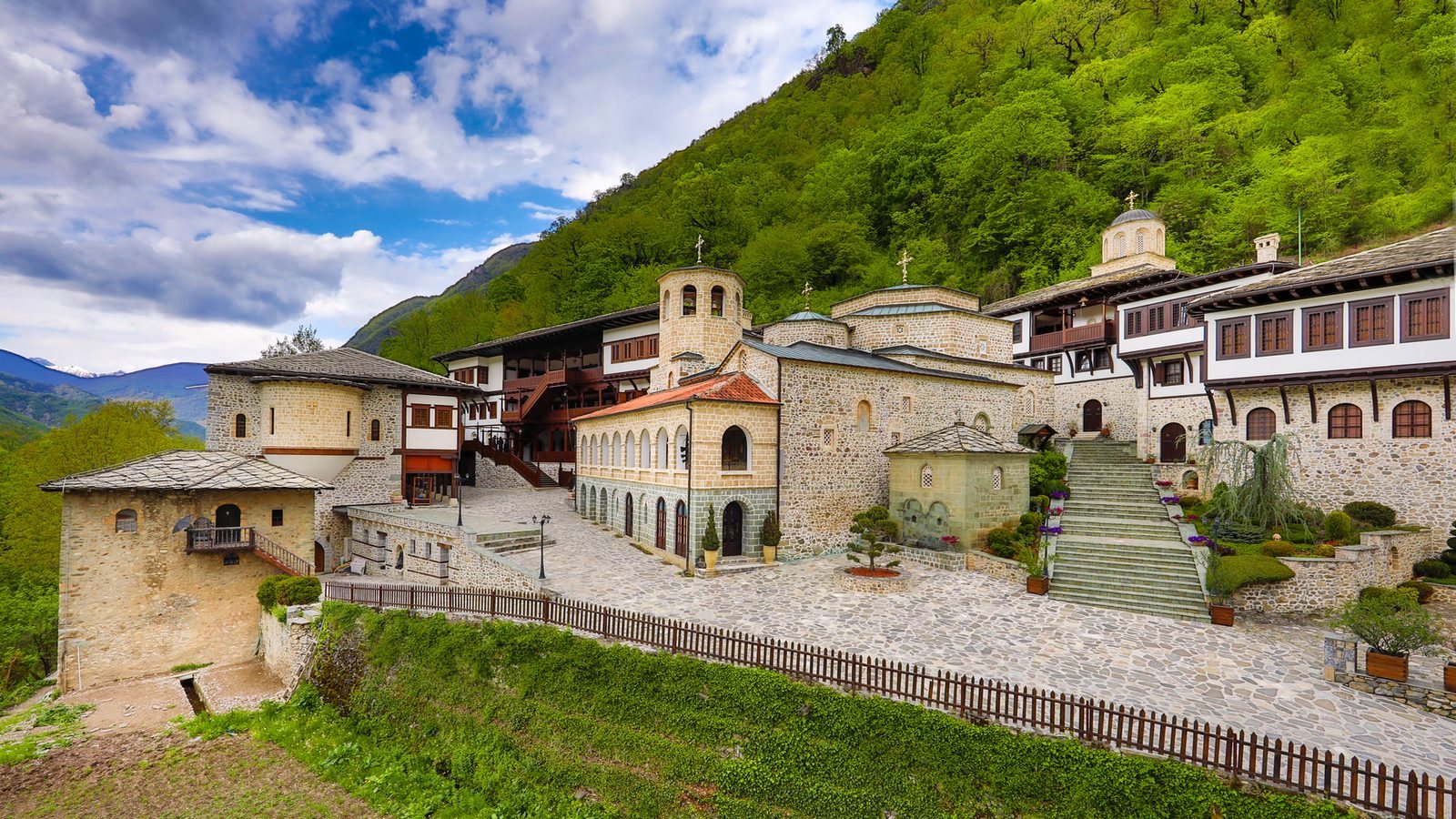
The monastery stands on a mountainside beside the Radika River, among the villages of Rostuše, Velebrdo, Bituše, and Trebište. Its name derives from bigor, the stone used to build the church and found in the surrounding area. The complex includes the Church of St John the Baptist, an ossuary beside it, and a defensive tower that also served as a bell tower, along with monastic and guest buildings. Chapels are dedicated to the Annunciation, St Nicholas, and St George of Kratovo; a small monastic community dedicated to St Seraphim of Sarov is located in the orchard.
The carved iconostasis
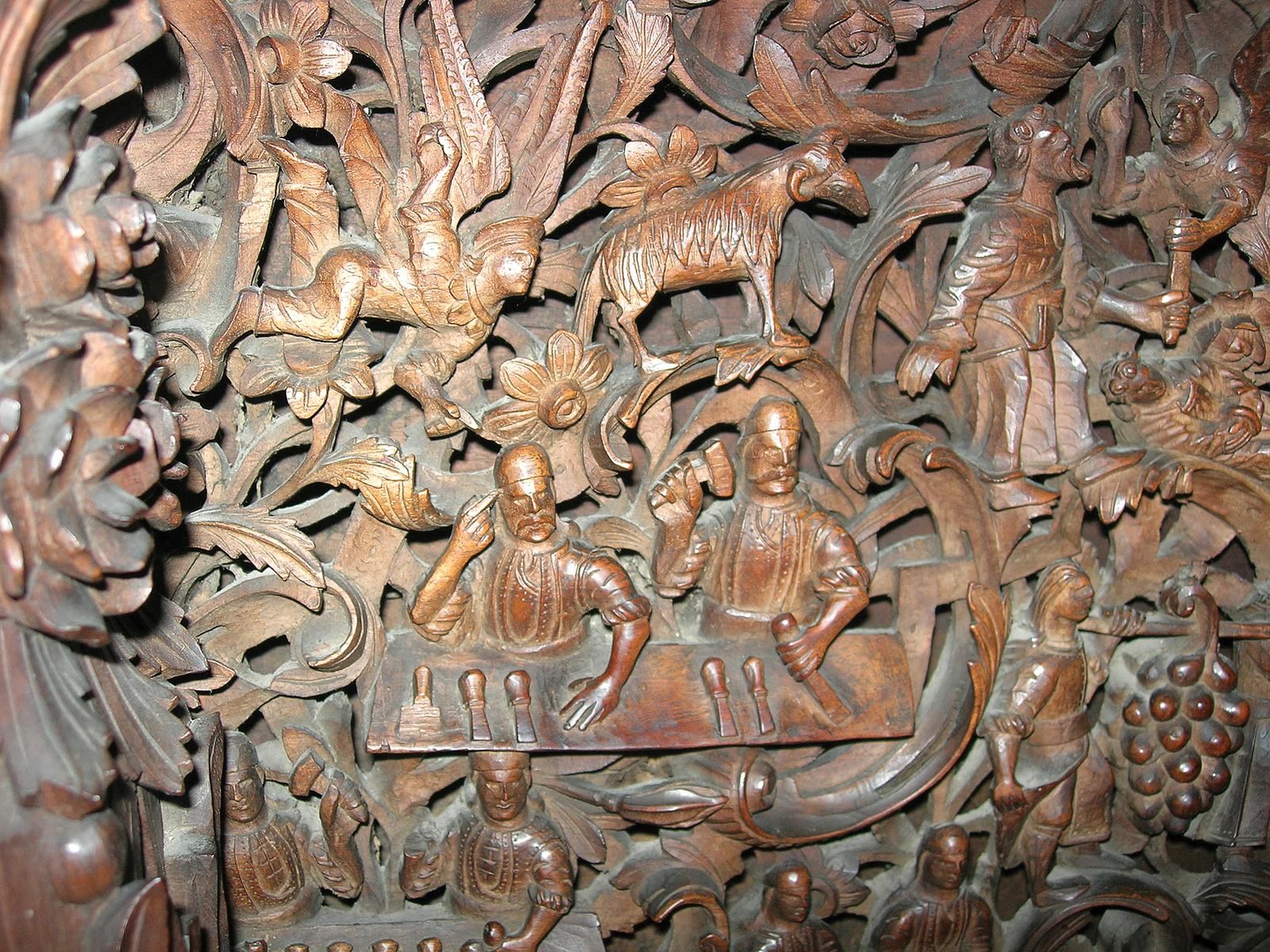
The church’s large wooden iconostasis is the screen that separates the sanctuary from the main body of the church. Its three tiers of icons differ from the two-tier arrangement found on many such screens. Central double doors, known as the Royal Doors, lead into the sanctuary, with entrances on the north and south sides. The carved and painted doors show the Annunciation, while nearby carvings portray Christ healing a blind man and driving merchants from the Temple.
Rectangular carved panels below the principal icons contain more than 500 human figures and about 200 animals. Their scenes include Abraham’s sacrifice, the Fall, Adam and Eve’s expulsion from Paradise, and Cain’s murder. Fourteen panels depict episodes from the Virgin Mary’s life, including the Annunciation, the Adoration of the Magi, and the Flight into Egypt.
Further carvings portray the Last Supper, Judas’s betrayal, Christ praying in the Garden of Gethsemane, the road to Golgotha, Doubting Thomas, and Christ before Pilate. Scenes from John the Baptist’s life include his birth, Herod’s birthday, Salome’s dance, and the beheading. Below the icon of the Council of the Apostles, another carving shows Christ among the apostles, with angels holding a model church and Peter and Paul in the foreground. The upper section is crowned by a large Crucifixion cross; dragons at its base represent evil overcome by Christ. Human and animal figures are interwoven with floral designs, in a composition resembling nineteenth-century icon screens from Mount Athos.
Frescoes and icons
Vestibule frescoes
Frescoes in the church vestibule were noted there in 1871. They portray Clement of Ohrid, Naum, John Vladimir, Cyril and Methodius, and medieval rulers. Bulgarian journalist Svetoslav Terziev later alleged that during Serbian rule from 1913 to 1941 the inscriptions identifying Tsar Boris and Tsar Ivan Shishman were changed to name the Serbian rulers Stefan Dečanski and Lazar Hrebeljanović instead.
Earlier church and icon gallery
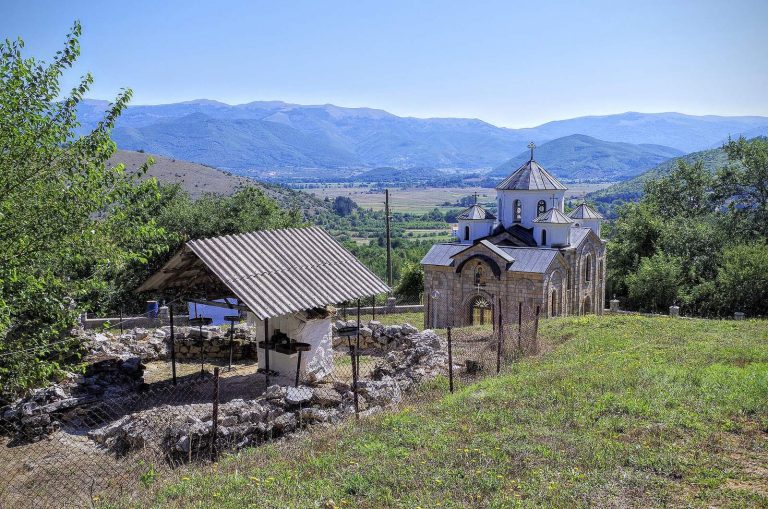
Remains of an earlier church survive within the complex, together with large icons associated with it. The oldest of these icons date to the sixteenth century and have been undergoing restoration at the Republic Institute for Protection of Cultural Monuments. An icon gallery displays about 70 works dated to the twelfth, thirteenth, and nineteenth centuries. It also includes icons from the first half of the seventeenth century arranged in a sequence of scenes from Christ’s life, from the Annunciation and Nativity through the Baptism, Transfiguration, entry into Jerusalem, Crucifixion, Resurrection, and Ascension, followed by the Dormition of the Virgin.
The miraculous icon of John the Baptist
Monastery tradition says that the monk John found the icon of John the Baptist near the springs of the Radika before the monastery was built. It is said to have disappeared when the monastery burned in the sixteenth century, then returned unharmed after remaining unprotected for 35 years. An inscription dates its silver covering to 1885. The saint appears with three hands, the additional hand understood as a blessing; believers associate the icon with help for parents unable to have children.
Copy of “It Is Truly Meet”
A copy of the Athonite icon “It Is Truly Meet” was blessed before the original on Mount Athos and brought to the monastery in 2009. It is displayed on the north side of the church’s raised platform in front of the iconostasis.
Relics and devotional objects
The reliquary
Abbot Arseniy commissioned a large reliquary made in the 1830s through the combined work of a painter, a woodcarver, and a silversmith. A hammered-silver medallion on its lid shows the Crucifixion with the Virgin Mary and John. Paintings inside by Mihail and Danail portray saints whose relics are held in the container, which also bears a silver engraving of them. Relics brought from Constantinople by Hadži Nake of Belčista in 1820 were placed inside; a fragment of the True Cross was added in 2000. Other relics at the altar are associated with saints including Clement of Ohrid, Seraphim of Sarov, Barbara, Nicholas of Myra, and Nektarios of Aegina.
Memorial books
A three-panel memorial book dated by its inscription to 1834 stood in the sanctuary, where the Eucharistic gifts were prepared. The inscription names the monk John as its first founder and patron. The monastery’s memorial books also included a fifteenth-century volume listing Serbian rulers and church leaders as well as Christian settlements in the Debar region.
Copper engraving
A copper engraving commissioned by Abbot Arseniy depicts John the Baptist in the form of the monastery’s miraculous icon. The Athonite monk Theophil made it in 1832, using accompanying text composed on 30 January 1831. The engraving was found in 1973 in the Church of the Virgin Mary at Rusjaci.
Furnishings and bells
The church contains a bishop’s throne and an abbot’s chair made by the iconostasis woodcarvers. Three bells stood in the tower in 1924. One had been donated by Prince Miloš Obrenović in 1837, and two more in 1850, one by Prince Aleksandar Karađorđević and another by Princes Petar and Andreja Karađorđević. King Aleksandar Karađorđević donated a bell in 1925. White double-headed eagles appear on the church floor, and older brass candlesticks carry engraved eagles of the same kind.