Rogoi: An Ancient Acropolis and Medieval Castle in Greece
Site at a Glance
- Popularity
- Medium
- Country
- Greece
- Primary era
- Medieval
- Eras represented
- Classical, Medieval
- Civilizations
- Ancient Greek, Byzantine
- Site type
- Military
- Remains
- Castle
On this page9 sections
History
Rogoi is a medieval castle in Greece, built on the hilltop acropolis of ancient Bouchetion. Founded as a colony in the seventh century BC, Bouchetion served as a coastal settlement and port before the site became a contested stronghold in medieval Epirus.
Bouchetion in antiquity
Bouchetion was an Elean colony, meaning it was founded by people from Elis, a region of ancient Greece. It served as the port for the inland settlements of Elatria and Baties. Nineteenth-century scholars identified the site as ancient Charadrus; N. G. L. Hammond later identified it as Bouchetion.
In the fourth century BC, Alexander I, king of the Molossians, an ancient people of Epirus, incorporated Bouchetion into the unified kingdom of Epirus. Rome sacked the settlement in 167 BC during the Third Macedonian War, a conflict between Rome and the Macedonian kingdom. Occupation continued afterward, but Bouchetion was eventually abandoned following the founding of Nicopolis in 28 BC.
Byzantine resettlement and the bishopric
Rogoi was probably resettled in the ninth century, during the Byzantine Empire’s recovery of Epirus after Slavic incursions in the late sixth and early seventh centuries. The Byzantine Empire was the Greek-speaking eastern continuation of the Roman Empire. The name Rogoi may be Slavic, but it more likely comes from a Sicilian Greek word for granaries. This has prompted the possibility that settlers from Sicily established the new community.
By the reign of Emperor Leo VI (886-912), Rogoi was the seat of a bishopric subordinate to the church authority at Naupaktos. The title of Bishop of Rogoi was revived in 2019 for Filotheos Theodoropoulos, when he was elected an assistant bishop of the Archbishopric of Athens.
Medieval rule and conflict
From around 1000 to 1500, inhabitants diverted the Louros River to drain marshes and expand farmland. The altered course may also have strengthened the castle’s defenses. Rogoi passed between Byzantine rule and the Despotate of Epirus, a medieval Greek state. In 1303/4, Philip I of Taranto attacked after Anna Palaiologina Kantakouzene, regent of Epirus, refused to accept Angevin suzerainty, a relationship in which a ruler recognizes a superior lord. The attack failed.
After Epirus was annexed by the Byzantine Empire in 1337, rebels led by Alexios Kabasilas seized Rogoi, Arta, and the fortress of Riniasa or Thomokastron in 1338/9. Emperor Andronikos III Palaiologos and John Kantakouzenos, the Grand Domestic, a senior military commander, blockaded Rogoi. Kantakouzenos eventually persuaded the settlement to surrender.
During the Byzantine civil war of 1341-1347, Epirus came under Serbian control. From 1345, Rogoi was under Serbian rule; in 1361, Emperor Simeon Urosh confirmed John Tzaphas Orsini as lord of Rogoi and other Epirote lands, although the proclamation probably had little practical effect. By 1367, the Albanian ruler Pjetër Losha controlled Rogoi and Arta. After his death in 1374, Gjin Bua Shpata took over his lands.
In 1416, Carlo I Tocco and his brother Leonardo II took Rogoi and Arta, restoring the Despotate of Epirus to its traditional boundaries. The Tocco family held Rogoi until the settlement was abandoned after the Ottoman conquest of the region in 1449.
The Italian humanist and antiquarian Ciriaco de’ Pizzicolli visited the castle in 1436 and 1448. He recorded that a church there held relics of Saint Luke, traditionally identified as the author of the Gospel of Luke. Contemporary Serbian texts said the relics had been brought from Constantinople after the Fourth Crusade captured the city in 1204.
Remains
The castle occupies a hill about 29 metres high, north of the Louros River, which curves around its eastern, southern, and western base. Rogoi lies about 4.5 kilometres southwest of Nea Kerasounta. The hill appears to have been an island in antiquity. In the Middle Ages, the Ambracian Gulf reached farther northwest than it does today, and Rogoi remained a coastal settlement.
Bouchetion’s acropolis
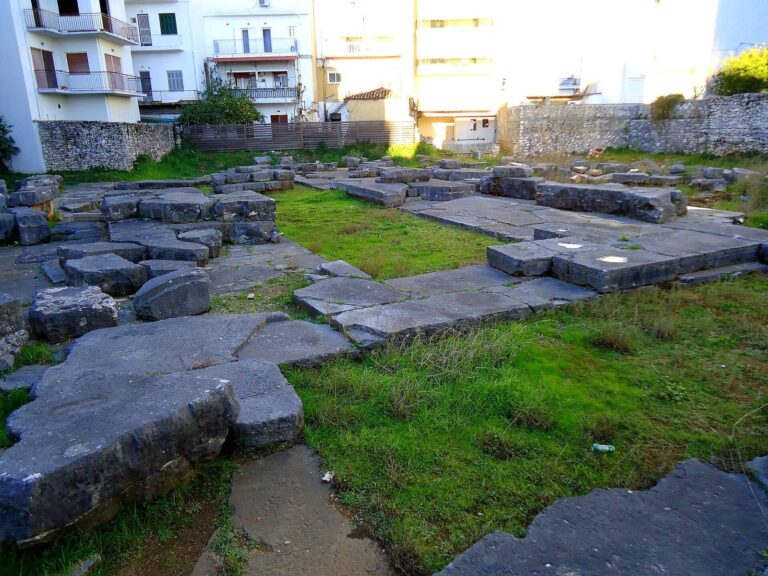
Bouchetion appears to have remained unfortified during its first two centuries. Its earliest known defenses formed a 450-metre circuit around the level summit. A later, irregular wall enclosed the northern slope, lengthening the perimeter to 730 metres and expanding the enclosed area from about 9,000 to 18,000 square metres. A further extension took in the settlement’s northeastern part. The final ancient circuit measured about 1,000 metres and enclosed approximately 37,000 square metres.
The medieval castle
Walls and fortified wards
The medieval castle was built over the first two phases of the ancient acropolis and incorporated ancient foundations. Its outer wall largely follows the lines of earlier defenses, while differences in masonry distinguish the ancient and medieval work. The date of the Byzantine refortification is uncertain; it may have taken place as early as the ninth-century resettlement or as late as the thirteenth or fourteenth century. Transverse walls reinforced with towers divide the enclosure into three wards. The citadel, or fortified core, has a gate in its wall. Construction used hewn stone, including ashlar, carefully cut blocks. The castle is now largely ruined and overgrown with vegetation. Wall maintenance was carried out in 1978-1980.
Monastery and Church of the Assumption
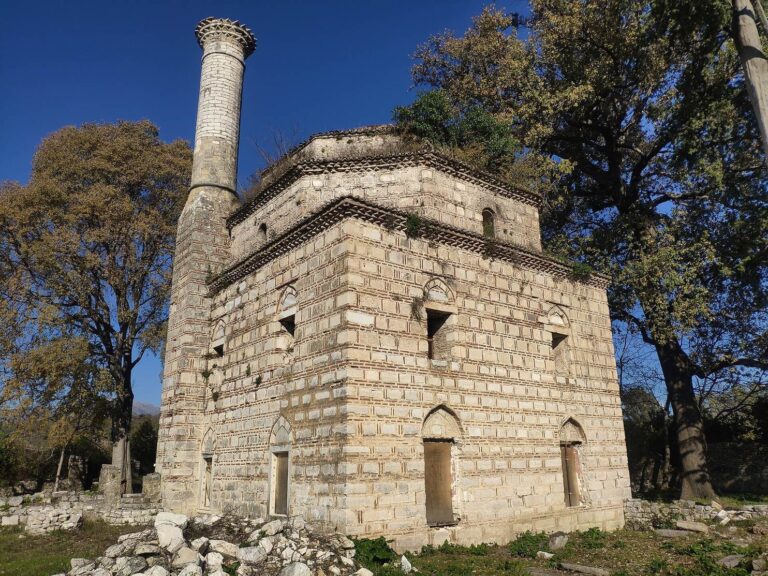
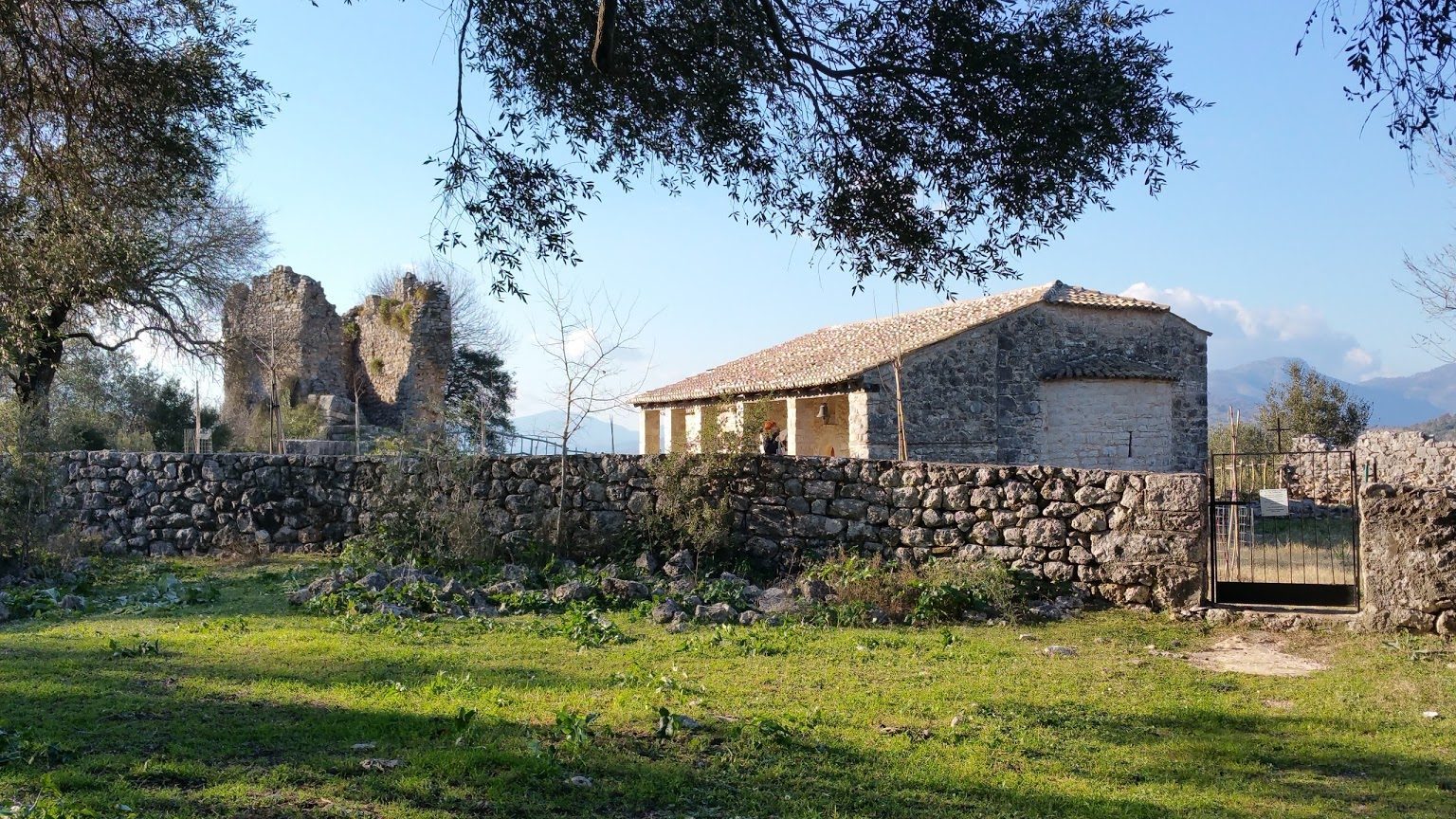
The outer ward contained a monastery. Its only surviving building is the fifteenth-century Church of the Assumption, named for the Christian belief that Mary was taken bodily into heaven.