Rock Eagle Effigy Mound: A Woodland-Period Bird-Shaped Earthwork
Site at a Glance
- Rating
- 4.7
- Popularity
- Low
- Country
- United States
- Primary era
- Classical
- Eras represented
- Iron Age, Classical, Medieval, Modern
- Civilizations
- Unclassified
- Site type
- Religious
- Remains
- Sanctuary
On this page7 sections
History
Rock Eagle Effigy Mound is a large bird-shaped earthwork near Eatonton in Georgia, United States, built by Woodland-period Native Americans between about 1000 BC and AD 1000. Earlier interpretations gave it an age of as much as 5,000 years, but current archaeological understanding places its construction after the Archaic period and before the later Mississippian, Creek, and Cherokee cultures of the region.
Woodland-period construction and purpose
The builders may have belonged to the Adena or Hopewell traditions, which were associated with ceremonial earthworks, burial practices, and long-distance exchange. A distinct local community is considered more likely, however. The earthwork evidently had ceremonial importance, but its exact purpose remains uncertain. Interpretations include a central burial place and a monument intended to communicate with deities. Evidence of cremated human burials also supports a possible funerary role.
Rock Eagle and the less well-preserved Rock Hawk, about 21 kilometres southeast in Putnam County, are the only two known bird-shaped effigy mounds east of the Mississippi River. Rock Eagle therefore belongs to a rare group of monumental earthworks whose original meanings cannot be securely reconstructed from the surviving evidence.
Investigation and preservation
Early settlers dug into the mound while searching for supposed buried treasure. Archaeological study began by 1877, when Charles T. Hyatt produced early measurements and Vincenzo Petrullo published measurements of the image. Investigations later established that the effigy had been built over a natural rock outcrop and recovered few objects beyond materials used in its construction.
During the 1930s, University of Georgia archaeologist A. R. Kelly excavated much of the site. Research in the 1950s identified a quartz tool and additional evidence of cremated human burials. Excavations also recovered a projectile point, possibly unrelated to the effigy, and a single set of human and animal bones. These discoveries have provided evidence about construction and funerary activity, but they have not resolved the monument’s intended purpose.
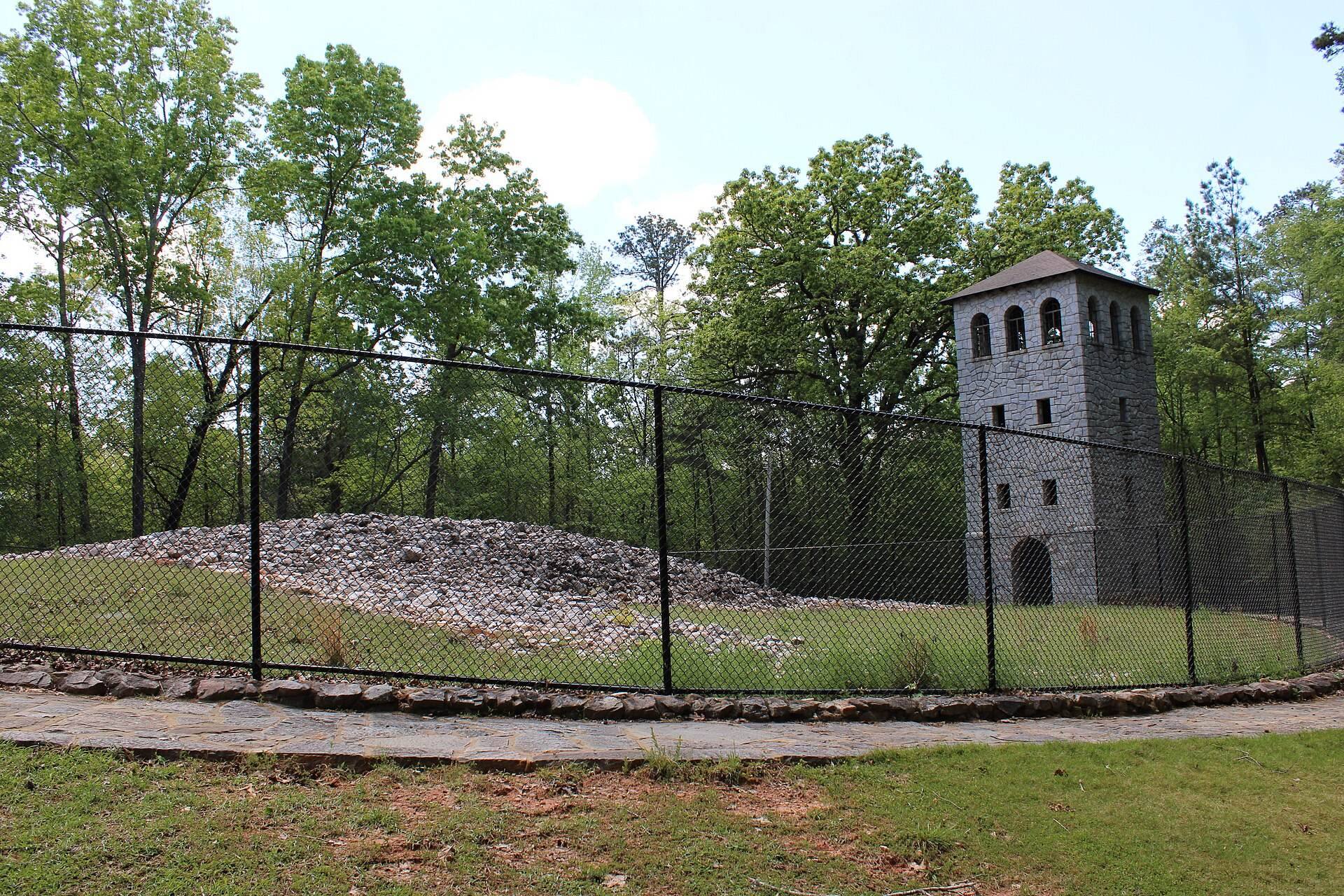
The property was sold to the United States government by Florence Scott. During the 1930s, the Works Progress Administration, a federal work-relief agency created during the Great Depression, worked with the University of Georgia to construct a granite observation tower at the foot of the effigy. A major renovation later removed vegetation from the mound and replaced stones that had been scattered nearby. The University of Georgia administers the site and uses adjoining land for the Rock Eagle 4-H Center, including environmental education and residential facilities.
In 1954, Kelly reported indications that Rock Eagle and Rock Hawk may once have been enclosed by walls made from materials similar to those used in the effigies. The possibility has been compared with wall-building traditions associated with Stone Mountain and Fort Mountain, but the interpretation concerns a reported former arrangement rather than a fully documented surviving enclosure. Rock Eagle was added to the National Register of Historic Places, the United States federal inventory of historically and culturally significant properties, in 1987. A bronze marker placed near the bird’s head in 1940 records the earthwork’s prehistoric ceremonial character and dimensions.
Remains
Effigy and associated features
Quartzite bird mound
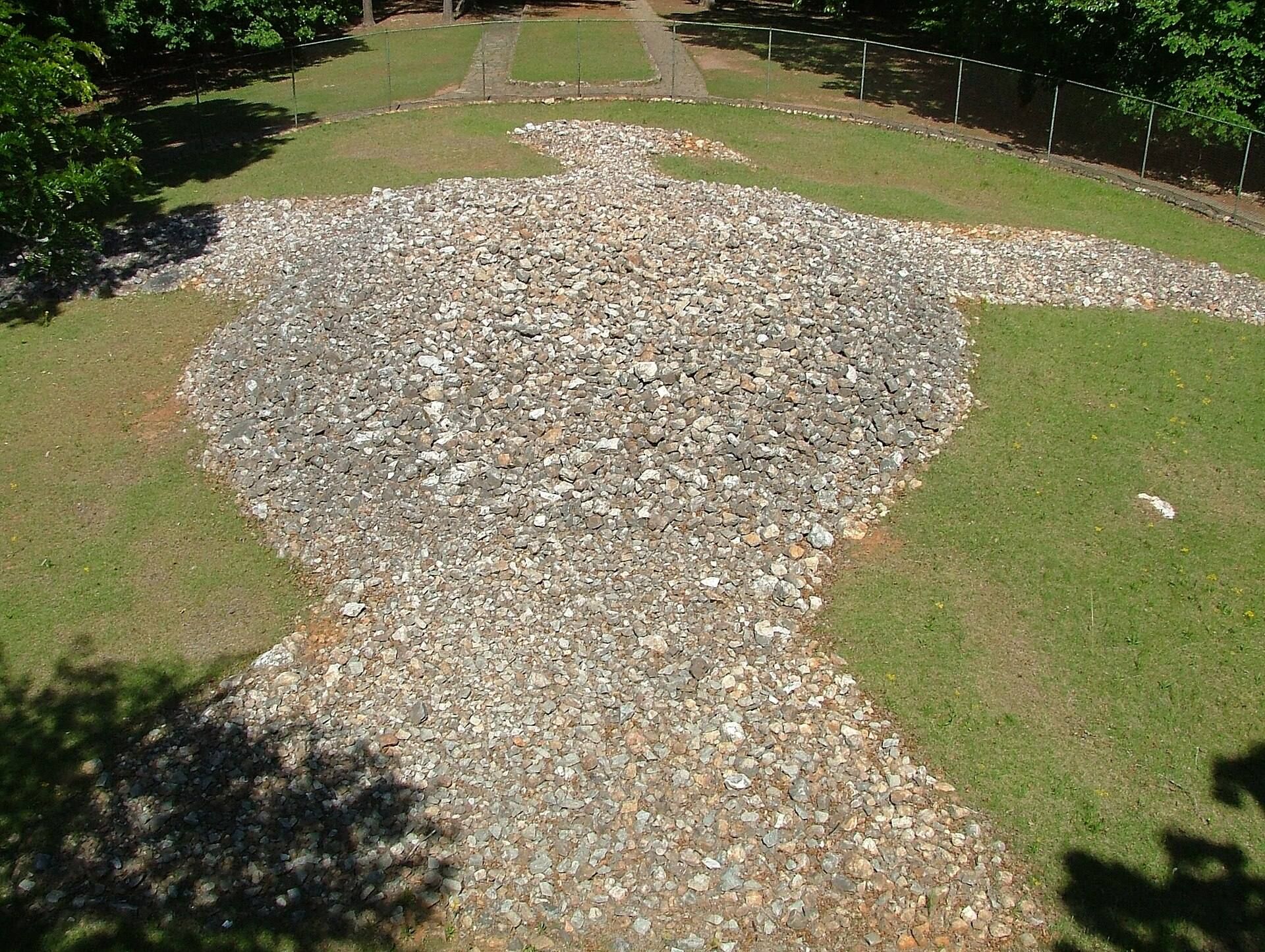
The principal feature is a stone effigy mound shaped as a bird with a prominent beak and a fan-shaped tail. The name “eagle” is conventional, since the intended species is unknown and some scholars have considered the figure closer to a buzzard or vulture. The image measures about 31 metres from head to tail and 37 metres across the wing tips. Its head faces south by southeast, with the beak pointing almost due south. The chest rises approximately 2.5 to 3 metres above the surrounding ground, while the wings, head, and tail are lower.
Thousands of small and medium-sized pieces of quartzite form the mound over a natural rock outcrop. Nonlocal clay within the earthwork indicates that some construction material was transported from elsewhere. The form appears to have developed from a large, dome-shaped central mound. Evidence of human cremation and a projectile point was found within or on the mound, while a quartz tool came from the 1950s research. These remains help establish construction and funerary activity without providing a definite explanation of the monument’s purpose.
Observation tower and site features
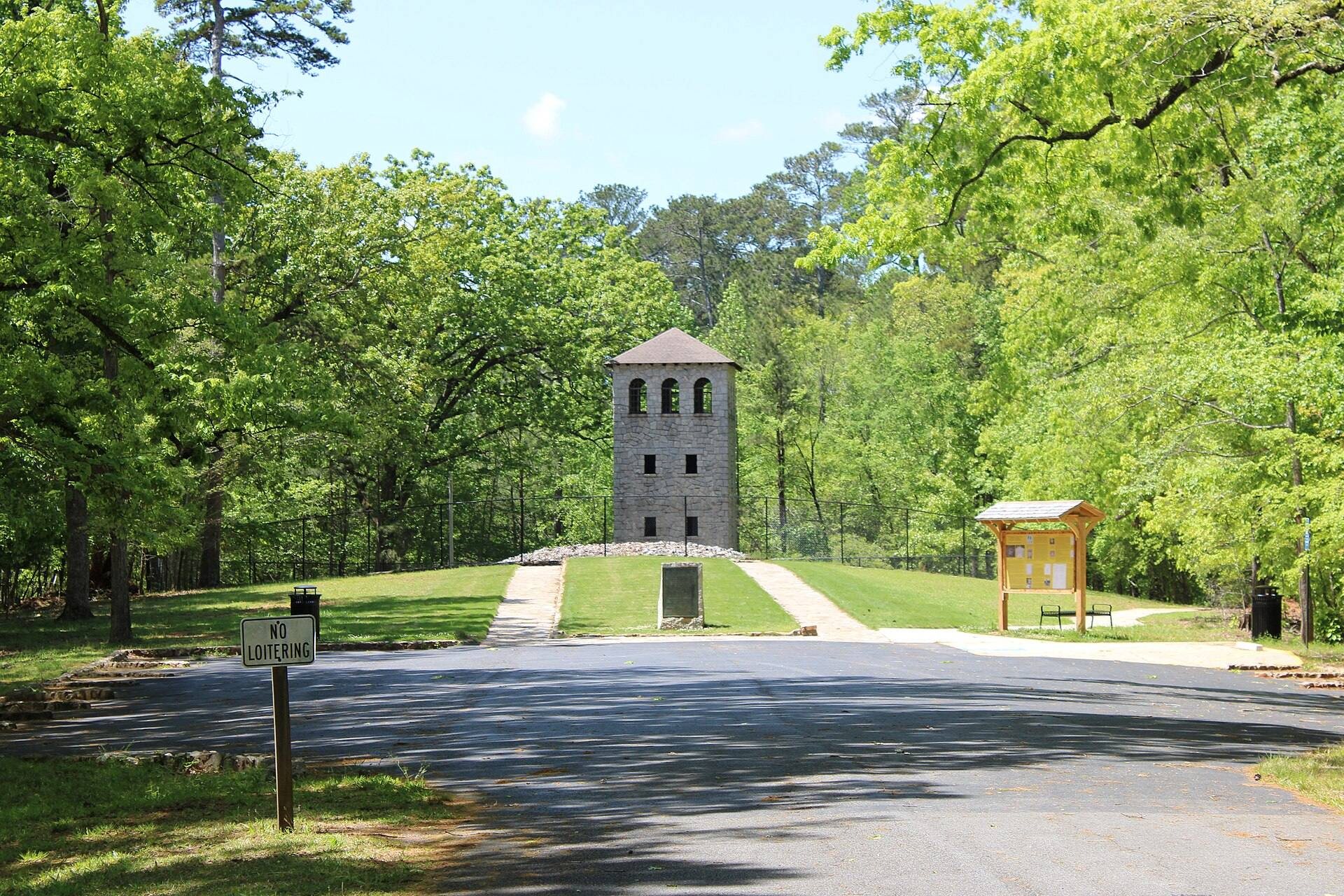
A granite observation tower stands at the foot of the effigy, providing an elevated view of the complete bird-shaped layout. The mound is enclosed by a tall fence, and a paved path circles the earthwork. Interpretive panels explain the site. The possible former enclosure or wall, made from material similar to the effigy’s quartzite, remains an interpretation based on reported indications.
The bronze marker installed near the head in 1940 identifies the earthwork as a prehistoric ceremonial mound made from white quartz rocks. It also records the mound’s dimensions and the presence of two such bird-shaped configurations east of the Mississippi River.