Rocca di Monte Poggiolo: A Renaissance Frontier Fortress in Italy


Site at a Glance
- Rating
- 4.2
- Popularity
- Very Low
- Country
- Italy
- Primary era
- Medieval
- Eras represented
- Medieval
- Civilizations
- Republic of Florence
- Site type
- Military
- Remains
- Fort
On this page7 sections
History
Rocca di Monte Poggiolo, also known as Rocca di Castrocaro, is a fortress in Italy above Castrocaro Terme. It developed from a lookout tower probably established for Castrocaro and became a Renaissance transitional fortification adapted to the use of firearms. Its position made it a contested stronghold and later a Florentine outpost linked with efforts to secure access to the Adriatic.
Medieval Stronghold
The earliest historical evidence indirectly associated with the site dates to 906, when a reference mentions Count Berengario of the castle of Montepoggiolo. The elevated stronghold was contested by the lordships of Forlì, Faenza, and Castrocaro. In 1080 it passed from the Ordelaffi, the ruling family of Forlì for much of the medieval period, to the Orgogliosi. In 1124 it came to the Pagani counts, whose fief of Castrocaro had been granted by Pope Gregory VII.
Ghibelline troops, supporters of the imperial cause in the medieval conflict between the Holy Roman Emperor and the papacy, burned and destroyed the castle in 1179. The Pagani rebuilt it in 1185 after taking refuge there when Cardinal Ottaviano degli Ubaldini expelled them from Castrocaro. Faenza controlled the site from 1234 to 1317. It then passed to the Ordelaffi, who sold it to the city of Forlì, before later coming into the possession of the Malatesta, a powerful lordly family of Romagna and the Marche. Gianciotto Malatesta regarded Monte Poggiolo as one of his preferred refuges.
Florentine Frontier Fortress
In 1382 Francesco Paulucci di Calboli, then lord of Monte Poggiolo, ceded the fortress to Florence. In 1403 it was annexed, together with the Castle of Castrocaro, to the Florentine Republic, and Florentine possession was formally recognized in 1482.
The transformation of the earlier lookout tower into a full fortress was decided in 1471. The enlargement took place between 1482 and 1490 under Giuliano da Maiano, a fifteenth-century Italian architect and sculptor known for major Renaissance buildings and fortifications. The work formed part of the Medici policy of reinforcing frontier defenses. Alongside the Castle of Castrocaro, Monte Poggiolo served as an outpost within a wider system intended to control the surrounding territory and help secure routes toward the Adriatic.
Decline and Later History
The construction of the nearby fortress of Terra del Sole after 1564, equipped with artillery, reduced Monte Poggiolo’s military importance. The older fortress was retained as a lookout for the new fortress-city. Earthquakes that affected Romagna in 1661 damaged the building. Grand Duke Peter Leopold I of Tuscany disarmed Monte Poggiolo in 1772, at the same time as Terra del Sole.
The fortress was sold at auction in 1782 during the disposal of the Grand Duchy of Tuscany’s state properties and has remained privately owned since then. Several partial restoration interventions followed the earthquake damage, but the complex is now abandoned and in structural decay.
Remains
Plan and Construction
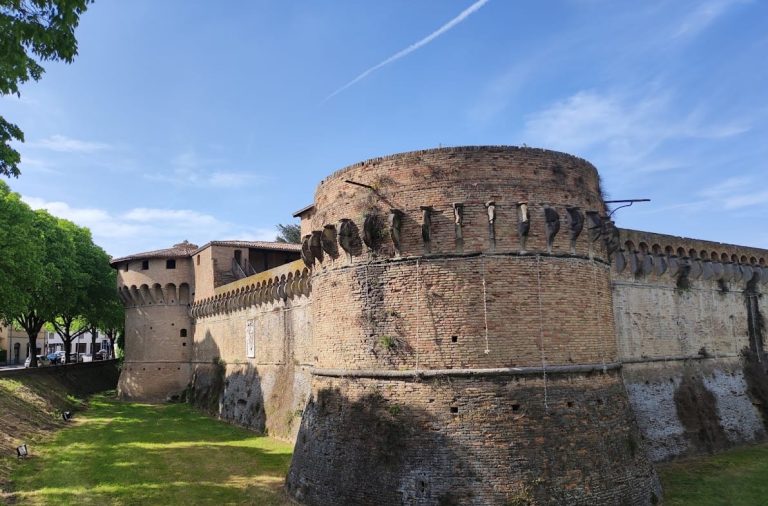
Rocca di Monte Poggiolo stands on Monte Poggiolo above Castrocaro Terme in Emilia-Romagna. Built entirely in brick, the fortress incorporates the earlier tenth-century lookout tower. Its plan forms an irregular quadrilateral, also described as rhomboidal, with sloping walls that narrow toward the top. Circular bastions occupy the four corners, giving the structure a compact form suited to a fixed military outpost held by a small garrison.
Towers and Defensive Features
One of the four cylindrical corner towers is notably large and serves as the keep, the principal fortified tower of the complex. The fortress combines medieval defensive elements with features developed for warfare after the introduction of firearms. Among its surviving elements is a wall-walk, a passage along the top of a defensive wall, supported by projecting corbels. The bastions, projecting fortifications that allowed defenders to observe and fire along adjoining walls, formed part of the system for controlling the surrounding territory.
The surviving structure is a deteriorated ruin. Partial restoration has not removed its abandoned condition, and the complex remains enclosed and inaccessible to visitors.
Nearby sites