Reuland Castle: A Medieval Hilltop Fortress in Belgium

Site at a Glance
- Rating
- 4.3
- Popularity
- Low
- Country
- Belgium
- Primary era
- Medieval
- External website
- Open
- Eras represented
- Medieval, Early Modern
- Civilizations
- Holy Roman Empire
- Site type
- Military
- Remains
- Castle
On this page10 sections
History
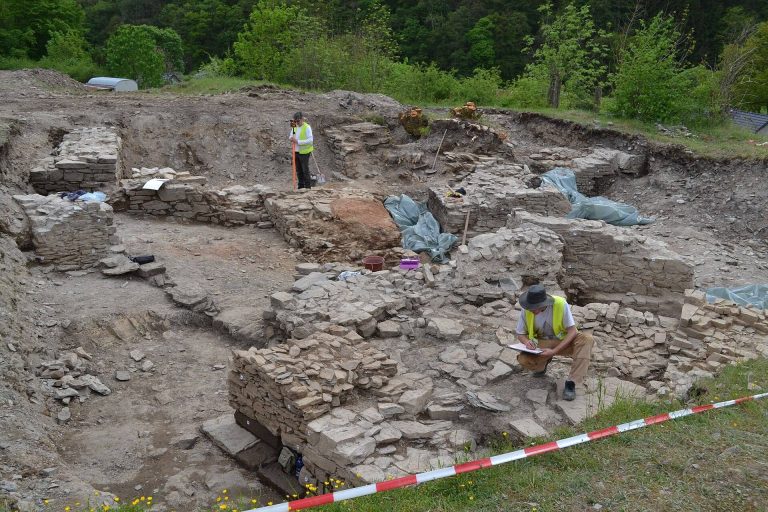
Reuland Castle is a medieval hilltop castle ruin in Burg-Reuland, Belgium, whose earliest surviving foundations date from the twelfth century. The Romans had earlier established a fortified fort at the location, and archaeological investigations indicate that the site was already in use by the tenth century. The castle became the residence of the noble family von Rulant and later developed through successive changes of lordship, fortification, and domestic use.
Early medieval origins
The site was first mentioned in 983. By the twelfth century, it served as the seat of the von Rulant family, whose foundations form the oldest discovered medieval remains. The lords of Reuland appear in a record from 1148, which names a son of Walter von Reuland as “Filio di Walteri de Rulant.” Theoderich von Reulant joined the crusade of Frederick I, the twelfth-century Holy Roman Emperor commonly known as Frederick Barbarossa, and died before Acre in 1189.
The von Reuland line ended in 1313. The castle then passed to the lords of Blankenheim, who sold it in 1322 to John the Blind, Count of Luxembourg and King of Bohemia. In 1384, Wenceslaus of Luxembourg granted Reuland as a fief, a lord’s grant of land or property in return for allegiance or service, to Edmund von Engelsdorf. The grant also included the hereditary office of chamberlain of the House of Luxembourg. The von Engelsdorf family retained that office until the abolition of the Ancien Régime, the political and social order that existed before the revolutionary changes of the late eighteenth century.
Palant and Hoemen inheritance
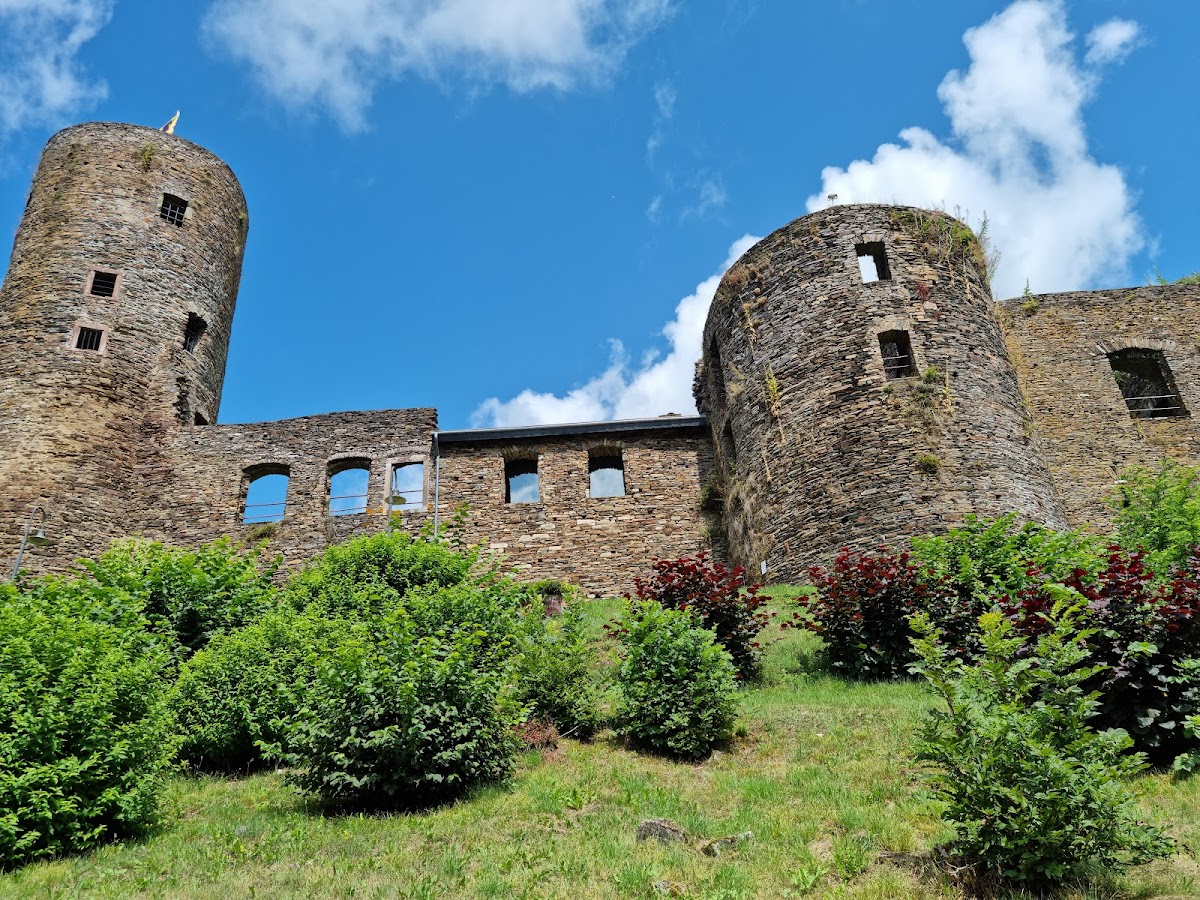
Around 1414, Reuland entered the possession of the von Palant family through the marriage of Werner II von Palant, Lord of Breitenbend, to Averadis von Engelsdorf. From the middle of the fifteenth century, the Palants strengthened the castle with semicircular gun towers, artillery structures that allowed firearms to be used against attackers approaching the walls.
Inheritance divided the lordship among several families. Through Margaretha von Palant’s marriage to Johann von Hoemen, Burgrave of Odenkirchen, part of the lordship and castle passed to the von Hoemen family in 1468. It later came to Wilhelm IV von Vlodrop. In 1560 and 1561, Wilhelm’s son Balthasar von Vlodrop transferred his share to his daughter Odilia and her husband, Carsilius V von Palant, Lord of Ruyff and Breitenbend.
Sixteenth-century settlements
The succession remained contested. After Gerhard von Palant died childless around 1489, his widow Johanna von Bodberg and his sister-in-law Margarete von Palant disputed the inheritance. In 1492, Maximilian I, acting as feudal lord of Luxembourg, settled the matter by enfeoffing, or formally granting, Reuland to Margrave Christoph I of Baden while allowing Johanna von Bodberg to retain the right of residence.
Further claims followed the marriage of Agnes von Palant, daughter of Thonis von Palant and niece of Gerhard, to the Hessian knight Ambrosius von Viermund in 1499. Their son, Johann I von Viermund, later became the focus of inheritance claims. In 1502, Christoph of Baden granted Reuland as a sub-fief, a further grant made by a previous holder, to Thonys, or Anton, von Palant. In 1526, Archduke Ferdinand mediated a settlement between Margrave Philipp of Baden and Johann I von Viermund’s guardians. Dietrich II von Millendonck and Drachenfels, another descendant of Johann von Hoemen, was co-lord of Reuland in 1549. His daughter Elisabeth married Balthasar von Pallandt, the son of Carsilius V von Palant, in 1589, bringing the Palant shares at Reuland together. Their tomb monument stands in Saint Stephen’s parish church at Reuland.
Residence, destruction, and preservation
From the second half of the sixteenth century, the fortified complex was reshaped as a lordly residence. Ottilia von Pallandt-Reuland, the last descendant, died in 1666, and the last heir died in 1736. A steward continued to live in the castle until French troops burned it in 1794.
In 1830, the complex was sold for demolition and building materials. The Mayeres family of Reuland later acquired it and donated it to the municipality. The Prussian Rhine Province undertook the first restoration work in 1901 and 1902. The Belgian state acquired the castle grounds in 1923 for an anti-aircraft position. Heritage protection followed in 1980, the Belgian state acquired the castle in 1986, and gradual restoration began in 1988.
Remains
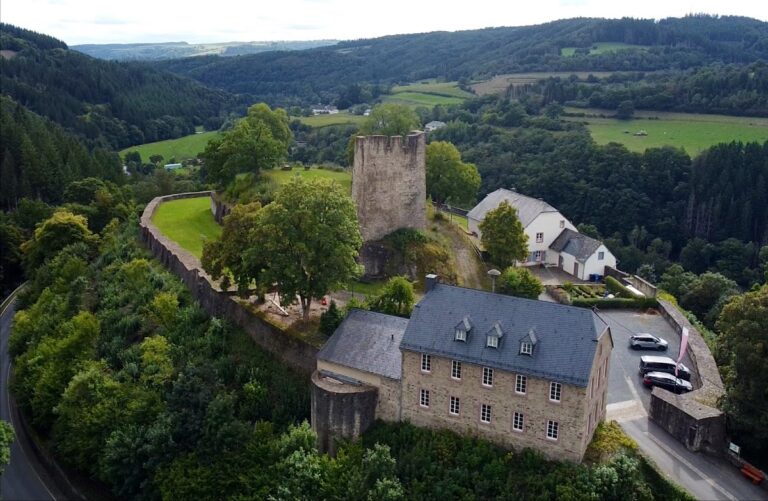
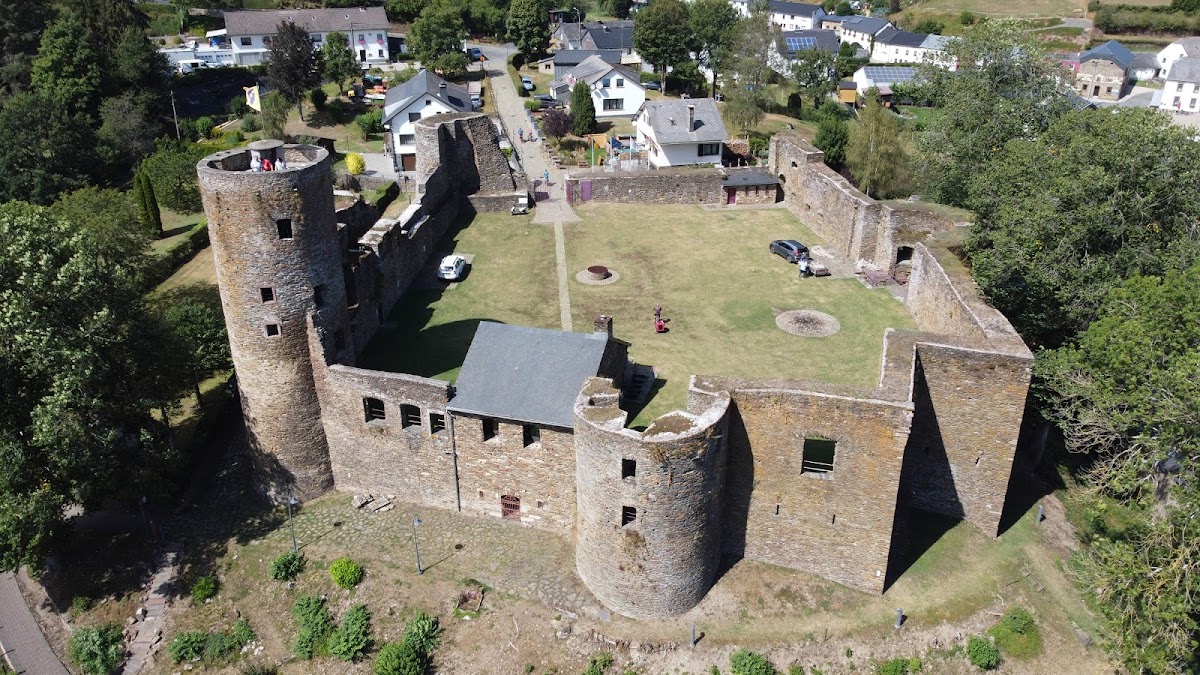
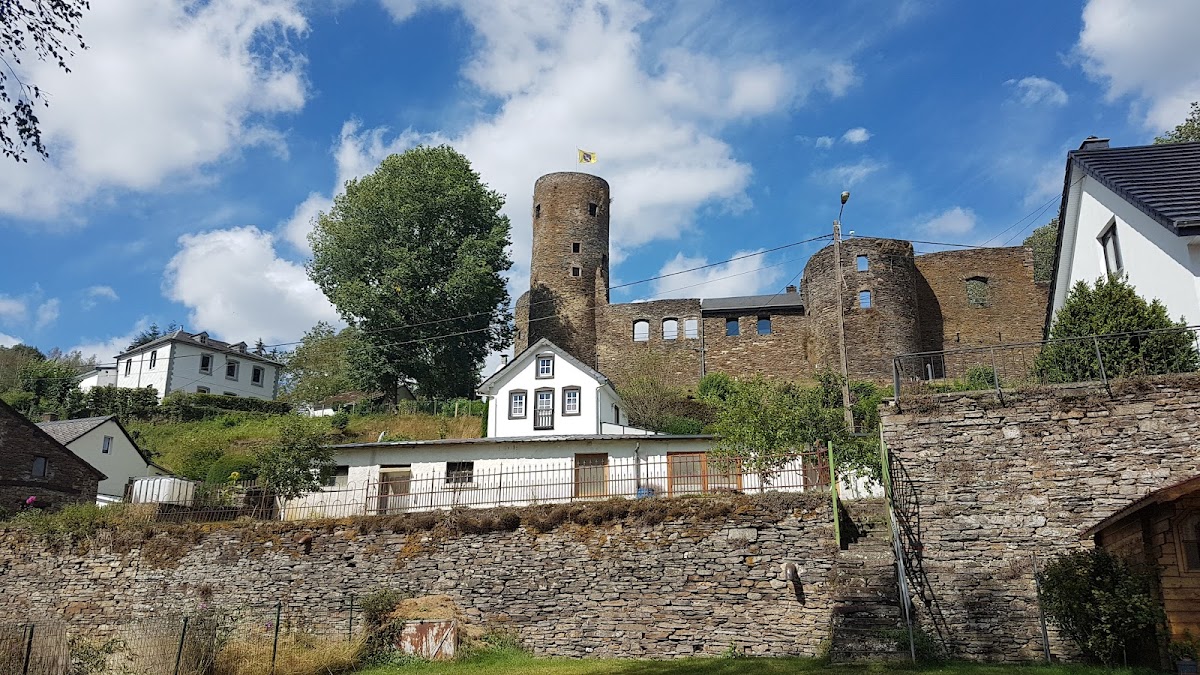
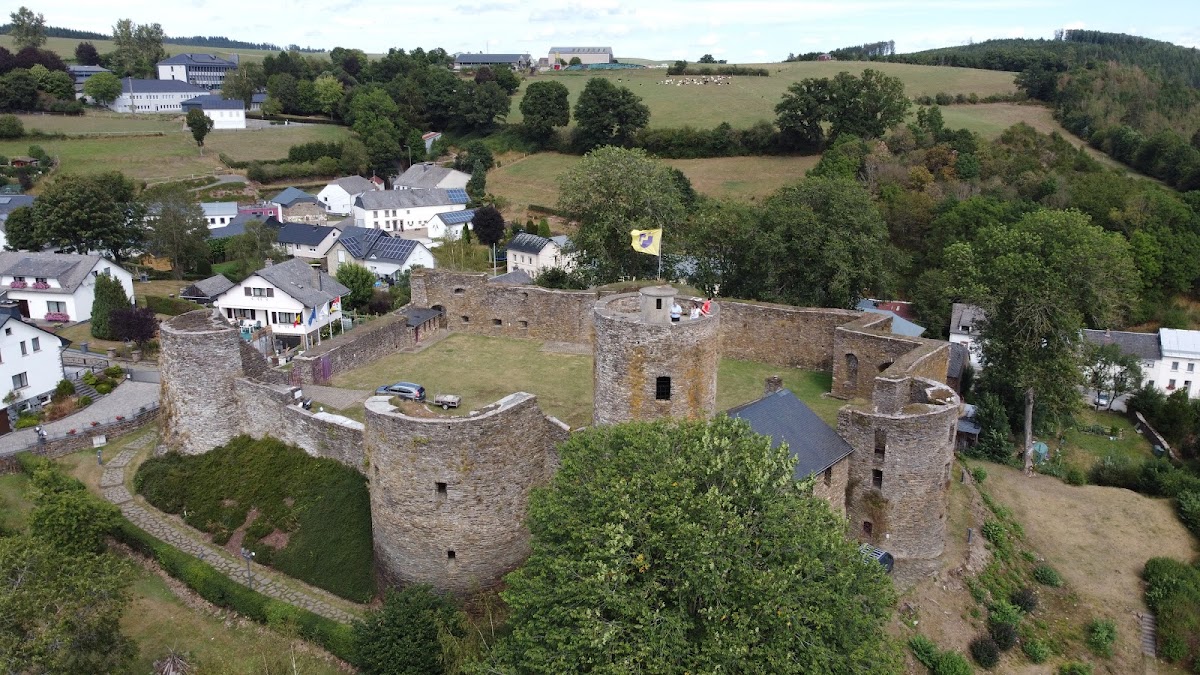
Reuland Castle occupies a low rocky plateau above Burg-Reuland. Slopes descend to the east, south, and west, and the ruin overlooks the settlement, including Saint Stephen’s Church about 100 metres to the southeast. The former enclosure covered approximately 60 by 55 metres and included an inner courtyard. Its walls were built from slate-bearing sandstone and reinforced by five towers.
Enclosure and early defenses
A ring wall enclosed the central castle area in the thirteenth century, with a ditch forming part of the defenses. The ring wall was rebuilt in the fourteenth century, when the castle also received a keep. A tower already occupied the northwestern corner during the earlier defensive phase.
Southwestern keep
A substantial section of the three-storey keep survives in the southwestern corner. Its walls are about 1.25 metres thick, and part of the structure was rebuilt in 1901. The walls probably collapsed for the first time as early as 1616. Remnants of fireplaces remain inside the round tower, preserving evidence of the building’s domestic as well as defensive use.
Southeastern bastion
The southeastern corner contains a bastion, a projecting fortified platform designed to strengthen defensive fire from a wall or corner. A heraldic stone in its upper section carries the arms of the Pallandt-Myllendonck family and the date 1604, linking the surviving defense to the period when the complex was being transformed into a residence.
Chapel and castle house
A castle chapel was still recorded in 1795. The present pharmacy in Burg-Reuland occupies the former castle house, preserving part of the complex within the modern settlement.