Reinfeld Abbey: A Cistercian Monastery in Holstein
Site at a Glance
- Popularity
- Medium
- Country
- Germany
- Primary era
- Medieval
- Eras represented
- Medieval
- Civilizations
- Holy Roman Empire
- Site type
- Religious
- Remains
- Monastery
On this page16 sections
History
Reinfeld Abbey was a Cistercian monastery in Germany, founded in 1186 at the initiative of Adolf III, Count of Holstein, on land he provided. The Cistercians followed a strict interpretation of Benedictine religious life. Reinfeld belonged to the order’s Morimond lineage, and its mother abbey, the house that established the new community, was Loccum. The monastery lay within the former Diocese of Lübeck.
Foundation and growth
Emperor Frederick I Barbarossa issued the abbey’s foundation charter in 1189. In November 1190, its first abbot, Hartmannus, arrived from Loccum with twelve monks. They initially lived in wooden structures, before stone buildings were constructed beside the Heilsau. The abbey grew into one of northern Germany’s wealthiest and most prominent monasteries, with lands reaching the Baltic region and valuable interests in the Lüneburg saltworks.
The monks drained and cleared marshy ground in the Heilsau valley and dug fishponds. By 1196 they were raising carp, and the ponds eventually numbered as many as 60. Their fish production became associated with the name “Holstein carp,” although the ponds could not meet the community’s needs: the abbey also bought large quantities of sea fish from Lübeck. Reinfeld held patronage rights over the churches at Zarpen and Klein Wesenberg, whose construction was undertaken by its building workshop. Its abbot authenticated contracts for the bishops of Lübeck and the dukes of Holstein, maintained a residence and economic base in Lübeck, and was permitted a gate in the city walls. He also had responsibility for the Cistercian nuns at Harvestehude.
The abbey in the later Middle Ages
Around 1440, Abbot Friedrich wrote the three-volume Abbot’s Mirror, covering monastic rules, the abbey’s possessions, and its finances. At that time the community had 60 members, including 52 priests and eight lay brothers, who were members of the religious community but not ordained as priests. The monastery buildings were renewed and enlarged, and the abbey maintained a substantial library.
Conflict and loss of possessions
During the Count’s Feud, Lübeck commander Marx Meyer besieged and set fire to the abbey in 1534. The monastery was plundered, but it avoided major war damage. The wet ground nevertheless made repairs difficult. After the Reformation was introduced in Schleswig-Holstein in 1542, the community initially continued its traditional ceremonies and resisted the change. An evangelical pastor was appointed for the village by 1550. That year Abbot Otto refused King Christian III’s demand for building materials, saying the monastery needed them for its own construction work. In 1554, Otto secured a protection letter from Emperor Charles V, but it did not preserve the abbey’s lands.
During the 1560s, local rulers took the abbey’s possessions in Pomerania, Mecklenburg, and Livonia. In 1567, several villages belonging to Reinfeld, including Woldenhorn, now Ahrensburg, Ahrensfelde, Meilsdorf, and Bünningstedt, were transferred to military commander Daniel Rantzau. In 1573, governor Heinrich Rantzau unsuccessfully sought to make his son Breide an evangelical abbot, while taking part of the library and art collection. After Breitenburg was looted in 1627, some of these holdings reached the Imperial Library in Prague.
Thirty-eight abbots led Reinfeld during its nearly four centuries as a monastery. Abbot Joachim, in office from 1560 to 1567, commissioned a bell in 1561. Eberhard Munstermann, abbot from 1567 to 1576, was the last abbot buried at the monastery. His successor, Johann Kule, remained in office until the abbey’s dissolution.
Dissolution and later changes
In 1582, Johann Kule surrendered the monastery to Duke Hans the Younger of Schleswig-Holstein-Sonderburg, and Reinfeld was secularized. The duke demolished part of the monastic complex and used its materials in a water castle built on the site between 1599 and 1604. Former abbey lands became the territorial district of Reinfeld, administered by officials based at the castle. The castle was demolished in the 1770s after the Schleswig-Holstein-Plön line died out.
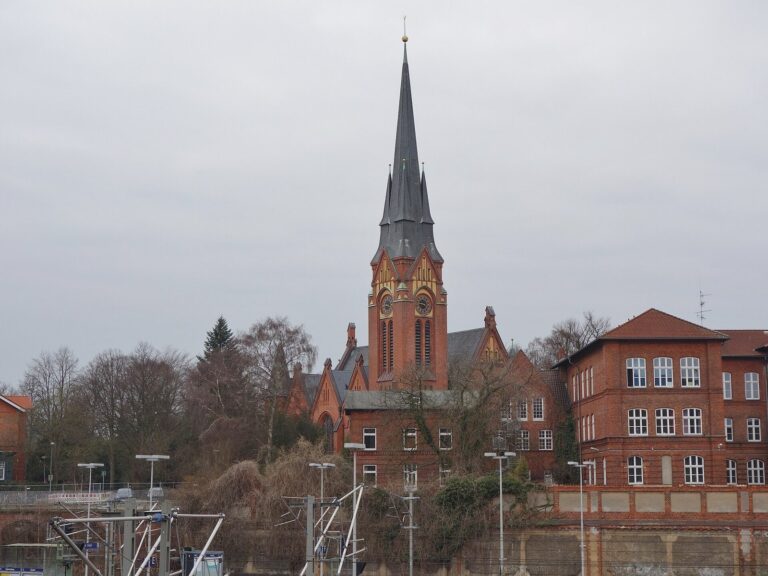
A breach in the dam holding back the Herrenteich in 1635 destroyed the abbey church and the last monastery buildings. The church that followed was named Matthias Claudius Church in 1940, after the poet, born about two centuries earlier to a pastor in Reinfeld.
Remains
The abbey stood beside the Heilsau on marshy valley ground that the monks drained and cleared. Its church and associated buildings occupied a precinct, part of whose medieval wall survives. The physical remains also include fishponds and material preserved or reused in buildings elsewhere.
Former abbey precinct
Church and precinct wall
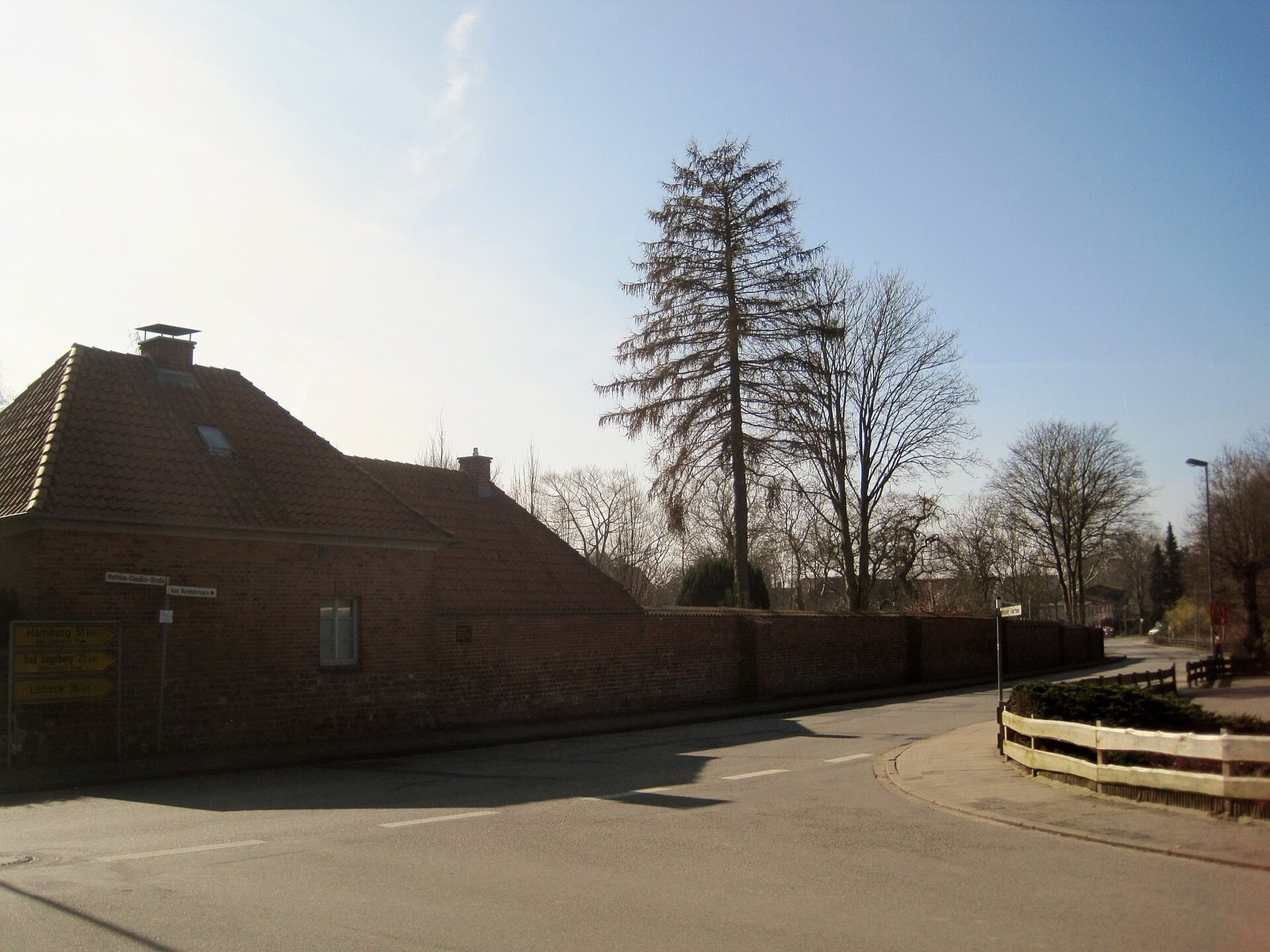
The abbey church, consecrated around 1237, was probably a brick basilica with a small roof tower. Only part of the medieval precinct wall remains at the former abbey site, with little else of the monastery’s buildings surviving there.
Fishponds
Some of the ponds dug in the Heilsau valley for fish farming remain. They are surviving features of the landscape the monks reshaped around the monastery.
Matthias Claudius Church
Church and bells
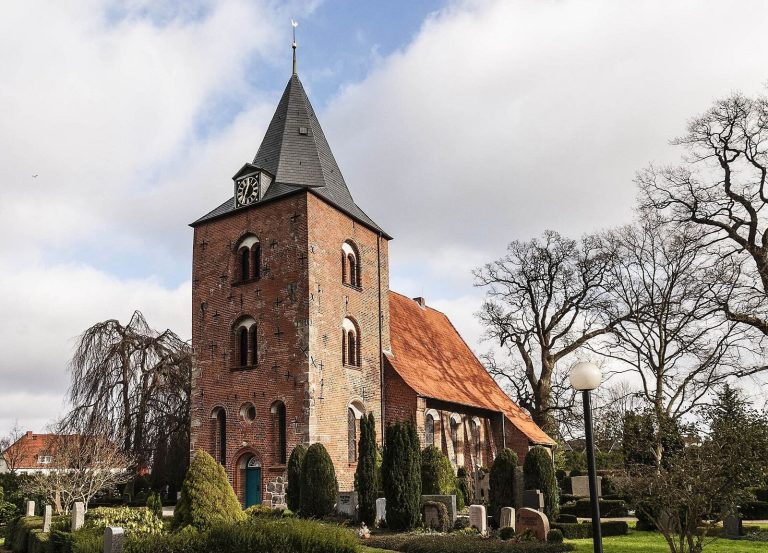
Built on Eichberg in 1636, the church was substantially smaller than the abbey church and incorporated material salvaged from its ruins. Two bells from the abbey church remain in its bell tower, including the bell commissioned in 1561 under Abbot Joachim.
Tomb slabs
Seven tomb slabs from the abbey are preserved at or inside the church. The slabs of Hartwich von Reventlow, Georgius, and Paulus are on exterior walls; those of Hildebrand, Johannes IV von Petershagen, Marquard, and Theoderich are in the north chapel.
Art and written records
Winged altarpiece
A painted winged altarpiece now belongs to St. Jakobi Church in Hamburg, where it has been since 2019. Previously it was at the Osterkirche in Hamburg-Eilbek. It may have come from Reinfeld Abbey’s church and is attributed to painter Hinrik Funhof or his workshop. A kneeling monk before God the Father in the lower part of the central shrine has been identified as Abbot Johannes von Petershagen, who died in 1498, because the figure resembles his tomb slab.
Abbot’s Mirror
The Abbot’s Mirror survives as a parchment manuscript decorated with elaborate initials. It is held by the Royal Library in Copenhagen.
Lübeck residence
The abbey’s Lübeck residence, known as “Im Reinfeld,” stood on Obertrave between Marlesgrube and Dankwartsgrube. After a chapel fire in 1821, most of the building was rebuilt. Its riverside section was demolished in 1938 for an air-raid bunker, whose design incorporated forms from the earlier residence.