Ralung Monastery: Traditional Seat of the Drukpa Lineage
Site at a Glance
- Popularity
- Medium
- Country
- China
- Primary era
- Early Modern
- Eras represented
- Early Modern
- Civilizations
- Tibetan
- Site type
- Religious
- Remains
- Monastery
On this page22 sections
History
Foundation and lineage
Ralung Monastery is a Tibetan Buddhist monastery in western Tibet, China, founded in 1180 by Tsangpa Gyare as the traditional seat of the Drukpa lineage. Tsangpa Gyare, a student of Lingje Répa, established the Drukpa tradition, a branch of the Kagyu school of Tibetan Buddhism.
A foundation story tells of a herder whose white goat repeatedly wandered away and returned. After consulting Lingje Répa and Tsangpa Gyare, the herder brought them to the place where the goat had lain down. The story says that when it stood, the stone beneath it bore naturally raised syllables, Om Ah Hum, formed where its milk had dripped. This sign led Tsangpa Gyare to choose the site, and the tale explains the name Ralung. The stone is said to be kept elsewhere.
The monastery’s community grew under Tsangpa Gyare’s leadership and followed Drukpa Kagyu practice. It was associated with thirteen sacred places, grouped as four outer, four inner, four secret, and one representing ultimate reality. Its head lineage passed through twelve successive recognized incarnations.
Drukpa influence and Bhutan
The Drukpa lineage spread across Tibet and Bhutan, with influence in southern, northern, and eastern Tibet. Its members were associated with red hats, and Bhutan was also called Dugpa because of the tradition’s prominence there. Ralung’s influence extended south through trade over Himalayan passes, including Yak La, and the monastery is linked to both the growth of the Drukpa school and Bhutanese history.
Ngawang Namgyal, later known as the first Zhabdrung Rinpoche and the founder of Bhutan, was born at Ralung in 1594 and served as its eighteenth abbot. In 1616, he left Tibet after the governor of Tsang disputed his recognition as the reincarnation of the scholar Kunkhyen Pema Karpo. In Bhutan, Ngawang Namgyal united rival valleys, resisted attacks from Tibet, and helped shape a national identity. He also established a system of government combining religious and secular authority, later continued in altered form under the Bhutanese monarchy.
Festival and restoration
Ralung’s annual festival is held on the 13th through 15th days of the seventh Tibetan lunar month in remembrance of Gampopa, also known as Dagpo Lhaje, an influential Buddhist teacher. The celebrations include Drukpa Kagyu dances honoring protector deities and a procession around the monastery. In it, a small monk rides a horse carrying an image of Ngawang Namgyal. Traditional offerings include chang, a fermented grain drink, yogurt, milk, and other dairy foods.
Restoration of the eight-pillar shrine brought sacred objects up from underground. Work on the Stupa of Untouched Glory included new construction over its recovered lower part, and new images replaced older statues.
Remains
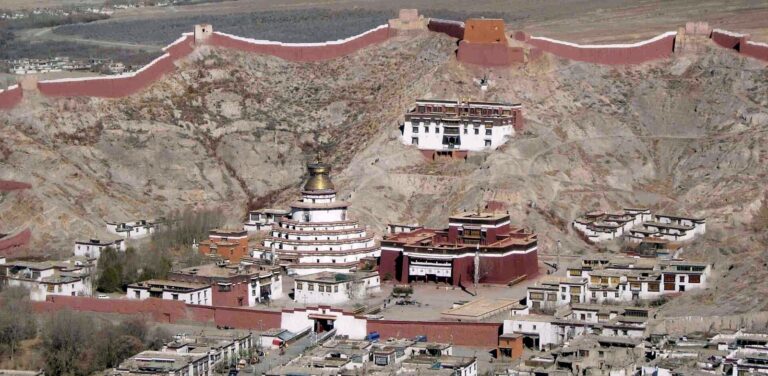
The monastery complex includes an assembly hall, numerous chapels and shrines, residences, and structures on the surrounding grounds. A stupa is a Buddhist reliquary or commemorative structure. The buildings and objects described across the complex combine multiple pillar-supported halls with images and ritual objects made from materials including brass, copper, silver, stone, clay, and wood.
Landscape and outer grounds
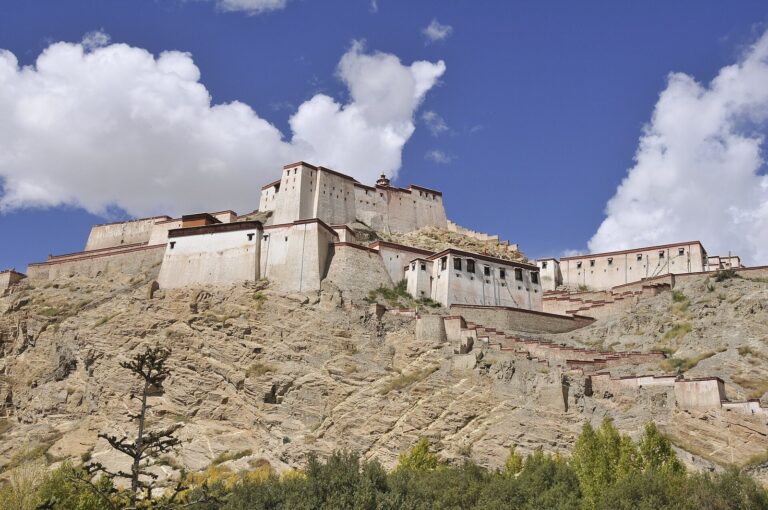
Ralung lies in the Tsang region south of Karo Pass and a few kilometres south of the road between Nagarzê and Lungmar. It is north of Bhutan’s Gasa district. Nearby peaks and glacier fields include Gyetong Soksum, at 6,244 metres, Jangzang Lhamo, at 6,324 metres, and Nojin Gangzang, at 7,191 metres. The surrounding landscape is associated with eight auspicious forms: the mountain in front resembles a white conch turning clockwise, Rala Pass a precious parasol, and the peak behind Pokya a full vase. Tsenchu Peak represents a victory banner, Yangon Hill a pair of golden fish, and the ground at Gormo a golden wheel. The hill toward Penthang is likened to an open lotus stem, with twin streams resembling facing birds, while Gyamo Meadow represents an auspicious knot.
Eastern meadow monuments
On a meadow east of the monastery stands an approximately life-size figure of Tsangpa Gyare, formed from earth and stones before the monastery was built. Nearby, the Tashi Gomang stupa was erected in his memory. Its principal image is a copper-alloy Avalokiteshvara, a bodhisattva associated with compassion. Tradition connects the stupa’s ornaments with a queen of Zahor’s necklace. The structure also contains thirteen Dharma wheels and a nearly life-size copper-alloy image of Vajradhara. Its doors depict deities belonging to the four classes of tantric practice. A story says that a religious figure riding an emanated horse raised a building element that masons had been unable to lift; the horse’s footprint remains visible.
Monastic ruins
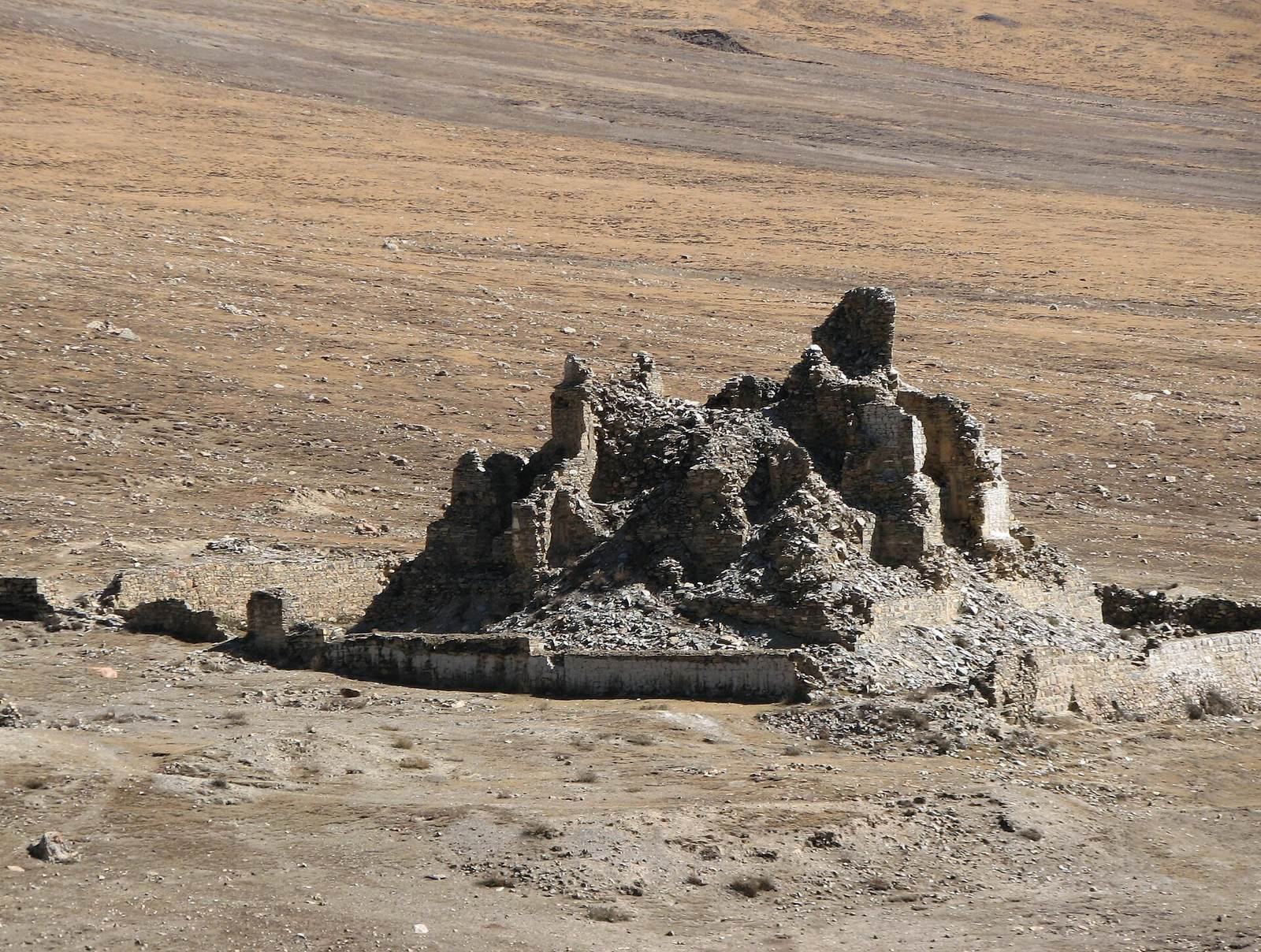
Ruins of a monks’ monastery remain above Ralung. Two ruined nunneries are also present, one to the north and the other to the south.
Assembly hall and teaching chapels
Main assembly hall
The main assembly hall had 42 pillars and sanctuaries on three sides. Its central sanctuary held a three-storey image of Maitreya, the Buddha associated with the future. In the eastern sanctuary, images of the seven Buddhas of the past stood nearly a storey high, accompanied by larger-than-life brass images of the Medicine Buddha. The western sanctuary’s principal image was a life-size figure of Amitayus, a form of the Buddha of Infinite Life, made from gilt copper. A turquoise in the mark between its brows was about the size of a bird’s beak.
Lama and Tara chapels
A chapel devoted to lineage teachers held more than fifty images and copies of the Kangyur and Tengyur, collections of Buddhist scriptures and commentaries, written with five precious substances. An eastern Tara chapel contained a thousand brass images of Tara, each slightly taller than a cubit, a traditional measure based on the forearm. Its adjoining chapel held more than a thousand Kadam stupas and two columns made from white and red sandalwood.
Upper Drukpa chapel
Above an entrance, an upper chapel associated with the Drukpa lineage held a brass image of a protector deity, a clay image of a religious protector, and a depiction of King Langdarma with nails driven into his feet. Langdarma is traditionally associated with the suppression of Buddhism. Other images in the complex were described as originating in eastern and western India.
Lineage shrine and residences
Western protector shrine and eight-pillar shrine
A residence of Pehar, a Buddhist protector deity, stood on the monastery’s western side. An eight-pillar shrine held a larger-than-life image of Tsangpa Gyare, whom devotees regarded as truly present as a wisdom being. The account of the image says that different viewers perceived it differently. Lingje Répa’s image stood to its right, while the Stupa of Untouched Glory stood to its left. Pema Karpo erected the stupa, whose value was given as 3,000 gold sho, a traditional Tibetan unit used to express value.
Other objects in the shrine included larger-than-life brass images of Pema Karpo and gilt-copper Amitayus, as well as an image of the teacher Drukpa Kunley. A brass image of a Drukpa teacher appeared on the stupa’s exterior, with a copper image of Tsangpa Gyare nearby. The shrine also held handwritten copies of the Hundred Thousand text and a gold-written Eight Thousand text, along with Tsangpa Gyare’s personal robes and other ritual garments.
Western guesthouse
The western guesthouse contained reliquary stupas holding relics of successive Drukpa lineage holders and silver-cast images of the lineage. Among its principal objects were three brass Tara images, each about the size of an eight-year-old child. A slate screen at a doorway bore naturally formed shapes resembling a snowy mountain above a lion. The complex also held a complete printed Drukpa Kagyu liturgy.
Four-pillar lineage residence
East of the guesthouse stood a four-pillar residence of the Drukpa lineage, with religious objects and supports inside.
Pearl Chapel
The eastern Pearl Chapel held a multi-storey image of Chakrasamvara, a tantric meditation deity. Its male figure was silver and its female figure red copper. A related mandala, a ritual diagram of a sacred realm and its deities, used pearls to the east, crystals to the south, coral to the west, and turquoise to the north. Pearls were the most prominent material, giving the chapel its name. To the right stood a nearly storey-high silver reliquary for Kunga Paljor, the second Drukpa incarnation, topped with a gold ornament.
Protective and ritual shrines
Mahakala and secret protector shrines
West of the Pearl Chapel, an eight-pillar shrine was devoted to four-armed Mahakala, a protector deity. It contained a ritual image of white gold about one and a half cubits high and a one-cubit image of Wisdom Mahakala carved from black stone. Images of other protector deities surrounded the latter. Beneath the Pearl Chapel, a secret shrine held an iron ritual dagger about as long as a pillar, another precious ritual object about one and a half cubits long, and boxes containing robes of successive Drukpa lineage holders. One box held a large Mahayana bell, and several meditation chambers were also present.
Vajrasattva chapel
Beside the water below the monastery stood an eighteen-pillar chapel to Vajrasattva, with a four-pillar sanctuary. Its three-storey gilt-copper image of Vajrasattva had five figures in its crown, each about a cubit high. The eastern figure was pearl, the southern crystal, the western coral, the northern turquoise, and the central figure crystal. The complex also contained ritual dance costumes, conches, other musical instruments, and a printed copy of the Kangyur.
Entrance images and Red Protector chapel
An area around a skylight above an entrance contained a cubit-high image of the Ten Grounds, made from medicinal clay, and an empowered image of Vajrapani believed to restrain water. The Ten Grounds are stages on the bodhisattva path. A nearby Red Protector chapel held a two-storey sand stupa covered in gold and silver. A tradition says that it enshrined one of the twenty-one Khasarpani images, a form of Avalokiteshvara, believed to have emerged from Tsangpa Gyare’s twenty-one vertebrae. Beside it stood a larger-than-life gilt-copper image of a religious teacher.
Southern chapel and meditation cave
A southern chapel associated with Ngawang Namgyal displayed a demon’s head and arm. A footprint attributed to Drukpa Kunley’s son appeared on the adjoining wall. To the west lay Lingje Répa’s meditation cave, which held a child-sized brass image of him.