Qigexing Buddhist Temple Ruins: A Buddhist Center on the Northern Silk Road
Site at a Glance
- Popularity
- Medium
- Country
- China
- Primary era
- Medieval
- Eras represented
- Classical, Medieval
- Civilizations
- Tang
- Site type
- Religious
- Remains
- Monastery
On this page15 sections
History
The Qigexing Buddhist Temple Ruins, southwest of Karasahr in Xinjiang, China, are the remains of a Buddhist complex founded during the Jin dynasty and developed chiefly in the Tang period. They formed the largest Buddhist site in the kingdom of Yanqi and a major center on the northern Silk Road during the second half of the first millennium CE. The archaeological sequence spans the Jin through Song periods, while the complex is predominantly Tang-era.
Yanqi and early Buddhism
The site belonged to the city-state of Ārśi, also called Agni, which was associated with Yanqi, an oasis kingdom in the Tarim Basin. Ārśi is believed to have been the homeland of Tocharian A, an extinct Indo-European language. Buddhist works and official documents in Tocharian A were still being written in the sixth century.
In 94 CE, Han forces conquered the region as part of their reconquest of the Tarim Basin, well before the Jin-era temple foundation. Around 400 CE, the Chinese monk Faxian visited Yanqi and described about 4,000 monks practicing what was then called Hinayana Buddhism. The term is a historical, often pejorative label for forms of Buddhism distinguished from Mahayana, rather than the name of one school. In the seventh century, the monk Xuanzang described ten monasteries and 2,000 monks in the region, associated with the Sarvastivada, an early Buddhist school whose doctrine held that phenomena exist in the past, present, and future.
Tang rule and Buddhist activity
Tang forces invaded and annexed Yanqi in 644 during conflict with the Western Turks, a Turkic political confederation active in Central Asia. Tang control was restored in 648, after a general defeated a usurper who had deposed the ruler installed by the Tang. The wider conflict with the Western Turks continued until 657. In 719, the Tang established one of the Four Garrisons of Anxi at Yanqi, a military post in the dynasty’s western regions.
Abandonment and later history
The temple had been abandoned by the fifteenth century, following the arrival of Islam in the region. Archaeologist Aurel Stein proposed that the temples were burned during iconoclasm after Islam became the state religion of the Kara-Khanid Khanate, a Muslim Turkic dynasty that ruled parts of Central Asia.
Qigexing is a name of Mongolian origin. After returning east, Torgut Mongols settled in the Hejing and Yanqi areas in the 36th year of the Qianlong reign, under an emperor of China’s Qing dynasty. The site is also known as Ming-oi or Mingoi, a Turkic expression meaning “Thousand Dwellings.”
Explorers and archaeologists visited the ruins from the late nineteenth century into the early twentieth. Albert Grünwedel investigated the site during the third German Turfan expedition in 1905–1907; Stein visited in December 1907; and Sergey Oldenburg investigated it during the Russian Turkistan Expedition of 1909–1910. Sven Hedin and other explorers also came during this period. The removal of portable objects and cutting away of murals caused serious damage. In 2001, the site received designation as a Major Historical and Cultural Site Protected at the National Level.
Remains
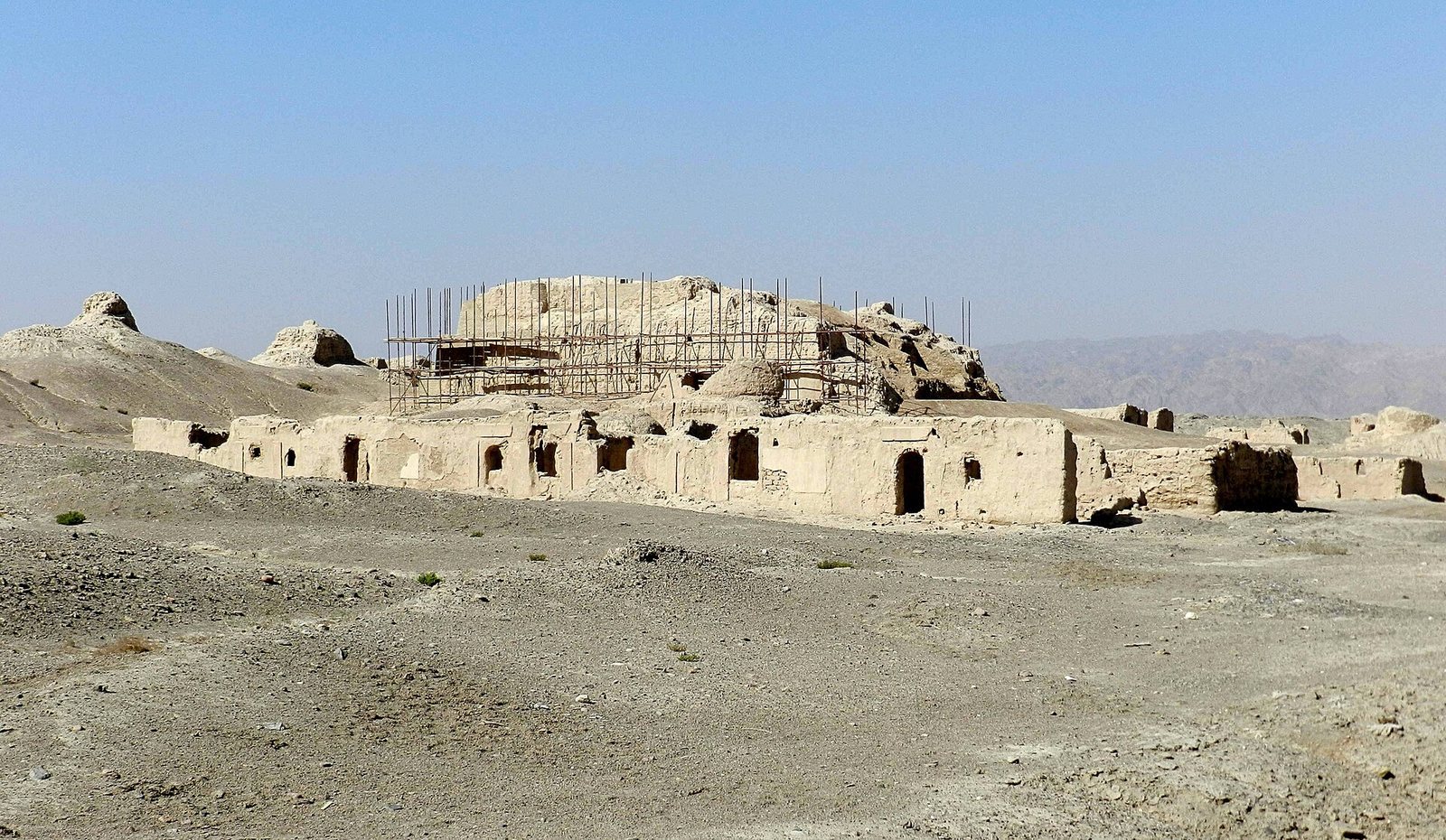
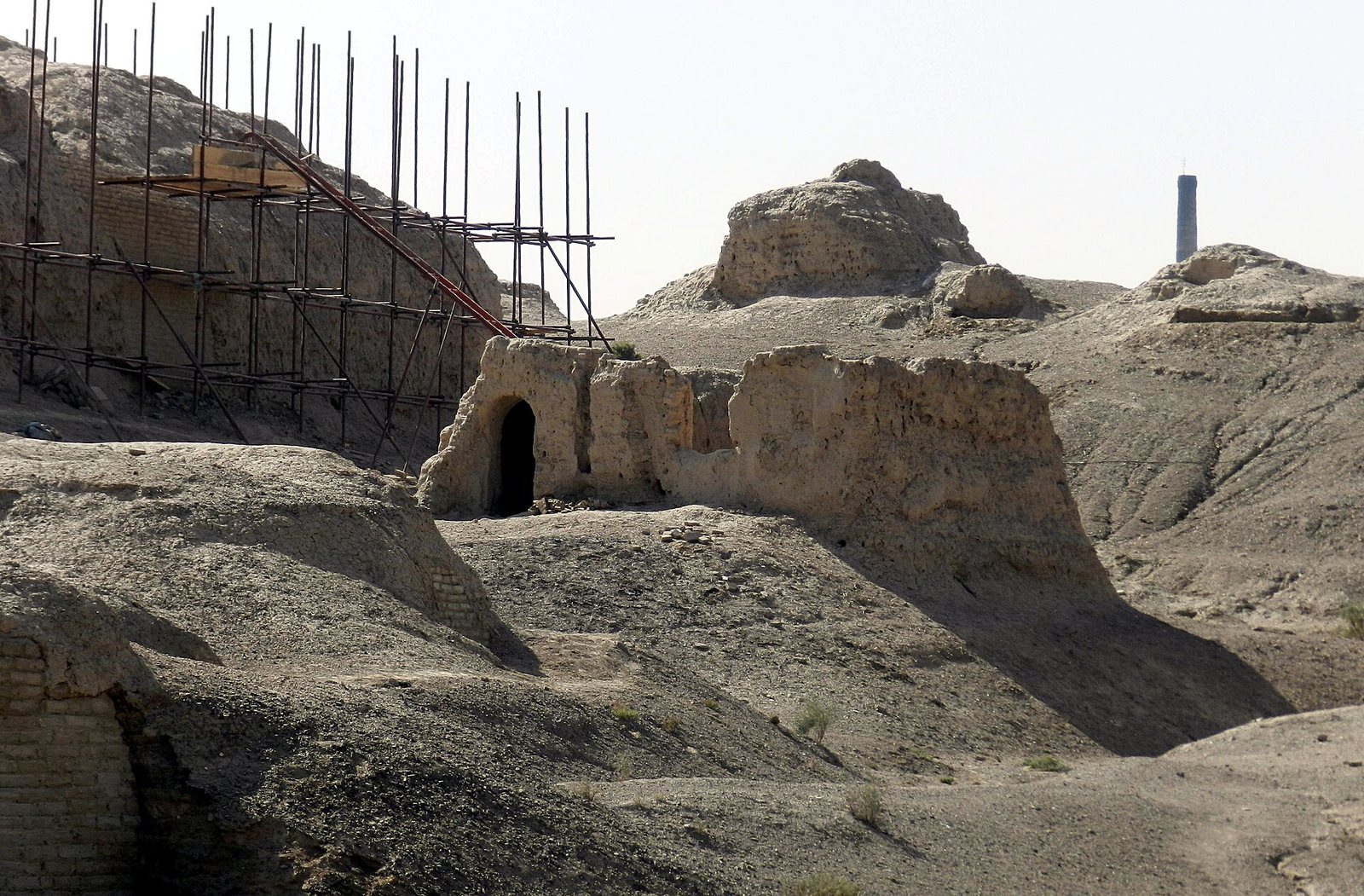
The ruins follow ridges and slopes, adapting to the terrain. A ravine with a spring divides the complex into northern and southern areas. The ground-level temple area covers about 40,300 square meters, within a compound approximately 470 meters from north to south and 200 meters from east to west.
Ground-level buildings
Compounds and halls
The larger temple compounds contained more than 100 buildings in total. Ninety-three ground-level buildings survive; they are made of adobe, or sun-dried earthen bricks, and face east. The principal structures include halls, rooms for monks, and pagodas. One main hall measures 24 meters along each side. The largest Buddhist hall stands in the southern area, where it measures about 25 meters east to west by 20 meters across and survives to a height of 6 meters.
Monks’ quarters
Rooms for monks are roughly square or rectangular and measure about 4 to 6 square meters. They form part of the ground-level building groups alongside the halls and pagodas.
Pagodas
The pagodas have round, square, or octagonal bases, cylindrical bodies, and domed roofs. Some are enclosed by square walls, while others have hollow interiors.
Cave temples
Twelve cave temples have been identified, and eleven survive. Some are long, flat chambers with vaulted ceilings; others are chaitya caves, Buddhist worship spaces with front and rear chambers. Their forms broadly resemble those of the first phase of the Kizil Caves. Statue bases survive inside the caves, and faint traces of formerly colorful ceiling paintings remain.
Sculpture and archaeological finds
Sculptural remains
Sculptures occur as individual figures and in friezes, combining Indo-Iranian influences with Chinese styles. Human heads have a rounded, bulging form. Finds include a figure from Nakshatra Cave dated to the fifth or sixth century and a sculpted king that may date to the eighth century. Soldier figures include an eighth-century Turk, an armored figure in an eighth-century depiction of the War of the Relics, a Central Asian statuette dated from the late fifth to the seventh century, and a Tang-period statuette dated to the sixth or seventh century. A cast of a soldier made from molds from Shorchuk and a mold from the site are held at Berlin’s Ethnological Museum.
Cave painting
A wall painting from cave 11, also identified as Grünwedel cave 9, depicts the Distribution of Relics, a Buddhist narrative about conflict over the Buddha’s relics after his death. A detail shows warriors. The painting is held by the Hermitage Museum.
Manuscripts and other finds
Excavated objects include the Tocharian A text The Meeting with Maitreya, Buddha heads and ornaments, clay animal figures, documents in Brahmi script, and Sogdian and Persian silverware. Brahmi is an ancient Indic writing system, and the Sogdians were an Iranian-speaking people of Central Asia. A 2007 survey included 1,150 East Tocharian manuscript leaves and fragments, of which 383 came from a single scriptorium, a place where manuscripts were copied or produced, at Qigexing. Artifacts from the site are held in collections in Berlin, London, Paris, Tokyo, Seoul, New Delhi, and St Petersburg.
Condition
Erosion at the wall bases reaches a maximum depth of 0.6 meters and follows the flow of surface water. Some comparatively well-preserved buildings have cracks extending through their full height. The cracks are wider outside than inside, and expose weak, crumbly soil; some contain weathered sand. Surface water has also caused localized ground collapse and uneven settlement. Collapse is the most common form of damage, and the largest recorded collapse measures 3.5 meters long and 2.5 meters deep.