Qala-e-Bost: An Ancient Fort and Islamic Monument in Afghanistan
Site at a Glance
- Rating
- 4.4
- Popularity
- Very Low
- Country
- Afghanistan
- Primary era
- Medieval
- Eras represented
- Medieval
- Civilizations
- Sassanid
- Site type
- Military
- Remains
- Fort
On this page8 sections
History
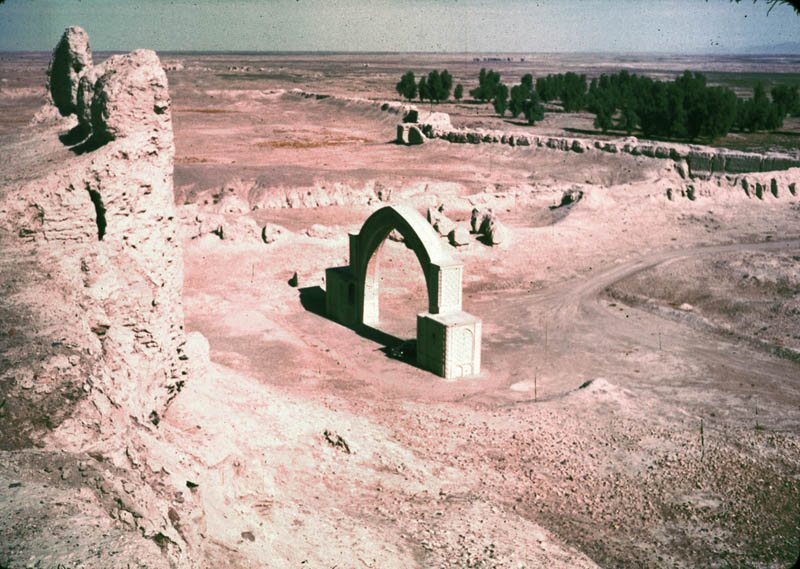
Qala-e-Bost is an archaeological site in Afghanistan near Lashkargah, preserving a fort, Islamic-period remains, and an eleventh-century pointed arch associated with an iwan, a large vaulted hall usually open on one side. The site lies where the Helmand and Arghandab rivers meet and covers approximately 10 square kilometres. It is regarded as one of Helmand Province’s important pre-Islamic archaeological and cultural-heritage sites.
Origins and pre-Islamic associations
The construction date of the fort remains uncertain. Local tradition places it approximately 3,000 years ago, while historians have associated its construction with the reign of Khosrow I, also known as Nushirvan, a principal emperor of the Sasanian Empire. This Iranian empire ruled much of the Near East from the third to the seventh century.
Islamic-period use
Qala-e-Bost also contains mud-brick walls belonging to private houses from the Islamic period. The Ghaznavid sultan Mas’ud is said to have stayed at the fort for leisure. The Ghaznavids were a medieval Islamic dynasty that ruled substantial parts of present-day Afghanistan, Iran, and South Asia.
Modern work and recent history
Construction of a cobblestone road from south of Lashkargah to the Qala-e-Bost Arch began in 2006. By April 2008, the road made it possible to descend into an ancient shaft with side rooms and a spiral staircase leading toward its bottom. Restoration work at the fort began in 2020. In 2021, the ruins provided shelter for hundreds of people who had fled fighting during the Taliban conflict.
Remains
The archaeological area combines the remains of a mud-brick fortification, an imposing fortress, Islamic-period house walls, a monumental arch, and an ancient shaft. The site occupies land near the confluence of the Helmand and Arghandab rivers, where river erosion has raised concern for the long-term survival of the remains. Fruit trees and date palms grow within the fort area.
Fortification and houses
Mud brick forms the surviving fortification and fortress remains at Qala-e-Bost. Within the fort area, mud-brick walls from private Islamic-period houses preserve evidence of domestic construction alongside the larger defensive structures.
Eleventh-century arch
The principal surviving monument is an approximately 25-metre-high pointed decorative arch dating to the eleventh century. It belonged to the iwan of a religious building and is also described as part of the remains of an ancient mosque. Baked, carved bricks form the arch, whose surface carries geometric patterns, stucco insets, and calligraphic inscriptions. Stucco insets are decorative plaster elements set into or applied to a building’s surface. The arch is depicted on Afghanistan’s 100-afghani banknote.
Ancient shaft
An ancient shaft measures approximately 20 feet across and 200 feet deep. Dark side rooms line its interior, while a spiral staircase descends toward the bottom.