Odenbach Protestant Parish Church: A Historic Place of Worship in Germany
Site at a Glance
- Popularity
- High
- Country
- Germany
- Primary era
- Early Modern
- Eras represented
- Medieval, Early Modern, Modern
- Civilizations
- German, Holy Roman Empire, Kingdom of Bavaria
- Site type
- Religious
- Remains
- Church
On this page13 sections
History
Odenbach Protestant Parish Church is a Protestant church in Odenbach, Germany. Its present nave was consecrated in 1764 in a late Baroque to Neoclassical style, alongside a surviving medieval tower. A church at Odenbach is recorded as early as 893, making the site part of the Glan valley’s medieval religious history.
Early church and parish independence
The church appears in the Prüm Urbar, a medieval register of Prüm Abbey’s lands and rights, together with 15 Tagwerk of land. A Tagwerk was a traditional measure based on a day’s work, and its area varied by region. The early church was probably dedicated to Saint Peter and was likely a Romanesque hall church, with a broad, undivided worship space. It was considerably smaller than the present building and may have been among the oldest churches in the Glan valley.
Rights to the church’s tithes passed from Prüm Abbey to other holders, possibly including the lords of Numagen. By the end of the thirteenth century at the latest, the County of Veldenz and local knights held at least some of those rights. For a period, Odenbach was a daughter church, or subordinate church, of the parish at Medard. At Count Henry II of Veldenz’s request, a charter dated 15 June 1367 made Odenbach an independent parish. The abbot of Disibodenberg retained church patronage, which included a role in presenting or selecting the parish priest.
Before the Reformation, the church had at least two altars. The main altar was dedicated to Saint Peter, and another was dedicated to Saint Valentine. A tower was added in the thirteenth century, although it is sometimes dated to the fourteenth. It was heightened by one storey in 1508.
Reformation and confessional change
The Reformation, the sixteenth-century movement that led to the formation of Protestant churches, was introduced throughout the Duchy of Palatinate-Zweibrücken in 1533. Its adoption in individual congregations was probably gradual. Odenbach’s pastor, Maximus Irsch, and clergy in nearby Meisenheim and Medard rejected the Augsburg Interim, a provisional settlement of religious practice issued in 1548. They preferred to resign rather than accept it, while Duke Wolfgang sought a compromise. A visitation in 1553 noted that Irsch generally used Martin Luther’s catechism for baptisms and was married. In 1557, the duke issued a new church order and sought to enforce it through regular inspections.
After Duke Johann I turned to Calvinism in 1588 and issued a synodal order in 1592, Odenbach’s formerly Lutheran congregation became increasingly Reformed. Lutheran congregations nevertheless continued in the area under a separate church administration. In 1584, Odenbach’s church elders asked for a new bell, hoping to have a tower clock as well. Two bells were to be installed, but one fell and broke. The elders then obtained a surplus bell from Hirsau while that parish was vacant, angering people in the Eßweiler valley. When Hirsau again had a pastor, Odenbach’s elders petitioned for the bell’s return in 1653. The Zweibrücken government ruled for Hirsau, and its pastor recorded the bell’s return the next year.
Bell disputes and repeated replacements continued. In 1644, fragments of a broken Odenbach bell stored in Meisenheim were used to pay for Duke Friedrich I’s wedding journey and a course of treatment. An effort in 1721 to take bells from Niederkirchen, based on a claimed ownership right, failed when local residents resisted with weapons. Odenbach had a large but worn bell by 1728. It was recast in 1736, cracked and became unusable in 1742, and was recast again in 1743. That casting lasted only about two years, and a replacement was installed in 1746.
During French rule, when Palatinate-Zweibrücken formed part of the French Saar Province from 1683 to 1697, the church appears to have been shared by several Christian confessions. In 1688, Odenbach’s 50 families were listed as 38 Reformed, 10 Lutheran, one Roman Catholic and one Jewish. The War of the Palatine Succession, a late-seventeenth-century European conflict involving France and a coalition of states, ended with the Peace of Ryswick. Afterward, Catholics and Lutherans were prohibited from sharing the church. Odenbach’s Lutherans continued to seek access, and in 1784 the authorities directed the Reformed congregation to permit Lutheran communion, services for special occasions and some prayer-day sermons.
Decay, fire and rebuilding
By 1608, parts of the church were described as dilapidated and supported by props. A visitation the following year warned that the choir was dangerously unsafe; the tower’s lower section may have served as the choir. In 1661, a survey described rotten beams, a collapsed stair, temporary plank repairs and windows that apparently had no glass. The building was considered cold and in need of rebuilding.
Records from the 1730s describe the earlier church as much smaller than the present one. They give its length as 28 Schuh, about 9.34 metres, and describe a neighboring building, possibly an ossuary, as about 3 metres long and 3 metres wide. That building was ordered demolished in 1730 because it risked collapse, and water was entering between it and the church. On 31 January 1733, a fire destroyed much of Odenbach and damaged the church tower. The tower was repaired, but the largest bell, recently replaced, broke in the fire. Townspeople commissioned a larger clock in 1735.
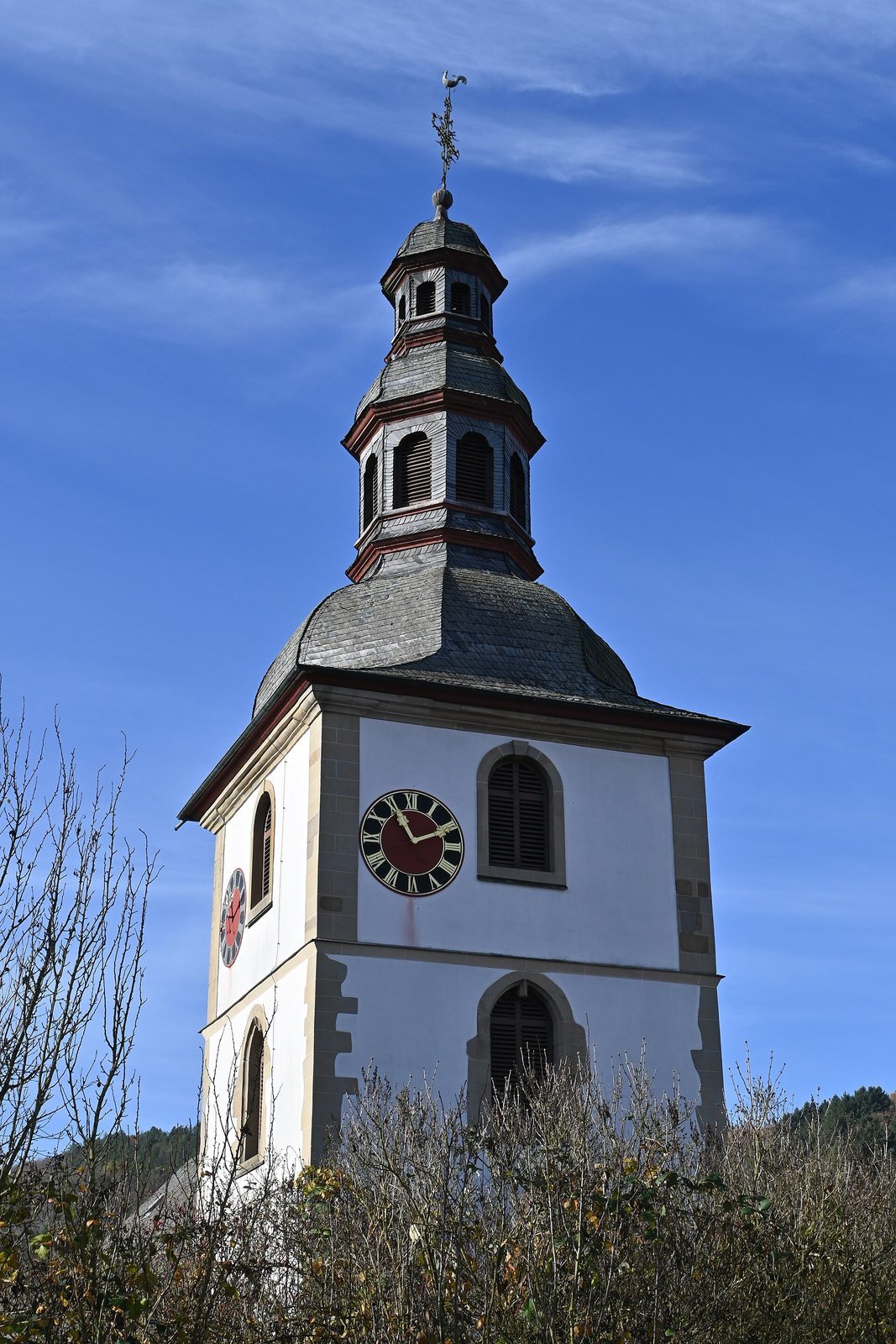
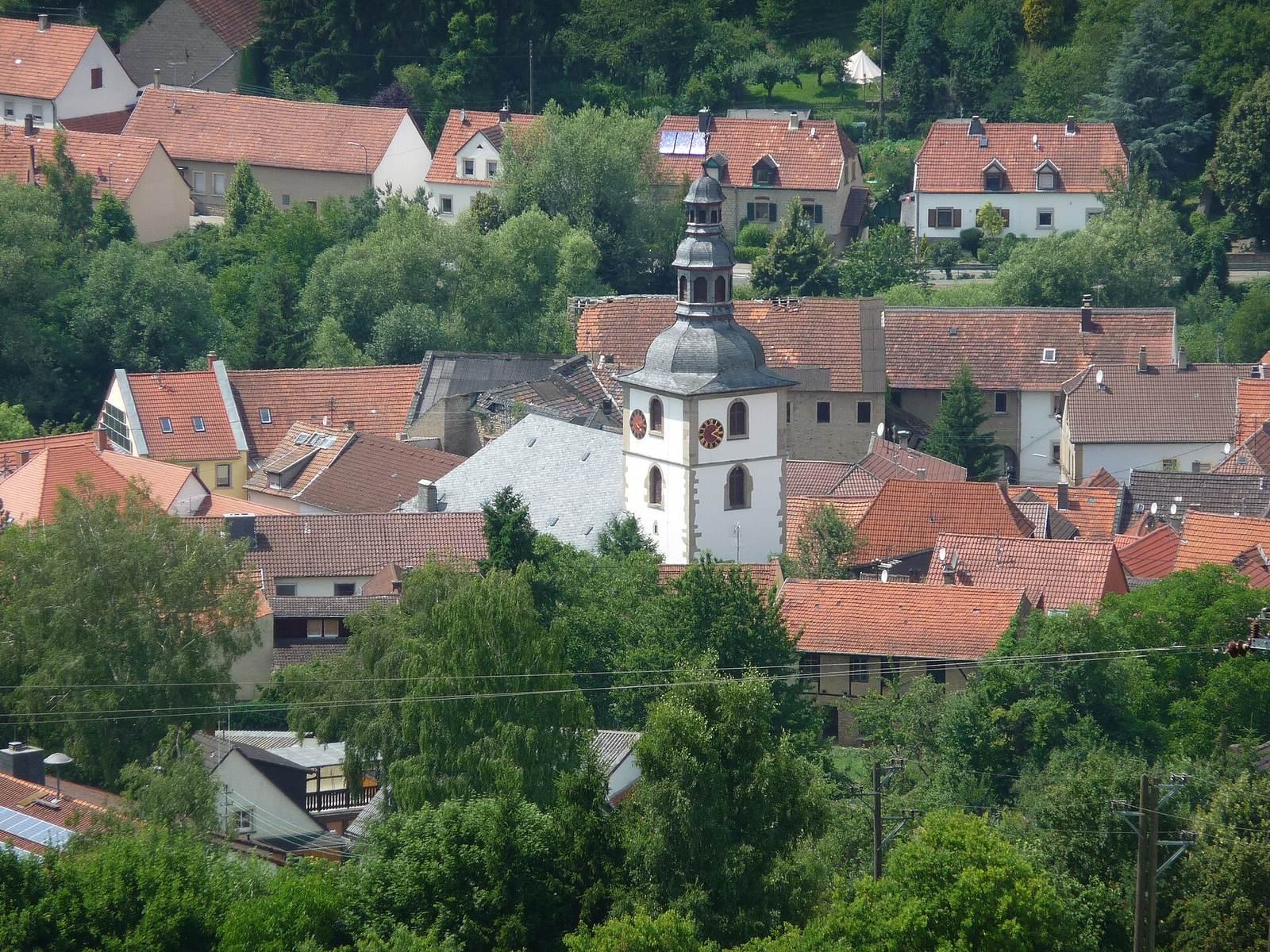
In 1759, the Reformed congregation warned the Palatinate-Zweibrücken building office that the church could no longer be entered safely. Its beams were rotten, and a falling stone had nearly killed the pastor some years earlier. The old nave was taken down in the winter of 1761–62, while the Gothic tower was retained. Architect Philipp Heinrich Hellermann planned the replacement nave, and local master mason Peter Schulz carried out the work. Because the new building occupied a larger area on sloping ground, it needed a high sandstone base. It was consecrated in September 1764. In 1766, the medieval tower was raised to a third storey and given its present Baroque cap.
Congregation and building in later centuries
In 1818, the Reformed and Lutheran branches of Protestantism in the Palatinate united. Before the union, a poll of about 130,000 Reformed and 105,000 Lutheran Palatines produced a relative majority in favor. The union ended serious disputes between Lutherans and the Reformed congregation in Odenbach. The Evangelical Church of the Palatinate continues in that united tradition.
The church’s bells and organ were altered over the nineteenth and twentieth centuries. Around 1850, two smaller bells were melted down to make a larger one because the three bells did not harmonize and one was cracked; the bell frame was also changed for structural reasons. A third, smaller bell was added in 1891. In 1854, organ builder Wagner of Kaiserslautern installed a two-keyboard organ. Before the First World War, Joseph Poppe installed a new organ in Wagner’s case, reusing most of the earlier pipes. The bells were requisitioned for war material during both world wars. Three replacement bells arrived in 1925, but all except the smallest were taken during the Second World War. New bells were installed in 1951.
Hermann Rudolf Wolfrum held the Odenbach pastorate from 1928 to 1934. He joined the Nazi Party in 1929 and became part of the regime-aligned German Christians movement in 1934. Local Communists reportedly demonstrated outside the rectory on Sunday mornings after the Nazi seizure of power. In 1935, a Social Democrat reportedly interrupted a sermon, objecting that Wolfrum was turning a house of prayer into a party venue, and left the service. Wolfrum left Odenbach in 1934 to lead the Rhineland Nazi Pastors’ League. He left the church in 1939 and rejoined after the dictatorship ended.
The interior and other parts of the building were renovated in 1966–67. The old clockwork, commissioned in 1735, was taken out of service in 1966. Between 1972 and 1991, the organ was rebuilt in stages by Oberlinger of Windesheim, and a municipal payment funded new tower clockwork in 1983. In 1975, the Gangloff congregation, including Roth, Becherbach and Reiffelbach, joined Odenbach. The congregation now serves seven villages: Odenbach, Adenbach, Ginsweiler, Becherbach, Gangloff, Roth and Reiffelbach. Some have their own church buildings.
Remains
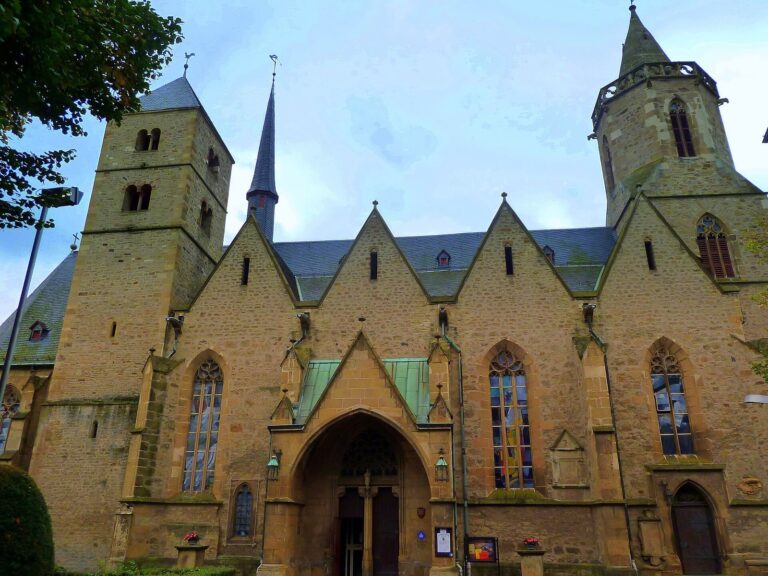
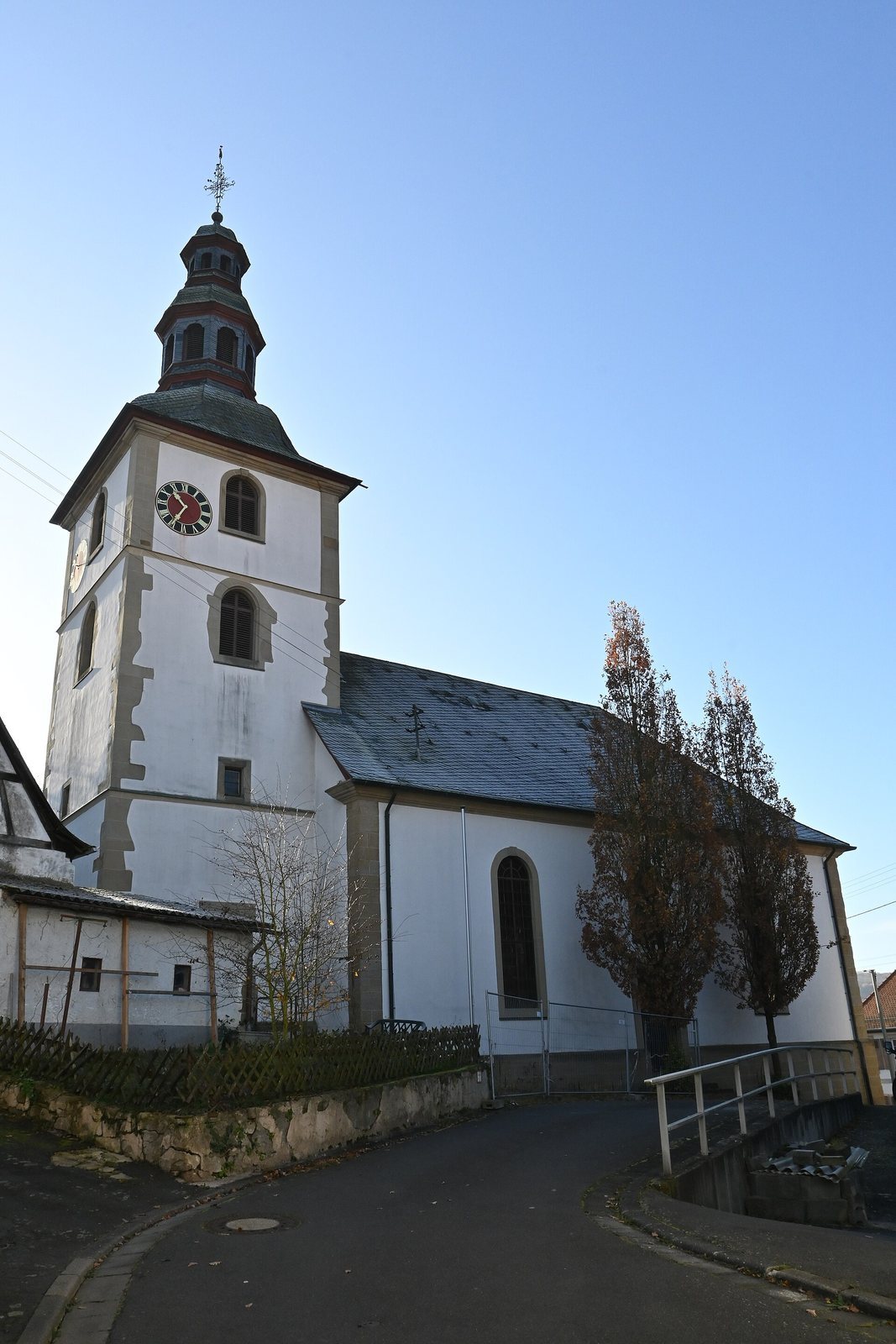
The church’s layout combines a southwest-facing nave with a tower attached at its eastern end. Its construction adapts to sloping ground, with a sandstone base that rises higher beneath the building. The altar is at the west end, opposite the tower.
Exterior
Nave
The nave has a half-hipped roof, with shortened sloping sections at the ends. Its exterior walls stand on a base of squared sandstone blocks and have corner pilasters, shallow wall-attached piers, and a projecting horizontal cornice. Three round-arched windows with keystones, the central wedge-shaped stones at the tops of the arches, line each side. On the north wall, a large church doorway sits beneath the central window.
Tower
The tower’s lower section is the oldest surviving part of the church and probably served for a long time as a choir tower. Three-light Gothic windows, divided by decorative stonework, illuminate it. The upper section has three cupola-like parts on an eight-sided plan, separated by two small raised structures called lanterns. The timber structure of the cap is severely deteriorated. A smaller, plain Renaissance doorway is set into the tower.
Interior and furnishings
Worship space
The altar stands at the west end, with the pulpit suspended above it beneath a canopy. The pastor’s pew is to the left of the pulpit, and a route from the nave to the pulpit passes through that pew. A glass door separates the tower passage from the nave. The 1966–67 renovation is reflected in the Solnhofen stone floor and the wooden pews. The pulpit, pastor’s pew and altar are unpainted to match the seating.
Organ
The organ retains the case made for Wagner’s instrument by Carl Wagner. Its later rebuilding incorporated reused parts from the Dürkheim Castle Church. The instrument has two keyboards and a pedal keyboard. Physical linkages operate the keys and stops; slider chests, which control the flow of air to the pipes, distribute the wind. An electric blower supplies the air.
Bells
The four bells sound at pitches f′, as′, b′ and c″. The f′ bell is associated with eternity and the dead, while the as′ bell is the evening bell. The c″ bell, the smallest, is the morning bell and formerly also served as the school bell. It is made of bronze; the other three are cast steel.