Pozzo di Gammazita: A Historic Well in Catania, Italy
Site at a Glance
- Popularity
- Medium
- Country
- Italy
- Primary era
- Early Modern
- Eras represented
- Early Modern
- Civilizations
- Habsburg, Habsburg Spain, Kingdom of Sicily, Spanish
- Site type
- Infrastructure
- Remains
- Well
On this page10 sections
History
Pozzo di Gammazita is a historic well in Catania, Italy, beside the former city wall known as the Gamma Zita curtain wall. Its present form is tied to Etna’s 1669 eruption, which buried the springs, while its name and history are closely connected to local legends.
The legend of Gammazita
In the best-known story, Gammazita is a young Catanese woman engaged to be married. On her wedding day, as she goes to draw water, a French soldier attacks her. Rather than submit to him, she throws herself into the nearby well. The tale is set under Angevin rule, when a French dynasty governed Sicily, and against the background of the Sicilian Vespers, a revolt against Angevin rule that began in 1282. A later telling places the event in 1278.
An expanded version adds Macalda Scaletta, widow of Guglielmo Amico, lord of Ficarra, and her page Giordano. After Giordano falls in love with Gammazita, whom he has seen embroidering outside her home, Macalda plots with the Frenchman de Saint Victor. He is to pursue Gammazita, while Macalda expects to have him for herself. Following repeated ambushes, de Saint Victor seizes Gammazita as she goes for water. She breaks free and leaps into the well; Giordano then kills the Frenchman with a dagger beside her body.
Catanese tradition remembered Gammazita’s death and virtue as examples of local patriotism and women’s honesty. Red marks on the well’s walls, caused by iron deposits, were explained as traces of her blood.
Other stories about the name
A different origin appears in a panegyric by Giacomo Gravina honoring Francesco Lanario, Duke of Carpignano. In this story, the nymph Gemma marries the shepherd Amaseno, also called Amenano. Pluto desires Gemma, though Gravina’s version identifies the suitor as Polyphemus instead. Proserpina, Pluto’s consort, transforms Gemma into a spring, and the grieving Amaseno becomes another. The well is said to mark the meeting of their waters. The story derives Gammazita from gemma and zita, meaning “fiancée” or “bride.”
Other proposed explanations connect the name to a stiff-legged man who lived in a cave near the spring, or to the Greek letters gamma and zeta, supposedly cut into the nearby wall. An unsupported proposal derives it from the Arabic phrase al gawsit, meaning “place of fresh water,” and links the name to a coastal water source used by sailors. The same explanation has also been proposed for Torre Guaceto in Brindisi province.
The medieval quarter and early waterworks
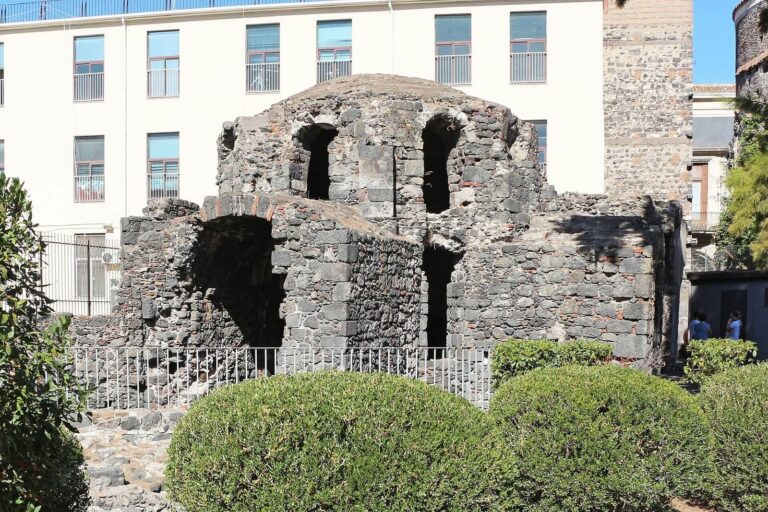
In the Middle Ages, the area formed part of Catania’s southern Jewish quarter, the Judeca Suttana, also called the Judeca di Jusu. Tanneries and butcher shops operated there, making use of the district’s many springs. Some watercourses may have been branches of the underground Amenano River, known locally as the Judicello. Nearby ancient building ruins, called the ‘Broken Wall,’ were identified by Bolano as the city’s Roman naumachia, a venue or installation for staged naval combat, and circus. His interpretation suggests that large public buildings once occupied the area.
From Michelangelo Azzarelli’s 1584 map onward, plans and drawings use Gammazita for the curved stretch of wall between Porta dei Canali and the Bastione di Santa Croce. They depict spring water running in small channels toward the sea. In 1621, Francesco Lanario, Duke of Carpignano and superintendent general of fortifications, reorganized the springs as part of a broader renewal of Catania’s defenses. The water was channelled into the Amenano, and public fountains and a paved seaside promenade with benches were made.
The 1669 eruption and rediscovery
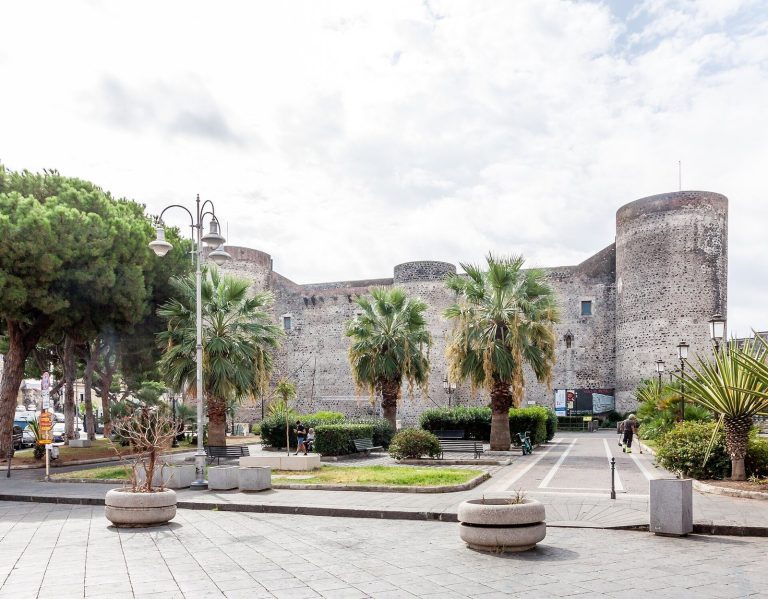
Etna’s eruption began on 11 March 1669 at a fissure above Nicolosi. Lava reached Catania and, on 16 April, flowed around Castello Ursino, filling its moat. Despite efforts to defend the city, the flow covered the springs in the Indirizzo district. The well was later excavated through the lava to reach what remained of the spring system.
The spring came back to light around the middle of the eighteenth century. European travellers making the Grand Tour, an extended journey through Europe to encounter its culture and antiquities, helped renew interest in the site. The scientist Patrick Brydone, abbot Richard de Saint-Non, painter Jean Houël, and writer Dominique Vivant Denon were among those who visited. Saint-Non and Houël depicted the well, but their images distort its proportions. Saint-Non’s view includes people fishing in the basin, a detail that may have been added for picturesque effect rather than showing how the water was actually used.
Later remembrance
Writer Charles Didier described a section of old city wall covered by lava, with a fountain below it. He counted the site among Catania’s most curious monuments and praised the water for its coolness and clarity. The story also inspired an anonymous folk poem from Catania. In 1957, Mimì Maria Lazzaro and D. Tudisco made a bronze candelabrum for Piazza Università from a design by architect V. Corsaro, incorporating the Gammazita story.
Remains
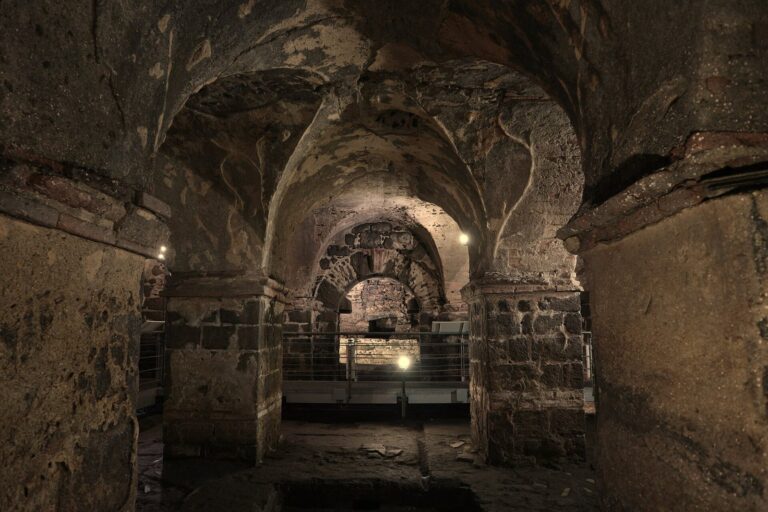
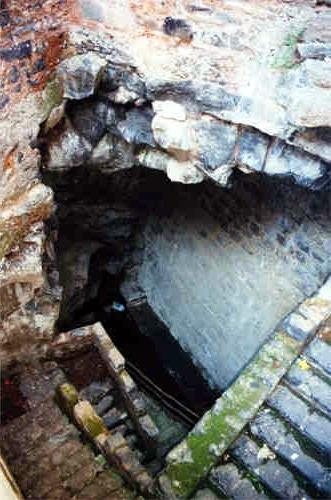
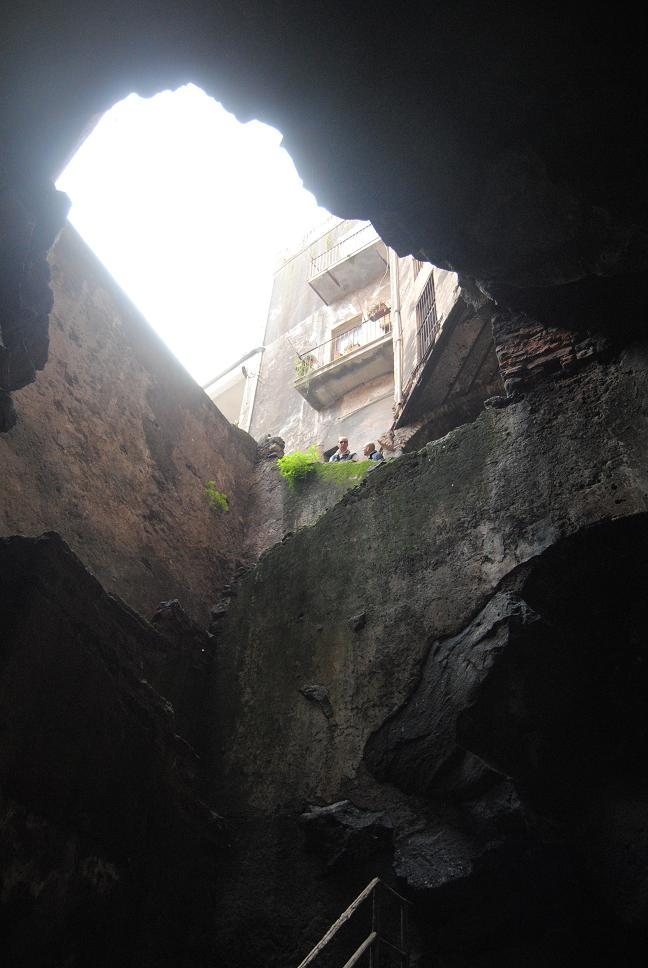
The well is a deep cut through the 1669 lava flow, beside a surviving section of the sixteenth-century city wall. A staircase descends from a courtyard to the spring at the bottom. The lava, the wall, and the narrow space around the water together define the surviving layout.
Courtyard and staircase
The well opens into a courtyard among nineteenth-century working-class homes on Via San Calogero, near Castello Ursino. From street level, the descent is about 12 metres. The present staircase has 62 steps arranged in five short flights, with landings surfaced in lava stone and Sicilian terracotta. It replaced an earlier staircase made of lava stone and cobbles. An eighteenth-century picturesque stairway also ran beside the lava and the sixteenth-century wall.
Wall, lava, and spring
The artificial well cuts into a steep face in the sixteenth-century wall and reaches a spring at its base. The spring is the remnant of three that existed before the eruption buried them beneath about 14 metres of lava. At the foot of the stairs, a narrow area paved with Sicilian terracotta is bounded by the surviving wall. Spring water once flowed there into a basin, now overhung by the lava that sealed the water source.
Washhouse and surrounding structures
A washhouse built of lava stone is also part of the site. Modern and contemporary structures and additions surround the well, emphasizing the depth of the excavated space.