Placard Cave: A Paleolithic Archaeological Site in France
Site at a Glance
- Popularity
- Medium
- Country
- France
- Primary era
- Stone Age
- Eras represented
- Stone Age
- Civilizations
- Unclassified
- Site type
- Civic
- Remains
- Rock Art
On this page13 sections
History
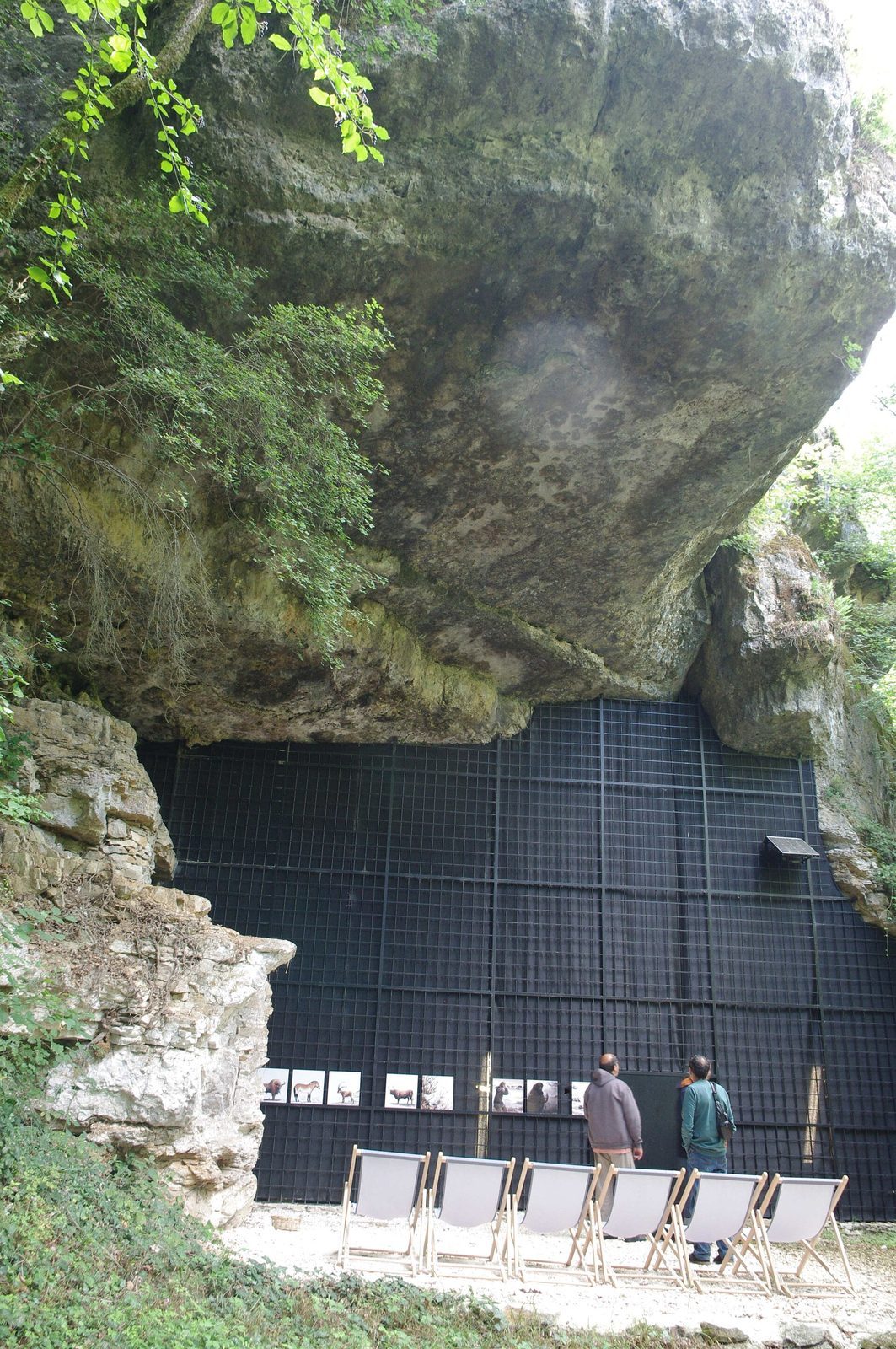
Placard Cave is a prehistoric cave in a cliff above the Tardoire River near Rochebertier in Charente, France. Its more than ten archaeological levels preserve evidence of activity from the Middle and Upper Paleolithic, including Mousterian, a Middle Paleolithic stone-tool tradition commonly associated in Europe with Neanderthals, and the Upper Paleolithic Solutrean and Magdalenian traditions. The cave is especially noted for its engraved art, including rare Solutrean images.
Paleolithic occupation and interpretation
Finds span several periods. The sequence includes Mousterian, Solutrean, and Magdalenian deposits, as well as Neolithic material and an upper deposit containing Bronze Age and historical-period objects. Human remains found in the cave prompted a long-running dispute when they were interpreted as evidence of Paleolithic funerary practices. The debate, which challenged views current at the time, became known as the “Aurignacian battle,” after another Upper Paleolithic tradition.
Nineteenth-century investigations
Jean Fermond is credited with discovering the cave around 1853 and carried out rough excavations from about 1868 to 1880. Father Bourgeois and Father Delaunay also excavated there during the 1870s; after Bourgeois died, Delaunay continued alone. Arthur de Maret conducted more intensive work from 1877 to 1888. Excavation practices of the period caused substantial damage: objects considered interesting were kept, while other material was discarded. De Maret identified Neolithic finds, four Magdalenian levels, two Solutrean levels, and one Mousterian level.
Twentieth-century research and protection
Excavations supported by the French Association for the Advancement of Science took place in 1902. In 1912, Henri Breuil drew partly on the cave’s excavation results when proposing subdivisions of the Upper Paleolithic. Father Jean Roche returned to the site in 1958 at the request of paleontologist Jean Piveteau. Louis Duport began further investigations in 1987 after an engraved reindeer antler was found. In 1990, clearing accumulated debris from a side passage exposed wall engravings. Research then continued under the joint responsibility of Duport and prehistorian Jean Clottes.
Clottes emphasized the rarity of Solutrean engravings, the distinctiveness of the cave’s engraved ensemble within Charente, and the quality of its images and enigmatic signs. Placard Cave became a French historic monument on 3 March 1989 and passed into public ownership in 1990.
Remains
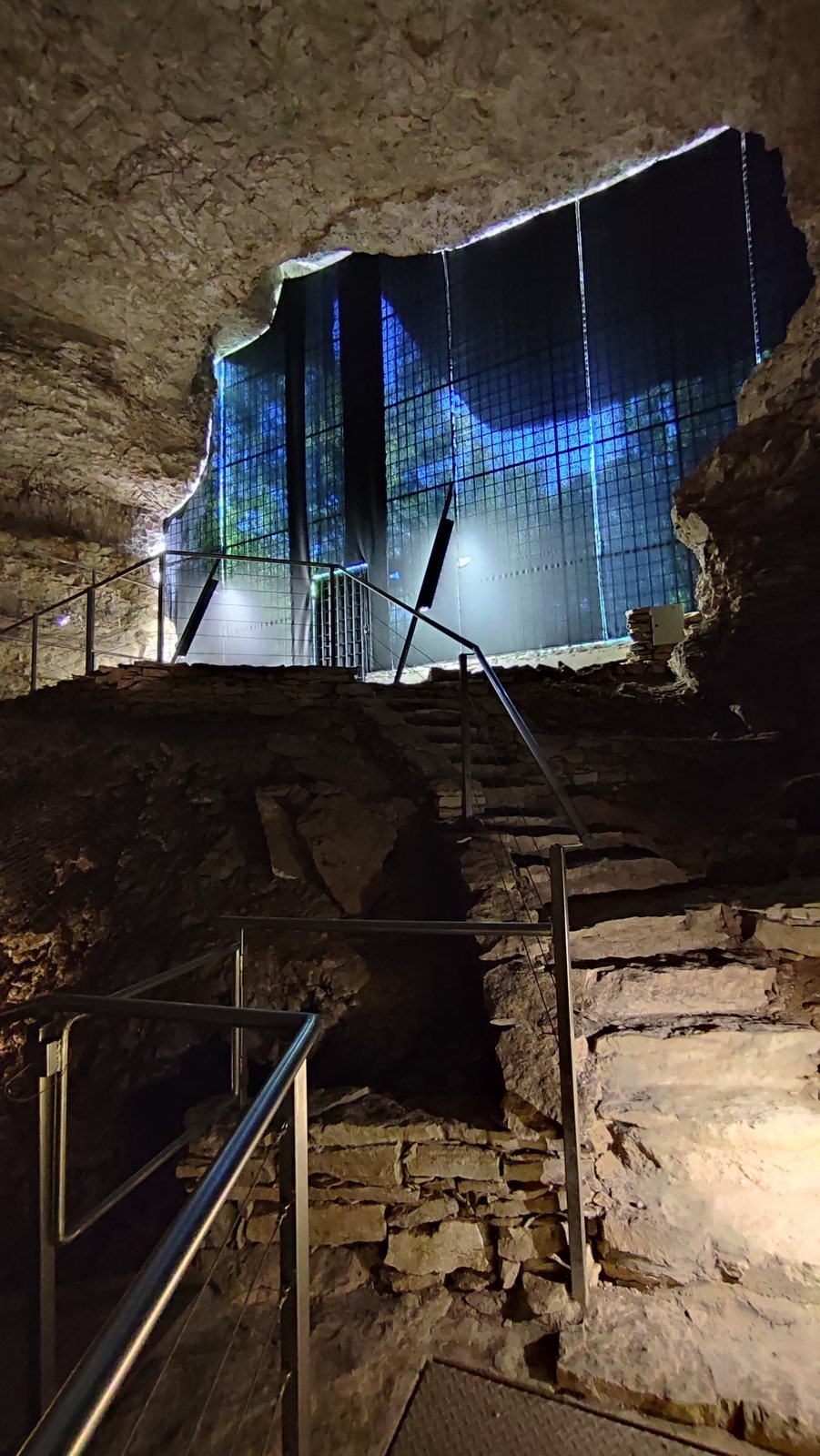
The cave’s main cavity measures about 17 metres long and 9 metres wide, with its entrance at 125 metres above sea level. A long gallery extends west from the cavity, which also narrows into passages to the northwest and north. The north passage is undecorated. The cave formed in Middle Jurassic limestone, and its floor consists of parallel blocks shaped by natural dissolution.
Archaeological deposits
Inside the cave, an upper deposit contains historical-period objects and Bronze Age material. Below it, a Magdalenian deposit about 1.5 metres thick is divided into four layers, followed by a Solutrean deposit about 1 metre thick and a Mousterian deposit about 1.5 metres thick. Roche recorded a separate sequence outside the cave, with Middle and early Magdalenian deposits above denticulate Mousterian and Mousterian layers. In the side passage, he noted a thin deposit of Magdalenian IV mixed with later material, limestone blocks, a 20-centimetre layer of Magdalenian IVa and IIIb containing many tools, and Middle Magdalenian deposits across 17 levels.
Engraved surfaces
Side-gallery frieze and signs
A frieze about 5 metres long and 1.9 metres high was uncovered in the side gallery in 1990. Some of it had been covered by old debris, while other sections lay in the Solutrean deposit. Fine incisions form figures of horses, deer, ibex, reindeer, a chamois, a saiga antelope, cattle-family animals, an aurochs, and two bison heads with their tongues extended. The frieze also bears roughly a dozen bracket-shaped, bird-like signs. Similar signs occur at Pech Merle and Cougnac, and related examples have been found at Cosquer, about 500 kilometres away. Their distribution has been taken to suggest a shared symbolic form over long distances during the Solutrean. Jean Clottes proposed the name “Placard-type signs” for this group.
Fallen engraved blocks
Sieving cave debris recovered 640 engraved limestone blocks, pointing to extensive engraving of the cave walls. By 1942, prehistorian Raoul Daniel had examined fallen ceiling slabs, including one marked with red ochre and an engraved reindeer and another bearing an engraved deer. Radiocarbon dating places the engravings at 19,708 ± 250 years before present, a dating convention that uses 1950 as its reference year, or approximately 20,000 years ago.
Portable finds
Stone tools
The Middle Paleolithic stone tools belong to Quina-type and denticulate variants of the Mousterian. Finds illustrated from the Natural History Museum of Toulouse include a retouched blade, Levallois points (made using a method of preparing a stone core to produce flakes or points), a scraper, a two-sided hand axe, and a Mousterian point. Solutrean tools include laurel-leaf and willow-leaf points; illustrated Upper Paleolithic finds in the Toulouse museum also include blades and shortened bladelets. Early Magdalenian deposits yielded scrapers and several kinds of burin, a stone tool used for cutting or engraving.
Antler, bone, and shell objects
Finds include numerous spear points made from reindeer antler, along with an awl, whistles, needles, and ornaments fashioned from animal teeth and pierced shells. Reindeer-antler spear-throwers were also recovered. One hooked, male-type example, made from the outer layer of the antler, belongs to a Middle Magdalenian phase associated with small, shuttle-shaped objects. A serrated bone plaque found during the 1961–1962 excavation campaign measures about 50 by 35 millimetres. Cut from the shoulder blade of a large animal and incised on one side, it may represent a fish.
Two antler objects shaped like genitalia have been interpreted as “batons of command,” a conventional label for decorated prehistoric objects that does not establish their actual function. One incomplete example is 140 millimetres long and shaped like a penis. The other measures 155 millimetres and ends in a pierced double swelling, with a vulva carved above the opening. De Maret found another perforated antler baton in 1870. Carved in the round, it has an animal head that may represent a fox or an ibex.
Human remains
Solutrean deposits yielded numerous remains identified as Homo sapiens, including skulls reshaped into cup-like forms. Some skull and jaw bones have incisions, traces of ochre, or marks from burning. A child’s tooth found in 1960 was associated with Mousterian tools. The cave’s varied animal remains also include saiga antelope (Saiga tatarica).