Písek Stone Bridge: A Gothic Crossing of the Otava River
Site at a Glance
- Rating
- 4.8
- Popularity
- Very High
- Country
- Czechia
- Primary era
- Medieval
- Eras represented
- Medieval, Early Modern, Modern
- Civilizations
- Habsburg, Habsburg Austria, Holy Roman Empire, Kingdom of Bohemia
- Site type
- Infrastructure
- Remains
- Bridge
On this page12 sections
History
Písek Stone Bridge is a Gothic stone crossing of the Otava River in Písek, Czechia, probably built in the third quarter of the 13th century during the reign of King Ottokar II of Bohemia. It is the oldest preserved bridge in the Czech Republic and among Central Europe’s oldest; historically, it was the country’s second stone bridge, after Prague’s now-lost Judith Bridge. It remains uncertain whether the bridge was first built on dry ground and the river diverted beneath it afterward.
Medieval crossing and trade route
The first written reference to the bridge dates to 1348. That year, Charles IV, king of Bohemia and Holy Roman Emperor, directed that money collected in Písek be used to maintain it. The crossing later served the Golden Trail, a trade route linking Bavaria and Bohemia and associated with salt transport, within a wider connection between the Baltic region and the Mediterranean. Salt from Bavaria was stored in Písek until a royal patent in 1707 required salt sold in Bohemia to come exclusively from saltworks controlled by the Habsburg ruling dynasty.
Road traffic and alterations
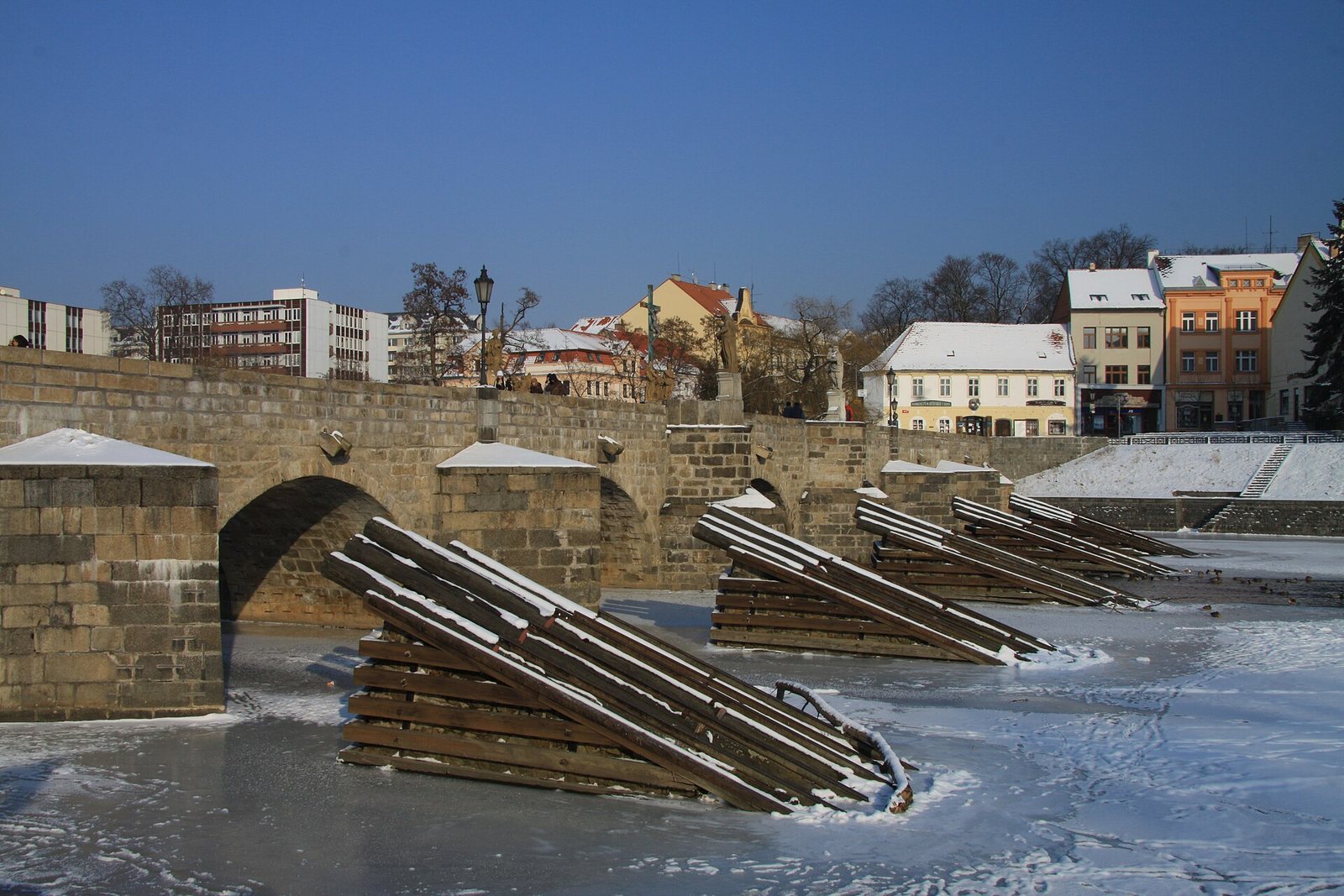
In 1768, a flood brought down one of the towers that had guarded the bridge’s ends, killing the tower’s watchman and his son. That year, a wider arch was also built to let rafts pass. From 1797, a state road over the bridge linked Vodňany with Blatná and Nepomuk. The state paid Písek a flat sum exceeding 743 gulden, a historical currency unit. The bridge came under state control in 1825, followed by state administration in 1827. The surviving end tower was demolished in 1825 as transport needs grew.
Modern changes and preservation
A new bridge farther north opened in 1941 to relieve increasing traffic through the town. The last city bus crossed the historic bridge in 1993. Major reconstruction followed from 1994 to 1996. In August 2002, floodwater rose to about two metres above the roadway. The bridge escaped major structural damage, helped by the earlier reconstruction; temporary wooden railings were fitted, and it reopened after two days. Subsequent flood-protection work received support from a public fundraiser.
In January 2007, windstorm Kyrill tore the crucifix from the bridge and cast it into the Otava. Divers, including Luboš Čuk, and firefighters recovered it on 20 January about 60 metres away. The roughly 80-kilogram tin figure had only minor scratches. Its crown of thorns was found on 4 February. After restoration by Robert Ritschel, a replica was installed on the bridge in March 2008.
The bridge is also called the Stag Bridge, following a tale that it would take the name of the first creature to cross it, said to have been a stag. Old Bridge was the more familiar local name. In 2007, Písek Stone Bridge became its settled official name, resolving a long-running disagreement. The bridge has been listed among Czech cultural monuments since 1989 and became a National Cultural Monument in 1998. It is also a longstanding symbol of the historic Prácheň region in southern Bohemia.
Remains
Bridge structure and setting
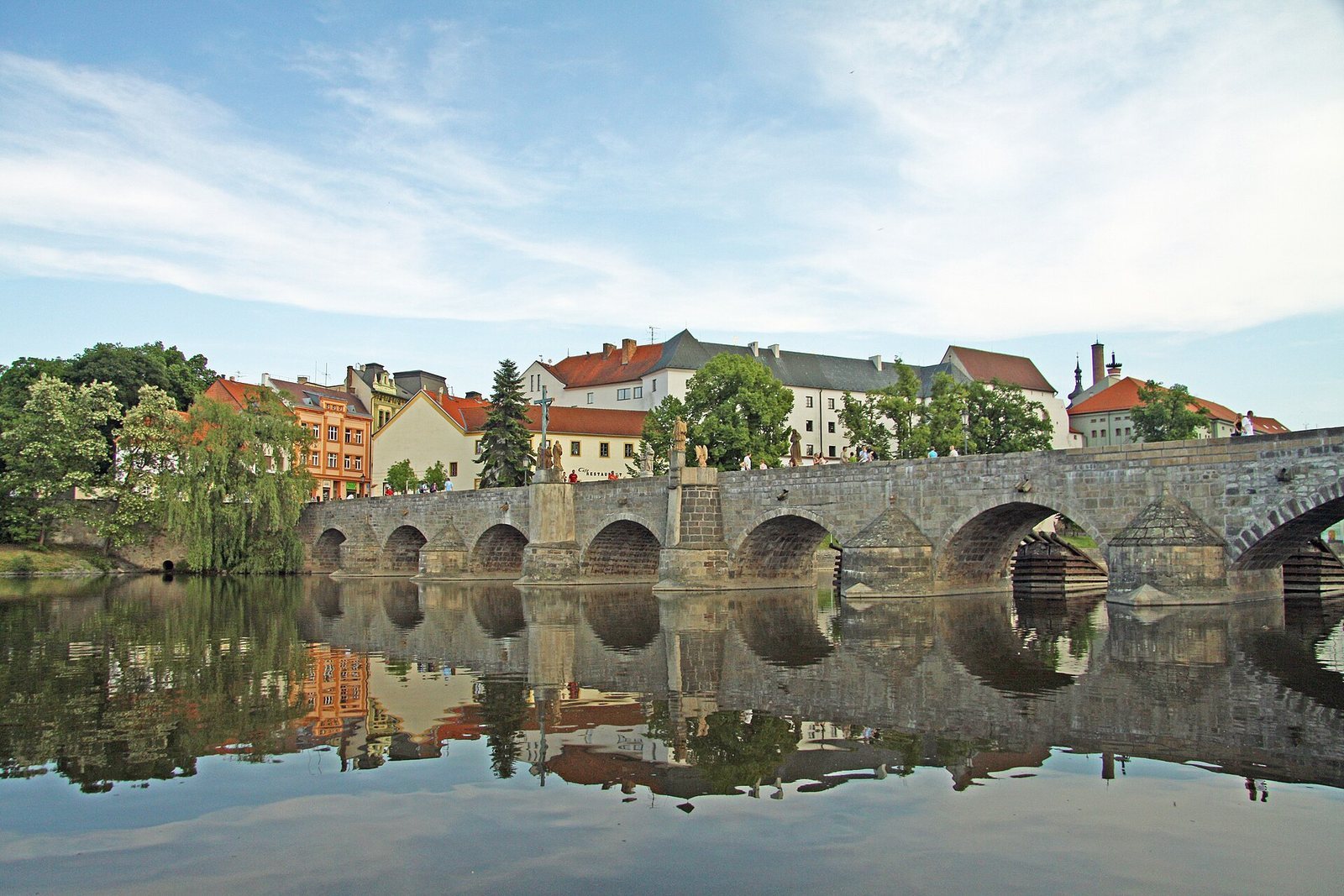
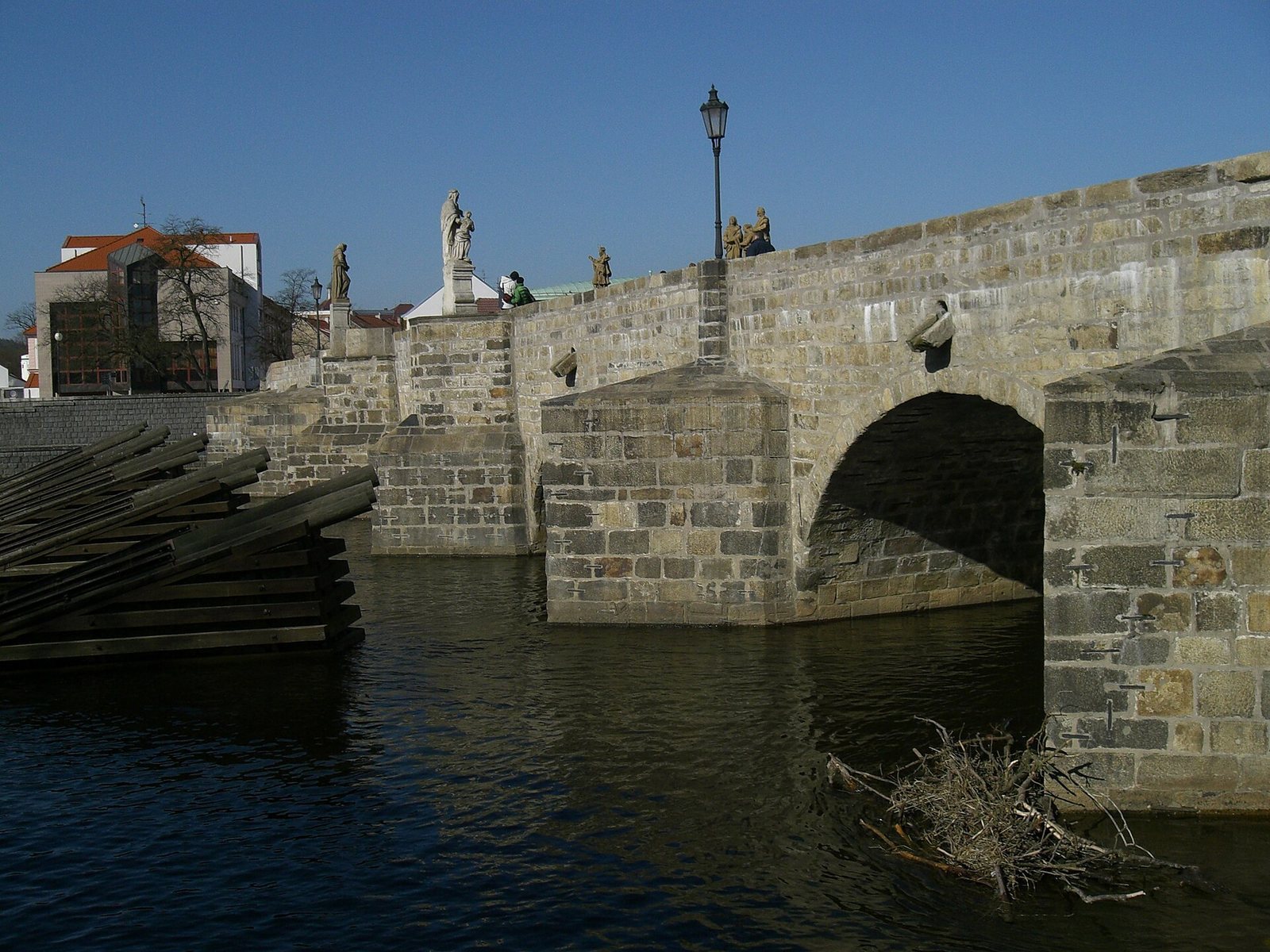
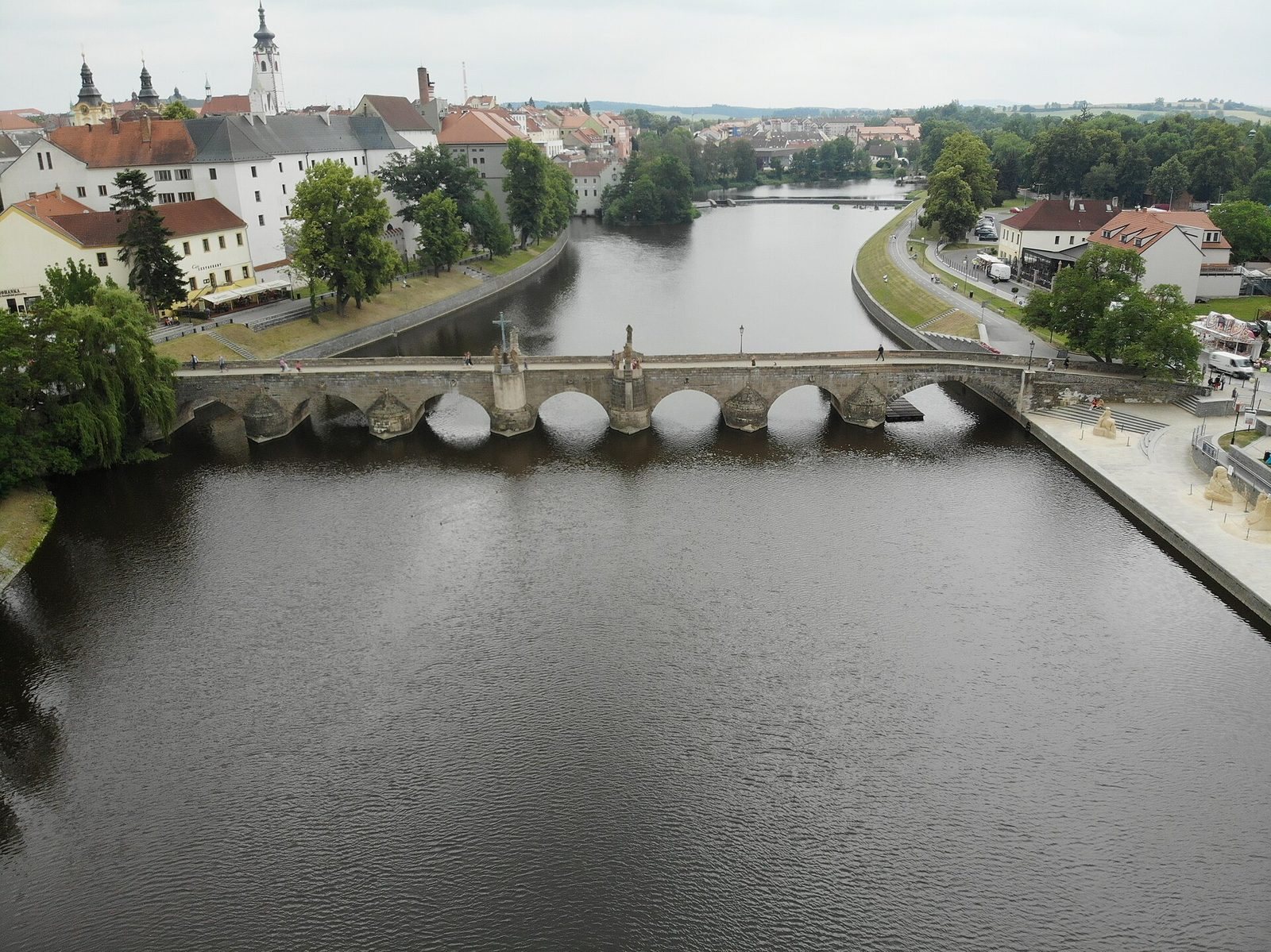
The stone bridge crosses the Otava between Písek’s old town and its Prague suburb. Including the walls at the left-bank approach, it measures 109.75 metres long and 6.25 metres wide; the roadway itself is 4.5 metres wide. Six piers support seven arches. Six are original semicircular arches, each spanning 7.0 to 8.2 metres. The seventh, built in 1768 for raft passage, is 13 metres across and is a segmental arch, a shallow arch formed from part of a circle. The roadway stands about 5.5 metres above the river. Stone fragments recovered from the riverbed during bridge repairs are displayed on the left bank nearby.
Baroque sculptural groups
Sandstone replicas of four Baroque sculptural groups stand on the bridge. The originals were removed and, after several years in the concert hall of the Church of the Holy Trinity, placed following restoration in a Prácheň Museum exhibition from May 2010. The originals were reportedly painted green, with some details highlighted in gold.
Calvary
The Calvary group, a Christian scene centered on the crucifixion, was made in 1757 by Jan Hammer of Čimelice. The Virgin Mary, Mary Magdalene and the apostle John are arranged around a six-metre crucifix. Václav Hanzl, a tin caster, made the original figure of Christ in 1791. Replicas of the group were made in 1997.
Saint John of Nepomuk
The group of Saint John of Nepomuk, a Bohemian priest and saint, includes two angels, Písek’s coat of arms and inscriptions meaning “Time to speak” and “Time to be silent.” A complete version, including an angel sculpted by Kačer, was installed in May 2004.
Saint Anne and Saint Anthony
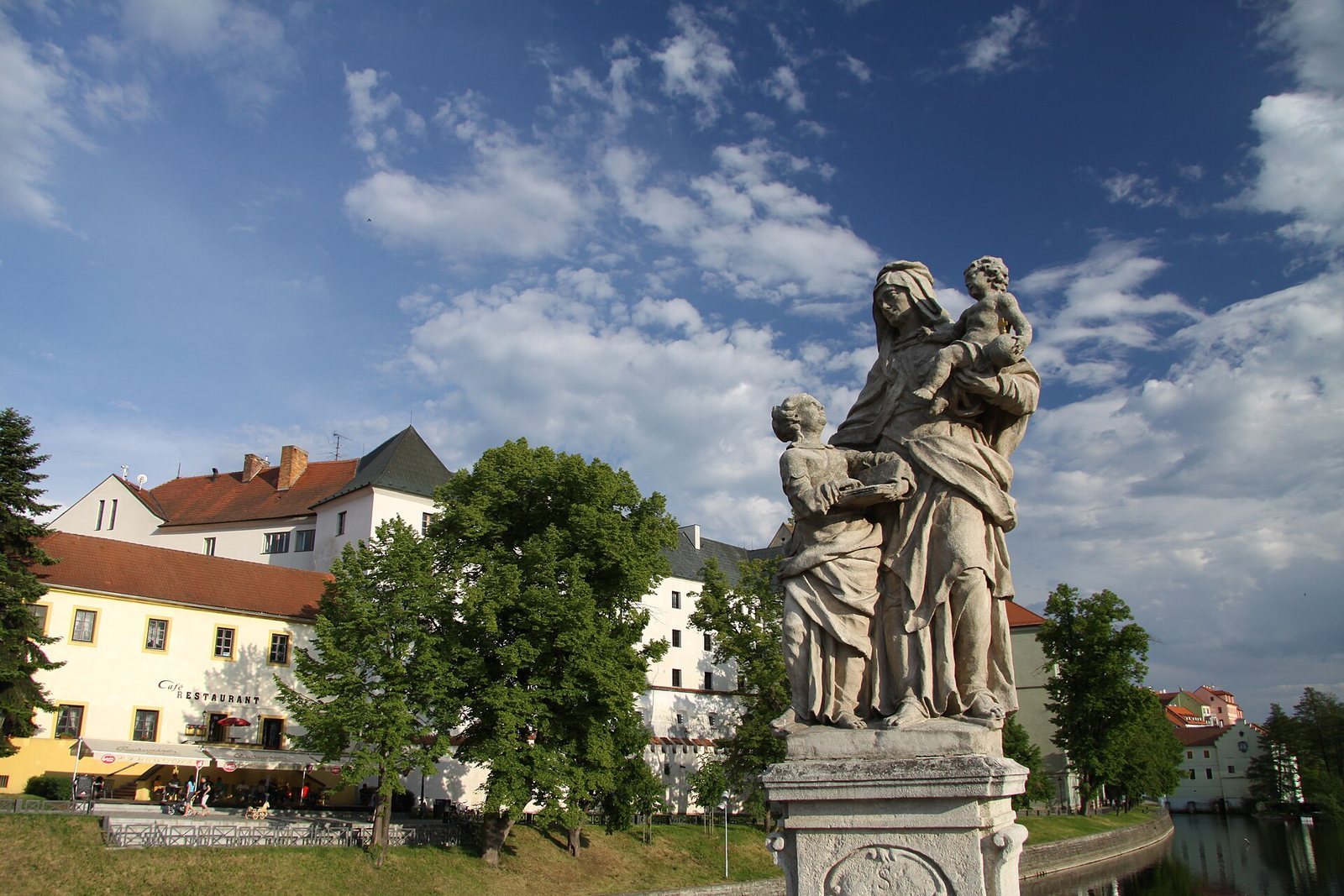
The 1770 statue of Saint Anne shows her with the infant Jesus and Mary as a young girl. Christian tradition identifies Anne as Mary’s mother. The statue of Saint Anthony of Padua, a Franciscan friar and preacher, depicts him holding the infant Jesus and a book. Both original statues are by an unknown artist.
The crucifix and its records
The original 1791 crucifix is displayed in an exhibition at Sladovna in Písek, while a faithful replica stands on the bridge. Documents found inside the crucifix during restoration include records of sculptor Karel Vlačiha’s work in 1897 to 1899 and repairs carried out from 1957 to 1959. They also include a copy of the 7 March 1959 issue of Rudé právo, a newspaper associated with Czechoslovakia’s Communist Party, and a message addressed to future generations.
Flood repairs and strengthening
The 2002 flood damaged the stone railings and dislodged several statues. Most displaced pieces and period railing stones were recovered and put back; a new replica replaced the lost angel. Later strengthening work added a concrete bed beneath the stone paving and piles drilled into the bridge and connected with reinforced-concrete rods.