Phlius: An Ancient Greek City-State in Phliasia
Site at a Glance
- Popularity
- High
- Country
- Greece
- Primary era
- Classical
- Eras represented
- Classical
- Civilizations
- Ancient Greek
- Site type
- Settlement
- Remains
- City
On this page11 sections
History
Phlius was an ancient Greek city-state near modern Nemea and Agios Georgios in Greece, and the principal settlement of the territory of Phliasia. Its wine and agricultural produce were noted in antiquity, and the city’s political history was shaped by conflict among regional powers.
Origins and traditions
Strabo describes Araethyrea, a place named by Homer, as an earlier center whose inhabitants moved roughly six kilometres to establish Phlius. The location of Araethyrea is uncertain. Pausanias gives a different sequence of names: the settlement began as Arantia, named after its founder Aras, became Araethyrea after Aras’s daughter, and was eventually called Phlius. The accounts also differ over Phlias’s ancestry. Pausanias makes him a descendant of Temenus through Ceisus, while other traditions connect him to Dionysus and Chthonophyle.
Local stories placed several legendary figures at Araethyrea. Heracles was said to have killed Kyathos, the cupbearer of Oineus, after being served poor wine. Amphiaraos, a seer and hero, was believed to have prophesied for the first time in a house shown there. Dysaules, brother of Keleos, was credited with bringing the Mysteries of Demeter, initiatory religious rites, to Araethyrea. Tradition placed his burial at Keleai, where a sanctuary of Demeter stood.
From Ionian city to Spartan ally
Phlius was first associated with the Ionians and later with the Dorians, two major Greek-speaking groups. Dorians led by Rhegnidas came from nearby Sicyon and took control of the city. Most residents remained and submitted, while others left for Clazomenae or Samos. Hippasus, an ancestor of Pythagoras, was among those linked to the migration to Samos. The city was generally governed by an aristocracy, although at times power was held by a tyrant, a ruler outside the customary constitutional order. Leon, a tyrant contemporary with Pythagoras, is known from the second half of the sixth century BCE.
Phlius sent 200 soldiers to Thermopylae and 1,000 to Plataea. Although close to Argos, it aligned with Sparta and joined the Peloponnesian League, the alliance led by Sparta. Concern about Argive expansion helped shape this policy. Phlius stayed on Sparta’s side during the Peloponnesian War, the fifth-century BCE conflict between Athens and Sparta and their allies. Its military contribution was limited in relation to a population estimated at about 5,000 male citizens.
Factional conflict and Spartan siege
A democratic government probably took shape around the beginning of the fourth century BCE, but rivalry between democratic and oligarchic factions continued. In 393 BCE, pro-Spartan exiles were outside the city, and the Athenian general Iphicrates inflicted a severe defeat on Phlius. The city appealed to Sparta, fearing that its allies might otherwise restore the exiles. A Spartan force arrived but left without changing the government.
In 383 BCE, the exiles gained Spartan backing and returned after Phlius yielded following Sparta’s destruction of Mantinea. Conflict resumed. The Spartan king Agesilaus II began a siege in 380 BCE, and Phlius surrendered in 379 BCE after a year and eight months, when its food supplies were exhausted. Agesilaus appointed a council of 100, divided equally between returned exiles and their supporters who had remained in the city. The council could sentence citizens to death and was empowered to prepare a new constitution. Phlius then had about 5,000 citizens.
Theban conflict and shifting alliances
Phlius continued to support Sparta during the Theban War, the struggle in which Thebes challenged Spartan power, though raids damaged its territory. Argive forces occupied and fortified Tricaranum above the city, while Sicyonians took Thyamia near their frontier. The Phliasians also sought to avoid direct involvement, pledging not to attack Theban targets or campaign against Sparta.
In 368 BCE, exiles joined with Arcadians and Eleans in an attempt to capture Phlius as the latter forces marched to join Epaminondas at the Isthmus. The exiles seized the acropolis, the city’s elevated center, but were driven back when they tried to enter the town. The allied troops also failed to break through the walls. The following year, a Theban commander based at Sicyon attacked Phliasian territory with support from Sicyon’s tyrant, Euphron. A ravine prevented the invading forces from joining up, and the Phliasians defeated them. Athens later sent its general Chares to help; Phlius and Athens formed an alliance in 362 BCE.
Macedonian and Hellenistic era
Phlius joined the alliance of Greek states organized by Philip II of Macedon in 337 BCE. Its position in the Lamian War, a Greek revolt against Macedonian rule in 323–322 BCE, is uncertain. Demetrius I Poliorcetes captured the city in 303 BCE. Phlius later came under tyrants. Cleonymus gave up power when the city joined the Achaean League, a confederation of Greek cities, around 229–228 BCE at the urging of Aratus of Sicyon. Cleomenes III of Sparta briefly occupied Phlius in 225 BCE; the city allied with Sparta again under him in 224 BCE. Macedonian troops devastated the surrounding countryside in 197 BCE. These events fell within the Hellenistic era, the period from Alexander the Great’s death in 323 BCE to the Roman conquest of Egypt in 30 BCE.
Phlius was the birthplace of the dramatist Pratinas, credited with introducing or inventing satyr drama, a Greek dramatic form featuring a chorus of satyrs. He competed with Aeschylus for a prize at Athens. Pratinas’s son Aristias was also a dramatist, and his tomb stood in the agora, the city’s public gathering place and marketplace. Other people associated with Phlius included the painter Kleagoras, the aristocrat Prokles, the musician Thrasyllos, the philosopher and poet Timon, who lived about 320–230 BCE, and Axiothea, a female student of Plato.
Echecrates of Phlius appears in Plato’s Phaedo. The dialogue’s strong Pythagorean influence has prompted the suggestion that it depicts a gathering of Pythagoreans at Phlius, and Diogenes Laertius also describes a Pythagorean group there. Pausanias described the city’s religious places and public buildings. A sanctuary of Hebe, also associated in this tradition with Ganymeda, was linked to asylum, a place offering protection, and to a festival called Kissotomoi, meaning ivy-cutting.
In 1460, Ottoman forces caused major damage in the region after treating it as a center of resistance to their expansion.
Remains
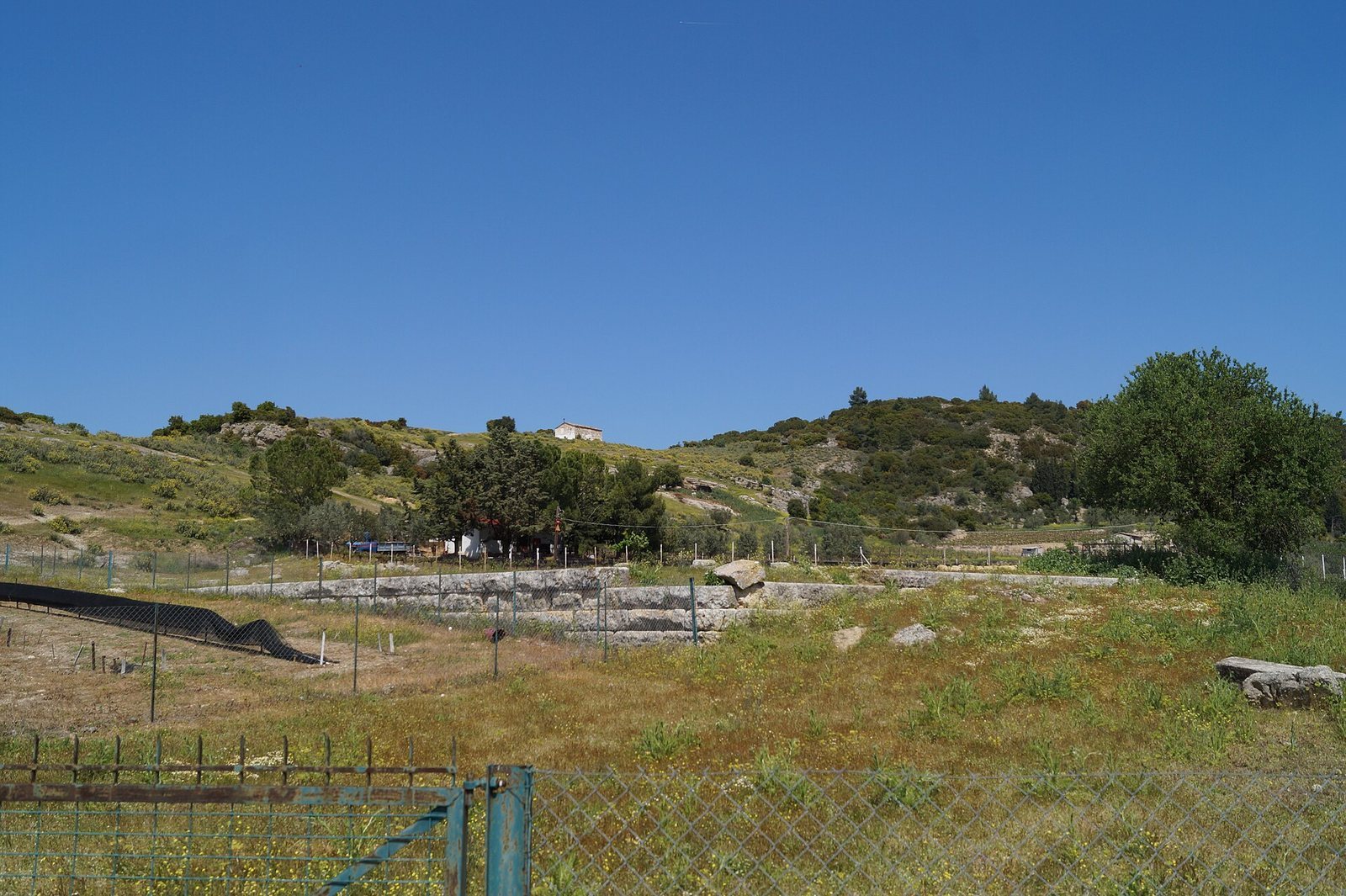
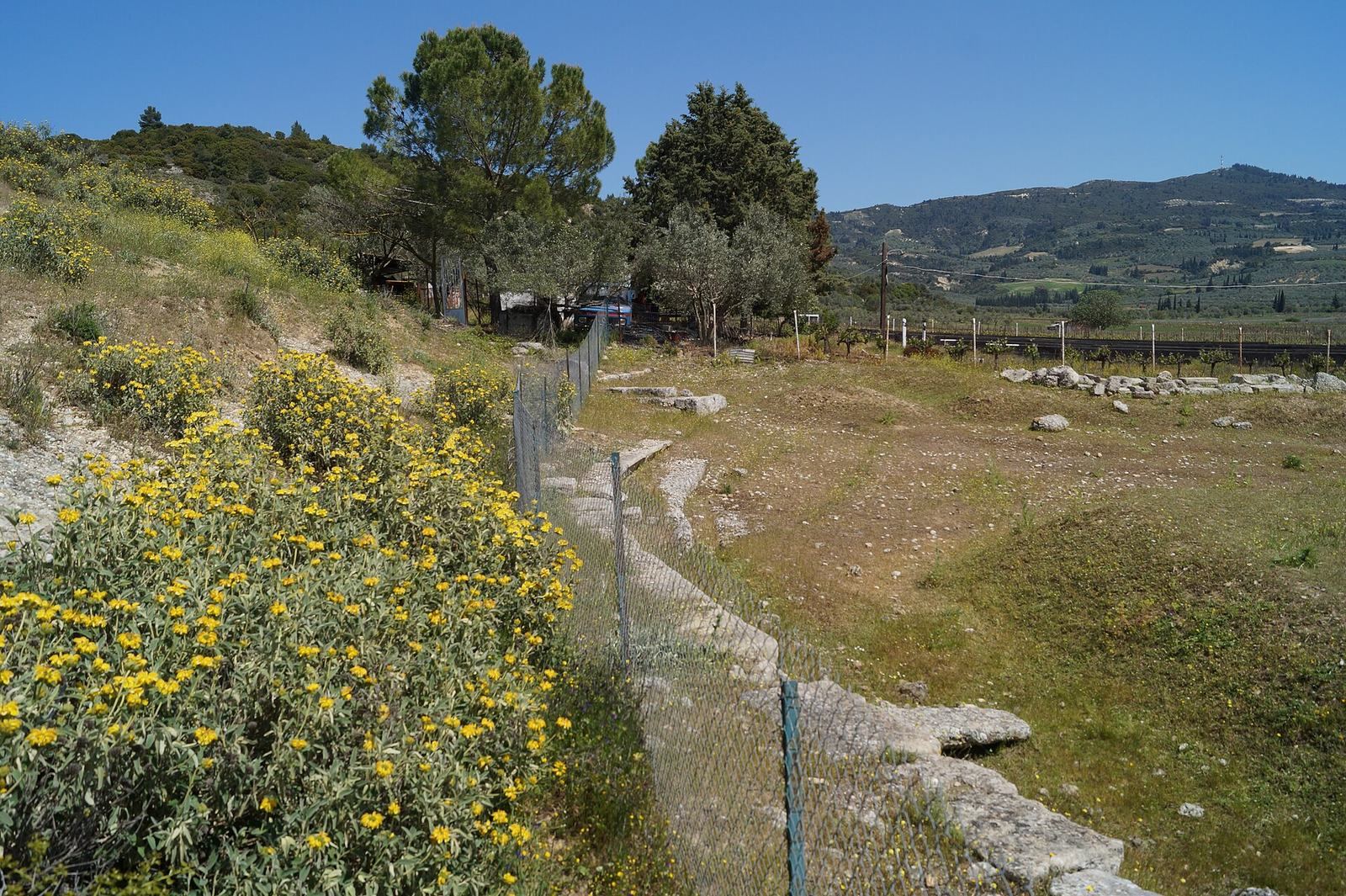
The ancient city occupied a hill in the Phliasian plain, within a valley about 270 metres above sea level. Mountains enclosed the valley, whose streams flowed into the Asopus River. The river’s principal spring rose on a southern mountain called Carneates. A road followed the Asopus north toward Sicyon. The remains include sections of the city wall and theatre above ground, along with the eastern, or Corinthian, gate uncovered by excavation. Excavations on the city hill also revealed a small temple, possibly dedicated to Demeter, and a Hellenistic-period basilica, a large public hall.
Sanctuaries and civic places
Acropolis sanctuaries
On the acropolis, Pausanias described a sanctuary of Hebe, or Ganymeda in this local tradition, within a cypress grove, as well as a temple of Demeter. The name Ganymeda here refers to Hebe, not to the male mythological figure Ganymede. The sanctuary’s association with asylum and the Kissotomoi festival forms part of its religious history. Pausanias also noted a temple of Hera with a marble statue of the goddess.
Temples below the acropolis
Descending from the acropolis, Pausanias placed a temple of Asclepius, the god of healing, to the right. Farther down stood another temple of Demeter. These landmarks formed part of the sequence of religious buildings between the elevated center and lower parts of the city.
Agora and tomb of Aristias
The agora contained public buildings and the tomb of Aristias, son of Pratinas. Its remains belong to the civic center described by Pausanias.