Motako Gaztelua-Castillo de la Mota: San Sebastián’s Historic Fortress


Site at a Glance
- Rating
- 4.6
- Popularity
- Medium
- Country
- Spain
- Primary era
- Early Modern
- External website
- Open
- Eras represented
- Medieval, Early Modern, Modern
- Civilizations
- Crown of Castile, Kingdom of Navarre, Spanish
- Site type
- Military
- Remains
- Castle
On this page16 sections
History
Motako Gaztelua-Castillo de la Mota is a defensive complex in Spain, on Mount Urgull above San Sebastián, founded and developed by Navarrese and Castilian rulers to protect the town from attacks by land and sea. Sancho VI of Navarre founded San Sebastián in 1180 on the site of an earlier settlement and monastery. In 1194, his successor Sancho VII the Strong ordered the construction of the first fortress and an extension of the town walls.
Navarrese and Castilian foundations
A defensive tower on Mount Urgull is traditionally attributed to Sancho III of Navarre in the eleventh century. The fortress was rebuilt and strengthened in 1194, and further work took place during the reign of Alfonso VIII of Castile. In 1200, San Sebastián and the rest of Gipuzkoa passed to Alfonso VIII. Alfonso X of Castile donated the castle to Joan I of Navarre in 1284, but it returned to Castilian control at the end of the thirteenth century. Fernando IV and John II of Castile later maintained and reinforced its defenses.
The fortress was tested repeatedly during the late fifteenth and early sixteenth centuries. French and Portuguese forces besieged San Sebastián in 1476 but failed to capture it, as the town resisted and the fortress held its defenses. The Catholic Monarchs, Isabella I of Castile and Ferdinand II of Aragon, then ordered the walls and surrounding defenses to be strengthened. A further French siege, led by the Duke of Bourbon in 1512, also ended without success.
Reforms and eighteenth-century siege
During the sixteenth century, a gallows was installed in the keep, the principal fortified tower, traditionally known as the Macho. It was used to execute wrongdoers and to shame them publicly, with the purpose of deterring others.
Major reforms in the seventeenth century, associated with Tiburcio Spanochi, gave the fortress much of its present configuration. In 1688, a storm caused an explosion and fire in the powder magazines. The architect Hercules Torrelli prepared new plans and directed the reconstruction that followed.
On 4 July 1719, a large French army commanded by the Duke of Berwick began the siege of San Sebastián. Bombardment of the town started on 27 July, and much of the population took refuge in the castle on 1 August. The town surrendered that day, but the castle continued to resist for more than two weeks. On 17 August, a fire in the arsenal spread through the fortress and forced its defenders to surrender. The French occupation ended on 26 August 1719.
The Peninsular War and later defenses
French troops occupied San Sebastián on 8 July 1808 during the Peninsular War, the Iberian phase of the wider Napoleonic Wars fought mainly between French forces and an alliance that included Spanish, Portuguese, and British troops. Anglo-Portuguese forces under the Duke of Wellington recovered the city after the siege of 1813. San Sebastián was burned on 31 August, while the castle remained under bombardment until 8 September. Its garrison then surrendered, and 1,836 prisoners were captured.
The fortress continued to serve a defensive purpose during the Carlist Wars, nineteenth-century Spanish civil wars involving competing claims to the throne. The demolition of San Sebastián’s town walls began in the 1860s, after the city ceased to be regarded as a fortified stronghold. Defensive works were subsequently added on Mount Urgull because the removal of the walls left the city more exposed.
Decline and civic preservation
Changes in military technology during the nineteenth century progressively reduced the castle’s strategic value. Its defensive function declined, and by the twentieth century the system had become obsolete and was gradually abandoned. On 25 August 1921, San Sebastián’s municipal government purchased Mount Urgull from the Spanish army and converted it into a park. The castle received heritage protection during the 1920s, including National Monument status and architectural-artistic protection in 1924. It also received provincial historical-artistic protection in 1964. The municipality has owned the site since 1921, and restoration began in 1963 after the complex had deteriorated.
A 24-metre monument to the Sacred Heart was installed on the summit in the 1950s. The complex now also contains the House of the History of Urgull, a museum devoted to the history of the fortress and the city within the San Telmo Museum institution.
Remains
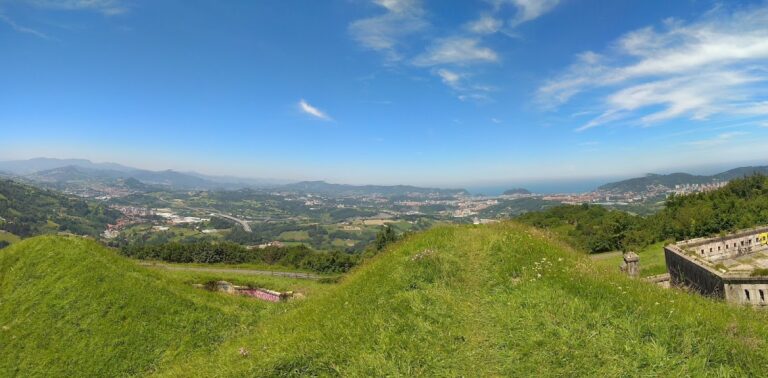
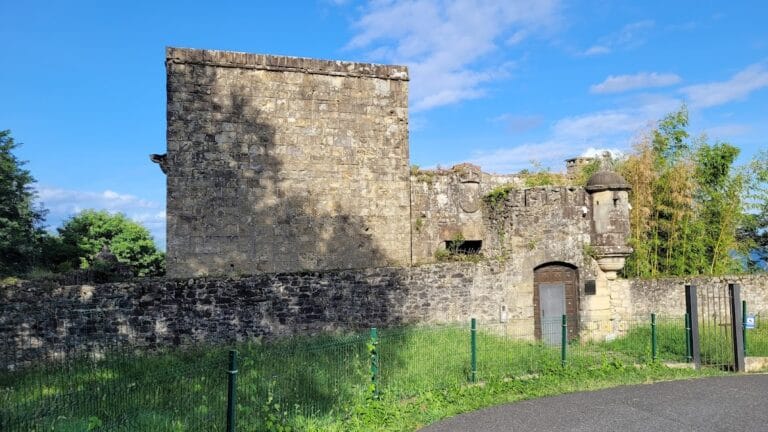
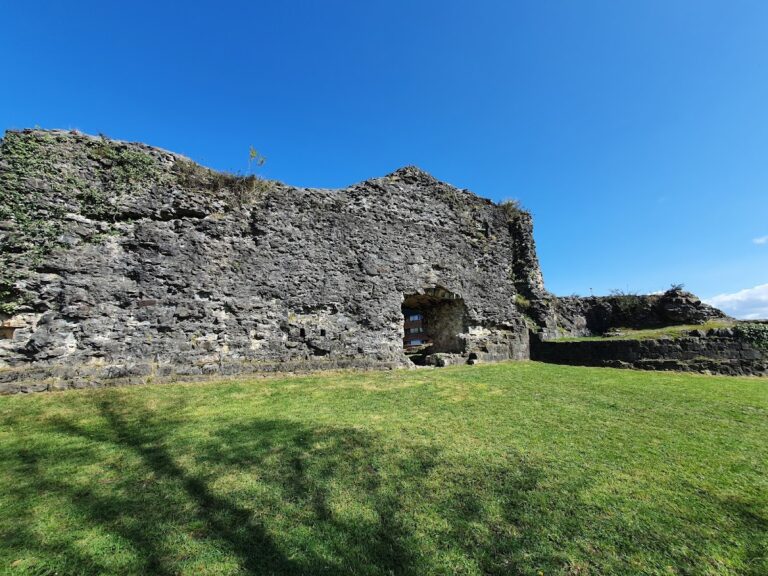
The complex occupies the summit of Mount Urgull, approximately 120 metres above San Sebastián, with another description placing the mountain at 88 metres above sea level. Cliffs surround most of the mountain and provide a natural defense. The southern side, facing the city, forms the principal accessible approach. The fortress is divided into several areas and includes strongholds, gun embrasures, artillery batteries, walls, the keep, and other defensive works.
Summit and principal strongholds
The Macho and Christ of La Mota
The principal tower or keep is traditionally called the Macho. Its area may occupy the same rock associated with an eleventh-century castle tower, and the Sacred Heart monument now stands there. A chapel dedicated to the Christ of La Mota also occupies this part of the complex. Its construction date is unknown, and it was destroyed in the 1688 explosion of the powder magazines.
El Mirador
El Mirador, meaning the Viewpoint, is a prominent seventeenth-century stronghold. Foundations survive between the Santa Teresa convent and the El Mirador bastion, a projecting defensive structure designed to support fire along the faces of a fortification.
Artillery batteries and walls
Named batteries
The surviving defensive system includes the Queen’s Battery, Napoleon’s Battery, the Ladies’ Battery, Santa Clara Battery, the Governor’s Battery, and Bardoca Battery. The Queen’s and Napoleon’s batteries were built during the Napoleonic Wars. Bardoca Battery was constructed after the Duke of Berwick’s attack on San Sebastián in 1719.
Spanochi wall
Only the gateway front of the seventeenth-century Spanochi wall remains standing at the site known as the Priests’ Walk. Its surviving masonry forms part of the larger network of walls and defensive positions that shaped the fortress after the seventeenth-century reforms.
Burials and later institutions
English Cemetery
The English Cemetery lies on the northern side of Mount Urgull. It contains the graves of English officers who fought with Allied forces during the Peninsular War or served in English legions during the Carlist Wars.
Sacred Heart monument
The summit monument to the Sacred Heart is 24 metres high and occupies the area traditionally associated with the Macho. Its position places a twentieth-century religious monument within the historic upper defensive area.
House of the History of Urgull
The House of the History of Urgull occupies a building within the castle complex. It presents objects from earlier periods and uses audiovisual material in Basque, Spanish, and English to explain the history of the fortress and San Sebastián. The entrance is located behind the cannon known as Rosita Wicke.