Othem Church: A Medieval Parish Church on Gotland


Site at a Glance
- Rating
- 4
- Popularity
- Very Low
- Country
- Sweden
- Primary era
- Medieval
- External website
- Open
- Eras represented
- Medieval, Early Modern, Modern
- Civilizations
- Danish, Swedish
- Site type
- Religious
- Remains
- Church
On this page13 sections
History
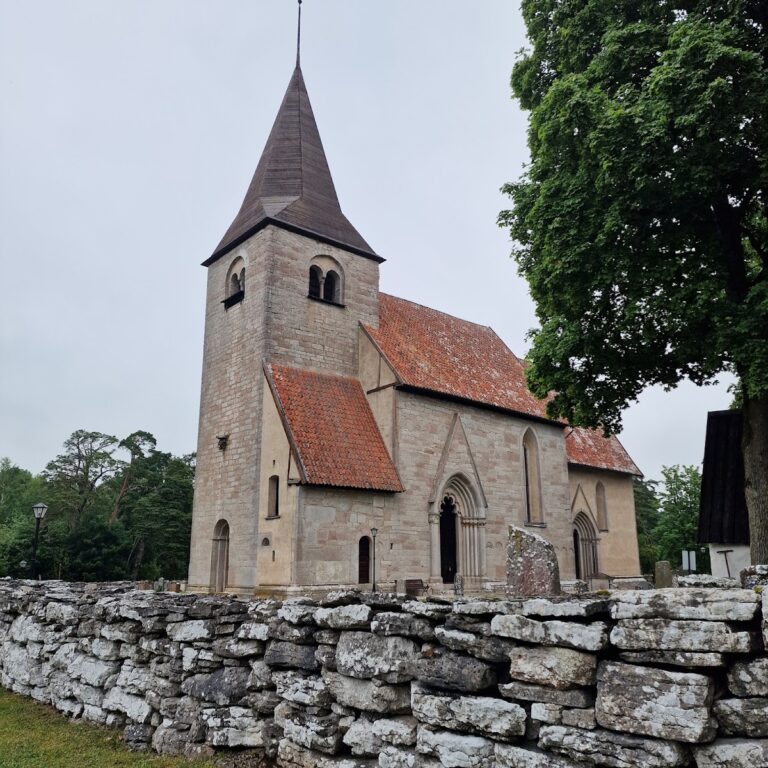
Othem Church is a medieval parish church in Sweden, located in northern Gotland near Slite. It belongs to Othem-Boge parish in the Diocese of Visby and stands about 29 kilometres northeast of Visby. The present limestone church took shape during the 13th century in a relatively plain Gothic form, while retaining elements of an earlier Romanesque building tradition.
Origins and medieval construction
Archaeological work beneath the church has revealed traces of a 12th-century building. At least one stone church stood on the site before the present structure, probably erected in the late 12th century or shortly before 1200. Its surviving features include the Romanesque north portal and a heavily weathered baptismal font made around 1200.
The lower part of the tower was added to this earlier church during the first half of the 13th century. Work on the present church then replaced the nave and chancel while incorporating the older tower. The upper part of the tower was completed during this rebuilding, and construction and decoration were probably finished around 1265.
Wall paintings and religious use
The church vaults received medieval paintings around the 1240s, with further decoration added around 1330 and near the turn of the 15th century. The medieval paintings were covered with whitewash in 1693, when a sandstone altar was installed in the chancel. Their later recovery revealed several phases of religious art within the medieval building.
Saint Denis may have been the church’s medieval patron saint. His presence in the later wall paintings, where he appears carrying his severed head, connects the church’s imagery with the Christian tradition of Denis as a martyr and the first bishop of Paris. Medieval funerary monuments also remained associated with the church, including rune-inscribed stones commemorating Halvard of Angabo and Niklas of Kikin, as well as a grave slab marking the original burial of the priest Nicolaus, who died in 1338.
Fire, restoration, and later furnishings
Othem Church suffered a major fire during a night in March 1908. Wooden elements in the tower, nave, and chancel were destroyed. The bell was used to raise the alarm before it fell and broke, while church silver, old documents, and other loose furnishings were saved. The fire was probably caused by a rupture in the heating system.
A new roof was placed over the nave and chancel in 1909. During the same work, the medieval paintings were uncovered beneath the whitewash and restored. The building was restored again in 1952 following a proposal by the architect Erik Fant, renovated in 2000, and repaired at the top of the tower in August 2004.
The church’s later furnishings include an altar donated in 1693 by Mårten Fries and Margareta Schröder, a pulpit installed in the 1730s, pews added around 1740, and a gallery built in 1774. Johan Nicolaus Weller, a sergeant and church painter, painted the gallery parapet in 1776.
Anders Vilhelm Lindgren of Stockholm built the original organ in 1854 with ten stops, the controls that determine the organ’s range of sounds. A pneumatic organ with eleven stops was installed behind Lindgren’s facade in 1924 by Mattias Johan and Harald Lindegren of Gothenburg. In 1983 and 1984, A. Mårtenssons orgelfabrik of Lund installed a mechanical organ with fourteen stops behind the same facade. The 1854 facade remains in place.
Remains
Building and exterior
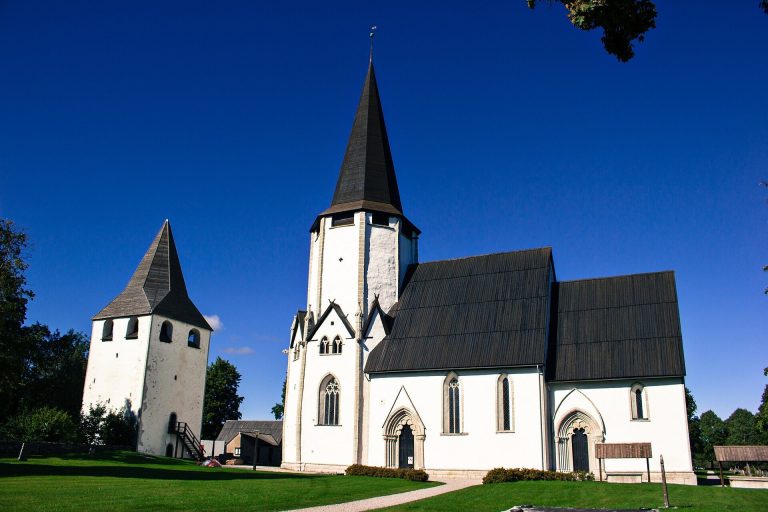
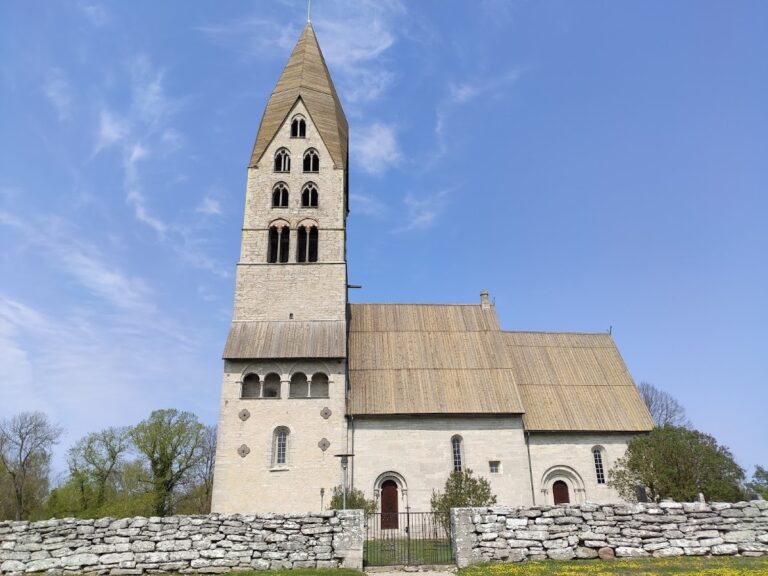
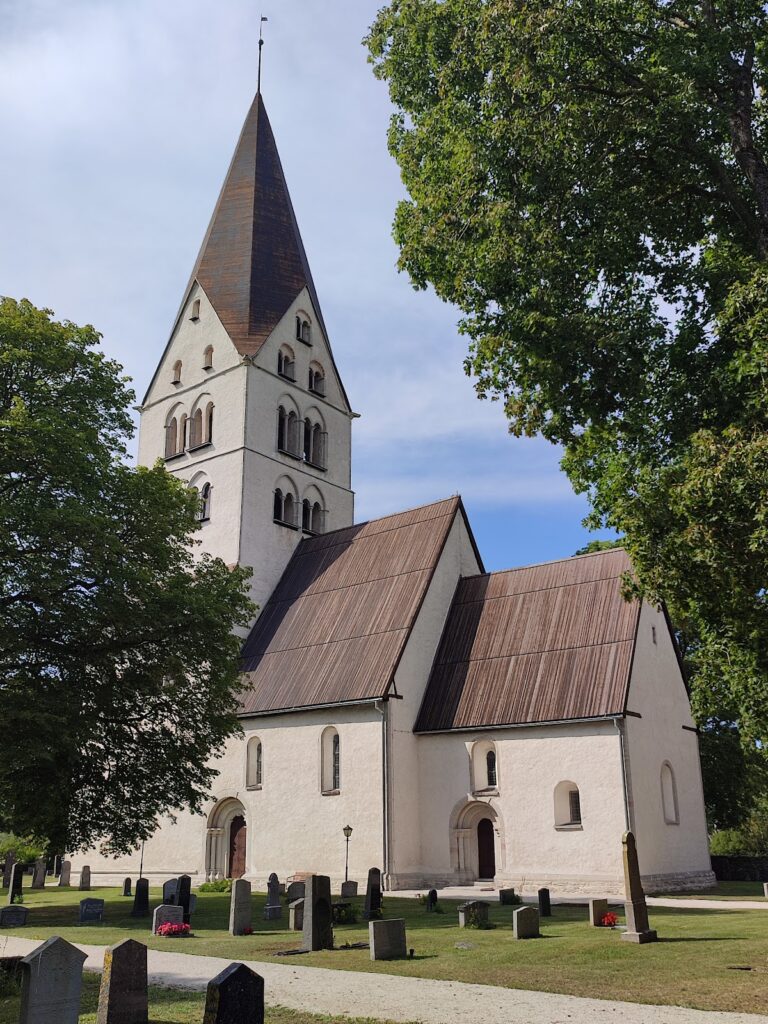
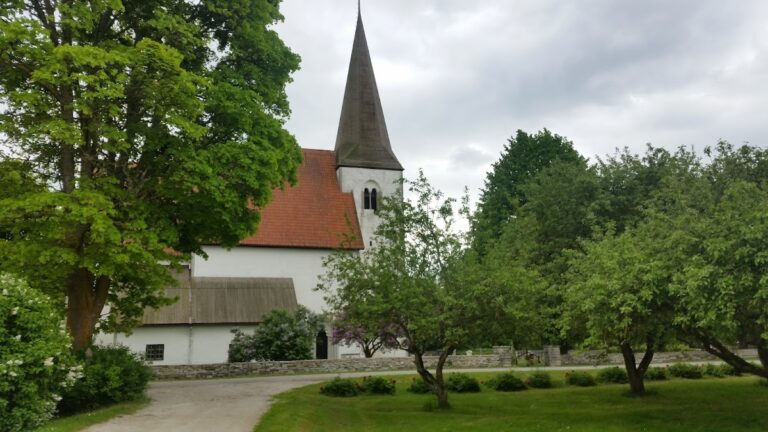
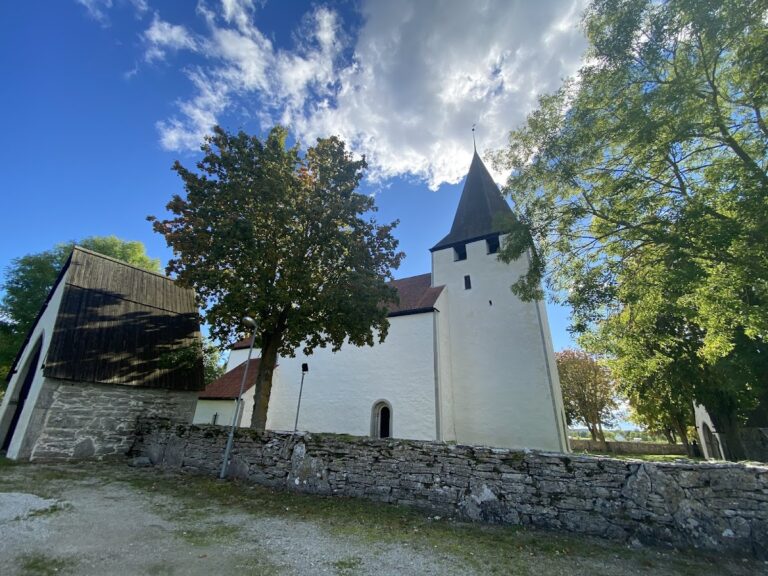
Othem Church is a white-plastered limestone building that combines the massive masonry and round arches associated with Romanesque architecture with the pointed arches of a later Gothic form. The nave is nearly square, the chancel is narrower and lies at the eastern end, and a pointed western tower completes the structure. The tower has paired round-arched openings arranged on three levels. Its lower section belongs to the phase connected with the earlier stone church, while its upper portion was completed during the construction of the present building.
South portals
Two entrance portals open on the south side. Both have pointed arches and cusped tympanum contours, meaning decorated areas within or above the portal arches. Their capital bands carry carved plant ornament. The larger nave portal has a pointed ornamental gable called a wimperg, while the chancel portal has more finely worked details.
North portal and later additions
A restored Romanesque portal survives in the north wall of the nave as a remnant of the earlier church. It is now closed and has no ornament. The sacristy, an ancillary room for vestments and church furnishings, stands north of the chancel and was added in 1882. Some windows on the southern sides of the nave and chancel were altered during the same period. A single unusually massive buttress supports the middle of the nave’s south wall.
Nave and chancel
Nave
The nave, the main body of the church, is almost square and is divided into four square bays by a central round pillar. Its capital is covered with relief carving and closely resembles the corresponding capital at Hellvi Church. This likeness may indicate that the Gotlandic master builder and sculptor Lafrans Botvidarsson also worked at Othem.
Chancel
The chancel is a single bay with rounded diagonal ribs. Its sandstone altar dates from 1693 and depicts the Crucifixion of Jesus. A triumphal cross showing Christ as the victorious crucified figure hangs in the chancel arch. Several medieval grave slabs are set into the chancel floor, including two with runic inscriptions.
Medieval paintings
Paintings from the 13th, 14th, and 15th centuries survive inside the church. The earliest decoration covers the vaults and may have been created as early as the 1240s. The best-preserved scene in the easternmost vault shows the Tree of Life rising from a stream in the Garden of Eden. Other painted elements include trees, decorated ribs, birds representing human souls, evil powers disguised as hunters shooting arrows, and a flying dragon opening its jaws toward the Tree of Life. Christ watches over the scene from a medallion beneath the tree.
A finely executed image of Mary with the Christ Child was added to the northern side of the chancel arch around 1330. Near the turn of the 15th century, the painter known as the Othem Master depicted Christ as King surrounded by disciples. The apostles Paul and Saint Denis appear on either side of the altar, with Denis holding his severed head.
Font, sculpture, and funerary monuments
The baptismal font made around 1200 is the oldest surviving object in the church. It was probably carved by Sighraf, a Romanesque Gotlandic stoneworker known for religious sculpture, and may originally have served the earlier church on the site. A modern wooden sculpture of Mary with the Christ Child, made by the Swedish artist Bertil Nyström of Slite, stands above the font.
The medieval grave slabs and rune-inscribed stones preserve names and memorial traditions linked to the church’s earlier community. Together with the surviving font, the Romanesque north portal, and the layered wall paintings, they connect the present building with the church that occupied the site before the 13th-century rebuilding.