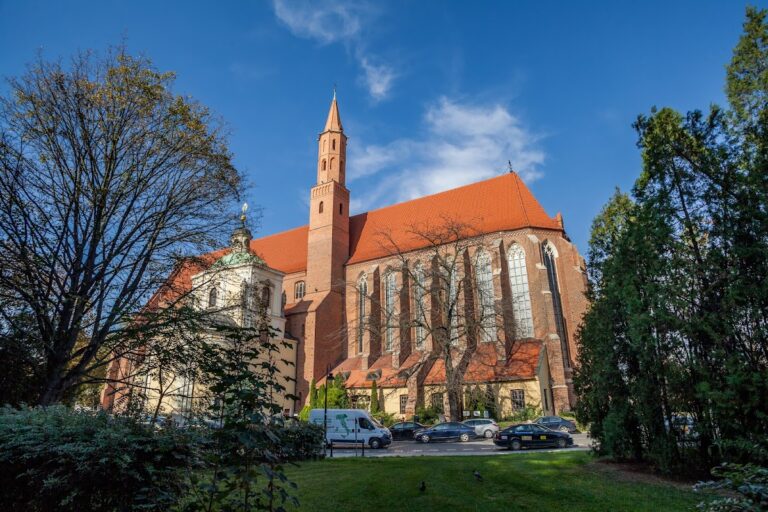
Orthodox Cathedral of the Nativity of the Virgin Mary in Wrocław: A Gothic Church and Orthodox Cathedral


Site at a Glance
- Rating
- 4.8
- Popularity
- Low
- Country
- Poland
- Primary era
- Medieval
- External website
- Open
- Eras represented
- Medieval, Modern
- Civilizations
- Holy Roman Empire, Kingdom of Bohemia
- Site type
- Religious
- Remains
- Cathedral
On this page15 sections
History
The Orthodox Cathedral of the Nativity of the Virgin Mary in Wrocław, Poland, is a Gothic church whose present building developed from a Catholic cemetery chapel and later became the cathedral of the Wrocław–Szczecin Diocese. Its history reflects the religious changes of Silesia, from Catholic parish use through Protestant worship to its present role in the Polish Autocephalous Orthodox Church.
Medieval Catholic origins
The site was occupied by a Catholic cemetery chapel built in the thirteenth century. The chapel belonged to the parish of St. Elizabeth from 1303 and burned before 1400. It was subsequently rebuilt and enlarged, producing the Gothic Church of St. Barbara around 1400–1414. The church served as a filial church, meaning a dependent church linked to a larger parish, and as the funerary church of St. Elizabeth.
Wenceslaus, the Piast duke of Sagan, was buried there in 1488. The Piasts were a medieval Polish and Silesian ruling dynasty, while Sagan is the historical German name of Żagań, a town and former duchy in Silesia.
Reformation and garrison use
In 1526 the church passed to Protestant worship and remained Protestant until 1945. From 1741 to 1920 it also served as a garrison church. This period linked the building to the military community stationed in the city while preserving its role as a place of Christian worship.
Wartime destruction and reconstruction
The building suffered extensive damage during the Battle of Breslau at the end of the Second World War. About 70 percent of the church was damaged. The roofs burned, the vaults collapsed, and the furnishings and medieval painted decoration were lost. After the war, the Protestant congregation was expropriated, and the church was secured before reconstruction took place in 1959–1961.
In June 1963 the reconstructed building was transferred to the Polish Autocephalous Orthodox Church, an Eastern Orthodox church with administrative self-government. It became the cathedral of the Wrocław–Szczecin Diocese, an ecclesiastical territory governed by a bishop, and it remains an active Orthodox cathedral. It is also the seat of the Nativity of the Mother of God parish, while the Exaltation of the Cross is identified as a military parish.
The church entered Poland’s register of monuments in 1947 under number 11 and again in 1961 under number A/288/15. Its facade was restored in 1963–1965, the towers were renovated in 1985, the roof covering was replaced by 1994, and another renovation took place in 2015. The cathedral’s dedication is the Nativity of the Most Holy Mother of God, commemorated on 8/21 September. In November 2019, a six-armed cross was installed on the taller tower.
Remains
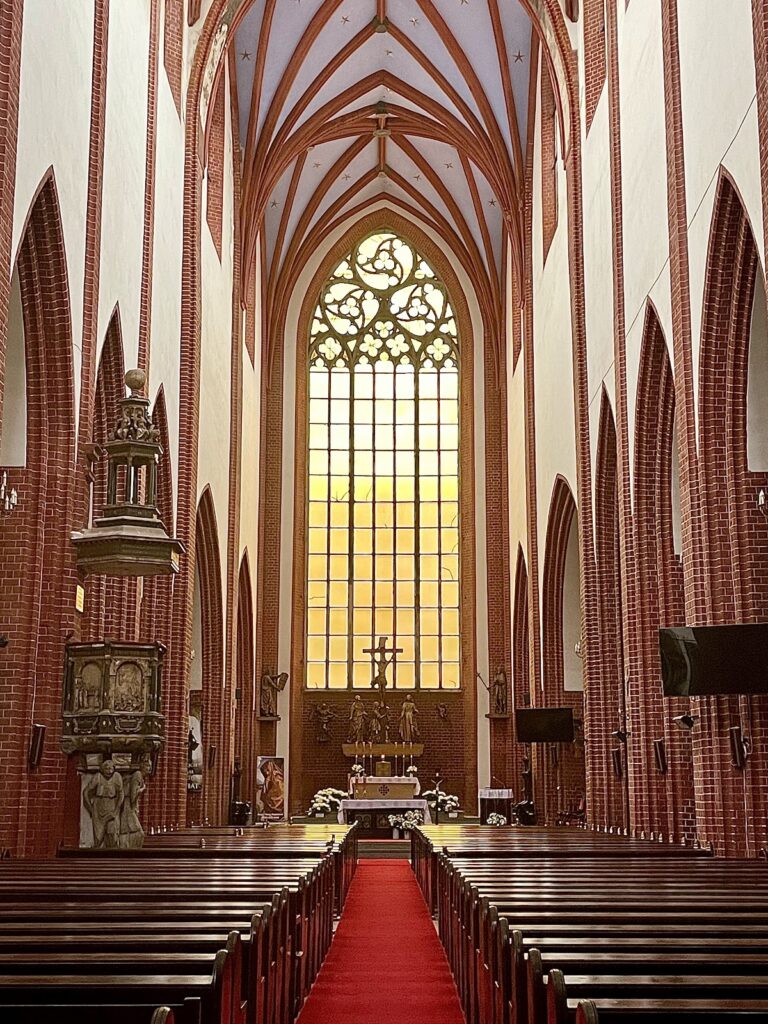
The former Church of St. Barbara is a three-nave Gothic brick building approximately 32.7 metres long and 24.6 metres wide. Its western side has two towers on square plans, positioned along what is now All Saints Street behind the neighboring Józef Babiński Voivodeship Hospital. The southern tower stands at the corner of St. Nicholas Street and reached its planned height, while the other rises no higher than the church walls.
Church structure and decoration
Towers and exterior sculpture
The two western towers form the main surviving vertical elements of the church. The taller southern tower carries the six-armed cross installed in 2019. A statue of St. Barbara formerly stood on the southern exterior. The church was once richly ornamented with carved work and paintings on its walls and ceilings, while the present interior includes frescoes produced under the direction of Jerzy Nowosielski, a Polish painter associated with modern religious art, Orthodox icon painting, and church decoration.
Gothic high-altar retable
The Gothic high-altar retable, an ornamental altar structure with painted or carved religious scenes, includes scenes from the Life of St. Barbara, the Passion of Christ, and Christ’s triumph. It is incomplete and is held in the National Museum in Warsaw. Its wings have been missing since 1945.
Medieval memorials and painting
A 1410 epitaph of Barbara Polani, a commemorative funerary monument showing the Virgin Mary and the Man of Sorrows, is held in Warsaw collections. The Man of Sorrows represents the suffering Christ. A Vera Icon painting from around the middle of the fifteenth century is held in the National Museum in Wrocław.
Orthodox furnishings
Main iconostasis
The iconostasis before the main altar is a carved wooden screen of icons separating the sanctuary from the main worship space in an Eastern Christian church. Made in Thessaloniki in 2019, it incorporates icons from the previous iconostasis, including works by Jerzy Nowosielski, Adam Stalony-Dobrzański, and Sotiris Adamopoulos.
Side-altar iconostasis
The iconostasis before the side altar came from the dismantled Church of St. Nicholas in Sosnowiec, which was demolished in 1938. Since December 2019, the cathedral has also contained two kiots, cases or shrines for icons, and three analogia, stands used for icons or liturgical books, made in Thessaloniki.
Clock and tower timekeeping
Kluskowy Clock
A reconstructed Kluskowy Clock, also called the Kließelseeger or Klößezeiger, is installed on one of the cathedral towers. The clock was reconstructed in 2014 after being destroyed during the Second World War. Before 1945 it was approximately fifteen minutes slow. Two smaller sundials are also associated with the tower.
The dumpling legend
The clock’s name is connected with a Wrocław legend. Housewives supposedly put Silesian dumplings into boiling water when the central-city bells rang and removed them when the delayed church clock struck. The delay was said to produce perfectly cooked dumplings.