Orsanmichele: Florence’s Guild Church and Former Grain Market


Site at a Glance
- Rating
- 4.6
- Popularity
- Medium
- Country
- Italy
- Primary era
- Medieval
- External website
- Open
- Eras represented
- Medieval, Early Modern, Modern
- Civilizations
- Grand Duchy of Tuscany, Republic of Florence
- Site type
- Civic
On this page18 sections
History
Orsanmichele is a communal building and church in Florence, Italy, built and transformed between the thirteenth and fifteenth centuries through the work of the city’s government, guilds, and religious institutions. Standing between the civic center at the Palazzo della Signoria and the Cathedral, it brought together the functions of a grain market, municipal storehouse, guild hall, and place of worship.
From garden church to grain market
Orsanmichele’s name derives from San Michele in Orto, meaning Saint Michael in the Garden. Tradition places a women’s monastery, kitchen gardens, and a small church dedicated to Saint Michael on the site, although this early medieval foundation is not archaeologically established. The church was demolished around 1240 to make way for a grain market connected with the nearby Mercato Vecchio.
Florence’s central grain market operated at Orsanmichele from approximately the middle of the thirteenth century until the later fourteenth century. An open loggia was constructed between about 1284 and 1290, probably under the direction of Arnolfo di Cambio, a leading Florentine architect and sculptor. Its covered space accommodated trading and storage and formed part of the city’s broader development of public and private loggias.
A Marian image associated with the earlier church or another predecessor building was venerated at the loggia as miraculous. In 1291, the lay Confraternity of Orsanmichele was founded to organize devotion to the image, administer donations and votive offerings, and sing religious praises after the market closed on evenings, Sabbaths, and holidays.
Fire, rebuilding, and civic devotion
On 10 July 1304, factional conflict between the Neri and Bianchi factions led to a fire that destroyed the loggia, the venerated Marian image, and much of the surrounding neighborhood. Bernardo Daddi painted a new enthroned Virgin and Child in 1347. The image inherited the earlier Madonna’s miraculous reputation and became the focus of the rebuilt building’s devotional life.
The expulsion of Gualtieri VI of Brienne, Duke of Athens, from Florence on Saint Anne’s Day in 1343 gave Orsanmichele another civic and religious association. The guilds had played a role in the uprising, and an altar to Saint Anne was dedicated in the building. The guilds traditionally decorated the church with their flags on the anniversary of the event.
On 25 September 1336, the city council ordered a representative structure that would combine religious and communal purposes and display Florence’s civic magnificence through art. Its foundation stone was laid on 29 July 1337. The project involved the cathedral works and the builders Simone Talenti, Neri di Fioravante, and Benci di Cione, while earlier phases had also been associated with Arnolfo di Cambio.
The new structure initially retained a ground-floor grain market, while its upper levels were intended for communal storage and guild-related uses. Construction was interrupted by the economic crisis connected with the plague of 1348, then resumed and continued into the early fifteenth century. The upper construction and crowning are generally placed between 1404 and 1406, although the final closure of the loggia is also dated around 1420.
Transformation into a guild church
Between approximately 1380 and 1404, the ground floor changed from a market loggia into a church for the guilds, dedicated to the Virgin and Saint Anne. The market moved elsewhere, and the arcades were progressively closed with masonry and delicate Gothic tracery from 1367 onward. The two upper floors continued to serve municipal storage and other administrative purposes.
In 1352, Andrea di Cione, known as Orcagna, began the marble tabernacle for Daddi’s painting. Completed in 1359, it was financed by the exceptional donations and bequests received by the confraternity, particularly after the plagues of 1340 and 1348. The tabernacle became the architectural and devotional focus of the church.
Florence’s major guilds were assigned spaces for statues of their patron saints from 1339 onward. A civic decision in 1406 required the guilds to commission the figures, producing a sculptural program made largely between 1399 and 1428 and extended by later replacements. Florence’s Arti were powerful occupational corporations that regulated trades, represented members in civic government, and sponsored religious and artistic works. At Orsanmichele, their patron statues expressed devotion, civic identity, and the competitive pride of the trades.
Municipal reuse and modern conservation
In 1569, Cosimo I de’ Medici installed the Archive of Contracts and Wills in the upper floors, which had not ultimately been used for grain storage. Buontalenti adapted the halls and built an arched passage to the adjacent Palazzo dell’Arte della Lana. The bridge and portal survive, while the associated staircase was demolished in the early twentieth century.
During the late eighteenth and nineteenth centuries, many marble statues received an artificial dark coating intended to make them resemble bronze. Restoration campaigns from 1834 to 1853 addressed the roofs, facades, structural supports, windows, and attic decoration. From 1883, the archive was transferred elsewhere, internal superstructures were removed, and a new floor was created to address cracks in the groin vaults. Proposals to reopen the ground-floor loggia or demolish the neighboring guild palace were rejected.
Donatello’s Saint George became the first Orsanmichele statue moved to the Museo Nazionale del Bargello in 1891. During preparations for aerial conflict in 1941, some statues were removed, others were protected with scaffolding and sandbags, and the building received a detailed photographic campaign. A structural and decorative program carried out from about 1960 to 1967 addressed the building’s stability and added a modern stair around an ancient pillar between the first and second floors.
From 1984 to 2005, the exterior stonework and guild statues underwent systematic examination and restoration, principally through the Opificio delle Pietre Dure and other Florentine laboratories. The work revealed earlier linseed-oil patination, traces of gilding on marble figures, gilding on bronze figures, and silver inlays in the eyes of Ghiberti’s Saint Matthew. The original exterior sculptures were moved indoors and faithful copies placed in the niches. Florence’s historic center had been nominated as a World Heritage Site in 1982, a designation that helped prompt the conservation program for Orsanmichele’s marble and bronze statuary.
The Museo e chiesa di Orsanmichele became part of Florence’s museum system in 2005 and, after the 2015 reform of museum autonomy, joined the Musei di Bargello. The church resumed regular liturgical service as a rectory in 2006 and is also used for liturgies of the Archconfraternity of the Parte Guelfa, a Florentine institution associated with the papal-aligned Guelf faction. The oratory became accessible again in January 2024 after extensive restoration.
Remains
Orsanmichele occupies a rectangular urban block bounded by the Via Calzaiuoli, Via dell’Arte della Lana, Via dei Lamberti, and Via Orsanmichele. Its base measures approximately 32.4 by 22.1 meters, and the building rises about 40 meters in three broadly uniform floors. Its form combines a former grain market, guild hall, church, and municipal granary rather than a fortified palace or private tower.
Exterior and former market structure
Arcades and upper floors
The ground floor began as an open loggia for grain trading. Its surrounding arcades were later enclosed by pointed arches and fine Gothic tracery, while the large three-light windows of the original composition were retained. The upper floors have smooth pietraforte, a hard local sandstone widely used in Florentine architecture, and large two-light marble windows decorated with civic and guild emblems.
The crowning is formed by trefoil arches resting on corbels. Small figures were placed at the springing level of the arches, and the pillars between the openings carry the exterior guild niches. The left portal on Via dell’Arte della Lana has ornament attributed to Niccolò di Pietro Lamberti and dated around 1410. Vegetal motifs at the four lower corners represent the seasons through dry branches for winter, flowering branches for spring, grain ears for summer, and grape clusters for autumn.
Grain-store features
Several elements inside preserve the building’s former storage function. They include a staio, an old measure for grain and fodder, an opening in a vault through which sacks were hoisted, and discharge openings in the northern pillars through which grain could pass from the upper storeys.
Guild niches and emblems
Fourteen Gothic niches occupy the pillars between the closed arches on all four facades. Each was intended for a guild’s patron statue, and some niches have reliefs below showing the guild’s trade and coat of arms. The three wealthiest guilds commissioned bronze rather than marble figures because bronze could cost at least ten times as much.
The sculptural cycle includes works by Lorenzo Ghiberti, Nanni di Banco, Donatello, Andrea del Verrocchio, Niccolò di Pietro Lamberti, Baccio da Montelupo, Giambologna, and other Florentine artists. It includes Ghiberti’s bronze Saint John the Baptist for the Arte di Calimala, the guild of cloth finishers and merchants, and his bronze Saint Matthew for the Arte del Cambio, the guild of money changers and bankers. Other figures include Ghiberti’s Saint Stephen, Nanni di Banco’s Saint Philip and Saint Eligius, Donatello’s Saint George and Saint Louis of Toulouse, Nanni di Banco’s Four Crowned Saints, Verrocchio’s bronze Christ and Doubting Thomas, Lamberti’s Saint James, Baccio da Montelupo’s Saint John the Evangelist, Giambologna’s Saint Luke, and the Madonna della Rosa, attributed to Piero di Giovanni Tedesco. Donatello’s Saint Peter is attributed by some art-historical research to Donatello and Filippo Brunelleschi.
Donatello’s niche for Saint Louis of Toulouse is the only exterior niche designed according to Classical principles rather than the usual Gothic form. It has an architrave on fluted pilasters framing a conch. The original statues have generally been replaced by copies. Most originals are preserved in the Museo di Orsanmichele, while others are held by the Bargello, the Museo di Santa Croce, and other museums.
Guild roundels
Large circular roundels above the niches bear the arms of the guilds below them. They were made as frescoes or glazed polychrome terracottas. Most fresco roundels are now difficult to read, while many terracotta examples remain visible. Works attributed to Luca della Robbia include the emblems of the Mercatanzia, the guild of judges and notaries, and the guild of stone and wood masters. Andrea della Robbia made the silk guild emblem, while the butchers’ emblem was produced in 1858 by the Ginori porcelain manufactory in a historicizing style.
Church interior and devotional works
Structure and circulation
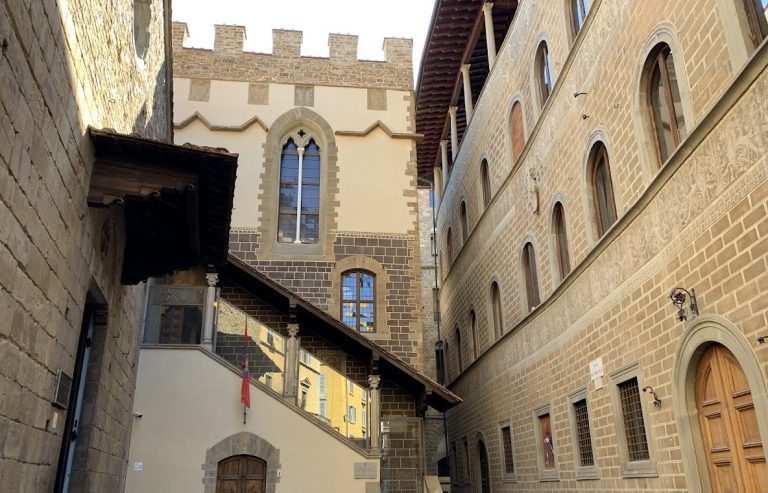
The interior has two aisles and two large square central pillars. Attached half-pillars support six round-headed groin vaults, which also carry the floors and halls above. A steep spiral staircase is contained within a corner pillar. Buontalenti’s surviving arched bridge and portal connect the building with the Palazzo dell’Arte della Lana.
Orcagna’s tabernacle
Orcagna’s marble tabernacle houses Bernardo Daddi’s 1347 painting of the enthroned Virgin and Child. Its four pillars have spiral columns, round-headed arches, triangular gables, pinnacles, buttresses, and spiral shafts. White-marble sculpture is combined with blue, red, and gilded glass tesserae.
The base contains high-relief panels of virtues and scenes from the life of the Virgin. On the reverse is a large relief of the Burial and Assumption of the Virgin, accompanied by Orcagna’s signature and the date 1359. Angels, prophets, sibyls, virtues, apostles, and a relief of the Redeemer decorate the remaining structure, including the apex of its ovoid dome. The relief cycle includes the Annunciation to Anne, the Birth of Mary, Mary at the Temple, her engagement, the Annunciation, the Nativity, the Adoration of the Magi, the Presentation at the Temple, the announcement of Mary’s death, her Burial, and her Assumption.
A marble enclosure with bronze grilles, spiral corner columns, and angel candle-bearers was made by Pietro Migliore in 1366. The tabernacle was surrounded by a railing because large numbers of worshippers visited it.
Saint Anne altar
To the left of the tabernacle, Francesco da Sangallo’s marble group of Saint Anne, the Virgin Mary, and the Christ Child dates from around 1526. Mary reads while the Child gives a blessing, and Saint Anne sits beside her daughter. The group replaced a painted image commissioned by the Signoria, Florence’s governing civic authority, in connection with the expulsion of the Duke of Athens.
Frescoes and stained glass
Late fourteenth- and early fifteenth-century frescoes cover the pillars, parts of the walls, and the vault compartments. Plaster concealed them in the eighteenth century, and nineteenth-century restoration brought them back to view. The vault cycle, painted in 1398 and 1399 according to a program devised by Franco Sacchetti, depicts figures from the Old and New Testaments. The painters include Lorenzo di Bicci, Ambrogio di Baldese, Spinello Aretino, Mariotto di Nardo, Niccolò di Pietro Gerini, Giovanni Bonsi, and Taddeo Gaddi. Subjects include patriarchal and biblical figures, saints, the Trinity, the Annunciation, the Good Thief, and Mary Magdalene.
The window lunettes contain scenes from the life and miracles of the Virgin and of the Orsanmichele Madonna. Stained glass was produced in phases from about 1380 to 1400 and from 1429 to 1432, with designs attributed to Agnolo Gaddi, Niccolò Gerini, Giovanni del Biondo, Lorenzo Monaco, and Lorenzo Ghiberti. Subjects include angels playing music, the Presentation of the Virgin, the Presentation of Jesus, the Assumption, the renunciation of worldly goods, miracles associated with the grain market and the Virgin, scenes from the Flight into Egypt, the Miracle of the Snow, and several other Marian miracles. Much of the glass remains substantially original.
Organ and associated works
A Tamburini opus 701 pipe organ, built in 1975, stands beside the Saint Anne altar. It has entirely mechanical transmission, two keyboards, a pedalboard, a tremulant control, lateral sliding stops, and a partly enclosed wooden case with a principal-pipe display.
Museum collections
The museum on the first floor houses the original exterior sculptures removed for protection, including twelve of the fourteen original statues. The upper floor also displays the small original figures that once stood on the pinnacles and in the tracery of the exterior niches. The collection includes Ghiberti’s bronze Saint John the Baptist and Saint Matthew, Nanni di Banco’s Four Crowned Saints, Donatello’s Saint George and Saint Louis of Toulouse, and Verrocchio’s Christ and Doubting Thomas. Donatello’s Saint George and its niche are in the Bargello, while Saint Louis of Toulouse is in the museum of the Basilica of Santa Croce.
Other works formerly associated with the oratory include a polychromed wooden Virgin and Child with Saint Anne, now in the Bargello, Orcagna’s polychromed wooden Crucifix, now in San Carlo dei Lombardi, and small marble lions from the corners of Orcagna’s tabernacle, now at the Opificio delle Pietre Dure. Paintings once held in the oratory are distributed among collections in Florence, Avignon, Denver, Philadelphia, Birmingham, and Turin. They include works by Bernardo Daddi, Jacopo del Casentino, Orcagna and Jacopo di Cione, Giovanni del Biondo, Lorenzo di Bicci, Niccolò di Pietro Gerini, Francesco di Antonio del Chierico, and Piero del Pollaiuolo.