Oppidum du Castellan: A Fortified Settlement in Istres, France
Site at a Glance
- Popularity
- Very Low
- Country
- France
- Primary era
- Iron Age
- Eras represented
- Iron Age, Classical
- Civilizations
- Celtic, Roman
- Site type
- City
On this page13 sections
History
The oppidum du Castellan, a fortified settlement, occupies a rocky promontory on the southern shore of the Étang de l’Olivier in Istres, France. It was inhabited intermittently from the sixth century BC into the first century AD. In the Gallo-Roman period, when Roman rule and local culture interacted in Gaul, a region that included present-day France, habitation shifted to the foot of the hill. An agricultural settlement there continued into the beginning of the third century AD.
Occupation and relocation
The settlement’s history includes both occupation on the hill and later habitation below it. Excavations at the foot of the hill uncovered the Villa of Sainte-Catherine, a rural estate dated to the first century AD.
Excavations
Investigations began in 1937, when Joseph Thoret examined a shelter on the oppidum’s flank. In 1948, members of the Friends of Old Istres association worked there under Eugène Aquaron; most structures exposed during that campaign were later destroyed. Excavations continued in 1950 and resumed under Amar in 1977 and Marty in 2000.
Remains
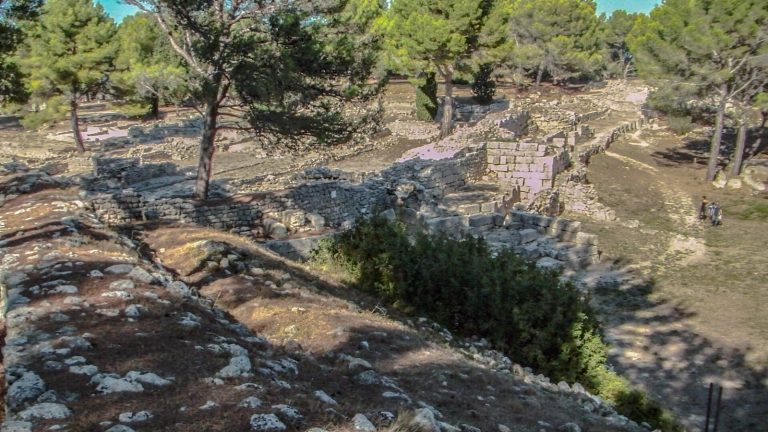
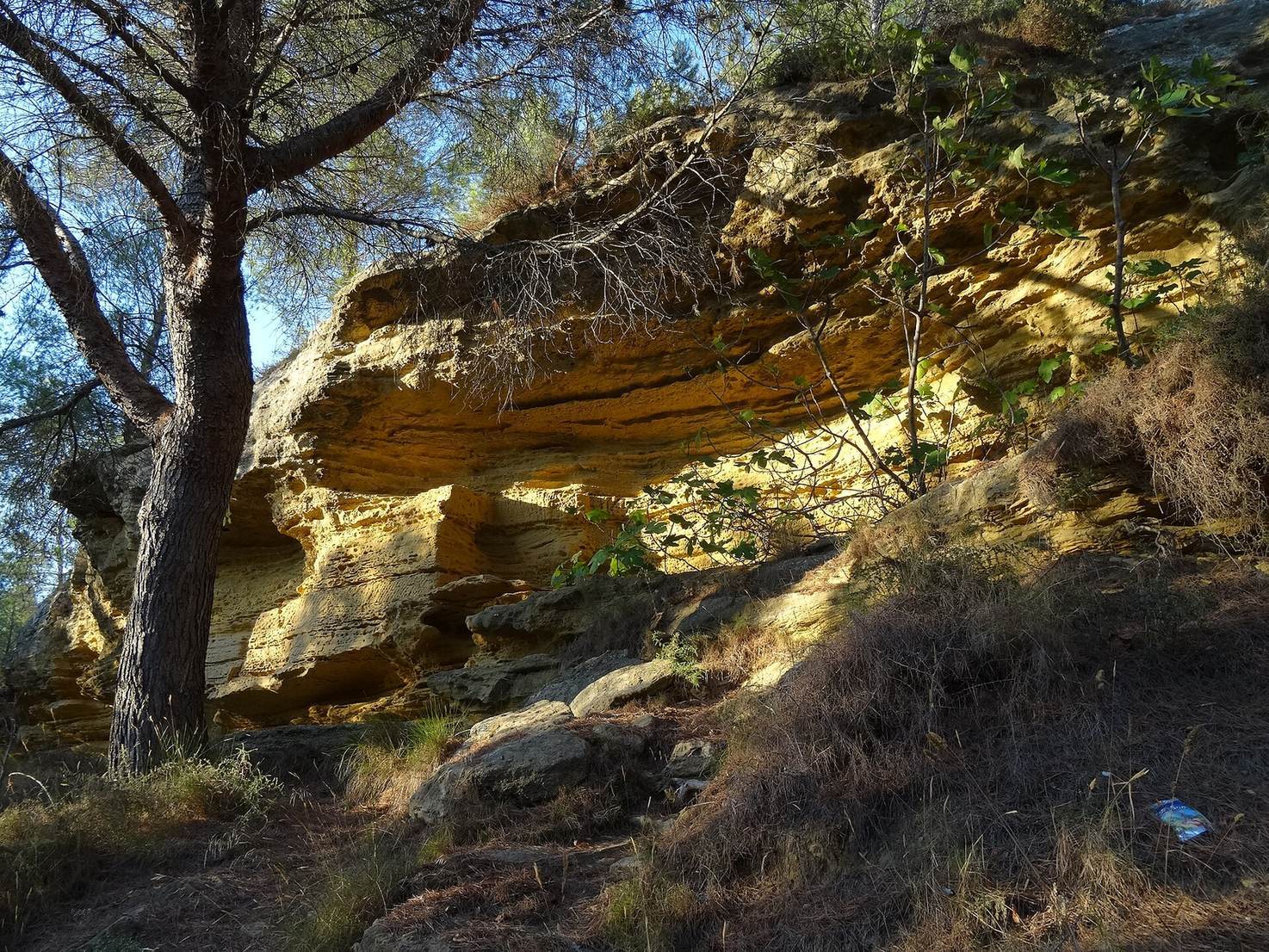
The site occupies a rocky spur rising about 40.7 metres above the lake. Its plateau measures approximately 300 by 130 metres, while the built-up area reached a maximum of about 500 by 250 metres. Excavated remains include housing blocks and streets. The ground includes chalk and green sandstone; the spur consists of soft sandy rock and shell-bearing consolidated sedimentary rock. Its steep faces expose marly clay and sandstone layers associated with a brown-coal formation near the summit.
Domestic settlement
Housing blocks and work areas
Excavations exposed streets, including one marked by worn wheel ruts, as well as traces of a bread oven, kitchen and smithy. Evidence of grape-growing included charred grape seeds.
Early Gaulish house
A dwelling dated to the sixth century BC had a rounded end and a central hole for a post. Its pottery included grey Aeolian ware, associated with Aeolia and decorated with wavy lines; soft pink Ionian ware, associated with Ionia and ornamented with circular red-brown bands, possibly made at Marseille; and Campanian ware, associated with Campania in southern Italy.
Second-century dwelling and cooking plate
A second-century house contained a bread oven and a U-shaped hearth. Its domestic clay cooking plate shows wear from household use. The plate carries a complex geometric design: a double rectangular frame crossed by two diagonal lines meeting at the centre. A tightly stretched cord pressed into the wet clay formed the lines. Impressions from metal objects added motifs resembling rings, shallow dishes and curved pegs, placed around the edge, at the corners and in the centre.
Fortifications
Remains of a first-century-BC fortification survive on the north and northeast sides. The M2 terrace-rampart, a raised defensive earthwork, has been exposed for 9.2 metres and stands 1.6 metres high at its western end. Matching blocks indicate that it continues farther east. Finds in material used to fill the structure provide its date. Its lowest course consists of roughly squared blocks about 1.5 metres long, made from stone quarried on site. The yellowish rock is rich in shell fragments and contains occasional splinters of vertebrate bone.
Inscription and excavated objects
Rock inscription
A Gallo-Greek inscription, Gaulish written with Greek letters, is cut deeply into a rock face 2.4 metres above ground. Its letters are nearly 20 centimetres high and cut 3 to 4 centimetres into the rock. The M is joined to an A whose crossbar is broken. Probably dating to the second or first century BC, the inscription reads ‘MATRON,’ translated as ‘Belonging to the mothers.’ It has been interpreted as a dedication to mother goddesses, female deities associated with motherhood, fertility or protection; its monumental scale supports this reading.
Pottery and vessel finds
Finds include fragments of amphorae made in a micaceous Marseille fabric and Campanian pottery. A scratched Greek inscription and the letter A on a vessel foot were also found. A large, incomplete shallow dish of the Arezzo type bears two rectangular stamps, one marked ‘L.’ and the other ‘Titi.’
Villa of Sainte-Catherine
At the foot of the hill, the first-century-AD Villa of Sainte-Catherine had painted wall decoration. Finds included cups and a coin of Vespasian, Roman emperor from AD 69 to 79. Kitchen debris was also found nearby.