O’Dea Castle: A Fortified Tower House in Ireland



Site at a Glance
- Rating
- 4.3
- Popularity
- Low
- Country
- Ireland
- Primary era
- Medieval
- External website
- Open
- Eras represented
- Medieval
- Civilizations
- Irish
- Site type
- Military
- Remains
- Castle
On this page8 sections
History
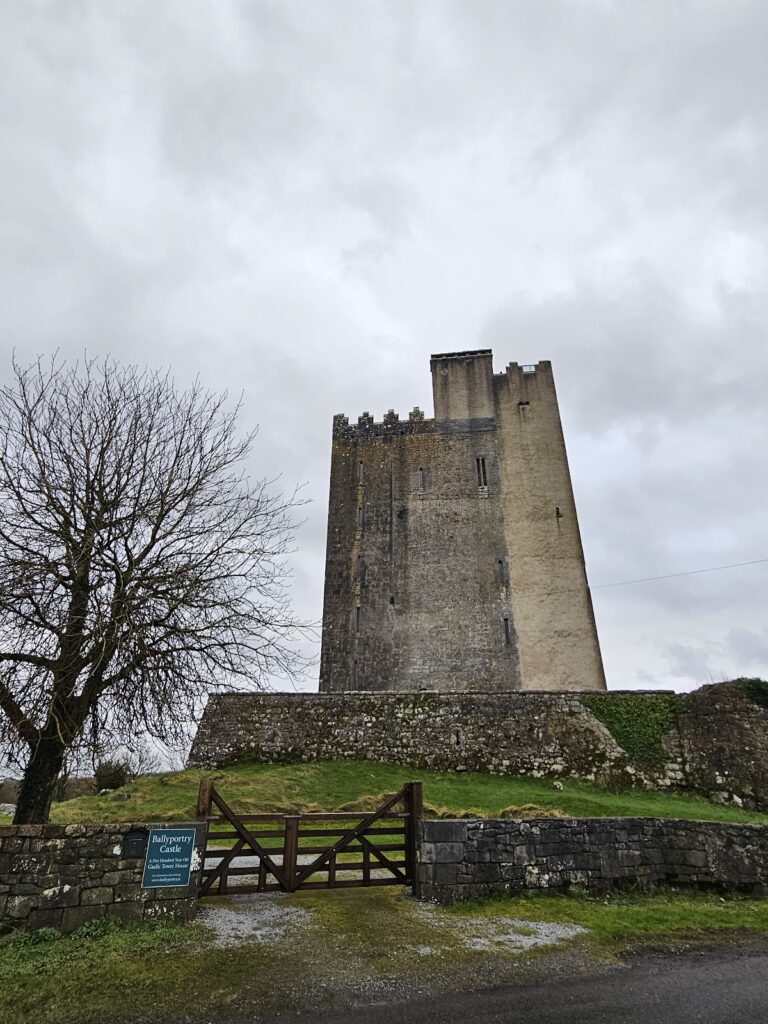
O’Dea Castle is a fortified tower house in Ireland, built for the O’Dea clan between 1470 and 1490 by Diarmaid O’Dea, lord of Cineal Fearmaic and chief of the clan. A tower house was a fortified residential tower built widely in Ireland between the fifteenth and seventeenth centuries. The building defended the O’Dea lands in their former stronghold at Mollaneen, near Corofin in County Clare.
The O’Dea stronghold
The castle stands in territory whose control by the O’Dea clan was regarded as ancient. The name Dysert comes from a word meaning “hermitage” or “hermit’s place.” Before the tower was built, the site was associated with the Battle of Dysert O’Dea, fought on 10 May 1318. Irish clan forces defeated the Anglo-Normans there and drove them from the region for more than two centuries.
Thomas Butler, 10th Earl of Ormond, seized the castle by force from the O’Deas in 1570. The clan had recovered it by 1584, when Domhnall Maol O’Dea was identified as its owner. He supported the northern clan chiefs during the Nine Years’ War, an Irish conflict against English rule that lasted from 1594 to 1603. During the war, the castle passed to Daniel Neylon, the Protestant bishop of Kildare, who left it to his son John. It later returned to the O’Dea clan.
Seventeenth-century conflict and decline
During the 1641 Irish uprising, the O’Dea clan supported the rebels, and the flag of the Irish Confederates, the Catholic-led political and military forces formed during the uprising, flew over the castle. Conor Cron O’Dea, its owner, took part in the successful siege of Ballyalla Castle in 1642.
After the fall of Limerick in 1651, troops of Oliver Cromwell, the English parliamentarian leader whose forces conquered Ireland during the 1640s and early 1650s, occupied O’Dea Castle with a small garrison. On their withdrawal, they demolished the battlements, upper floors, and staircase. The Neylon family then returned and partly restored the ruined building.
During the reign of Charles II, the restored Stuart king of England, Scotland, and Ireland, Conor Cron O’Dea regained the castle. His sons Michael and James supported James II during the Jacobite and Williamite wars in Ireland. After that conflict, the O’Deas lost the castle again, and the lands passed to the Synge family. The building gradually fell into ruin.
Restoration and archaeological use
John O’Day of Wisconsin Rapids, Wisconsin, bought the tower in 1970 and arranged for its restoration. He later leased it to the Dysert Development Association. With support from the Irish Tourist Board, the association opened the Dysert O’Dea Castle Archaeology Centre in 1986.
The centre, also called the Clare Archaeology Centre, presented local archaeological artefacts ranging from the Stone Age to 1922. It forms part of the Dysert O’Dea archaeological trails, which include sites around the castle and monastery. The restoration received a Clare Tourism Award for one of the most authentically restored ancient castles in Ireland.
Remains
Fortified tower and setting
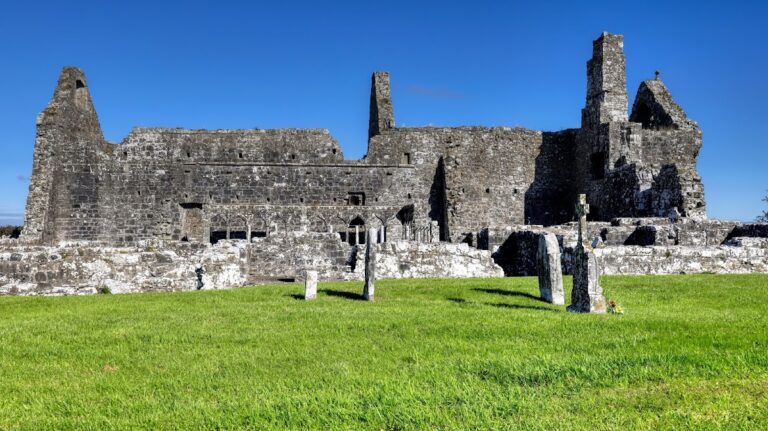
O’Dea Castle is a rubble-stone fortified tower house, sometimes described more generally as a castle. The tower rises approximately 15 metres and stands on a limestone outcrop measuring about 6 by 12 metres. It lies beside the remains of Dysert O’Dea Monastery, a religious community and its associated buildings, near the R476 road, about 5 kilometres south of Corofin.
Tower house
The restored tower preserves the principal vertical form of the building and includes access to a wall walk across part of the castle. Its original defensive purpose is reflected in its fortified construction and elevated position on the limestone outcrop. The demolition of the battlements, upper floors, and staircase after the Cromwellian occupation shaped the ruined form later addressed by the twentieth-century restoration.
Archaeology centre
The restored castle also houses an archaeological exhibition of local artefacts. The material ranges from the Stone Age through the early twentieth century, extending to 1922. In this use, the tower presents archaeological evidence from the surrounding area alongside the remains of the castle and the nearby monastery.