Nisa: Parthian Royal Fortress and City in Turkmenistan
Site at a Glance
- Rating
- 4.4
- Popularity
- Low
- Country
- Turkmenistan
- Primary era
- Classical
- Eras represented
- Classical, Medieval
- Civilizations
- Khwarazmian, Parthian, Sassanid
- Site type
- City
On this page16 sections
History
Nisa is an ancient settlement in Turkmenistan, near Bagyr on the western side of Ashgabat, whose principal development took place under the Arsacid, or Parthian, dynasty between the third and first centuries BC. The site consists of two urban complexes about 2 kilometres apart: New Nisa, a city in the valley, and Old Nisa, a royal fortress on a raised, fortified hill. Together they became an early political centre of the Parthian state and a place of lasting dynastic importance.
Early settlement and the rise of Parthia
Human activity in the area reaches back to the fourth to second millennia BC. A substantial settled community existed by the first millennium BC, although excavated occupation layers earlier than the Arsacid period have not been established. Older pottery leaves open the possibility of earlier settlement. Two traditions explain the beginning of Nisa as a fortress. One places its transformation into a frontier stronghold under Darius I, the Achaemenid king of the sixth century BC, to protect the region from nomadic groups to the north. Another attributes its foundation to Arsaces I in the second half of the third century BC. The precise identity of the earliest fortress therefore remains uncertain.
Parthiene entered the realm of Alexander the Great in the fourth century BC. A city called Alexandropol was founded near the Nisa fortress, and the region later passed to the Seleucid state, the Hellenistic kingdom established by Seleucus I after Alexander’s death. In 250 BC, the local governor Andragoras rejected Seleucid authority. Five years later, the Dahae-related Parni tribe, led by the brothers Arsaces and Tiridates, seized Parthiene and made Nisa their capital. This takeover laid the foundations of the Arsacid kingdom, which ruled the Parthian Empire until AD 226.
Nisa became an important political and trading centre and one of the earliest seats of Arsacid government. Under Mithridates I, the royal fortress received the name Mithradatkirt, meaning “fortress of Mithridates.” During the second and first centuries BC, the political capital of the expanding Parthian Empire shifted westward toward Asia Minor, but Nisa retained a special place in the dynasty’s memory. Members of the Arsacid royal family were buried there, and the fortress served as a royal burial place until the first century AD, when a younger branch of the dynasty transferred the royal cemetery to Arbela.
Urban development and royal transformation
New Nisa grew into a city of about 18 hectares, with residences associated with the slave-owning elite and a temple. Old Nisa developed as a royal fortress under Mithridates I, or possibly Mithridates II, during the second century BC. The surviving buildings and excavated objects belong especially to the cultural flourishing of Parthia between the third and first centuries BC. They show monumental palace and temple architecture alongside artistic forms drawn from both Iranian traditions and the Hellenistic world.
The Arsacid kingdom ended in AD 226 when Ardashir, an Arsacid governor in Persia, founded the Sasanian dynasty. Old Nisa was destroyed first because of its role as a dynastic reserve and memorial centre for the Parthian kings. Occupation resumed there only several centuries later. New Nisa continued after the destruction of the fortress, although the crisis of the slave-based period severely weakened its functioning. In the fifth century, during the reign of the Sasanian king Peroz, the city was rebuilt and strongly fortified because it served as a defensive barrier against nomadic groups. For a time it was called Shahri-Firuz, “the city of Peroz.”
Medieval rule and destruction
Arab forces captured the Nisa region in 651. From the first quarter of the ninth century it belonged to the Tahirid domains, and by the tenth century it had passed to the Samanids. In 992, the Samanid ruler Nuh ibn Mansur granted Nisa to the emir of Gurganj after assistance in a battle against Boghra Khan, whose power was based at Bukhara. When Mamun united the two parts of Khwarazm in 996 and assumed the title of Khwarazmshah, Nisa entered the Mamunid realm. In 1004, the last Samanid, Muntasir, tried to recover the city, but the Khwarazmshah defeated him after Nisa’s governor had briefly introduced the Friday sermon in his own name.
Nisa became part of the Ghaznavid domains in 1017. Seljuk Turkmen forces seized it in 1035, and the Ghaznavids ceded the city to Muhammad Tughril Beg. From 1040 it formed a stable part of the Seljuk Empire. The Khwarazmshah Atsiz annexed Nisa in the 1150s, but in 1159 the Karakhanid Mahmud detached it and gave its full administration to the local emir Omar ibn Hamza al-Nasawi. Omar protected the city during destructive feudal conflicts, and his local dynasty controlled Nisa for several decades.
Later in the twelfth century, the struggle for Khorasan between the Yaziri Turkmen confederation and the Khwarazmshahs of the Anushteginid dynasty brought further conflict. Oghuz forces supporting Yagmur Khan moved toward Nisa and defeated Aytak, a Khwarazmshahid appointee, in 1160. In 1164, al-Mu’ayyid Ayaba of Nishapur drove the Oghuz from Khorasan, but withdrew when Khwarazmshahid forces approached. Nisa then came under Tughan-Shah, son of al-Mu’ayyid, who ruled from 1174 to 1185 and submitted to the Khwarazmshah Tekesh as a vassal in 1182. The city itself remained under the authority of Omar ibn Hamza’s son by agreement with Tekesh, who had previously made several unsuccessful attempts to capture its fortress.
After the deaths of Imad al-Din Muhammad Omar ibn Hamza and, soon afterward, his son and heir, the Khwarazmshah Muhammad II took the family’s younger sons to Khwarazm and seized their treasure. He ordered Nisa destroyed to its foundations and its ground ploughed, leaving only a few buildings. In 1220, after Muhammad II’s defeat by Chinggis Khan, the emir Baha al-Din Muhammad ibn Sahl urged the inhabitants to flee to the mountains. Nisa’s vizier, Zahir al-Din Masud ibn al-Munawwar al-Shashi, rejected the proposal and organized new defensive walls with Khwarazmian forces and Khorasanian emirs.
Mongol forces besieged the city for 15 days using 20 catapults and drove captives before them as human shields. They breached the walls and entered Nisa. The death toll was said to exceed 70,000, and Shihab al-Din al-Khivaqi was tortured to death. Ikhtiyar al-Din Zangi, son of Imad al-Din Muhammad, soon returned to the devastated city and asserted his hereditary claim, which Jalal al-Din, son of Muhammad II, confirmed. In 1221, Jalal al-Din’s forces defeated Mongol troops near Nisa, and prisoners were brought into the city and beheaded. The walls were repaired late that year.
In 1222, Turkmen forces based at Nisa under Taj al-Din Omar ibn Masud moved to Merv, captured it, and soon controlled much of Khorasan. The Zengids defeated Taj al-Din’s army beneath Nisa in early 1223, after which the city changed hands repeatedly. In 1225, the territories around Nisa entered the state of Hulagu, a descendant of Chinggis Khan. Nisa later came under the Turkmen emir Arghun and was incorporated peacefully into Timur’s empire in 1381. Timur’s forces defeated Emir Vali of Mazandaran and part of Khorasan near the boundary of the Nisa and Durun districts in 1384.
Timurid, Safavid, and Turkmen periods
After Timur’s death, Nisa again became involved in civil wars. Sultan-Husayn seized Nisa and Abivard briefly in 1458 and captured the city again ten years later. In 1498, his sons Abu’l-Muhsin Mirza and Muhammad Husayn Mirza, the ruler of Nisa, rebelled against him. The settlement that followed assigned Abu’l-Muhsin control of Tus, Mashhad, Abivard, Nisa, Durun, and Yazyra.
In the early sixteenth century, Nisa passed to the Khwarazmian state under Shaybani Khan. After the battle of Merv in 1510, it came under the Safavids and Shah Ismail. Following Ismail’s death in 1524, Khwarazmians seized Nisa, which then belonged to the sons of Aminek Khan. For about two decades, the city suffered repeated raids by the Bukhara-based Khan Ubaydullah. Shah Tahmasp I restored Nisa to Safavid control in 1538 and entrusted it to Dinmuhammad, who relied on the Adakly-Khyzyr Turkmen tribe and expelled the Bukharans even from Khwarazm.
Nisa remained a strong fortress during the sixteenth century, although its surrounding lands were devastated by Kazak, the ruler of Herat, in 1561. Khwarazmians and Bukharans continued to contest the city. Nisa briefly entered the Bukhara state in 1595 under Suyunuj Muhammad-biy. Shah Abbas I recaptured it in 1597 and returned it to the former Shaybanid ruler Nurmuhammad, who rebelled. Shah Abbas besieged Nisa, captured it in 1601, and placed it under the Persian governor Mulkash Sultan.
After Shah Abbas’s death, the Khivan ruler Isfandiyar Khan seized Nisa in 1628. The inhabitants surrendered without fighting to his brother Abulghazi Khan after appealing for assistance. Several decades later, the people of Nisa expelled the Khivans themselves. In the early eighteenth century, Nader Shah assigned administration of Khorasan to the Turkmen commander Muhammad Khan and forcibly suppressed Khivan attempts to take the city.
Abandonment and archaeological investigation
Nisa’s later history was marked by decline. Vali Mirza, the ruler of Khorasan, plundered its lands in 1809. From the beginning of the nineteenth century, the Teke Turkmen controlled the area, and the settlement of Bagyr was founded. For a time both names remained in use, but after Nisa was completely abandoned, the ancient city became ruins on the outskirts of Bagyr.
Archaeological interest began before systematic excavation. The first-century BC to first-century AD geographer Isidore of Charax identified Parthaunisa with Nisaia and recorded royal tombs there. Western attempts in the nineteenth century to identify those tombs lacked sufficient evidence. Russian archaeologists carried out the earliest surveys and excavations. Their first work at New Nisa exposed mainly medieval remains, leading them to seek Parthaunisa at Old Nisa. Postwar expeditions continued the work, including excavations directed by Mikhail Masson from 1946 to 1960. Italian excavations by the Turin Archaeological Expedition have continued since 1990.
The excavations have clarified Nisa’s role in Parthian political history and revealed administrative records written in the Parthian language with the Aramaic alphabet. Many concern wine production and the accounting of food supplies, providing evidence for the operation of the royal centre. Nisa is also associated with al-Nasa’i, a Persian-born ninth-century Muslim authority on hadith who was born there and died at Ramla in 915. The Parthian Fortresses of Nisa were inscribed on the UNESCO World Heritage List in 2007 under cultural criteria (ii) and (iii). The inscribed property covers 77.9 hectares and has a 400.3-hectare buffer zone.
Remains
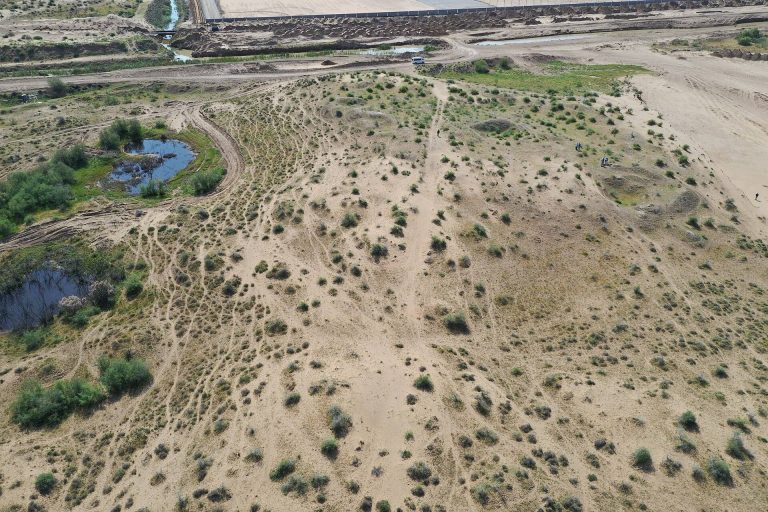
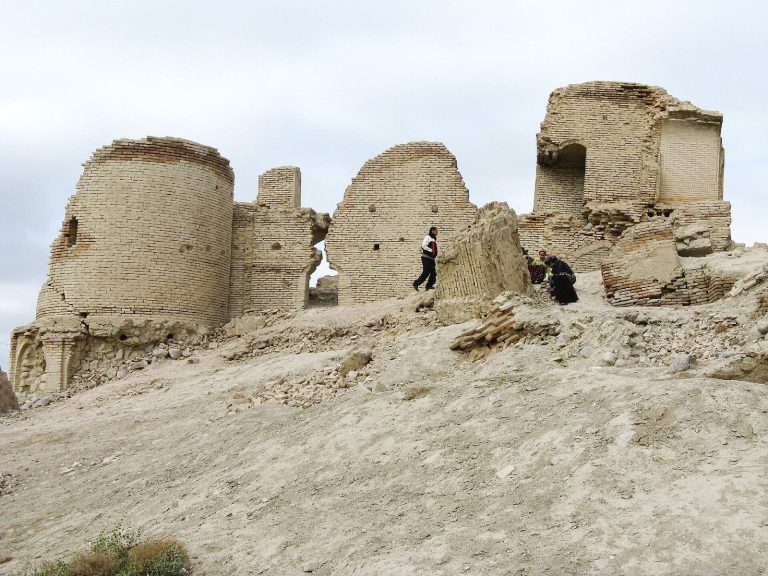
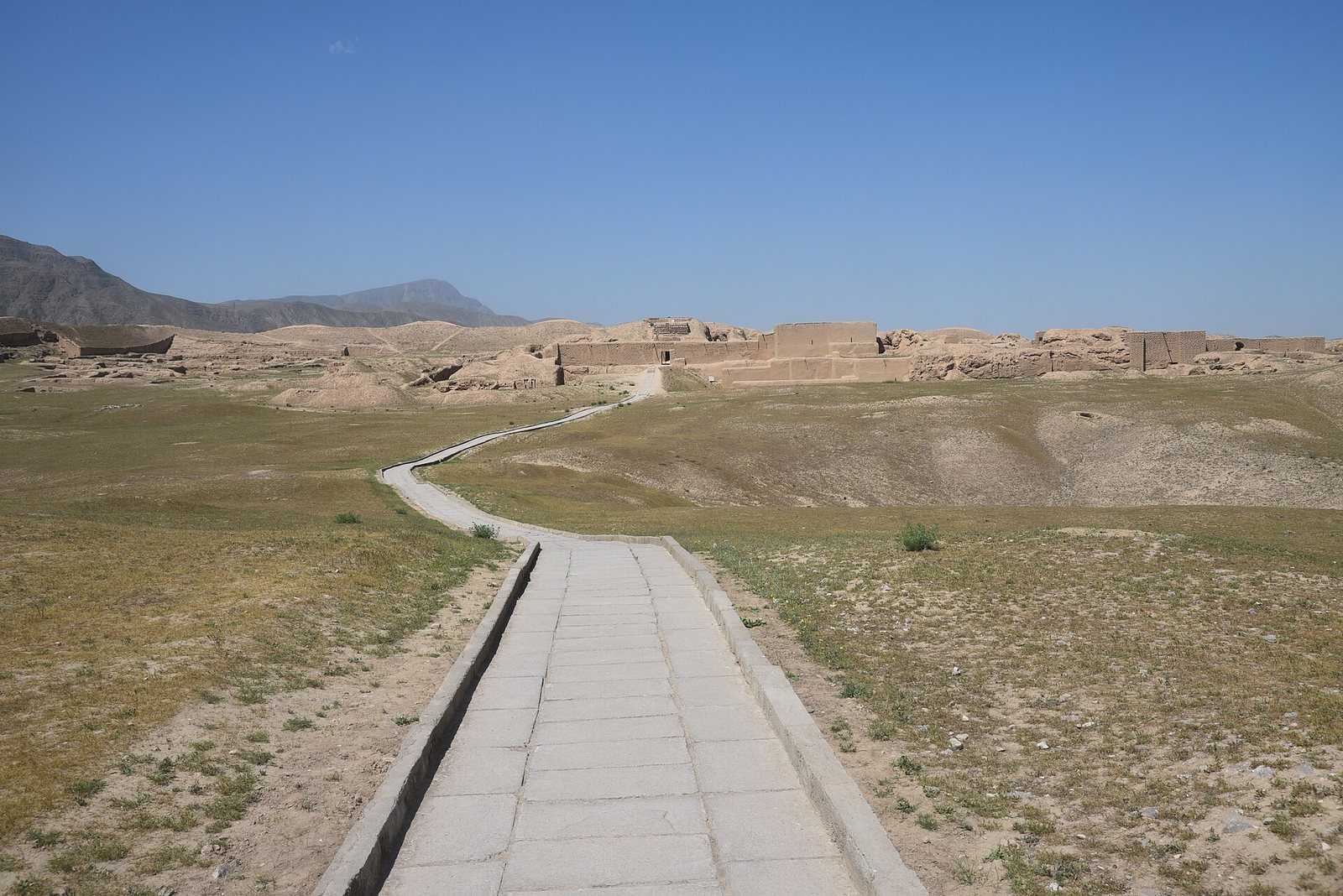
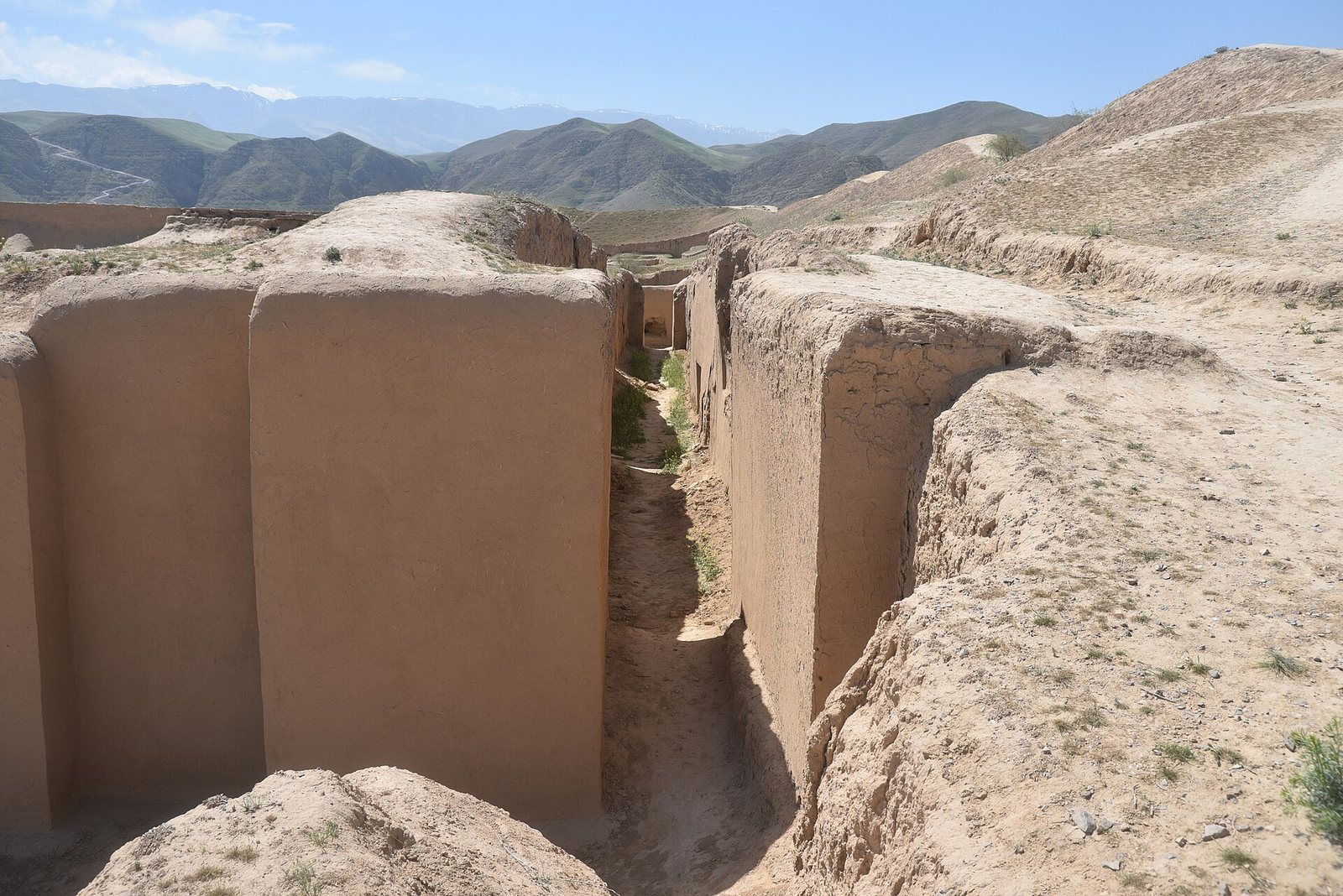
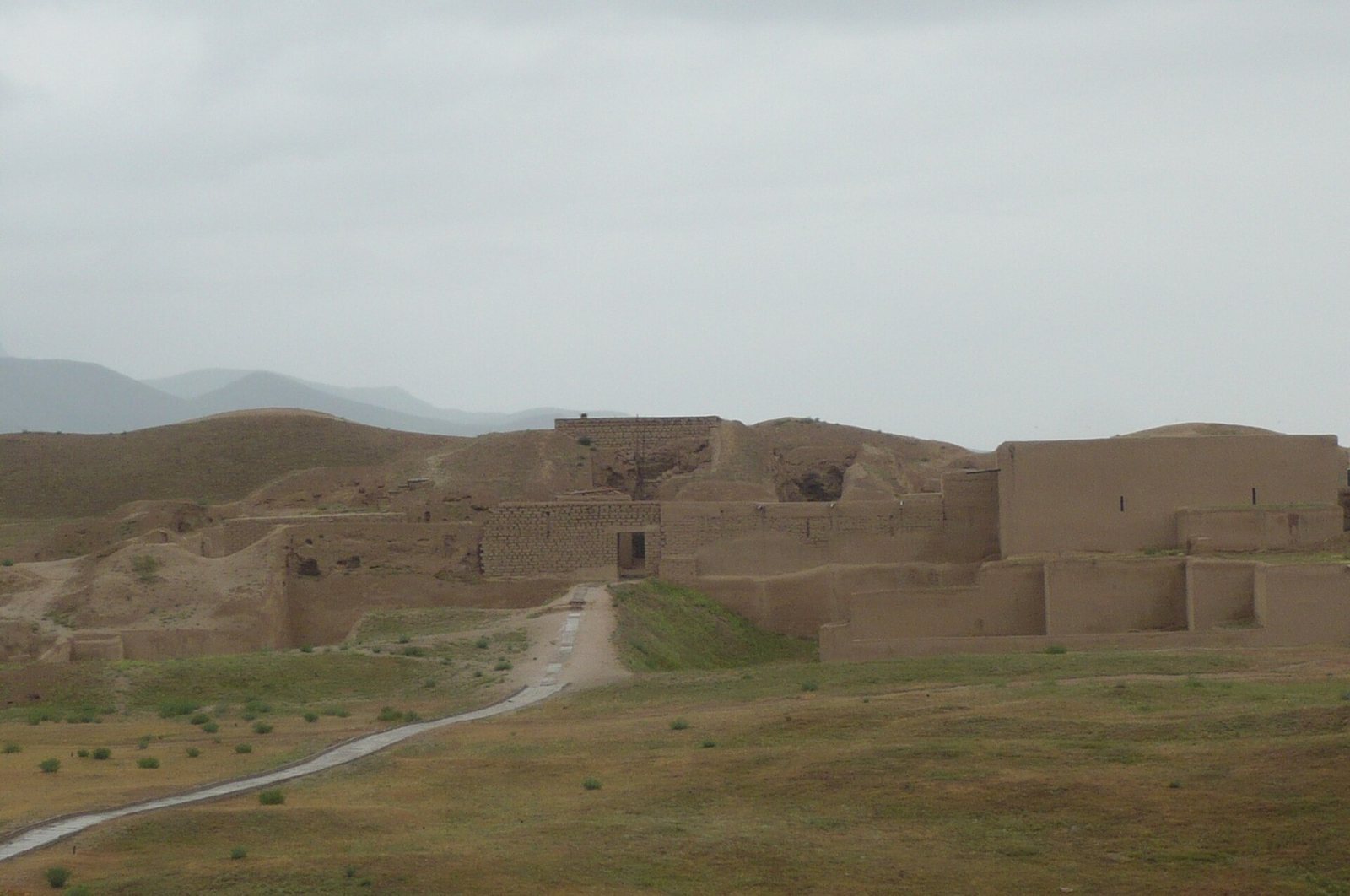
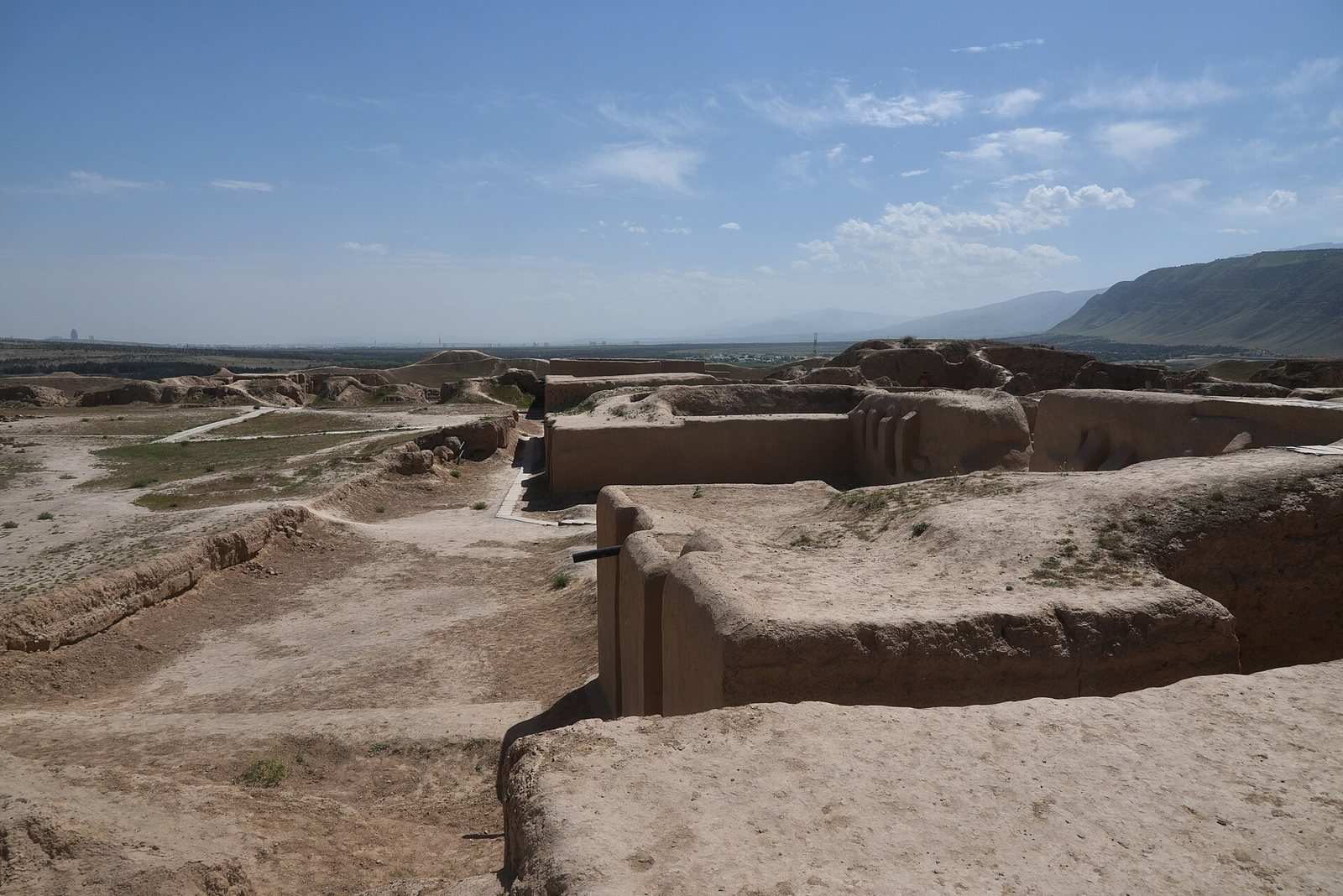
Nisa consists of two tells, artificial or naturally accumulated mounds formed by successive human occupation, separated today by Bagyr village. New Nisa occupies the valley and covers about 18 hectares. Old Nisa stands on a flattened, squared hill of about 17 hectares, enclosed by walls of fired brick. The older royal complex had 43 towers and was built as a heavily fortified centre. Its ruined remains include defensive works, shrines, columned halls, mausoleums, temples, administrative spaces, and buildings associated with royal use.
Old Nisa’s northern complex
The Square House
The Square House occupies the northern part of Old Nisa. Built in the second or first century BC, it measures 60 by 60 metres and has mud-brick walls with wooden roofs. The building was arranged around an open central courtyard and contained 12 surrounding rooms, each furnished with an earthen-brick bench. Its original purpose remains a matter of architectural interpretation. It has been identified as a royal treasury, while another interpretation sees it as a banqueting building that was later converted into a storehouse. Looting removed most of the objects kept inside, while damaged or less valuable material remained.
Friezes in the Square House combine Hellenistic subjects, including Heracles and lion heads, with a distinctively Arsacid image of a quiver and arrows. Finds associated with the building include the so-called Statue of Rhodogune, a statue of an eastern goddess, and numerous decorated ivory rhytons. A rhyton is a vessel often used in ritual or ceremonial settings, commonly shaped like an animal or horn. These objects are exhibited in the Main Museum of Turkmenistan.
Old Nisa’s southern royal complex
The Tower Building
The southern group includes the Tower Building as part of a palace-like architectural complex. Its surviving setting combines features associated with Hellenistic palaces with forms outside Greek and Hellenistic traditions. Rooms in the group were decorated with Ionic capitals, a type of column capital, and with Greek-style marble and clay statues.
The Square Hall
The Square Hall was a ceremonial room in the royal residence. It was rebuilt in the first or second century AD from an earlier structure and measures 20 by 20 metres. The hall stands on a mud-brick platform 2 metres high. Its walls rose 10 metres and were 3 metres thick, while the roof rested on four columns with Corinthian capitals. Clay statues and polychrome wall paintings decorated the interior, and corridors linked the hall with two tower-like structures on either side. The entire complex has been interpreted as possibly serving as a fire temple.
The Round Hall
The Round Hall, also described in excavation accounts as the Circular Veranda, is a circular building 17 metres in diameter. Its interior was arranged in two tiers. The lower level was faced with smooth white ganch, a gypsum-based plaster used for architectural surfaces. Small columns divided the upper level, with clay statues placed in the intervening niches. The central circular space was surrounded on four sides by corridors and enclosed by a mud-brick dome.
The Red Building
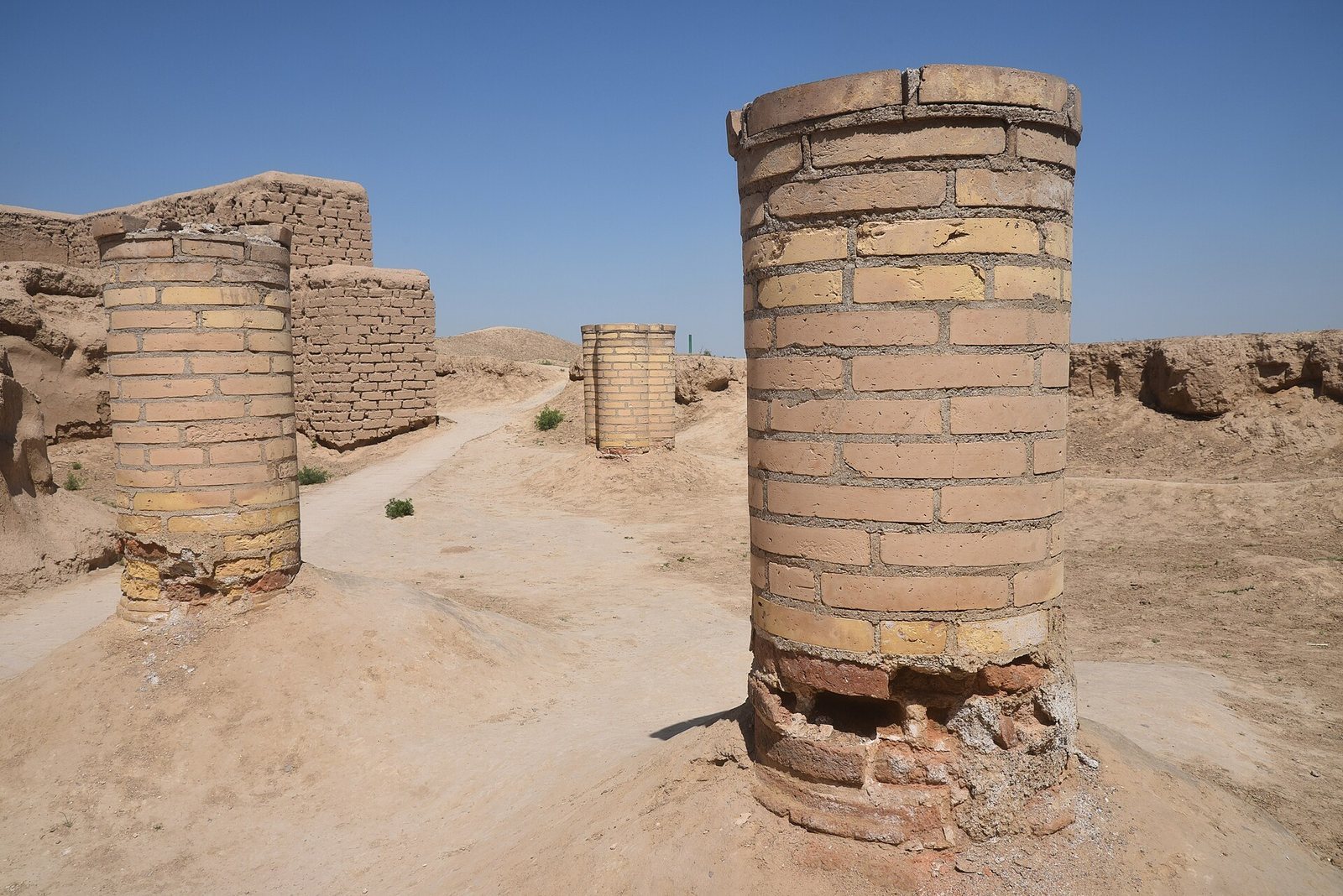
The Red Building is a monumental structure whose brick walls survive to approximately 4 metres. Excavation produced a fired-brick column, fragments of large painted clay statues, marble statues probably of Greek origin, and many terracotta sculptures in a Hellenistic style. These remains belong to the wider artistic environment of Old Nisa, where Iranian traditions were combined with selected Western forms and subjects.
Artistic and administrative finds
The excavated complexes include shrines, mausoleums, temples, and a treasury in the central area. The treasury had been looted, but surviving artistic material and written records still illuminate the royal centre. The finds include finely decorated ivory rhytons with relief ornament, metal and terracotta jewellery, small sculptures, weapons, household vessels, and other archaeological material.
Excavations recovered 2,751 ostraka, fragments of pottery used as writing surfaces, bearing inscriptions in the Parthian language, along with many other inscribed documents. Records concerning wine production and food supplies connect the written material with the practical administration of the settlement. The buildings, sculptures, painted decoration, ivory vessels, and inscriptions together express the distinctive Arsacid combination of Iranian artistic traditions and Hellenistic vocabulary.
New Nisa
New Nisa formed the urban settlement in the valley and covered about 18 hectares. Its remains include the city’s fortifications, residences of the elite, a temple, and other buildings. Early Russian work there exposed mainly medieval remains, while later archaeological research across both complexes established the relationship between the valley city and the royal fortress on the elevated hill.