Naples Mound 8: A Hopewell Burial Mound in Illinois
Site at a Glance
- Rating
- 4.8
- Popularity
- Very Low
- Country
- United States
- Primary era
- Classical
- External website
- Open
- Eras represented
- Classical
- Civilizations
- Hopewell
- Site type
- Burial
- Remains
- Burial Mound
On this page7 sections
History
Havana Hopewell Burial Ground
Naples Mound 8 is a Havana Hopewell burial mound near Griggsville, Illinois, in the United States. The Havana Hopewell culture was a regional expression of interconnected prehistoric societies known for monumental earthworks, elaborate burials, and long-distance exchange. Occupation and burials in the surrounding Napoleon Hollow Archaeological District date from about 50 BC to around AD 100.
The mound forms part of the Russell Mound Group, which includes twenty-six burial mounds and two possible burial knolls. Later investigations concluded that activity in the area began around 50 BC and ended around AD 100. Artifacts came from many parts of the eastern two-thirds of the United States, revealing the broad exchange network associated with the Hopewell culture.
The 1834 Zelph Tradition
In June 1834, members of Joseph Smith’s Latter-day Saint expedition, known as Zion’s Camp, visited the mound while traveling through west-central Illinois. They reported seeing human bones on the surface and excavating about a foot below ground, where they found a skeleton with a stone arrow point in its ribs.
Joseph Smith’s followers interpreted the burial through visions as that of Zelph, whom they identified as a white Lamanite warrior killed in a battle with the Nephites. Lamanites and Nephites are peoples described in the Book of Mormon, the foundational scripture of the Latter-day Saint tradition. Six members of Zion’s Camp recorded the episode in their journals, and Willard Richards incorporated it into Latter-day Saint history in 1842. The leg bones attributed to Zelph were removed and later reburied near Liberty, Missouri, while the arrow point was retained.
Surveys, Reidentification, and Preservation
Judge John G. Henderson and a colleague excavated and documented several mounds near Naples in 1876 after Henderson examined artifacts recovered from them. He mapped fifteen mounds, including Naples Mound 8, and described an eagle pipe recovered from the mound about forty years earlier. His work prompted the Smithsonian Institution to begin a broader exploration of the mounds in December 1879. The name Naples Mound 8 was applied in 1882.
The mound was apparently forgotten after 1882. In 1974, a Northwestern University team led by archaeology professor Jane E. Buikstra identified the large earthwork during investigations connected with a proposed Central Illinois Expressway bridge. Journals, landmarks, and earlier mound surveys enabled the team to reidentify it with the mound described in the 1834 Zelph records. Buikstra renamed the archaeological site Naples-Russell Mound 8, using Russell for private landowner Roy Russell.
Buikstra applied for the mound’s inclusion on the National Register of Historic Places, and it was listed in 1975. The State of Illinois acquired 280 acres of Illinois River frontage containing the mound in 1988. A 1990 University of Illinois at Urbana-Champaign excavation, carried out with the Center for American Archaeology and supervised by archaeologist Ken Farnsworth, confirmed its Hopewell mortuary character. The work was funded by the Illinois Department of Transportation. The mound is now within the Ray Norbut Fish and Wildlife Area, administered by the Illinois Department of Natural Resources.
Remains
Bluff-Top Earthwork
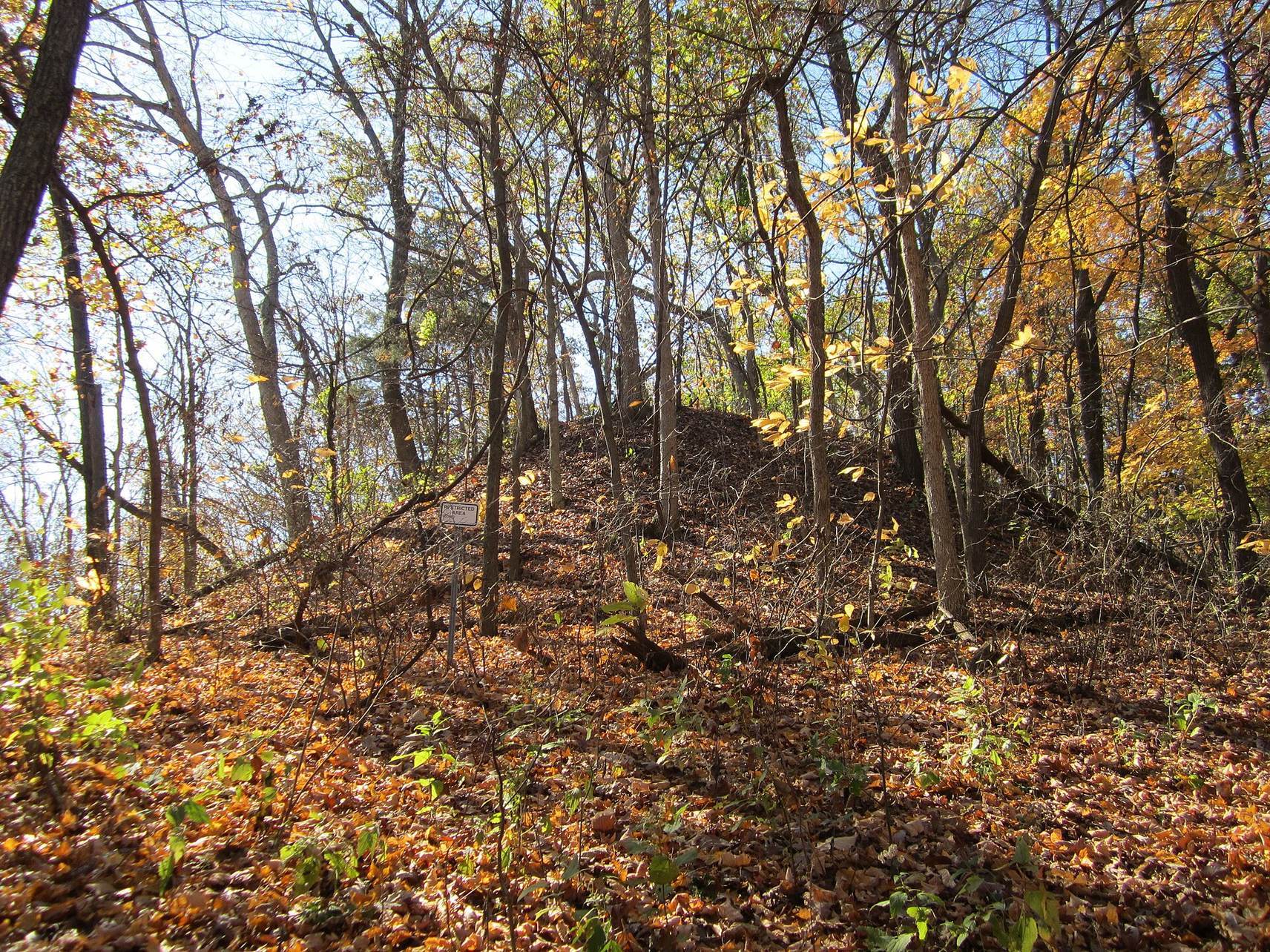
Naples Mound 8 occupies the summit of a bluff rising approximately 300 feet above the Illinois River. It is the largest mound on the bluff top in the lower Illinois Valley. Henderson described the oval earthwork as approximately 150 feet long, 92 feet wide at its middle, and 25 to 30 feet high. The mound stood about 300 yards south of Griggsville Landing, approximately one mile south of Valley City, and across the Illinois River from Naples, Illinois.
The structure is a tumulus, a mound raised over a burial or group of burials. It occupies less than one acre within its National Register listing and lies about 150 yards north of the Elizabeth Mound Group. The mound is also part of the wider Russell Mound Group in the Napoleon Hollow Archaeological District.
Burials and Archaeological Evidence
Burial 1, Skeleton 1, designated QL-4904, lay on the upper western side of the mound. Archaeological investigation in 2001 identified it as one of the final burials placed there. Radiometric dating, which estimates age through radioactive decay, produced an interment date of AD 91 and a calibrated two-sigma range of AD 58 to 127. The burial was interpreted as marking the mound’s terminal use.
The 2001 investigation recorded two areas of looter disturbance about halfway down the hill. Either area could correspond to the excavation described in 1834. Finds associated with investigations include human skeletal remains, the stone arrow point reported with the skeleton, and other artifacts confirming the mound’s Hopewell mortuary character. These excavated artifacts are held by the Illinois State Museum.