Gua Tambun: A Prehistoric Rock-Art Site in Malaysia
Site at a Glance
- Rating
- 4.2
- Popularity
- Low
- Country
- Malaysia
- Primary era
- Stone Age
- Eras represented
- Stone Age
- Civilizations
- Unclassified
- Site type
- Civic
- Remains
- Rock Art
On this page9 sections
History
Gua Tambun is a prehistoric rock-art site at Gunung Panjang near Ipoh in Perak, Malaysia. Its paintings are generally assigned to the local Neolithic period, approximately 2500–500 BCE, although broader estimates place them between about 2,000 and 12,000 years old. The makers are uncertain, but they may have included ancestors of the Orang Asli, the Indigenous peoples of Peninsular Malaysia, possibly from the Senoi population group. The paintings may also have held spiritual significance.
Prehistoric occupation and quarrying
Evidence from the shelter reflects activity beyond the painted walls. Until the mid-twentieth century, parts of Gunung Panjang and the overhang were used as a quarry. Quarrying removed a sediment deposit that had once reached up to 2 metres in thickness. Cord-marked pottery sherds were found within this deposit, while later excavation recovered red-coloured stone tools and animal remains probably associated with the Hoabinhian culture. This archaeological tradition represents hunter-gatherer societies in mainland Southeast Asia during the late Pleistocene and early Holocene, broadly between 12,000 and 2,000 years ago.
Discovery and investigation
In May 1959, 2/Lt R. L. Rawlings of the 2nd Battalion, 6th Queen Elizabeth’s Own Gurkha Rifles, discovered the paintings. J. M. Matthews documented them extensively during the same year and excavated three trenches near the middle of the shelter. The cuts remain visible as shallow depressions. Further investigations took place during the 1980s, including a detailed description by Paul Faulstich in 1984. Work in 2009 identified many additional pictorial elements, including six small groups of panels that earlier investigations had not recognized.
Protection and interpretation
Malaysian authorities recognized Gua Tambun’s archaeological importance in 1976, and the paintings were later designated a public monument under Malaysia’s Heritage Act 2005, national legislation concerned with protecting and designating cultural heritage. Radiometric dating has not been carried out because modern human damage is considered likely to have distorted the results excessively. Comparisons with other Southeast Asian rock art remain limited, while stylistic similarities have been noted with paintings in Australia and India.
Remains
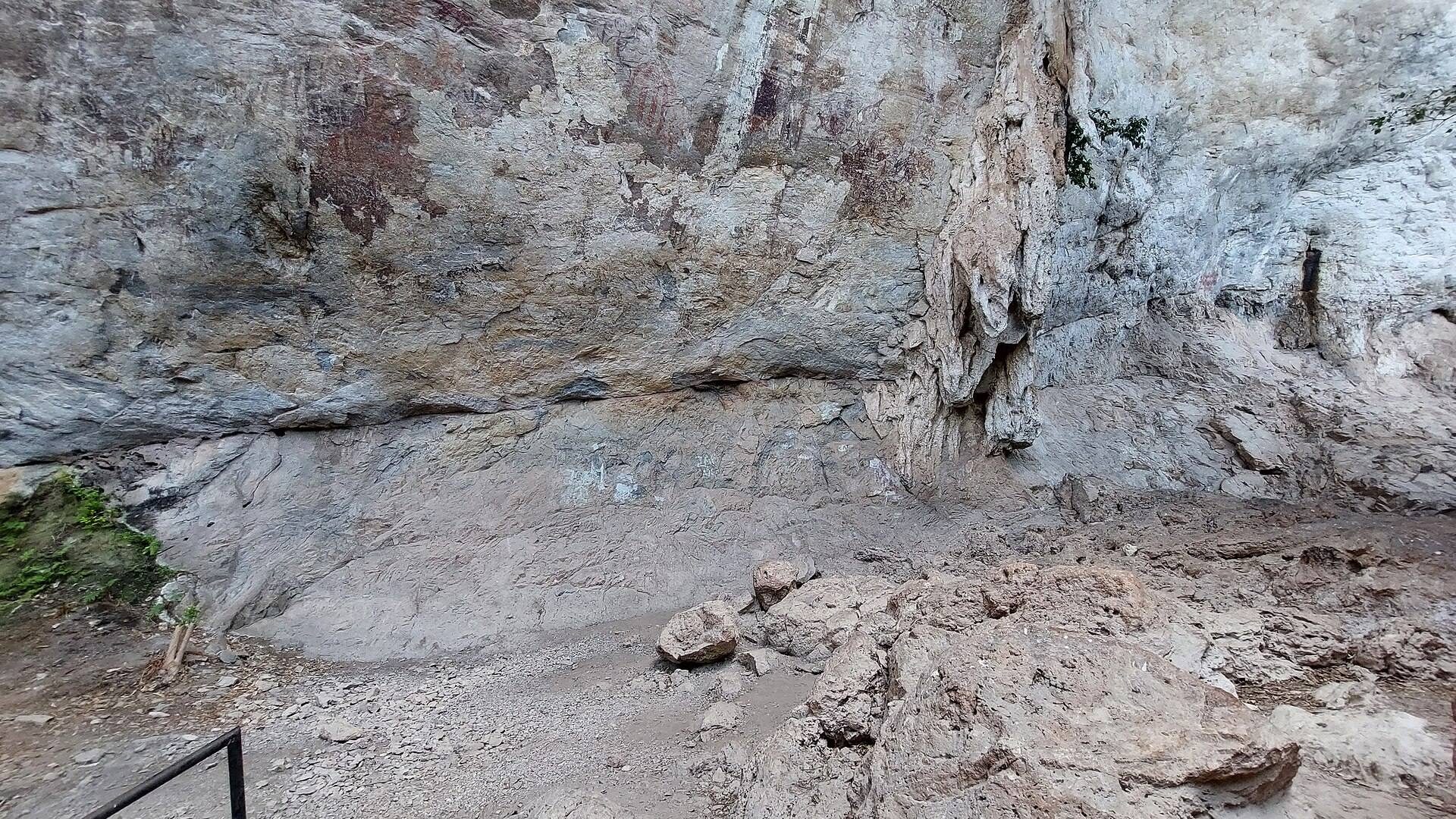
Gua Tambun occupies a prominent rock face and overhang on the western side of Gunung Panjang, an isolated karstic limestone hill overlooking Ipoh and the Kinta Valley. Karst terrain forms through the dissolution of soluble rock and commonly contains caves and shelters. The painted shelter lies about 30 metres above the valley floor. Its overhang extends approximately 120 metres from north to south, projects up to 20 metres, and reaches about 20 metres in height. The associated cave is described as nearly 2 kilometres long, about 15 metres deep, and having two entrances. Gunung Panjang consists of light-grey marble belonging to the Devonian limestone of the Kinta Valley.
Painted rock face
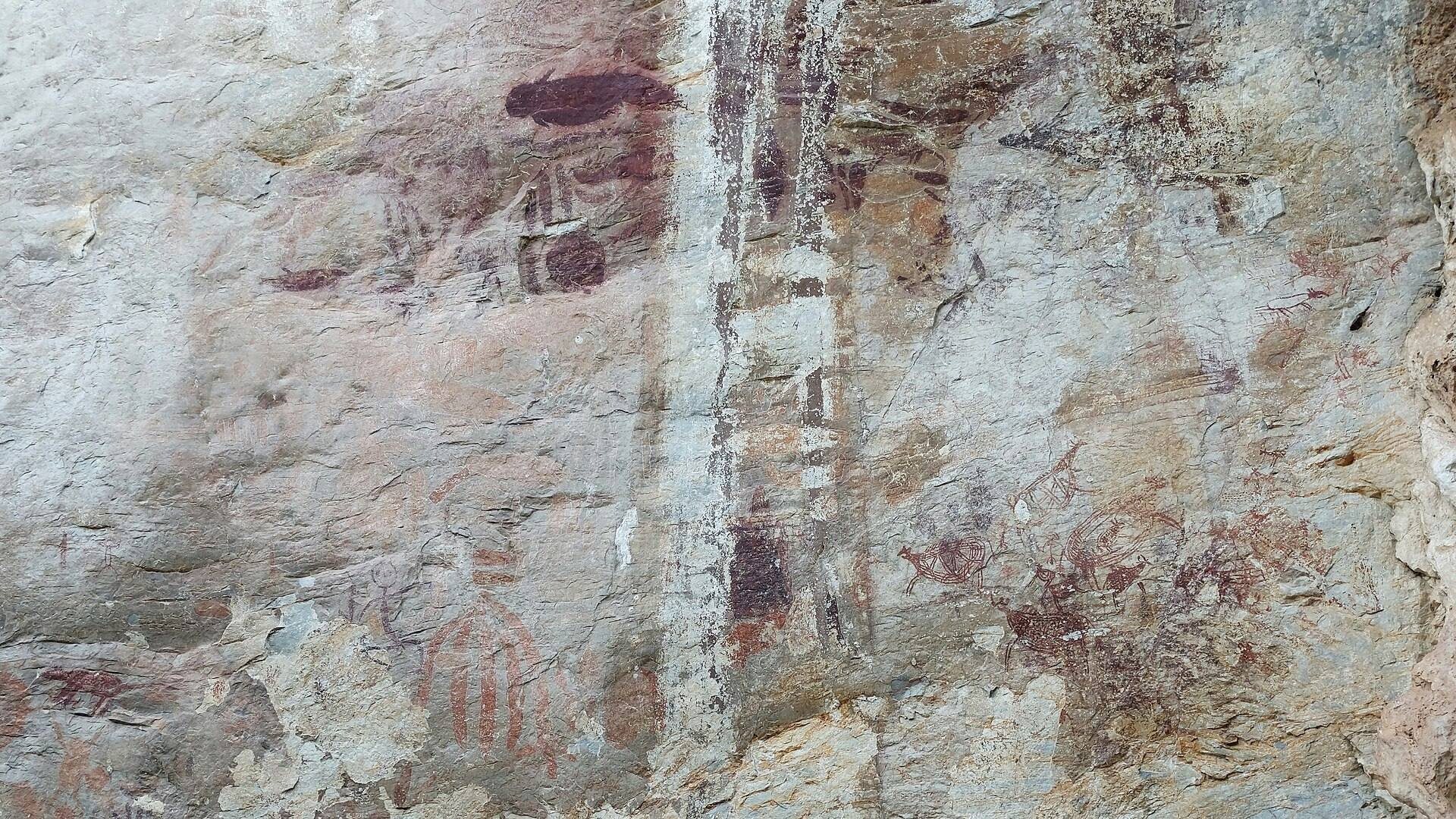
The paintings are arranged in ten panels, designated A through J. They are monochrome compositions made mainly with red pigment, alongside smaller amounts of brown and orange. Chemical analysis indicates that the pigment came from locally obtained haematite, an iron-oxide mineral that produces red to reddish-brown colour. At least 500 pictorial elements have been identified. Earlier counts recognized only 24 to 50 individual images, while the later total places Gua Tambun among Malaysia’s most extensive prehistoric painting sites and among Asia’s largest displays of Neolithic paintings.
Panel C
Panel C measures approximately 10 metres in length and 4 metres in height, with its painted surface about 6 metres above ground level. It contains roughly 400 images, most painted in red. The imagery includes animals that may represent muntjacs, sambar deer, monitor lizards, turtles, and catfish, possibly including the locally occurring walking catfish. Some animal figures use an “X-ray” style. Human-like figures account for slightly more than 3 percent of the paintings and include highly stylized forms in apparently dancing poses, as well as possible composite beings such as a human-like bird.
Other panels
Animal figures make up approximately 8 percent of the images but occupy more than half of the painted area. Plant forms constitute a similarly substantial part of the imagery and consist mostly of unidentified fruits. Abstract symbols and geometric figures together account for more than 70 percent of the pictorial elements while covering about one-third of the painted wall surface. Panel D includes angular patterns, lines arranged in prominent groups of three, and oval signs grouped in sets of six or seven. Panels E through J, identified during the 2009 investigations, are generally small. Panel J contains unique white images on a black background. Their appearance is more reminiscent of petroglyphs, although their meaning is unknown.
Weathering, exfoliation, the flaking of thin layers from the rock surface, and human impacts have left the paintings poorly preserved. Some sections have been severely washed out. When the paintings were discovered, the rock shelf at the base of the painted face was covered with empty conical snail shells whose tips had been broken off.
Archaeological deposits and excavation cuts
The former sediment deposit beneath the overhang produced cord-marked pottery sherds. The 1959 investigations also yielded red-coloured stone tools and animal remains probably attributable to the Hoabinhian culture. Three excavation cuts made near the middle of the shelter survive as shallow depressions, preserving visible traces of the earliest modern investigation of the site.