Næsbyholm: A Danish Manor House and Estate
Site at a Glance
- Popularity
- Low
- Country
- Denmark
- Primary era
- Early Modern
- Eras represented
- Early Modern, Modern
- Civilizations
- Danish, Denmark–Norway
- Site type
- Domestic
- Remains
- Manor House
On this page12 sections
History
Næsbyholm is a manor house and estate near Glumsø in Næstved Municipality, Denmark. Its principal house was built in 1585 in the Dutch Renaissance style, which adapted Renaissance forms developed in the Netherlands. The estate’s history includes successive noble ownership and reforms to farming and forestry.
Medieval farm and early ownership
In the Middle Ages, Næsbyholm was an ordinary farm called Næsbygaard. Its earliest known owner was the knight Anders Olufsen Lunge, who died in 1408. During the reign of Margrethe I, the Danish monarch who also exercised authority in Norway and Sweden, Lunge acquired additional local land from the Diocese of Roskilde in exchange for property elsewhere. The farm thereby became a manor.
Laurens Axelsen Thott held the estate from 1483 to 1498. After his death, it seems to have been divided among his four children. His daughter Anne Lauridsen Thott, wife of Hans Bille, a senior royal adviser, held a share. Christian II seized the shares belonging to her sisters Ingeborg and Margrethe because their husbands had supported the Scanian uprising, a revolt in Scania, now part of southern Sweden. The confiscated shares were sold to Torben Oxe, who tried unsuccessfully to gain the whole estate through deception. His scheme was exposed, but he was not punished.
Otte Holgersen Rosenkrantz acquired Næsbyholm in 1513, and it passed to his son Otte Ottesen Rosenkrantz in 1525. During the Count’s Feud, a Danish civil war fought from 1534 to 1536, townspeople from Skælskør plundered the estate. It may have remained uninhabited for a time. Otte died of plague in Lübeck in 1557, and his daughter Birgitte Ottesdatter Rosenkrantz inherited the property.
The Brahe family
In 1575, Birgitte married Steen Ottesen Brahe, a diplomat and adviser to the Danish kings Frederik II and Christian IV. Brahe expanded his holdings and built a new main house in 1585. Birgitte died in childbirth shortly after its completion. Brahe moved away but kept the estate until his death.
Næsbyholm then passed to Brahe’s son, Otte Steensen Brahe, who enlarged it further. Otte died at the estate. His two daughters had already died, so his only grandson, Otto Christopher Ulfeldt, inherited Næsbyholm. Ulfeldt died a few years later at the age of 17. Næsbyholm and Bavelse have shared owners since 1610.
Royal and noble ownership
In 1663, Henrik Bielke, Admiral of the Realm, a senior naval officer, acquired Næsbyholm, Bavelse, and Tarsløsegaard. He left the navy in 1679, died in 1683, and was buried at Næsby Church. His eldest son, Christian Frederik Bielke, inherited the estates at the age of 13. A military career kept him abroad for much of his life. On 11 September 1708, he was severely wounded during the capture of Tournai, a city now in Belgium, and died three days later.
Frederik IV acquired Næsbyholm and nearby Bavelse in 1709 and 1710 for his mistress, Charlotte Helene von Schindel, whom he made Countess of Frederiksholm. A countship was a territorial holding associated with a count’s title. After their relationship ended in 1711, Frederik ordered her to leave court for her estate in Zealand. She maintained an active social life there and began a relationship with Ernst Gottschalck Bülow, a former German-Danish military officer who was then county governor of Antvorskov County. They had a child and married on 9 February 1716 with the monarch’s permission. Næsbyholm and Bavelse returned to the Crown when the countship was dissolved.
In 1720, the Crown sold the estates to Peder Thott, who was succeeded by his son Otto. Christian Sigfred von Plessen bought them from Otto Thott’s daughters in 1723. Later in the eighteenth century, Johan Ludvig Holstein acquired the properties and incorporated them into the countship of Ledreborg. He sold them in 1775 to Carl Adolph Raben. Raben’s son Frederik Sophus sold the estates in 1804 to Christian Conrad, Count of Danneskiold-Samsøe.
Reform and later ownership
Danneskiold-Samsøe promoted forestry and horticulture and introduced rural reforms beyond those required by law. To move timber from the Næsbyholm forest, he had the Suså River canalized between Bavelse and Næstved. The Danneskiold Canal opened on 11 September 1812. An agricultural crisis following the war with England and the national bankruptcy severely affected him. The government took over his estates a year after his death.
Næsbyholm was sold in 1836 to Christian Rønnenkamp, the son of a merchant from Flensburg. After moving to Copenhagen when young, he made his fortune through speculative investments during the war years. He settled on his estates and managed them himself. As he had no children, he left them to his wife’s grandson, P. Christian Howden (1854–1930), who adopted the surname Howden-Rønnenkamp. Howden built new farm buildings and redesigned the garden.
Howden’s eldest daughter Jessy married Mogens Holck in 1910. The couple later used Næsbyholm as a summer residence alongside Holckenhavn. Fires in 1932 and 1947 were followed by rebuilding in the original style. In 1948, the estate passed to their son Mogens Preben Christian Eiler Holck, who owned it until 1975.
Remains
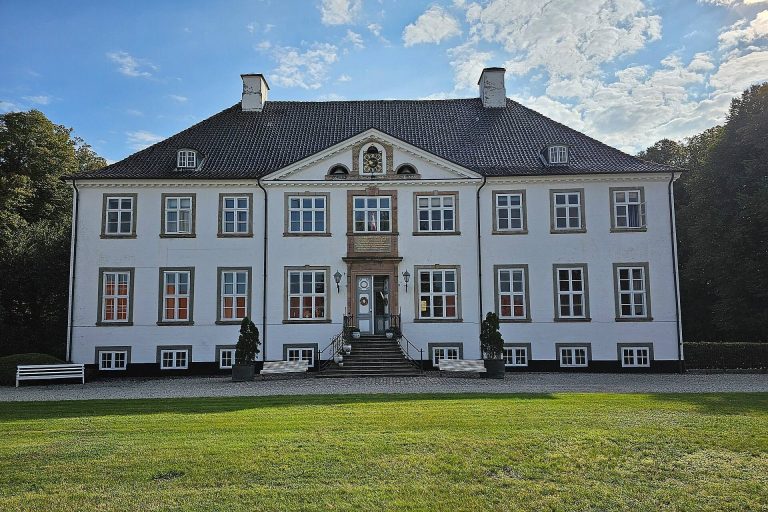
East of Tybjerg Lake, between Sorø and Glumsø, Næsbyholm’s physical features include its three-winged main building, an eighteenth-century park, and the canalized Suså River. In 2012, the combined Næsbyholm-Bavelse estate covered 1,424 hectares, about half of it forest.
Main house and painted ceiling
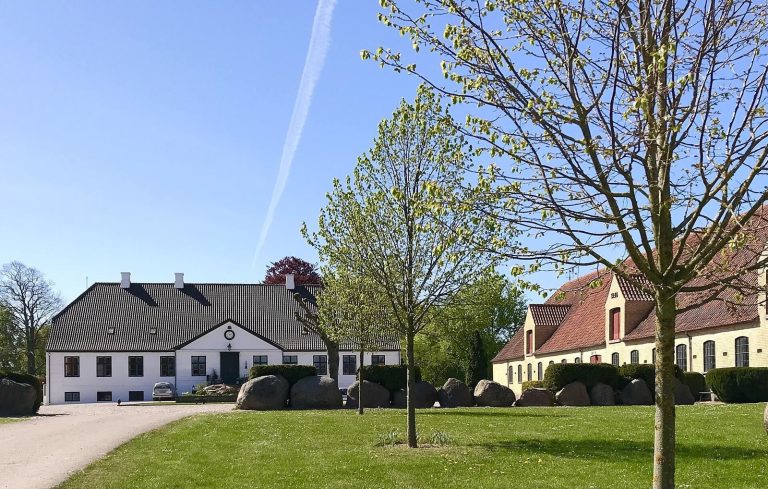
Main building
The three-winged main building follows Dutch Renaissance forms. It incorporates elements of the house built in 1585, alongside the later reconstruction of the building.
Næsbyholm Ceiling
The Næsbyholm Ceiling was decorated with four allegorical paintings made on wet plaster, each representing a season. The paintings for Winter and Spring survive.
Estate landscape and waterway
Park
The park was laid out in the eighteenth century.
Danneskiold Canal
The Danneskiold Canal is a canalized stretch of the Suså River between Bavelse and Næstved, created to carry timber from the Næsbyholm forest.