Mokrice Castle: A Medieval Castle and Estate in Slovenia


Site at a Glance
- Rating
- 4.4
- Popularity
- Low
- Country
- Slovenia
- Primary era
- Early Modern
- External website
- Open
- Eras represented
- Medieval, Early Modern
- Civilizations
- Habsburg, Holy Roman Empire
- Site type
- Military
- Remains
- Castle
On this page7 sections
History
Mokrice Castle is a medieval castle in Slovenia, first recorded in the fifteenth century and rebuilt and enlarged during the sixteenth century. It stands near Jesenice na Dolenjskem, southeast of Brežice, in a landscape where the Gorjanci Hills descend toward the Sava Valley near the Croatian border.
Medieval origins and noble ownership
The castle was mentioned in 1444 as a geslos, meaning a castle, and in 1451 as a sicz, or fortified place. In 1474 it appeared under the name Mokruz. The sixteenth-century rebuilding created the form of the complex that largely defines it today. Among its principal noble owners were the Erdődy and Auersperg families, as well as the Moscon, Draschkovich, and Gallenberg families. The Erdődys were a major Hungarian-Croatian noble family, while the Auerspergs belonged to the prominent nobility of the Habsburg lands.
Vice-Ban Ambrož Gregorijanec, a senior official who governed or represented a regional governor, became the first recorded owner of the entire estate when he purchased it from Lucas Zäckl and Franz Tacho on 4 August 1560. The Gregorijanec family died out in 1610, after which the property passed through several inheritances. It became Auersperg property in 1727. The succession included Anna Barbara Erdődy, married to Dismas Andreas Christian von Auersperg, in 1719; Wolfgang Nikolaus von Auersperg in 1727; Maria Nikolaus Tolentinus von Auersperg in 1760; Michael Franz Sales Nikolaus von Auersperg in 1812; Gustav Franz Viktor Nikolaus von Auersperg in 1847; Beatrix Aloisia Serafina Maria von Auersperg in 1880; and Nicolaus Gustav Max Heinrich von Gagern in 1915.
The estate and its wider connections
Mokrice operated as a large landed estate with forestry, a sawmill, dairy farming, fishponds, orchards, and vineyards. Its holdings included more than 900 hectares in the Sichelburg Forest. Viticulture ended around 1900 after phylloxera, an insect pest that attacks grapevines, damaged grape production. Mokrice sandstone was used in major buildings in imperial Vienna, including the Votive Church, the Vienna Stock Exchange, Vienna City Hall, and the Kunsthistorisches Museum, Vienna’s major museum of art history.
The Auersperg-Gagern connection brought prominent nineteenth-century intellectuals to Mokrice, including Theodor Mommsen, a German classical scholar and historian, and Anastasius Grün, an Austrian poet and politician who was a cousin of Gustav von Auersperg. During the First World War, Nicolaus von Gagern sold half the estate to Count Economo of Trieste. The Economo and von Gagern families remained co-owners from 1915 to 1922. Economo later sold his share to Milan Prpič, a timber merchant.
Twentieth-century transformation
Berger, an industrialist from Zagreb, acquired the entire castle on 1 August 1923 and sold it in 1937 to the Archdiocese of Zagreb. The archdiocese used Mokrice as a seminary and as a summer residence for Cardinal Stepinac, the archbishop and cardinal of Zagreb, while maintaining and renovating the complex. In 1941 the German Wehrmacht, the armed forces of Nazi Germany between 1935 and 1945, occupied the castle and carried out further renovation. Mokrice was nationalized in 1945 after the Second World War.
After the war, the castle became a hotel with restaurants. An eighteen-hole golf course was established in the grounds in 1988, and the complex is currently managed by Terme Čatež.
Remains
Castle structure and courtyard
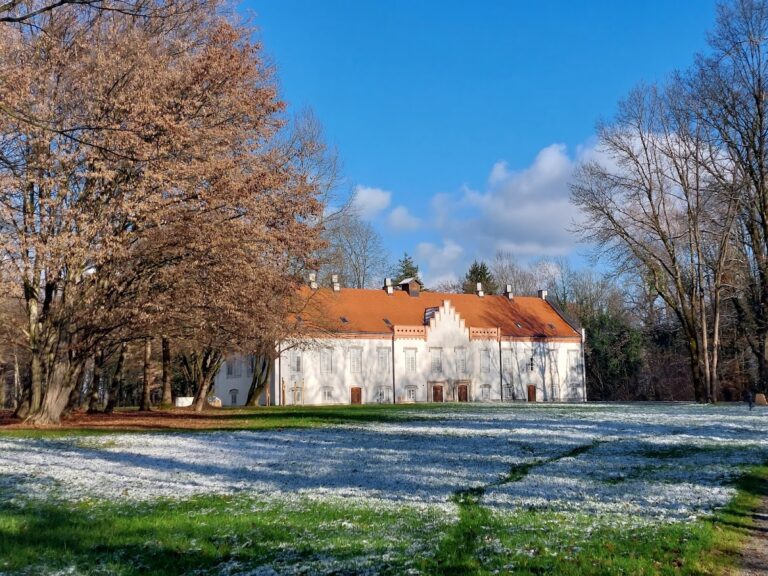
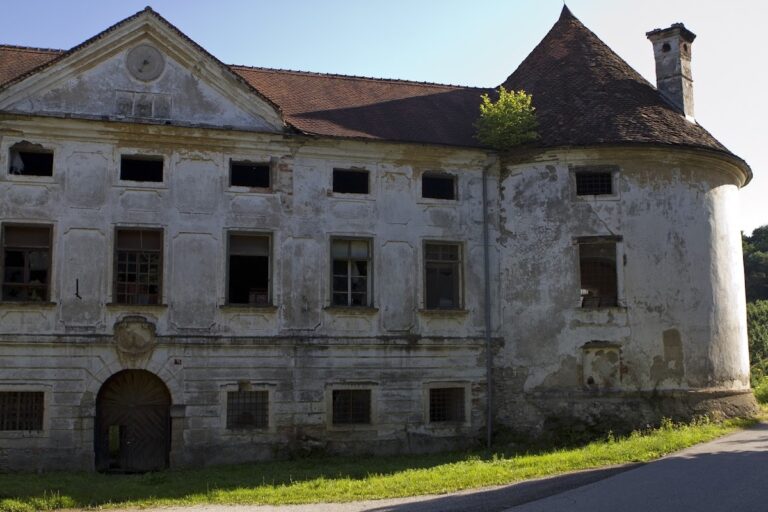
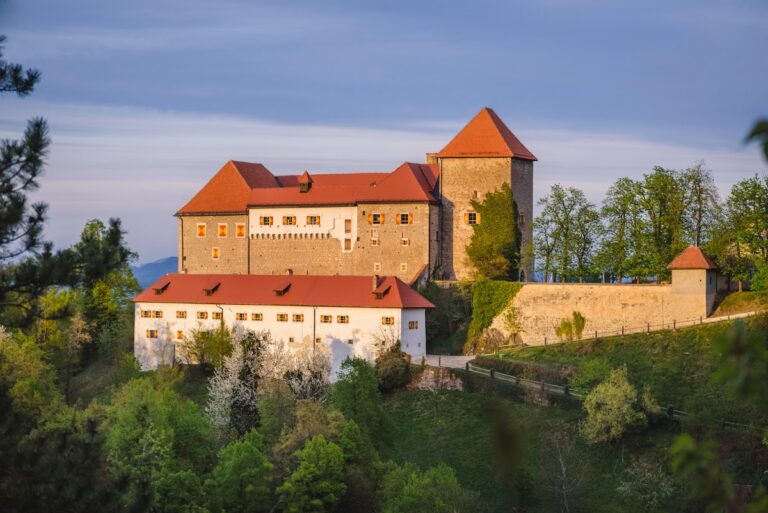
Mokrice Castle stands on a hill in the northern part of Rajec. The sixteenth-century rebuilding produced four distinct wings around an irregular four-sided inner courtyard. Arcades line the courtyard, while projecting round towers provide the castle’s principal defensive elements.
A stone well occupies the courtyard. Its wrought-iron crown is accompanied by four statues representing the seasons, which were brought to the well from the castle park.
Park and golf grounds
The castle grounds include the golf course established in 1988. It has eighteen holes and extends across more than 66 hectares, forming part of the present estate surrounding the historic castle.