Mogao Caves: A Buddhist Cave Complex on the Silk Road
Site at a Glance
- Rating
- 4.6
- Popularity
- Low
- Country
- China
- Primary era
- Medieval
- Eras represented
- Classical, Medieval, Modern
- Civilizations
- Tibetan, Western Xia, Yuan
- Site type
- Religious
- Remains
- Sanctuary
On this page18 sections
History
The Mogao Caves are a Buddhist cave complex near Dunhuang in Gansu, China, begun in 366 under the Former Liang and developed over centuries at a major Silk Road crossroads. Also called the Thousand Buddha Grottoes, the complex became a place of meditation, worship, pilgrimage, artistic production, and cultural exchange between China, Central Asia, India, Tibet, and other regions.
Dunhuang and the foundation of the caves
Dunhuang was established as a Han frontier garrison by Emperor Wudi in 111 BC to defend against the Xiongnu. It later became a commercial gateway to the west and a meeting place for peoples and religions moving along the Silk Road. The first Mogao caves were excavated in 366, when Dunhuang was under the Former Liang. Buddhist tradition preserved in the text Fokan Ji attributes the foundation to the monk Le Zun, who saw a vision of a thousand Buddhas in golden light and began excavating a cave. Another document gives the earlier date 353. The monk Faliang later joined Le Zun, and a small monastic community had formed by the Northern Liang period.
The earliest caves served hermit monks seeking places for meditation. They later developed into sanctuaries connected with monasteries established nearby. From the fourth to the fourteenth century, monks continued to create caves with financial support from donors. Caves 268, 272, and 275, built and painted between 419 and 439 during the Northern Liang period, are the earliest decorated examples that survive.
Imperial patronage and Buddhist worship
Members of the Northern Wei and Northern Zhou ruling families sponsored many caves, and the complex expanded during the Sui dynasty. Under the Sui and Tang dynasties, Mogao became a public center of Buddhist worship and pilgrimage. Its paintings and architecture supported meditation, illustrated Buddhist narratives, and taught religious beliefs to people who could not read. Patrons included senior clergy, local ruling elites, foreign dignitaries, Chinese emperors, merchants, military officers, women’s groups, and other local communities.
During the Tang dynasty, Dunhuang became a major commercial and religious center on the Silk Road, and the number of caves exceeded one thousand. Dunhuang was under Tibetan rule from 787 to 848, governed through Tibetan political authority combined with Han administrative methods. The complex escaped Emperor Wuzong’s persecution of Buddhism in 845 because the region was then under Tibetan control. During the later Guiyijun period, from 848 to 1036, Dunhuang was ruled by the Zhang and Cao families. The period is named for the local regime traditionally translated as the “Return to Righteousness Army.”
Decline, abandonment, and rediscovery
Cave construction declined after the Tang dynasty and ended after the Yuan dynasty. The expansion of Islam in Central Asia and the growing importance of maritime trade reduced the influence of the Silk Road. During the Ming dynasty, the route was officially abandoned and Dunhuang became depopulated. Local people nevertheless continued to use the caves for pilgrimage and worship into the early twentieth century.
In 1900, the Taoist abbot Wang Yuanlu discovered the sealed Library Cave while clearing sand and attempting to repair the site. After showing manuscripts to officials, he resealed the chamber in 1904 on the order of the governor of Gansu, who was concerned about the cost of transporting the documents. Aurel Stein obtained many manuscripts, paintings, and textiles from Wang in 1907 in exchange for a donation toward restoration. Paul Pelliot’s French expedition followed in 1908, while Japanese and Russian expeditions led by Otani Kozui and Sergei F. Oldenburg visited in 1911 and 1914. The removal of materials dispersed the Library Cave collections among institutions in Beijing, London, Paris, Berlin, and elsewhere.
Concern over the manuscripts led to their transfer toward Beijing in 1910, although some were stolen or left behind. Wang later concealed another cache, which was found in the 1940s. The manuscripts are now being digitally reconstructed and studied through the International Dunhuang Programme. In 1921, some caves were damaged and vandalized when local authorities housed Russian soldiers fleeing the civil war after the Russian Revolution. Langdon Warner removed several murals and a statue in 1924, and Kuomintang soldiers stationed at Dunhuang caused further damage to murals and sculptures in 1939.
Modern preservation and study
Zhang Daqian worked at the caves for two and a half years from 1941, repairing and copying murals. His exhibitions and publications in 1943 helped increase recognition of Dunhuang art in China. The Research Institute of Dunhuang Art, later called the Dunhuang Academy, was established at Mogao in 1944 to care for the site and its contents. In 1956, Zhou Enlai authorized a grant for repairs and protection. The State Council designated the caves a specially protected historical monument in 1961, after which large-scale renovation began. The site largely escaped the extensive damage suffered by many religious sites during the Cultural Revolution.
The Dunhuang Academy began scientific conservation in the 1980s and explored digital conservation from 1993. By 2010, it had photographed 120 caves, processed images from 40 caves, created panoramic tours of 120 caves, and produced three-dimensional reconstructions of 20 painted sculptures. Its I-m-Cave system presents virtual restorations alongside damaged artifacts. The Mogao Caves were inscribed as a UNESCO World Heritage Site in 1987 for their artistic achievement, cultural exchange, architectural history, interaction between people and the environment, and association with living traditions and beliefs. Visitor limits now form part of measures intended to reduce damage while conservation and research continue.
Remains
The complex occupies a cliff almost 2 kilometres long and contains about 500 temple caves within a total of 735 surviving caves. The principal southern group contains 487 caves, used mainly for worship and pilgrimage, while 248 caves lie to the north. The northern caves include living quarters, meditation chambers, and monastic burial sites. Southern caves are generally decorated, whereas most northern caves are plain. The northern group was identified between 1988 and 1995 in addition to the 487 caves known since the early twentieth century. Dates have been established for about 500 caves from their murals, sculptures, and other contents.
Cave plans and wooden structures
Rock-cut sanctuaries
The local rock is a soft gravel conglomerate that was unsuitable for elaborate rock sculpture or detailed architectural carving. Mogao therefore combines excavated spaces with clay sculpture, painted surfaces, and added wooden structures. Some early caves follow Indian and Central Asian chaitya models, or Buddhist worship halls organized around a stupa. These caves contain a square central column with sculptural niches representing a stupa, allowing worshippers to walk around the sacred form. Other caves follow Chinese and Buddhist temple-hall designs.
Ceilings include truncated pyramidal forms sometimes painted to resemble tents, as well as flat and gabled ceilings imitating traditional buildings. Meditation caves adapted the Indian vihara plan, with side chambers large enough for one seated person. Many caves originally had wooden porches or fore-temples projecting from the cliff. Most were lost through decay or other damage, leaving five surviving examples. The two earliest are rare pieces of Song-period wooden architecture.
Nine-storey wooden building
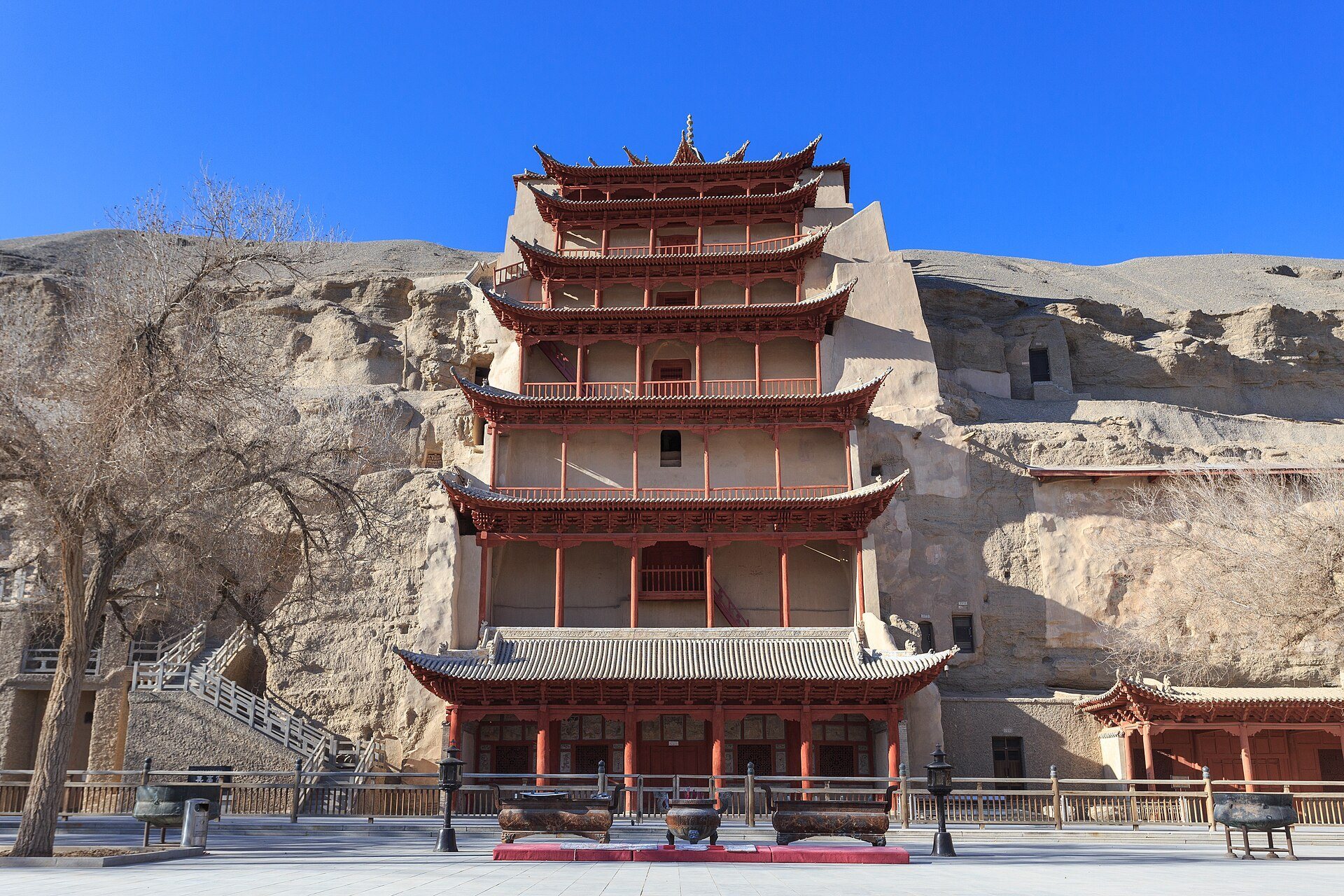
The principal wooden building at Mogao houses the larger Great Buddha. Its first construction took place during the Tang dynasty, and it was originally four storeys high. One storey was added between 874 and 885, followed by repairs during the Guiyijun period and two further storeys during restoration in 1898. Two twentieth-century restorations produced the present nine-storey structure. The building has been repaired at least five times and is not the original structure.
Murals and painted imagery
Wall and ceiling paintings
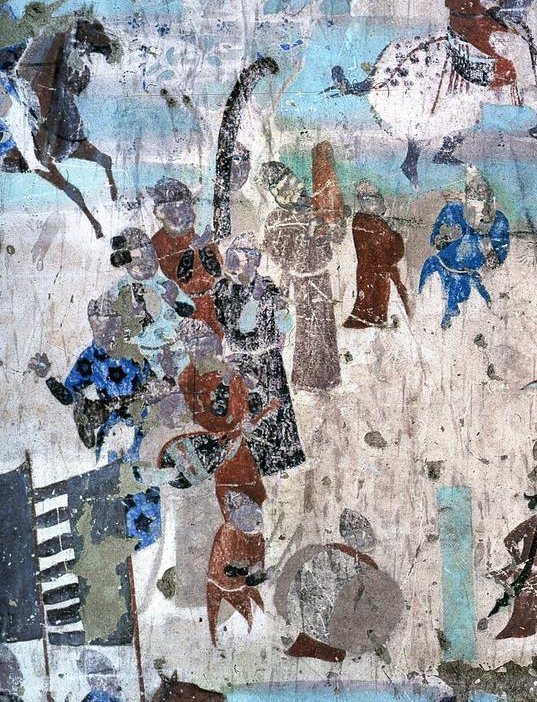
The murals date from the fifth to the fourteenth century and cover about 490,000 square feet, or 46,000 square metres. They fill walls and ceilings in the most extensively painted caves. Geometric and plant ornament surrounds figurative scenes, while painted sculpture and images of Buddhas dominate many compositions. Subjects include Buddhist narratives, Jataka stories about the Buddha’s previous lives, Avadana moral tales, religious themes, traditional myths, and donor portraits.
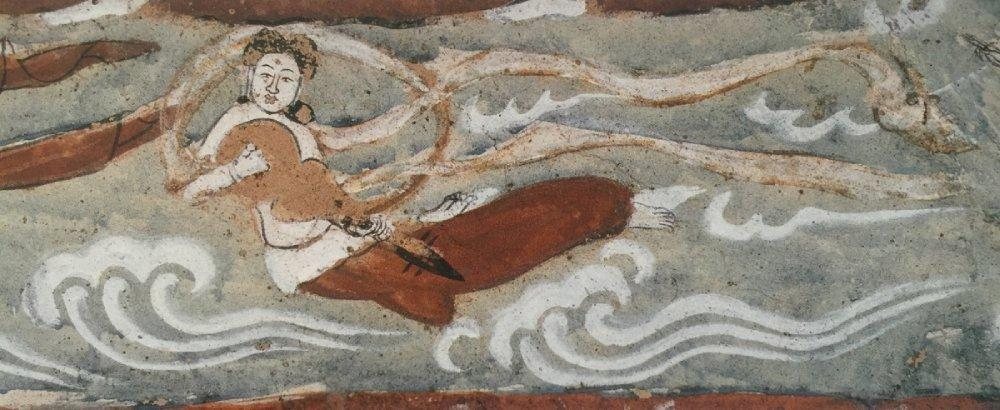
Rows of small seated Buddhas, often made with stencils so that figures could be repeated, are a widespread motif and contributed to the name Thousand Buddha Caves. Flying apsaras and other celestial beings appear on ceilings or above Buddha figures, while donors are often shown along the lower walls. Early paintings display Indian and Central Asian techniques, compositions, costumes, and shading. A distinctive Dunhuang style emerged during the Northern Wei, while Chinese elements increased during the Western Wei. A single cave can combine Chinese, Indian, and Central Asian motifs.
Many earlier paintings were repaired, covered with plaster, or repainted during later periods, and earlier layers sometimes remain visible where later paintings have been removed. The artistic quality of the murals reached a peak during the Tang period and declined after the tenth century. Lead-based pigments darkened through oxidation, especially in figures exposed to air and light. As a result, shading originally intended to suggest three-dimensional form can now appear as heavy outlining.
Buddhist narratives and donor portraits
The paintings include Bodhisattvas, Buddhist figures who seek enlightenment while assisting other beings. Avalokitesvara, a Bodhisattva associated with compassion, became especially prominent. Large depictions of Mahayana sutras and Pure Land paradises developed during the Sui and Tang periods. The Western Paradise mural in Cave 220 is a well-preserved example. Tantric Buddhist imagery, including eleven-headed and thousand-armed forms of Avalokitesvara, appeared during the Tang period and became especially popular under Tibetan and later Yuan rule.
Donor portraits reflect contemporary secular painting styles. Late Tang murals depict General Zhang Yichao and commemorate his victory over the Tibetans in 848. Under the Cao family, donor portraits became larger and included members of the Cao family and allied rulers from the Ganzhou Uyghur, Qocho, and Khotan polities.
Clay sculpture and monumental Buddhas
Sculptural groups
Approximately 2,400 clay sculptures survive at Mogao. Most were made over wooden frames padded with reeds, modelled in clay stucco, and painted. The giant statues have stone cores. Buddha figures generally occupy the central position in groups and may be accompanied by Bodhisattvas, heavenly kings, devas, apsaras, yaksas, and other mythical beings. Early groups are relatively simple, while sculpture from the Northern Wei, Northern Zhou, Sui, and Tang periods developed into larger ensembles. Some early works reflect Indian, Central Asian, and Gandharan prototypes, while later figures became progressively more Chinese in style.
Giant and reclining Buddhas
The two giant statues represent Maitreya, the Buddha expected to appear in the future. The larger statue in Cave 96 is 35.5 metres high and was constructed in 695 following Empress Wu Zetian’s instructions for giant Buddhist statues. The smaller statue is 27 metres high and was constructed between 713 and 741.
The northern giant Buddha was damaged by an earthquake and repaired and restored several times. Its clothing, colour, and gestures were altered, while the head retains its original early Tang appearance. The southern statue largely retains its original form apart from its right hand. A Tibetan-period Nirvana Cave contains a reclining Buddha extending across the length of the hall, with mourners represented behind it in murals or sculpture. The reclining Buddha in Cave 158 is 15.6 metres long.
The Library Cave and its contents
Cave 17 memorial shrine
Cave 17 lies beside the entrance passage to Cave 16. It originally served as a memorial shrine for the monk Hongbian after his death in 862 and may also have been his retreat during his lifetime. Hongbian was associated with the construction of Cave 16. The chamber originally contained a statue of him, which was moved when the cave became a manuscript repository and later returned. A stone stele records his life, while the wall behind the statue bears a painted attendant, combining sculpture and wall painting in one composition.
Manuscripts and textiles
The Library Cave was sealed early in the eleventh century, although its exact sealing date remains uncertain. The latest dated document found there is generally assigned to 1002, and the chamber was probably sealed not long afterward. The contents included documents from the fifth century to the early eleventh century, including about 1,100 bundles of scrolls, more than 15,000 paper books and shorter texts, and an estimated total of up to 50,000 ancient documents.
The manuscripts include Buddhist scriptures and commentaries, apocryphal works, prayer books, Confucian and Taoist texts, Christian writings, government and administrative documents, anthologies, glossaries, dictionaries, and calligraphic exercises. They are written mainly in Chinese, with additional Tibetan, Uyghur, Sanskrit, Avestan, Sogdian, and Khotanese materials. The cave contained hemp-paper scrolls, Tibetan pothi manuscripts, paintings on hemp, silk, and paper, textiles, silk banners, damaged Buddhist figurines, and other Buddhist equipment.
The Diamond Sutra, printed in 868, is the earliest surviving dated printed book. Other images were made with woodblocks, sometimes coloured by hand, and served as devotional pictures or material for display and distribution to pilgrims. More than one thousand paintings on silk, banners, and embroideries were found in the cave. Most date from the late seventh century or later and depict sutras, Buddhas, and narrative scenes, combining Chinese, Indian, Tibetan, and Uyghur traditions.
Textiles from the Library Cave include silk banners, altar hangings, manuscript wrappings, and monastic garments. Silk banners decorated the cliff during festivals, while altar and temple hangings used horizontal bands with suspended strips of fabric. The collection also includes a two-page, four-fold Syriac manuscript identified as part of the Psalms, with Uyghur-script annotations between the lines. It provides evidence for the presence and study of Eastern Christianity, including traditions associated with the Church of the East, in Dunhuang during the Mongol Yuan period.
Together, the surviving material encompasses architecture, clay and stucco sculpture, wall painting, silk and paper painting, calligraphy, woodblock printing, embroidery, literature, music, dance, and popular entertainment.