Menhir von Benzingerode: A Prehistoric Standing Stone in Germany
Site at a Glance
- Popularity
- Low
- Country
- Germany
- Primary era
- Classical
- Eras represented
- Classical
- Civilizations
- Unclassified
- Site type
- Civic
- Remains
- Megalithic Monument
On this page7 sections
History
The Menhir von Benzingerode is a prehistoric standing-stone monument in Wernigerode, Germany. Its surroundings contain evidence of activity in several periods, while later excavations uncovered burials and other features beside the stone.
Surveys conducted in the surrounding area from 1975 to 1983 recovered more than 600 pottery fragments. They represent the Linear Pottery culture, an early Neolithic culture of central Europe, as well as the Late Bronze Age, Iron Age, and Middle Ages. This range points to activity in different periods, but does not establish continuous occupation.
In 1939, archaeologist Alfred Tode excavated beside the menhir. Gerhard Bosinski later noted that the arrangement of features there closely resembled one at the Menhir of Einselthum in Rhineland-Palatinate.
A rescue excavation in 2001 uncovered the Benzingerode mortuary house, a collective burial structure associated with the Bernburg culture, a prehistoric group linked to communal burials.
The stone is also known as the Giant’s Stone and the Huns’ Stone, and by a local name meaning “megalithic tomb.” One legend describes it as a marker over the grave of a pagan hero killed in battle. Another tells of three giants who loved a farmer’s daughter and competed by throwing stones from Struvenburg. The eldest threw the largest stone, which stood upright and was said to be the Benzingerode menhir. The second stone landed nearby at an angle in soft ground, while the youngest threw the smallest stone the farthest. The giants quarrelled when they realized the contest was unequal, then left; the farmer’s daughter waited in vain for her suitor.
Remains
The standing stone and its setting
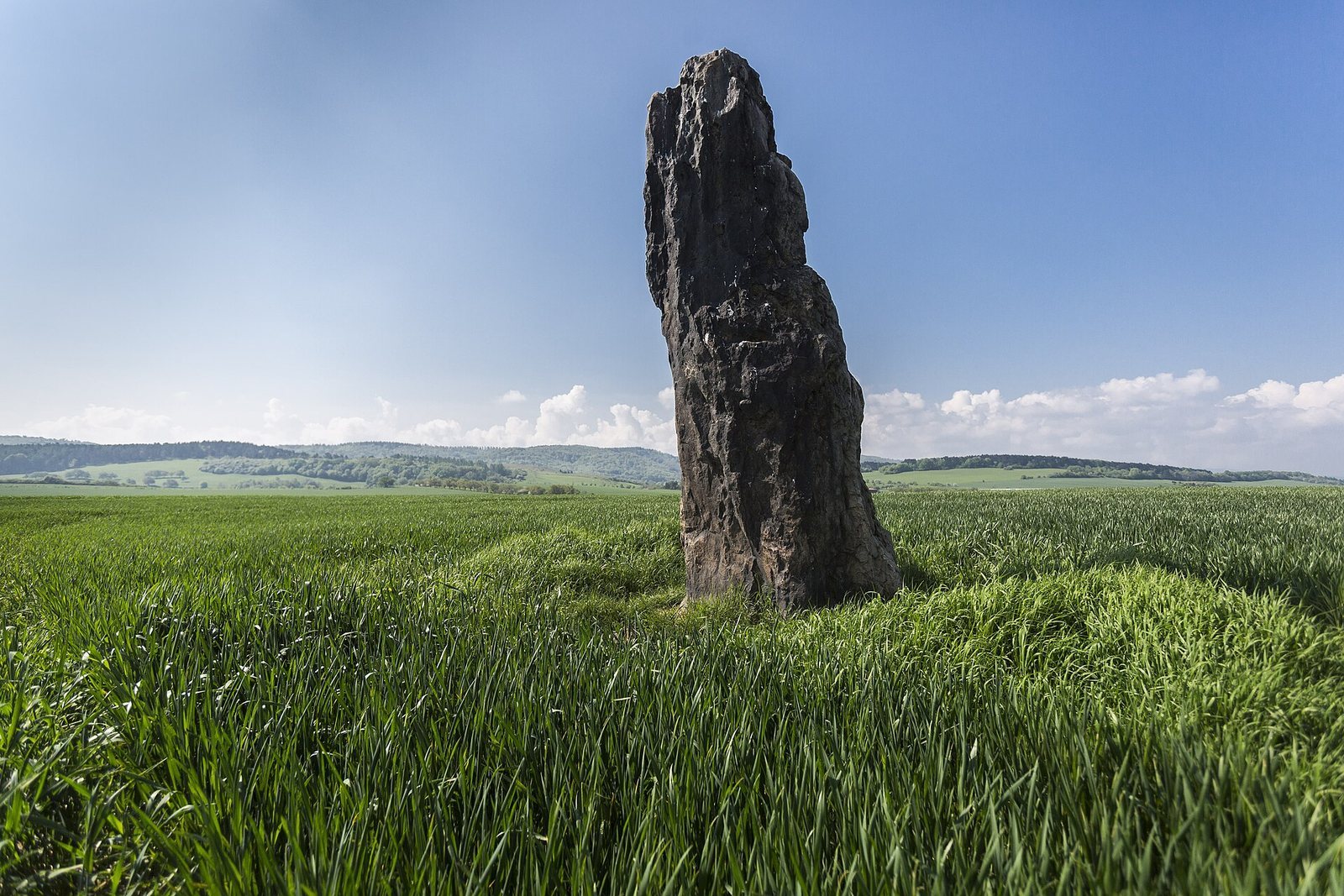
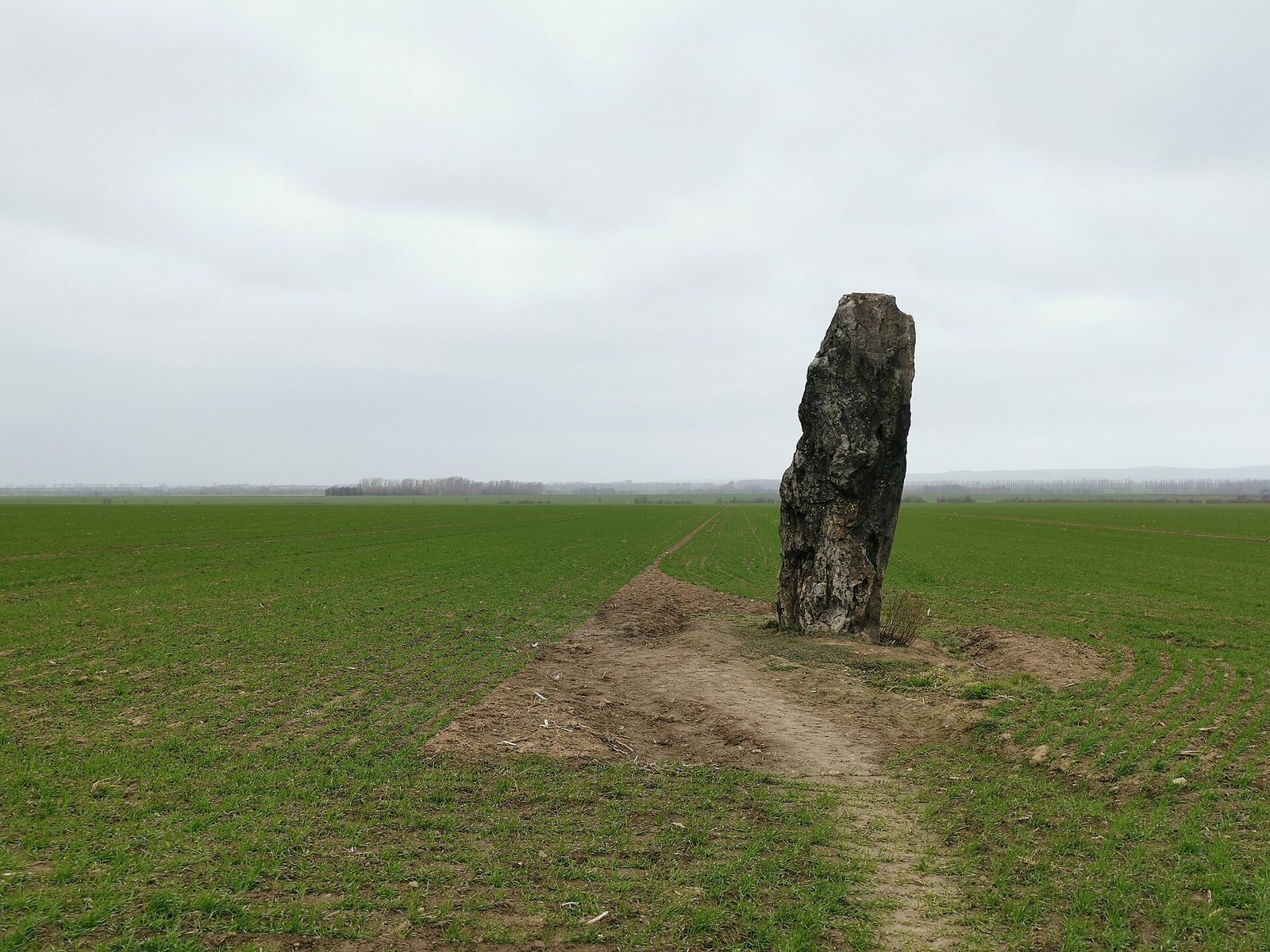
The menhir stands northeast of Benzingerode, just below the highest point of a hill called Steinfeld. Made of Senonian quartzite, a hard rock composed chiefly of quartz, it is 4.5 metres tall overall, with 3.85 metres above ground. It measures 1.6 metres across and 0.6 metres deep. The stone is heavily fissured and narrows toward its top. At 3.85 metres above ground, it is regarded as the tallest prehistoric menhir in northern Germany. The nearest known occurrence of its rock is 1.5 kilometres away at Heimburg.
At least four other menhirs once stood in the surrounding area. Two remain: the Menhir of Heimburg and the Menhir of Derenburg. A sightline connects the Benzingerode stone with the Derenburg menhir.
Features beside the menhir
Stone-packed grave
A west-to-east-oriented stone-packed grave, a burial formed or covered with tightly arranged stones, lay beside the menhir. It may have been a grave whose skeletal remains did not survive, or it may have been intended as a cenotaph, a memorial grave without the deceased’s remains.
Burnt pit and stone paving
Beside the menhir, an excavated pit contained burnt remains. Stone paving lay directly at the foot of the standing stone.
Late Roman urn grave
An urn grave, a burial in which cremated remains are placed in an urn, belonged to the Late Roman period. Finds from it included resin, melted glass beads, and remains of a bone comb.