Marmoutier Abbey: A Merovingian and Benedictine Monastery in France
Site at a Glance
- Popularity
- Medium
- Country
- France
- Primary era
- Medieval
- Eras represented
- Medieval, Early Modern
- Civilizations
- French, Holy Roman Empire
- Site type
- Religious
- Remains
- Church
On this page15 sections
History
Marmoutier Abbey is a former monastery in Marmoutier, France, founded around 589 by Irish monks led by Saint Leobard, a disciple of Columbanus. Its surviving church is Romanesque, a style marked by rounded arches and massive forms. The abbey became a royal foundation under the Merovingians, an early Frankish ruling dynasty, and from 659 held imperial status. Childebert II, king of Austrasia, one of the Frankish kingdoms, supported it financially and gave it a large estate.
Foundation and early reform
The abbey’s earliest name was Aquileia; later forms included Mauri Monasterium, Maursmünster, and Marmoutier. Although it belonged to the Diocese of Metz, a bishop’s territorial jurisdiction, its imperial status placed it directly under the emperor rather than a local lord. It was exempt from the local bishop’s authority and could levy taxes and administer justice. With Neuweiler Abbey, it formed an enclave of Metz’s jurisdiction within the territory of the Diocese of Strasbourg as that diocese took shape from the eighth century.
A fire damaged the monastery in 724. Saint Maur, identified as its fifth abbot, restored it, and the abbey’s later name derives from his. He is also sometimes regarded as its founder. In 728, Saint Pirmin introduced the Rule of Saint Benedict, a set of precepts for monastic life, replacing the Columbanian tradition associated with the missionary monk Columbanus. Maur became the first abbot under the new rule.
Reform and medieval growth
At the initiative of Louis the Pious, the abbey was developed around 814 as a model Benedictine house. Benedict of Aniane, a Benedictine monk and reformer, was appointed abbot, and he and other monks arrived in 816. A second fire destroyed the abbey in 824. It was rebuilt and placed in the care of Drogo, Louis’s brother and the bishop of Metz. Erchenbald, bishop of Strasbourg, consecrated the abbey church in 971. On 1 March 1096, Pope Urban II visited and performed a consecration, though what he consecrated is not known.
Under Abbot Meinhard and his successors, the abbey grew again during the twelfth century and consolidated a broad territory. In 1144, it issued a forest regulation limiting the cutting of wood to what could grow back, an early formulation of a sustainability principle. The monastery’s prosperity later weakened. During the thirteenth and fourteenth centuries, disputes over property, particularly with the Geroldseck family, lords of the town that developed around the abbey, and declining income contributed to its difficulties.
Late medieval and early modern upheavals
In 1517, the abbey joined the Bursfeld Congregation, an association of Benedictine monasteries organized around reform. Its monks also held the Priory of Our Lady of the Fields, a dependent monastic house, until 1604, when they transferred it to Carmelites, a Catholic religious order, who had arrived from Spain.
During the German Peasants’ War, an uprising in 1525, the abbey was looted and partly destroyed, and its library was lost. Anton of Lorraine and his troops prevented the buildings from being burned. The abbey was plundered again during the Thirty Years’ War. Under the Peace of Westphalia in 1648, much of Alsace passed to France.
Revival and dissolution
The abbey’s fortunes recovered in the later seventeenth century, and rebuilding continued during the eighteenth under Abbots Anselm Moser and Placid Schweighäuser. The French Revolution brought the monastery to an end in 1789. Its buildings were demolished or sold, while the abbey church continued as the parish church of Saint Stephen. Other former monastic buildings were used as a presbytery and town hall.
The church received historic-monument protection in 1840, extended in 1991 to the wing containing the tithe barns. Musicologist and organist Albert Schweitzer played the abbey organ and helped bring about its restoration in 1955.
Remains
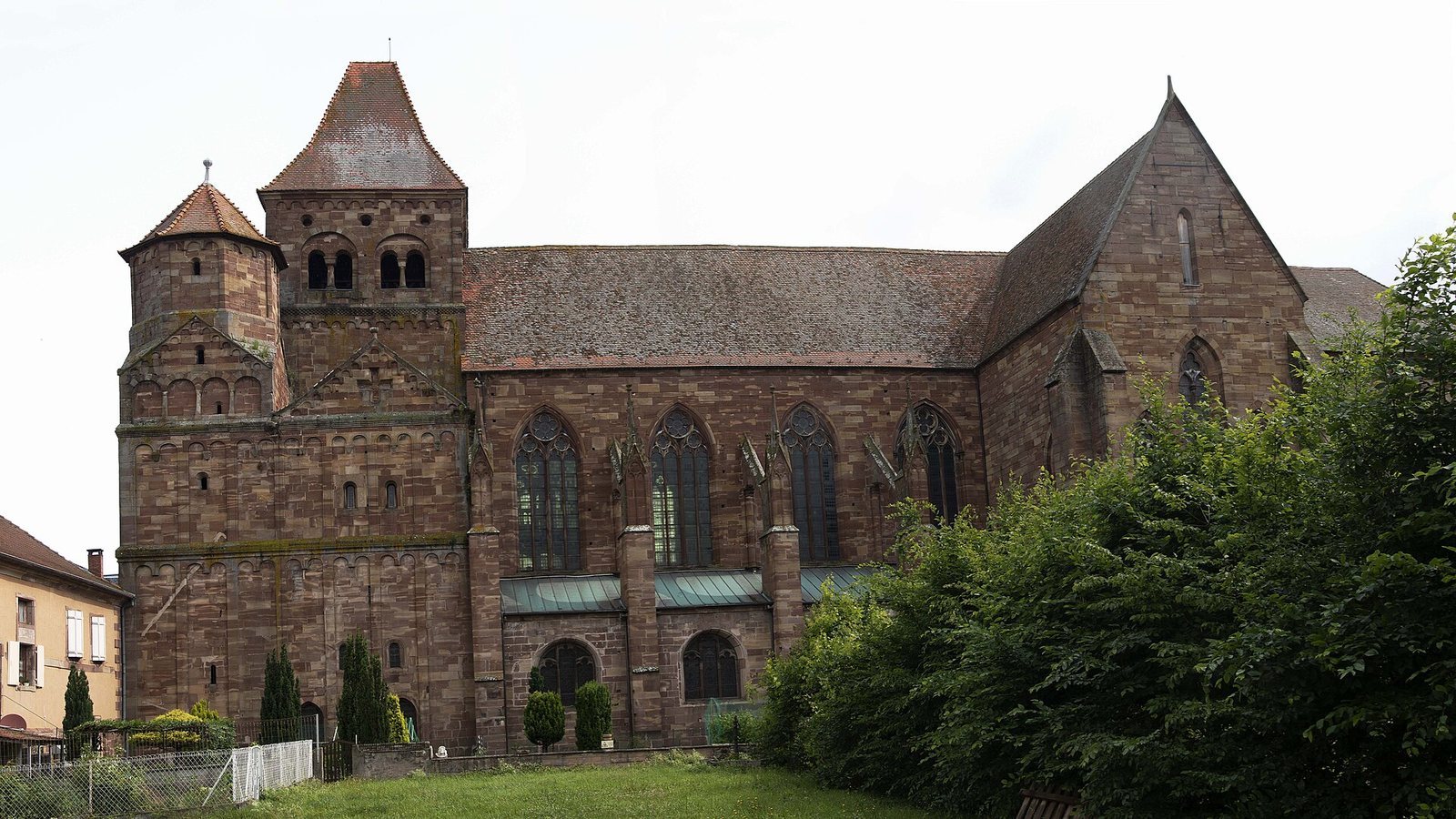
The surviving complex centers on the 74-metre-long abbey church of Saint Stephen, which stands on Market Square along the Alsace Romanesque Route. Its fabric includes an earlier western front, later church structures, and former monastic buildings.
Church structure
West façade and towers
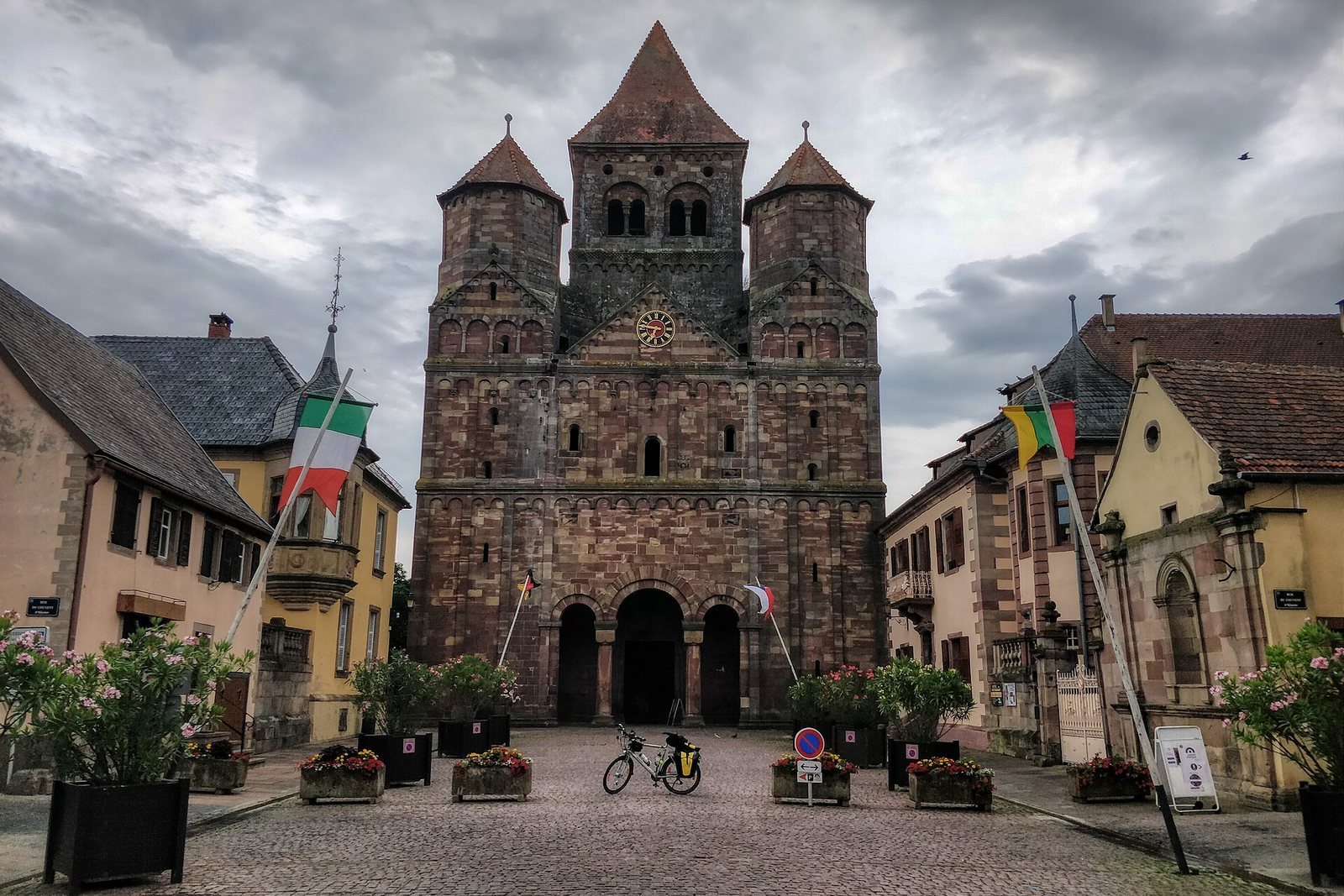
The west façade dates from the late tenth and eleventh centuries and is described as Romanesque-Byzantine, drawing on the Eastern Roman tradition. Its open porch has three arches and is flanked by two square towers; three massive towers mark the western end. Staircases within the towers lead to a room above the porch and to a large gallery. The gallery survives from the eleventh-century church and forms the base of the twelfth-century bell tower.
Transept and interior
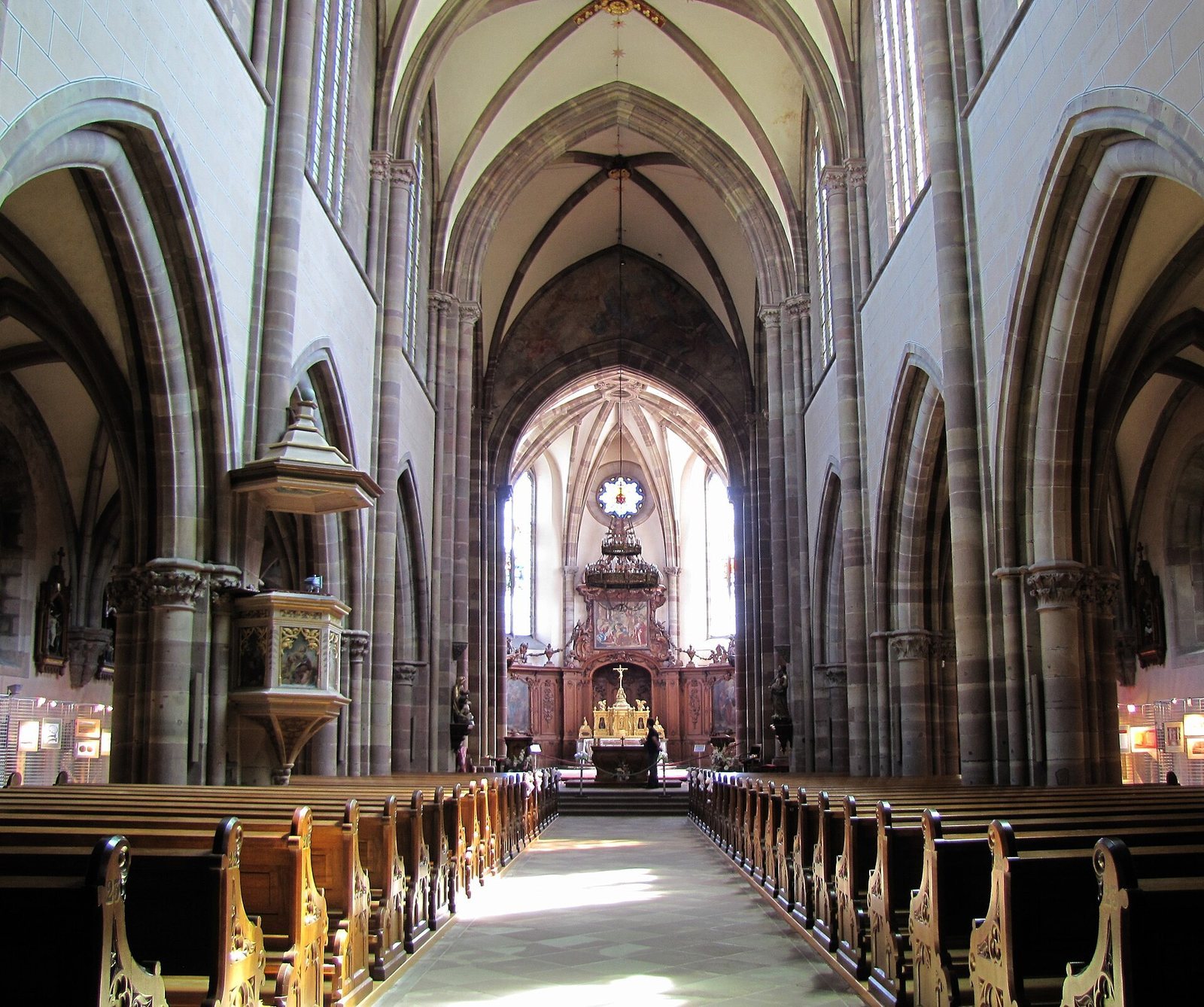
Remains of a twelfth-century doorway survive on the exterior of the north transept, the crosswise part of a church that intersects the nave. The interior has a fourteenth-century Gothic character, associated with pointed arches and rib vaults, and the side-aisle windows were enlarged.
Choir
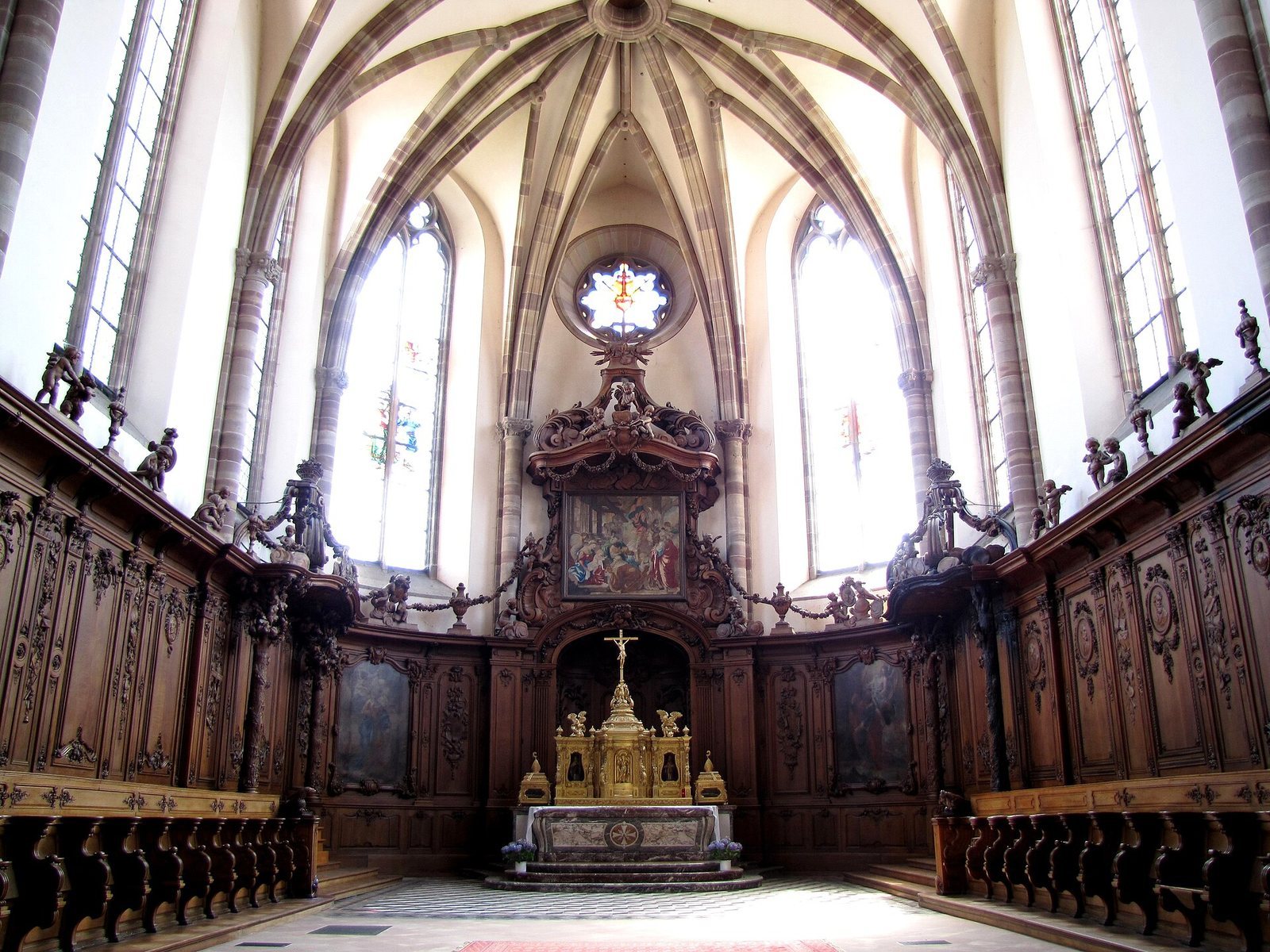
The choir was rebuilt in the 1760s in a post-Gothic style that echoes earlier Gothic forms, during the Baroque period, an early modern style known for richly ornamented design. It contains eighteenth-century carved oak woodwork, a high altar, and choir stalls.
Furnishings and church contents
Tombs, pulpit, and Pietà
Four tombs of the Geroldseck family stand against the west wall of the transept in a late Renaissance style. The church also contains a pulpit dated 1561 and a fifteenth- or sixteenth-century Pietà, a devotional image of Mary holding the dead Christ.
Organ
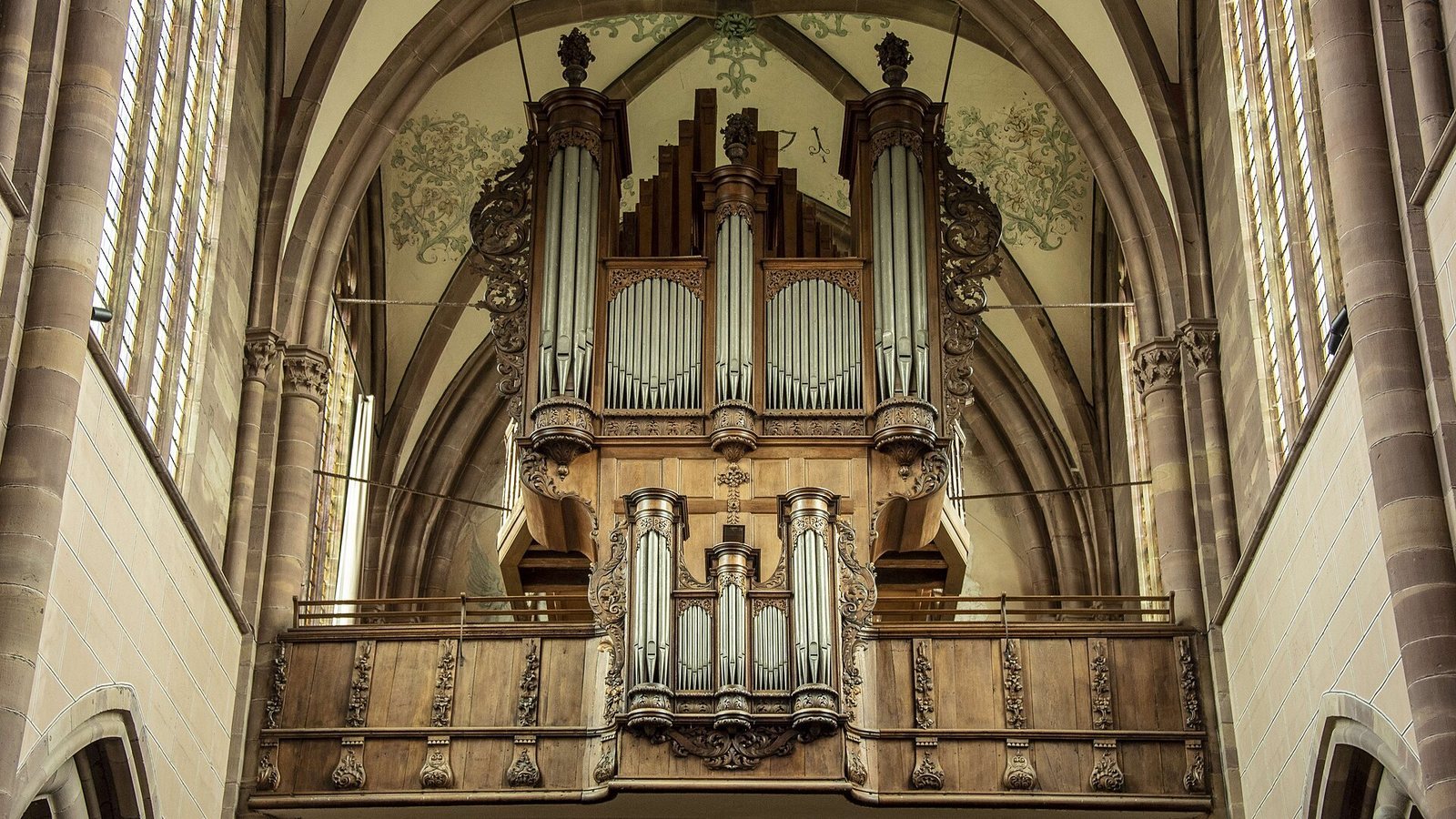
The organ dates to 1710 and is attributed to Andreas and Johann-Andreas Silbermann. Its components include the organ case, a rear positive, the division of pipes situated behind the organist, and the console.
Bells
The church’s seven bells include a 2,250-kilogram C-sharp cast by Causard in 1902. Five bells date from 1971: an E bell weighing 1,239 kilograms, an F-sharp of 874 kilograms, a G-sharp of 682 kilograms, a B of 463 kilograms, and a C-sharp of 332 kilograms. The remaining bell is a 550-kilogram G cast in 1707 and associated with the name Edel; it does not ring with the others.
Former monastic buildings
The former monastic buildings include a structure dating to 1750, used as a cellar and agricultural store, a passage through the abbey courtyard, and an eighteenth-century former convent library. A house incorporates elements of earlier convent buildings. The wing containing the tithe barns, buildings for storing agricultural dues, has façades, roofs and roof frames, vaulted cellars, and paved floors.