Maria Himmelskron Church: Former Dominican Convent Church in Worms-Hochheim
Site at a Glance
- Popularity
- Very Low
- Country
- Germany
- Primary era
- Medieval
- Eras represented
- Medieval, Early Modern, Modern
- Civilizations
- Electoral Palatinate, German, Holy Roman Empire
- Site type
- Religious
- Remains
- Church
On this page14 sections
History
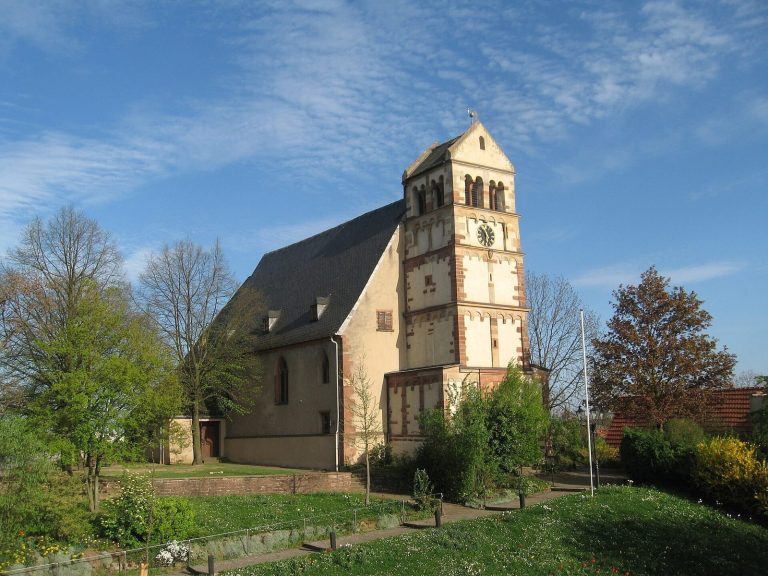
Maria Himmelskron Church, the Church of Mary of the Heavenly Crown, is the surviving church of a former Dominican nuns’ convent in Worms-Hochheim, Germany. Begun in 1287 in the Gothic style, it is the oldest surviving Gothic church in Worms and the only surviving Dominican church in the wider Worms area. Its dedication refers to the Assumption of Mary, the Catholic belief that Mary was taken body and soul into heaven, celebrated on 15 August.
Foundation and medieval convent
Knight Dirolf von Hochheim and his wife Agnes founded the convent in 1278, endowing it with nearly all their wealth and providing for a priest to celebrate regular Masses. The bishop of Worms approved the foundation on 25 January that year. Dirolf’s sister Adelheid became the first prioress, or head of the women’s community. Their daughter Agnes later became the second prioress; the couple had no other children.
Construction of the convent buildings began in 1279 and was complete by 1282. From 1283, the nuns could use St. Amandus Church in Worms in exchange for an annual payment of 50 Malter of grain, a regional measure of dry goods. Work on their own church began when its foundation stone was laid on 8 June 1287. On 8 August, the convent joined the Dominican Order, a Catholic religious order of friars and nuns, and came under the supervision of the Dominican friars of Worms. Its high altar was consecrated on 2 April 1293, by which time the church was sufficiently complete for worship there.
By 1307, the convent had limited its community to 52 nuns in response to demand for entry. Noble women and members of wealthy, influential urban families were especially represented, and the convent also received further gifts. Its buildings were damaged in 1388 during the War of the Cities of 1387–1389 and rebuilt over several decades. King Rupert exempted the convent from royal and imperial taxes in 1404, possibly in connection with the rebuilding. In 1455, the bishop of Worms brought Hochheim’s Beguine community, women who lived in religious groups without formal monastic vows, into the convent. It had 37 nuns in 1493 and at least 21 in 1518. Guda von Dalberg served as prioress from 1494 to 1506.
Reformation and convent dissolution
In May 1525, the church and convent were plundered during the German Peasants’ War. Hochheim lay in the Electoral Palatinate, a territory of the Holy Roman Empire ruled by an elector. Its ruler, Frederick III, a leading supporter of the Reformation, tried to dissolve the convent in December 1561 and again in May 1562. In March 1563, his officials and the governor of Alzey forced the convent doors and took possession. The community then comprised 22 nuns, 14 lay sisters, who did not have the same role as choir nuns, and seven students. The women were initially permitted to stay but could not admit new members. Frederick formally dissolved the convent in 1570, and its income was transferred to the Palatinate’s administration of church property in Heidelberg in 1580.
The church’s denomination changed several times. It became Lutheran in 1556, Reformed in 1563, Lutheran again in 1577, and Reformed once more in 1583. Until 1609, the Reformed congregation used it as a winter church, meaning a church for winter worship; this arrangement ended after the congregation rebuilt Bergkirche, or Mountain Church. In 1706, following a division of church property in the Palatinate, Maria Himmelskron returned to Roman Catholic use.
From convent property to parish church
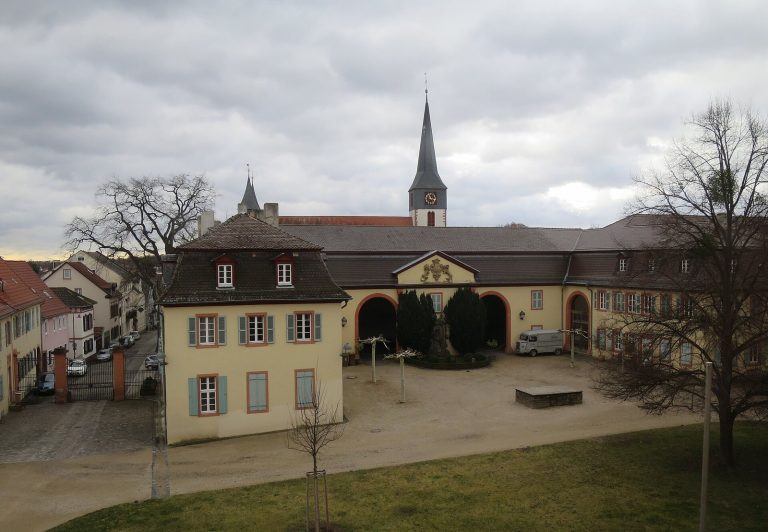
After the convent was suppressed, its buildings housed an estate administrator and served the management of the former convent’s lands. They were later sold and passed into private ownership in the early nineteenth century. Vines were planted in the former convent garden.
Hochheim became part of Worms in 1898, and industrial growth brought an increase in the local population. A parish named Maria Himmelskron was established on 1 May 1904, making the former convent church its parish church. Following renovation, the church was consecrated on 10 November 1907. It is protected as a cultural monument under Rhineland-Palatinate law, and its later changes are recognized as reflecting its transition from convent church to parish church.
Remains
Plan and Gothic fabric
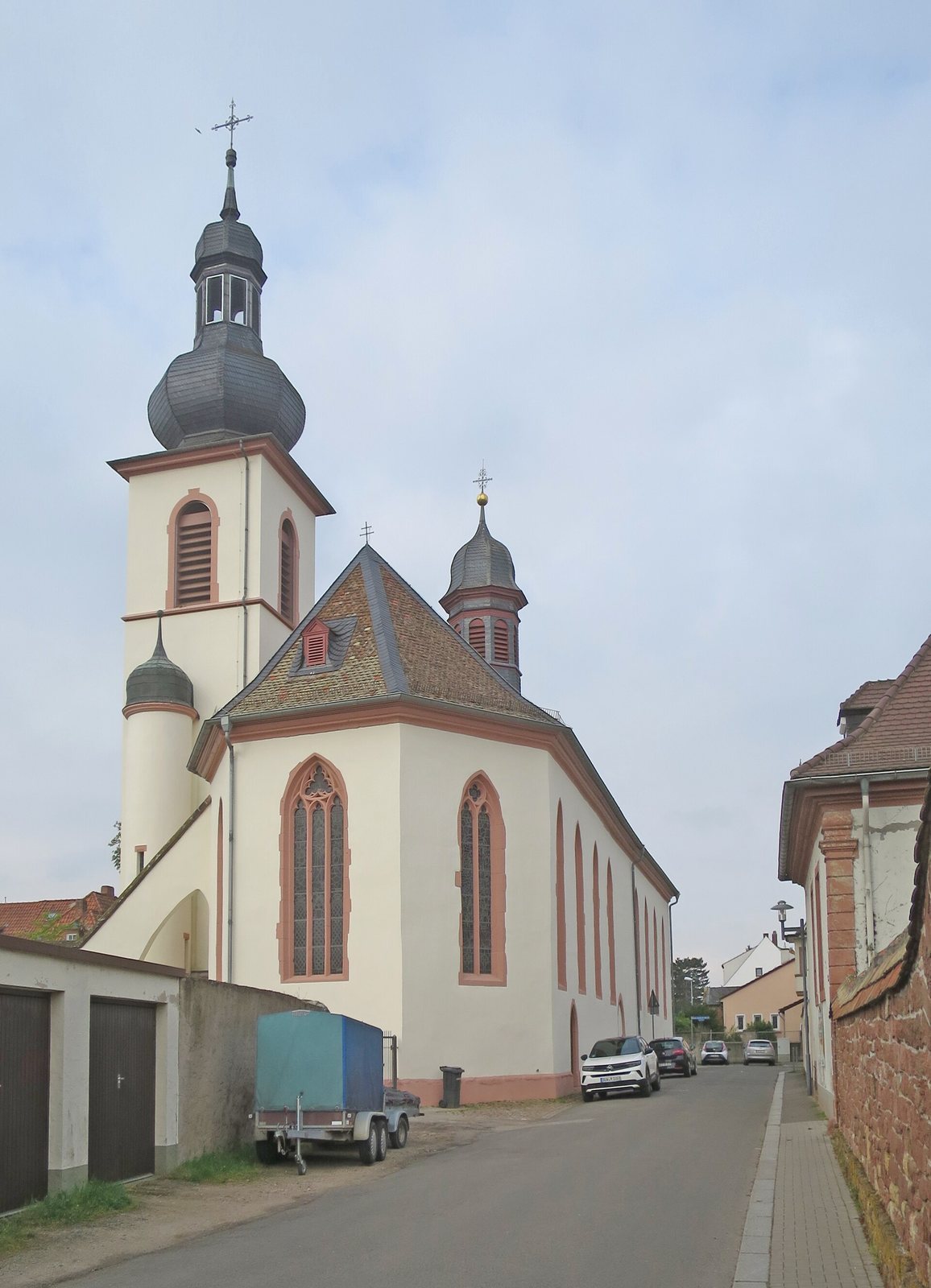
The church occupies the site of a water castle once belonging to its founders. It originally stood at the western edge of Hochheim; as the settlement expanded, the building came to lie within its center. The church is a long Gothic hall without vaulted ceilings, including in the choir, the area around the main altar. The choir ends in a polygonal shape based on five eighths of an eight-sided plan. Pointed windows with patterned stonework are arranged in groups, with a wider interval between them; two central openings are now blocked.
The broad interval marks where a screen once divided the eastern part of the church, open to the public, from the western part containing the nuns’ gallery. The south window sills are higher because the cloister formerly adjoined that side. A large buttress projects from the southeast corner, probably because the ground there was damp and soft when the church was built. The surviving Gothic portal and window frames probably belong to the original thirteenth-century building, although some were replaced during the 1905–1906 renovation.
Towers and later alterations
A small roof tower, centrally placed on the church, dates to the early eighteenth century. A separate bell tower in Baroque-inspired forms was added along the south side in 1905–1906. During work after the church returned to Roman Catholic use in 1706, the medieval cloister was taken down, partly to provide inexpensive building material. Work at the west end in 1951 added an entrance hall and altered the west gallery. Further restorations followed in 1973–1974 and 1996–2001.
Interior decoration and furnishings
Paintings and stained glass
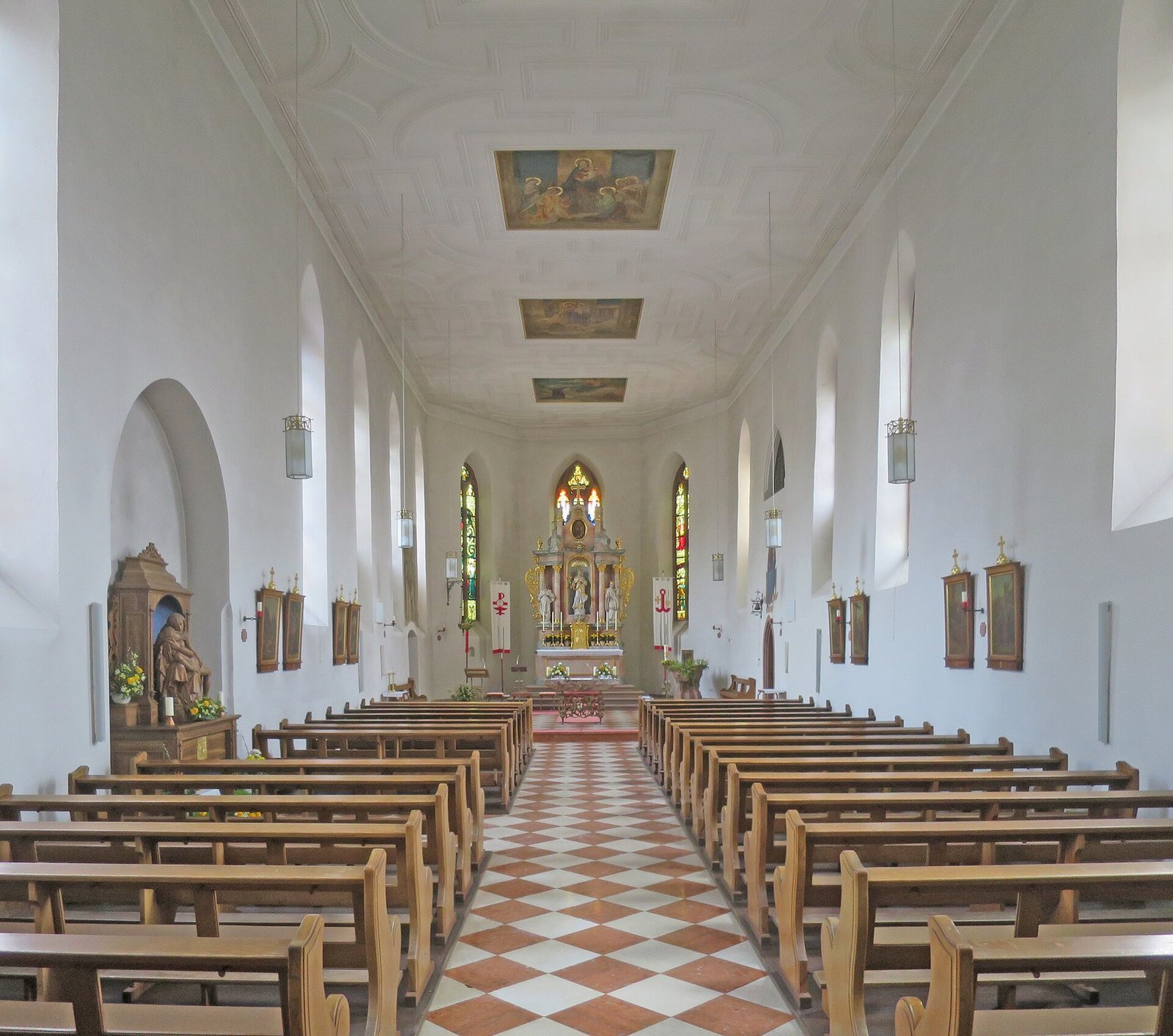
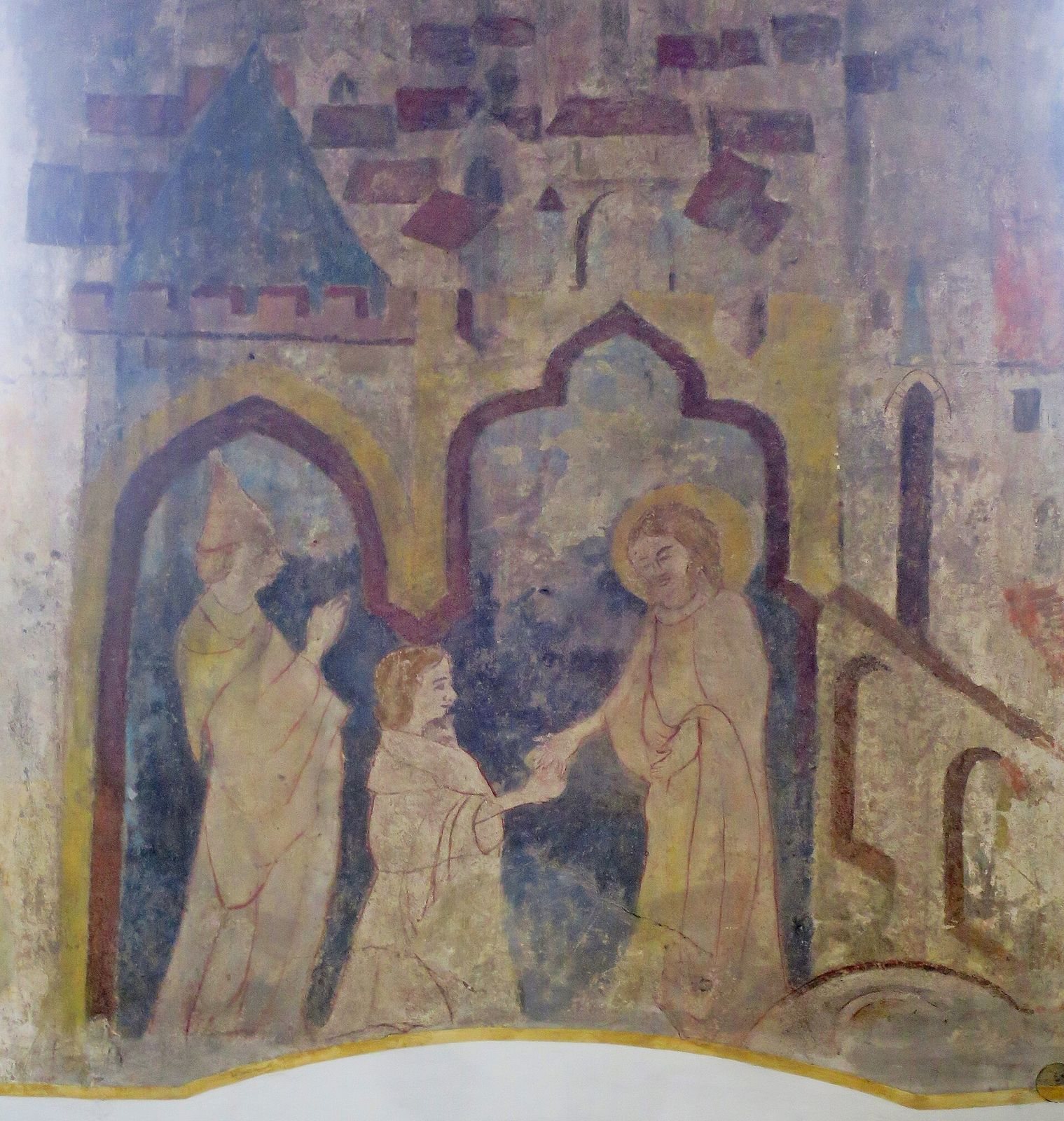
Fragments of wall painting dating to around 1300 survive on the north wall. The flat ceiling has geometric stucco decoration and Baroque-style paintings made by Fritz Muth in 1907. Seven stained-glass windows installed in 1906 in the choir and eastern part of the church depict episodes from Mary’s life.
Altars and baptismal font
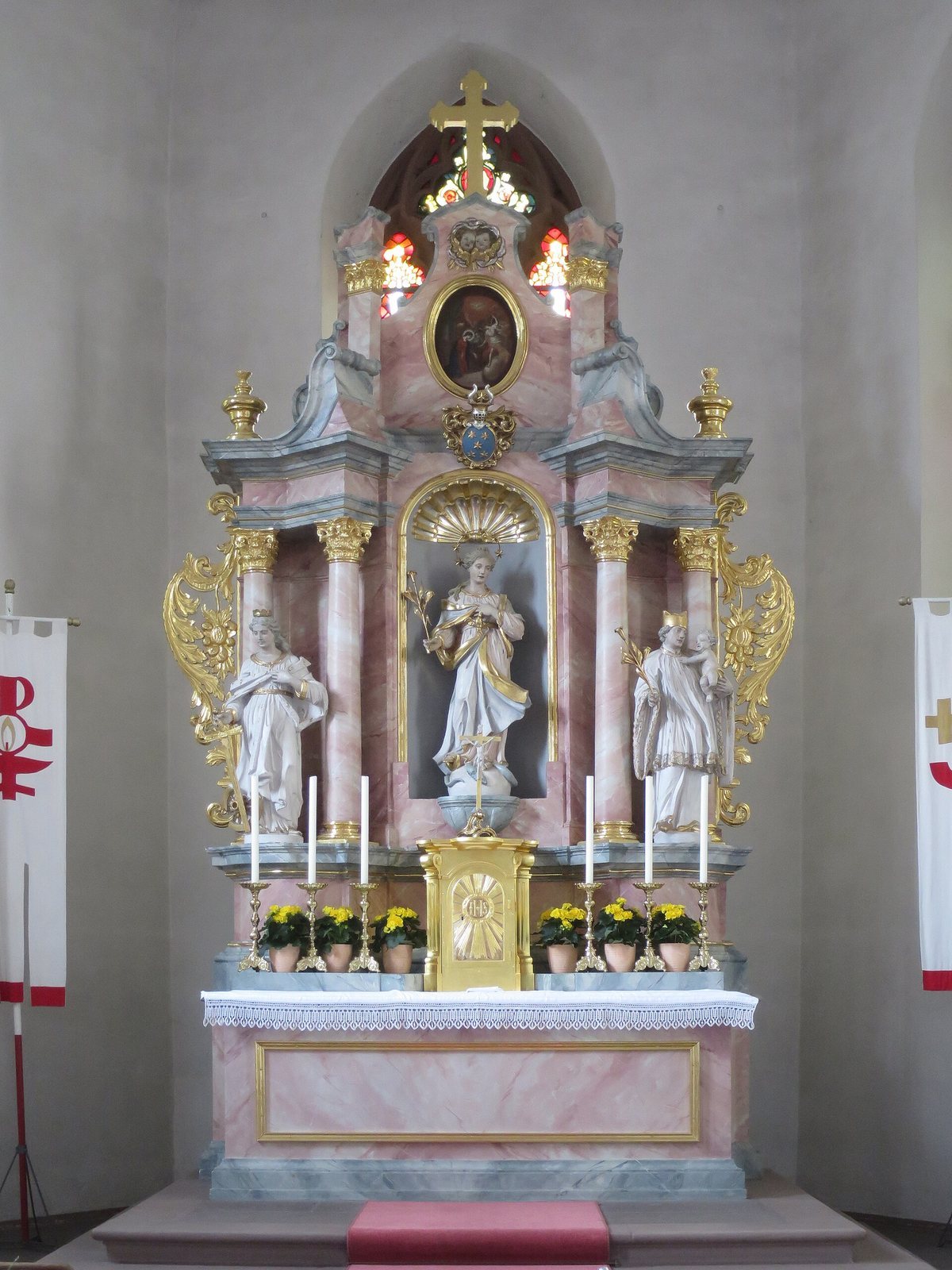
The high altar was consecrated in 1712 and enlarged in 1742. A lion baptismal font, originally from Bergkirche, was probably brought to Maria Himmelskron in the early eighteenth century. Sculptor Gustav Nonnenmacher, who lived in Worms-Hochheim, made the people’s altar.
Organ and bells
The church acquired its first organ in 1741. The instrument was probably built by Johann Georg Linck, an organ builder in Worms, and was repaired in 1810. Its inner workings were renewed in the nineteenth century, possibly by Rothermel of Zwingenberg or by the Stumm family of organ builders. Extensive work was carried out in 1952. A new organ installed by the Windesheim firm Oberlinger in 1999–2000 retained the Baroque case. It has 25 stops, or sets of pipes, two manuals, or hand-played keyboards, and a pedal. A bell was placed in the roof tower in 1736. Three bells went into the new tower in 1905–1906; two were taken during the Second World War and melted down in 1943. The present peal consists of five bells.
Memorials and burials
Commemorative stones
The church and convent served as a burial place for nuns, members of the founders’ family, local noble families, and convent officials. A shared memorial tablet for the nuns, dated 1535, records their burial beneath the gallery. The gravestones of founder Dirolf and his sister Adelheid, the first prioress, are now in the entrance hall. A stone first made for the founders’ daughter Agnes, who died in 1321, was later reused for Barbara Engelmann, who died in 1579. Dirolf’s wife is generally dated to 1329, although her stone’s inscription has also been read as 1321, possibly through confusion with her daughter or an error in transcription.
Relocated gravestones
During the 1905–1906 renovation, medieval and early-modern gravestones were lifted from the floor and placed against the walls. Fungal growth on the walls was later attributed to this arrangement, and in 1951 most of the stones were taken down. Four remained in the church, including the three now in the entrance hall. Estimates of the earlier total vary, giving about 33 stones, or counts of 25 or 32. Of the stones that survived removal, 22 went to the Museum of the City of Worms and one to the Cathedral and Diocesan Museum in Mainz.