Malta: A Late Paleolithic Settlement in Russia
Site at a Glance
- Popularity
- High
- Country
- Russia
- Primary era
- Stone Age
- Eras represented
- Stone Age
- Civilizations
- Unclassified
- Site type
- Domestic
- Remains
- House
On this page22 sections
History
The Malta archaeological site is a Late Paleolithic settlement near the present-day village of Malta in Irkutsk Oblast, Russia, beside the Belaya River and west of Lake Baikal. The Late Paleolithic was the later phase of the Old Stone Age. The site dates to about 24,000 years ago and is associated with the Malta-Buret culture, an archaeological grouping identified in part through similarities between finds from Malta and Buret. Both sites lie in the Upper Angara region west of Baikal; Buret is about 20 kilometres away, and Malta’s stone tools have also been compared with finds from Achinsk.
Discovery and excavation
The site came to attention after a local farmer uncovered a large bone while deepening a cellar. Bertram, the head of the village reading room, recognized that the find could be unusual and notified Irkutsk. Mikhail Gerasimov, then working at the Irkutsk local-history museum, arrived on 7 February 1928. He began excavations that summer, examining about 1,000 square metres. Major excavations at Malta continued between 1928 and 1958.
Rescue archaeology took place in 2020 because a planned road for the Usolye-Sibirskoye bypass was to cross the site. Malta is designated a cultural heritage site of federal significance in Russia.
The child burial and genetic research
Among the burials excavated at Malta was that of a boy estimated to have been three or four years old. Known as MA-1, he was dated by calibrated radiocarbon analysis to between 23,891 and 24,423 years before 1950, consistent with the site’s approximate age. His remains were studied again in 2009, and genetic findings were published in 2013 and 2014.
Genetic analyses found affinities between MA-1 and both European and Indigenous American populations, while detecting no connection with present-day East Asian populations. Estimates varied: one analysis reported affinities of about 37% South Asian, 34% European, 26% Indigenous American, and 4% Oceanian. Another estimated that gene flow from people related to Malta accounted for 14% to 38% of Indigenous American ancestry.
MA-1’s Y-chromosome was assigned to haplogroup R-M207*, a genetic lineage group interpreted as branching near the base of a line that includes modern Europeans. His mitochondrial DNA, inherited through the maternal line, belonged to haplogroup U. Comparisons with genomes from the Yana site in northern Yakutia led researchers to infer that the population represented by MA-1 descended from Ancient North Siberians, a proposed population that lived about 31,600 years ago. His genome-wide DNA also resembled that of Afontova Gora-2, another Siberian Paleolithic individual. MA-1, Afontova Gora-2, and Afontova Gora-3 have been grouped in what researchers call the Malta Cluster.
Comparisons with other Paleolithic populations
Dental comparisons have linked Malta-2 with individuals from Kostyonki, while an older child from Malta has been compared with people from Kostyonki and Sunghir. Similarities in tooth size and in a dental feature were used to suggest that an eastern population component may have been present among people associated with the Kostenki-Gorodtsov culture.
Remains
Excavations revealed fifteen dwellings arranged in a line beside the river. Their different sizes and forms, together with the tools, animal remains, burial, and carved objects recovered at the site, provide evidence of a settlement occupied around 24,000 years ago.
Dwellings
Riverbank structures
The fifteen dwellings did not overlap, which has led to the interpretation that they were occupied at the same time. They formed groups of six, four, and four. A central structure measured 14 metres long and between 4 and 5 metres wide. Most houses had floors set 50 to 70 centimetres below ground. Large mammoth bones formed their walls, hides covered the roofs, and smaller bones were used in the foundations. The dwelling type has been described as partly dug into the ground, with a bone framework and a narrow, tunnel-like exit.
Above-ground structure
One dwelling stood above ground. Deer antlers framed its walls, and a ring of massive limestone slabs set on edge formed its base.
Plants and animal remains
Vegetation
Pollen samples indicate that pine and birch grew near the settlement, with spruce possibly present as well. Pollen from herbaceous plants predominates in the samples.
Animals
Reindeer were the most common animals represented in the faunal remains. Arctic fox came next, followed by woolly rhinoceros, mammoth, bison, cattle, horse, wolverine, lion, and wolf. The evidence indicates that people hunted Arctic foxes and some other predators for their fur.
Tools and small objects
Stone and bone tools
Stone tools were made from gray banded flint. The assemblage includes prismatic, conical, and cuboid cores, the blocks from which flakes or blades were struck, as well as points, piercing tools, small knives, burins used for cutting or engraving, and other chisel-shaped implements. Mammoth ivory was shaped into long points with crosswise cuts, awls, and needles.
Jade and bead
Jade objects and a single tiger’s-eye bead were also recovered from the site.
Figurines
Female figures
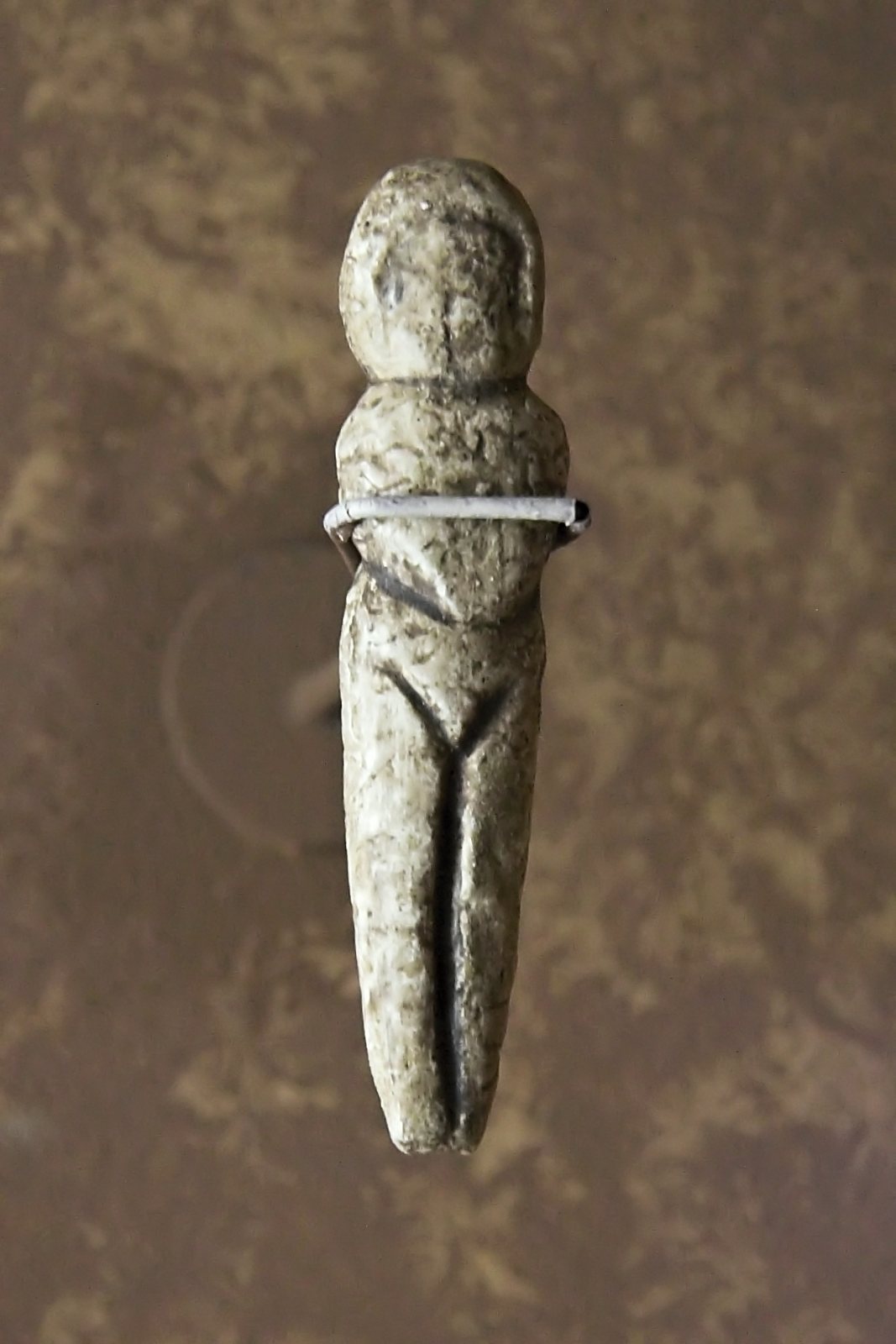
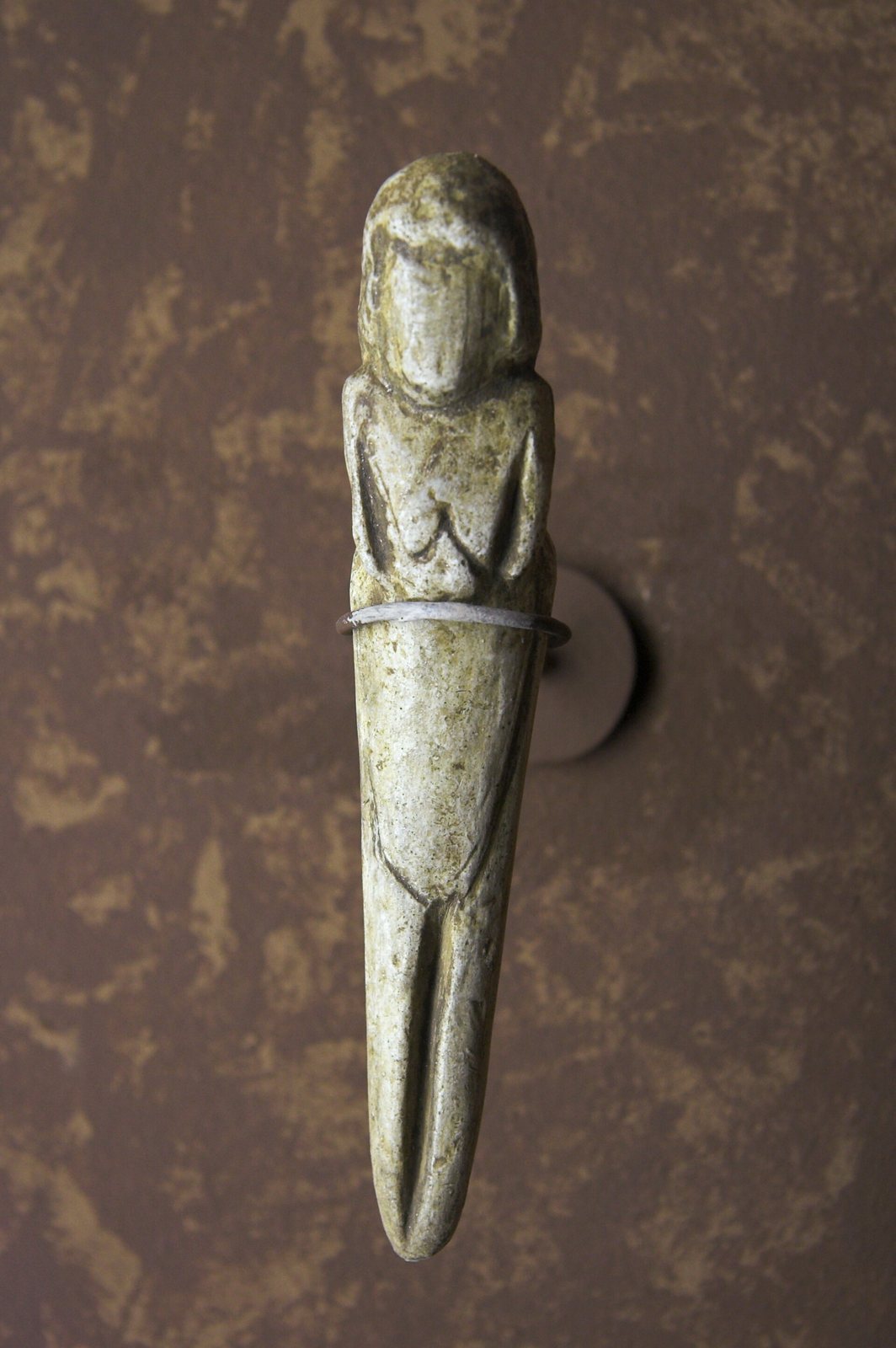
About 40 figurines from Malta and Buret measure between 3.7 and 13.6 centimetres high. Nearly all are mammoth ivory; one highly simplified figure is made from reindeer antler. About 30 female figurines are known from Malta. They vary from fuller-bodied to slender forms. Some are nude, while incised designs on others may represent fur clothing. Their heads are often large, with simply modeled faces, and head details have been interpreted as hairstyles. Breasts may be omitted or shown by a shallow line, and the figures lack the pronounced abdomen common on many Western European Paleolithic examples. Holes near the ends of their short legs may have allowed the figurines to be suspended.
The patterned clothing and modeled faces of the Malta and Buret figures differ from Western European Paleolithic figurines, which more often show nude bodies and give less emphasis to facial features. The works have also been compared with finds from the Russian Plain, including Kostyonki, Avdeevo, Sunghir, and Zaraysk, and, to a lesser extent, with finds from Aurignac and Grimaldi in central and western Europe.
Bird and animal figures
Other figurines depict birds and a possible wolverine decorated with rows of crescent-shaped cuts. The bird figures include partridges, swans, geese, ducks, and other waterfowl shown in flight. Some have flattened oval bodies, small wing projections, and triangular heads on long necks.
Engraved objects
Plaques and carved images
Engraved mammoth-ivory plaques include an image of a mammoth with a trunk, tusks, and thick legs. Straight marks along its body indicate long hair. Another plaque shows three snakes with swollen heads. Geometrically patterned plaques from Malta have been compared with churingas, sacred patterned objects used in some Aboriginal Australian traditions to support oral accounts of ancestral events. A separate mammoth-bone image of a mammoth from Malta is held at the State Hermitage Museum in St Petersburg.
Trapezoidal buckle
A trapezoidal buckle held at the Hermitage has three snakes engraved on its inner face. On the outer face, circular pits correspond to raised bumps on the reverse. A large spiral occupies the centre, with smaller spirals on either side and two additional figures. The central spiral has seven turns containing, in sequence, 14, 21, 26, 33, 40, 47, and 62 pits, for a total of 243. Each side group has 122 pits. On the left, these form a complex spiral of 63, a simpler spiral of 45, and a crescent-shaped figure of 14. On the right, they form spirals of 58 and 53, plus a curved line of 11 dots. The complete design has been counted as either five or seven spirals.
B.A. Frolov proposed that the buckle might have served as a calendar. Adding the central spiral’s 243 pits to either side’s 122 gives 365; excluding the right-side line of 11 produces 354. These numerical readings remain hypotheses. Frolov also examined nearly 30 decorated objects from Malta and described recurring patterns of five and seven. The flying-bird image from the child burial has 28 rows and 274 pits, while one button has 212 pits. Numerical and astronomical readings of such designs are difficult to verify.
Notched rod
A long, slightly curved rod, about 21 centimetres long, carries at least 95 notches. V.E. Larichev called it the Malta staff. Its head has 53 pits, and counts on its body range from 118 to 120, giving a total of either 171 or 173. The exact count is uncertain because of the object’s condition. Larichev interpreted 173 as half a draconic year, the time for the Moon to return to an orbital node, and 118 as four synodic months, the intervals between repeated lunar phases. He proposed that the body and head could have been used to predict lunar and solar eclipses, but this interpretation did not gain broad scholarly acceptance.
Child burial
The boy’s burial was beneath a stone, and traces of pigment were found on his bones. The associated objects included a Venus figurine, a type of prehistoric sculpture generally depicting a woman, an ivory diadem, a bead necklace, mammoth-ivory pendants, fragments of a flying-bird image, flint objects, and a bracelet. The human remains are held at the State Hermitage Museum in St Petersburg.