Lorium: An Ancient Roman Settlement and Imperial Residence in Italy
Site at a Glance
- Popularity
- Medium
- Country
- Italy
- Primary era
- Classical
- Eras represented
- Classical
- Civilizations
- Roman
- Site type
- Settlement
On this page14 sections
History
Lorium was an ancient Roman settlement in Etruria, Italy, near present-day Castel di Guido, about 19 km west of Rome, on the Via Aurelia. It developed substantially during the second half of the 1st century BC and later became both a road station and a residence of Roman emperors.
Road station and imperial residence
The Tabula Peutingeriana, a map of the Roman road network, places Lorium at the Via Aurelia’s twelfth mile from Rome and identifies it as the road’s first post station. Baebiana lay a further 7 km west. Inscriptions from that post indicate that fleet sailors were stationed there, probably as a detachment from Centumcellae.
Antoninus Pius built an imperial villa at Lorium, probably on an estate belonging to his family. The emperors Hadrian and Marcus Aurelius also stayed there. Antoninus Pius had been educated at Lorium and died there in March AD 161. Marcus Aurelius visited often and complained that the Via Aurelia’s uneven surface made his horse stumble and slip.
Excavations and renewed discoveries
Excavations in 1823 and 1824 revealed ancient buildings and inscriptions along the road near Castel di Guido. Finds made in 1824 helped establish the location of the imperial palace between Castel di Guido and the Bottaccia estate. In 2005, illicit digging was detected at Villa dell’Olivella; archaeological work the following year exposed parts of the complex. Another elaborate villa was found on the Castel di Guido estate after illicit activity.
Diocese of Santa Rufina
Lorium was the seat of an ancient diocese bearing the title of Santa Rufina. In the early 12th century, Pope Callixtus II united it with the Diocese of Porto. The resulting diocese is the present-day suburbicarian see of Porto-Santa Rufina, a diocese near Rome traditionally assigned to a cardinal-bishop.
Remains
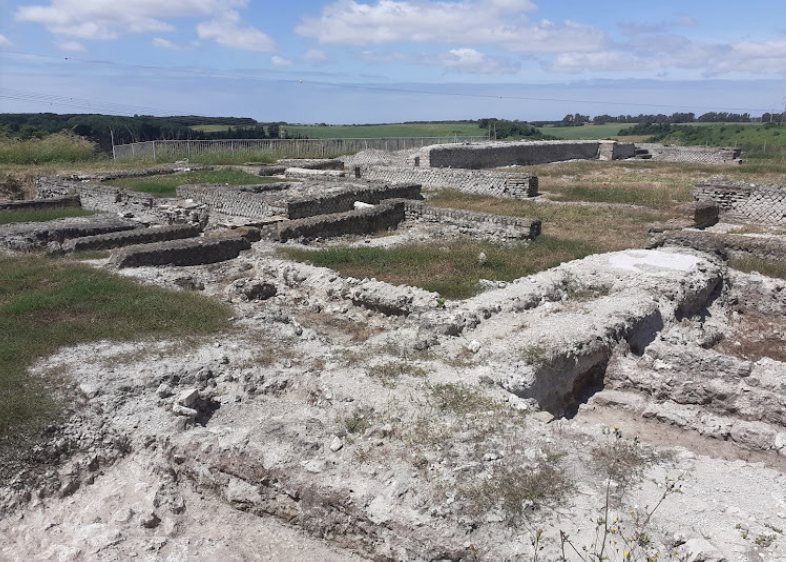
Roman building remains extend along both sides of the Via Aurelia near Castel di Guido, while traces of residential villas occupy nearby hills. Around 300 Roman tombs have been found along the old road. The remains include roadside structures, an imperial complex, and villas with terraced layouts and substantial masonry walls.
Roadside remains and imperial complex
Roadside buildings and tombs
Ancient buildings stand on both sides of the Via Aurelia, near the area where roughly 300 Roman tombs were found along the former road.
Imperial palace and statues
The imperial palace was located between Castel di Guido and the Bottaccia estate. Statues recovered in 1824 included a Veiled Juno, a statue of Livia in a Pietà-like pose, and a statue of Domitia dressed as Diana. They are now preserved in the Vatican Clementine Museum.
Rufinus’s epitaph
A Greek metrical epitaph from Lorium describes Rufinus as a ‘God-fearer,’ meaning a non-Jewish sympathizer with Judaism, and praises his learning in the holy Laws and wisdom.
Residential villas
Villa di Monte Aurelio
Villa di Monte Aurelio is a monumental complex at the junction of the Via Aurelia and the Arrone River.
Other hillside villas
Further residential remains have been identified on Monte Aurelio and Monte delle Colonnacce, and a villa lies behind the Church of Santo Spirito.
Villa dell’Olivella
Dating to the 2nd and 3rd centuries AD, Villa dell’Olivella occupied three monumental terraces in the valley. Imposing white-limestone walls, built using a Roman net-pattern masonry technique, supported the terraces. The baths, with mosaic floors, lay at the valley’s bottom; the residential section was also in the valley, to the west. A water-display structure had niches and fountains.
Abundant marble and glass paste point to elaborate decoration made from fitted pieces of stone and glass. Brick stamps name Stertinia Bassula, daughter of Stertinius Noricus, an estate owner and suffect consul in AD 113, an appointed consul who filled a position during its term. Another stamp names Marcus Pontius Sabinus, associated with Antoninus Pius, who became suffect consul in AD 153 and governed Upper Moesia, a Roman province in the Balkans, in AD 159 and 160. A third bears the name of Faustina, Antoninus Pius’s wife.
The villa’s mosaics and marble and glass decoration have been compared with those of Lucius Verus’s villa at Acquatraversa. Lucius Verus ruled jointly with Marcus Aurelius, and the comparison has linked Villa dell’Olivella with Lorium’s imperial palace. Mosaics and frescoes from the complex are displayed at the Palazzo Massimo National Museum.
Villa delle Colonnacce
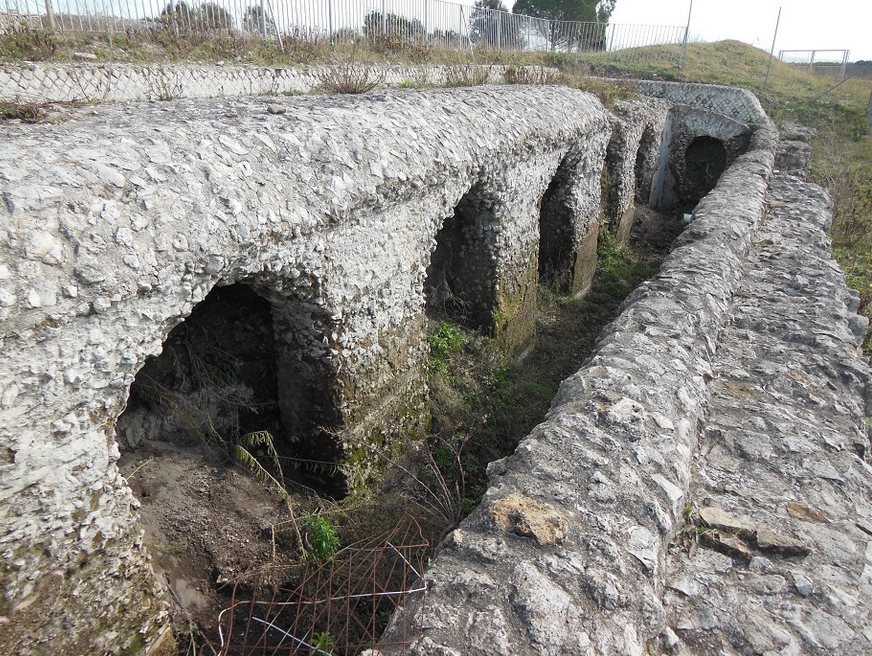
Villa delle Colonnacce dates from the 2nd century BC to the 4th century AD and was probably owned by the Coelii, a family connected with the imperial court. Its agricultural section dates to the Republican period; during the imperial period, the residential part was separated from the working area. The villa’s monumental plan extended across three levels and included niches and fountains. Grave robbers plundered it in the 1970s.
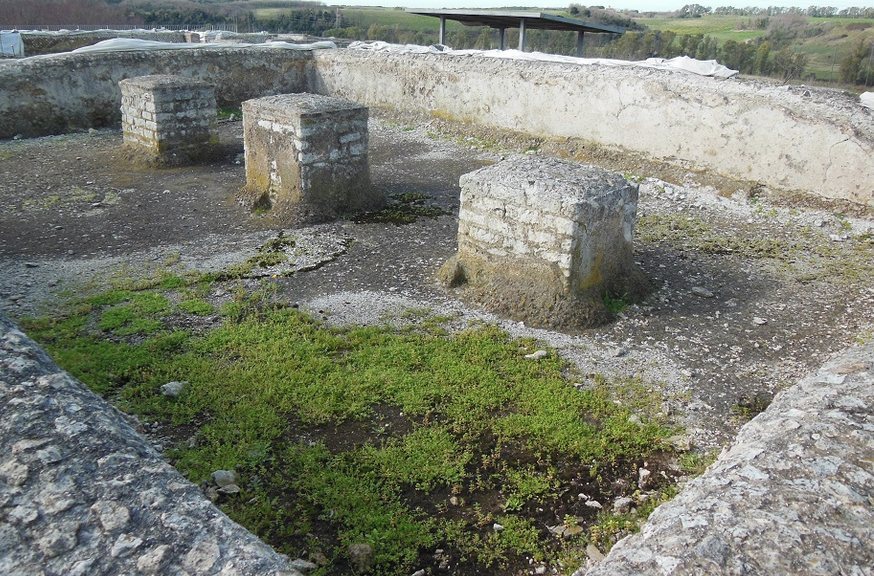
The agricultural area included a large covered courtyard, where the bases of three roof-supporting pillars survive, with a circular well at its centre. A rainwater cistern retains bases for the pillars that supported its vaulted ceiling. Two rooms held a press for olive oil and grapes connected to collection tanks, and a lower room served as a kitchen with large storage jars.
The residential section had a central hall with a marble rainwater basin and a household shrine. Spacious dining rooms had mosaic floors and frescoed walls; concealed corridors let servants pass behind them without disturbing diners. A colonnaded garden had twelve columns in its portico and sloped towards its central area.