Loreta: A Baroque Catholic Pilgrimage Complex in Czechia
Site at a Glance
- Rating
- 4.6
- Popularity
- Very High
- Country
- Czechia
- Primary era
- Early Modern
- Eras represented
- Early Modern
- Civilizations
- Habsburg, Habsburg Austria, Holy Roman Empire, Kingdom of Bohemia
- Site type
- Religious
- Remains
- Sanctuary
On this page16 sections
History
Loreta is a Catholic pilgrimage complex in Czechia, begun in 1626 in the Baroque style, a European tradition known for elaborate ornament and dramatic forms. It was intended as a replica of the Holy House at Loreto in Italy. In Catholic tradition, the Holy House is the house associated with the Virgin Mary at Nazareth, believed to have been miraculously transported to Loreto. Copies of the house became pilgrimage shrines.
Loreta was founded after the 1620 Battle of White Mountain, in which Catholic League forces defeated Bohemian Protestant forces. The victory formed part of a wider effort to revive Catholicism in Bohemia and establish new places of pilgrimage. The Bohemian noblewoman Kateřina Benigna of Lobkowicz founded the shrine to promote devotion to the Holy House and financed its construction. Ferdinand II, a Habsburg ruler and Holy Roman Emperor, also supported the project.
Foundation and pilgrimage
Construction began under the Italian architect Giovanni Battista Orsi. The chapel was consecrated on 25 March 1631. The Lobkowicz family strongly supported devotion to the Holy House and promoted its cult in Bohemia; the family’s burial crypt was placed beneath the chapel.
Between 1634 and 1664, the complex grew around the central chapel, with the addition of a covered gallery around a courtyard, known as a cloister, and 16 chapels. Loreta became a pilgrimage destination and the starting point of a route to Hájek, near Unhošť, where a Franciscan monastery also had a Loreto chapel. The Loreto Madonna was the dedicatee of the twentieth chapel on the Holy Way from Prague to Stará Boleslav, established between 1674 and 1690.
Clockmaker Peter Neumann assembled Loreta’s bell chime in 1694 using bells cast in Amsterdam. It first sounded on 15 August 1695. Two unverified local stories offer different explanations for the bells. One tells of a textile merchant who obtained them in gratitude after his daughter recovered from plague. The other describes a poor widow whose 27 children died of plague, after which the chime played a song in praise of Mary for her.
Baroque expansion and completion
The western façade took shape in the early eighteenth century under Christoph and Kilián Ignác Dientzenhofer, with its main construction dated to 1716–1723. The Nativity church followed in 1734–1735, associated with Kilián Ignác Dientzenhofer and Johann Georg Achbauer the Younger. Kilián Ignác raised the cloister by adding an upper storey in 1747–1751, when the complex was completed.
Later use and treasury
Loreta remains a Catholic complex administered by the neighboring Capuchin monastery associated with the Church of Our Lady of Angels. Capuchins are a branch of the Franciscan religious order. The Loreto treasury probably took shape by the mid-eighteenth century. Its holdings were confiscated in the nineteenth and twentieth centuries; an inventory and partial restoration took place in 1882. Part of the collection has been exhibited on the cloister’s first floor since the early twentieth century.
Remains
Layout and western entrance
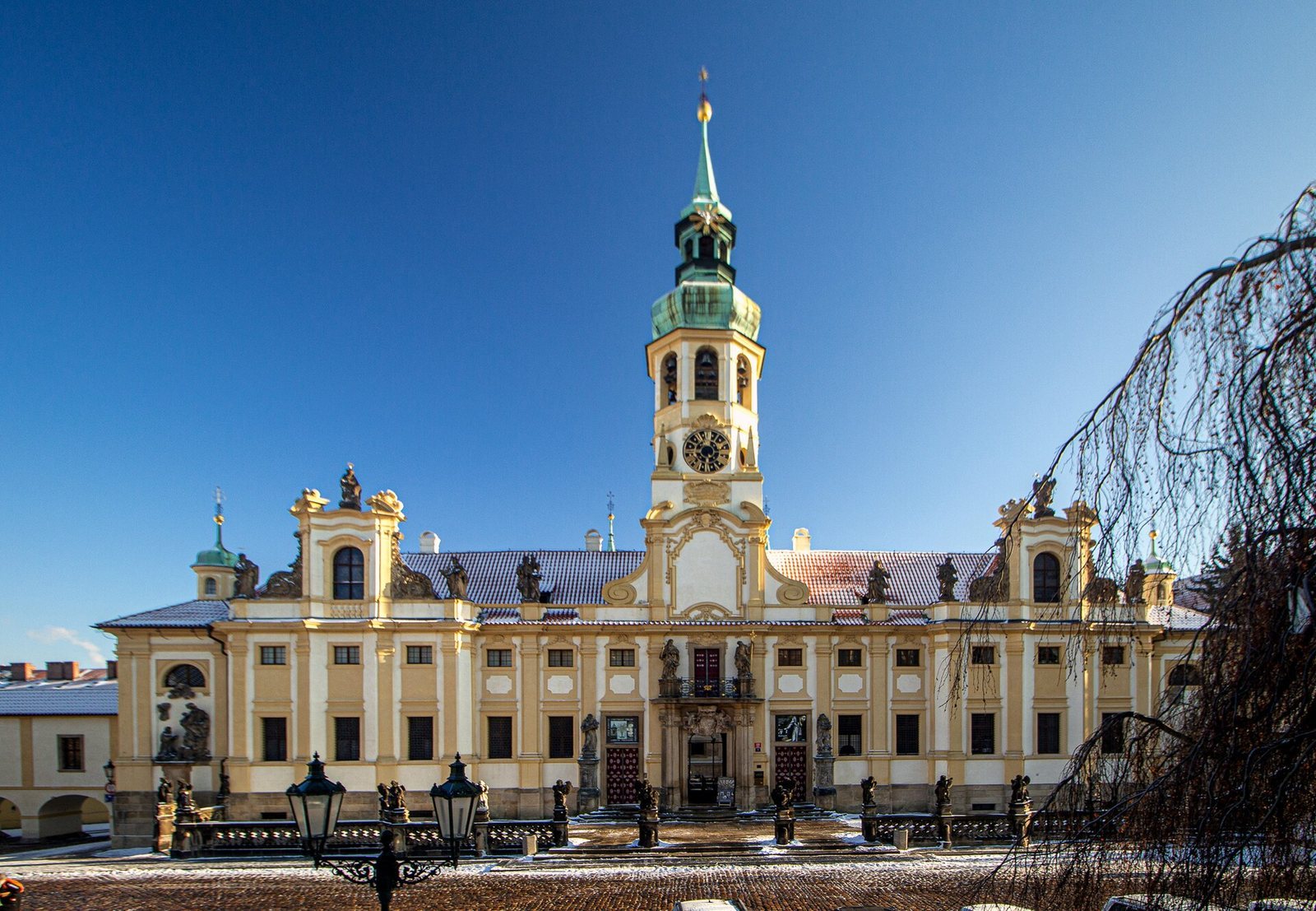
The Baroque complex occupies the east side of Loreto Square. Its main façade faces west onto the square, with the courtyard and central Holy House behind it and the Nativity church at the courtyard’s eastern end, adjoining the chapel. Together, the façade, courtyard, chapel, and church form a west-to-east axis. The cloisters enclose the courtyard and Holy House. A covered passage connects Loreta to the neighboring Capuchin monastery, which is associated with the Church of Our Lady of Angels.
Façade and entrance
The broad western frontage has three gables, a central tower, and two side chapels incorporated into it. Its central section focuses on the entrance portal and a large balcony with a stone railing, above which rises a decorative scroll-shaped gable without an opening. Sculptures on the side gables depict the Virgin Mary and the Archangel Gabriel, with figures of the Evangelists below. Statues of Saint Joseph and Saint John the Baptist stand on the balcony; Saint Christopher and Saint Anne flank the portal. Saint Anthony of Padua and Saint Francis of Assisi are placed on either side of the three-part entrance. At the outer chapels, Saint Felix of Cantalice appears before a Madonna sculpted by Jan Bedřich Kohl, while the other features Saint John of Nepomuk with angels.
Terrace sculpture
A railed terrace stands in front of the façade. Its decoration includes 19 statues and nine groups of angels carrying ornamental panels with reliefs of episodes from the Virgin Mary’s life. The sculptures were made in the workshop of Ondřej Filip Quitainer. Some angel figures and statues on the upper façade are modern copies; the originals are held in the National Museum’s Lapidarium.
Courtyard and religious buildings
Holy House
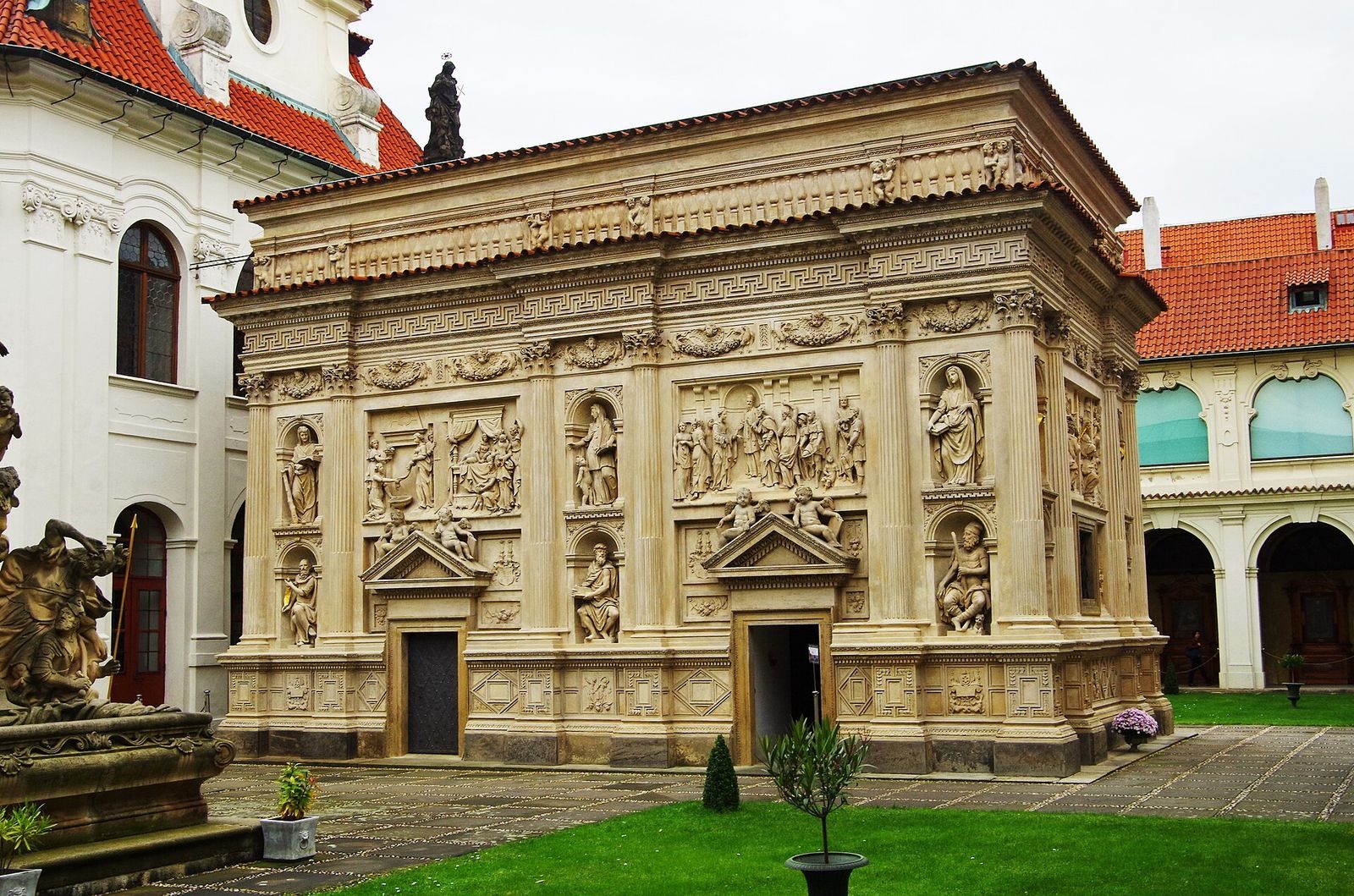
The central chapel copies the shrine at Loreto. Its exterior has two tiers of sculpted stonework, with statues of Old Testament prophets and reliefs showing events from Mary’s life and the legendary transfer of her house. Half-columns and other decoration follow the model of the marble screen at Loreto. Fragments of paintings survive on the interior walls, and several bricks and beams from the Italian shrine are probably incorporated into the building. A dark-colored devotional image of the Virgin Mary, the Black Madonna of Loreto, stands on the main altar, which is decorated with silver reliefs.
Cloister and chapels
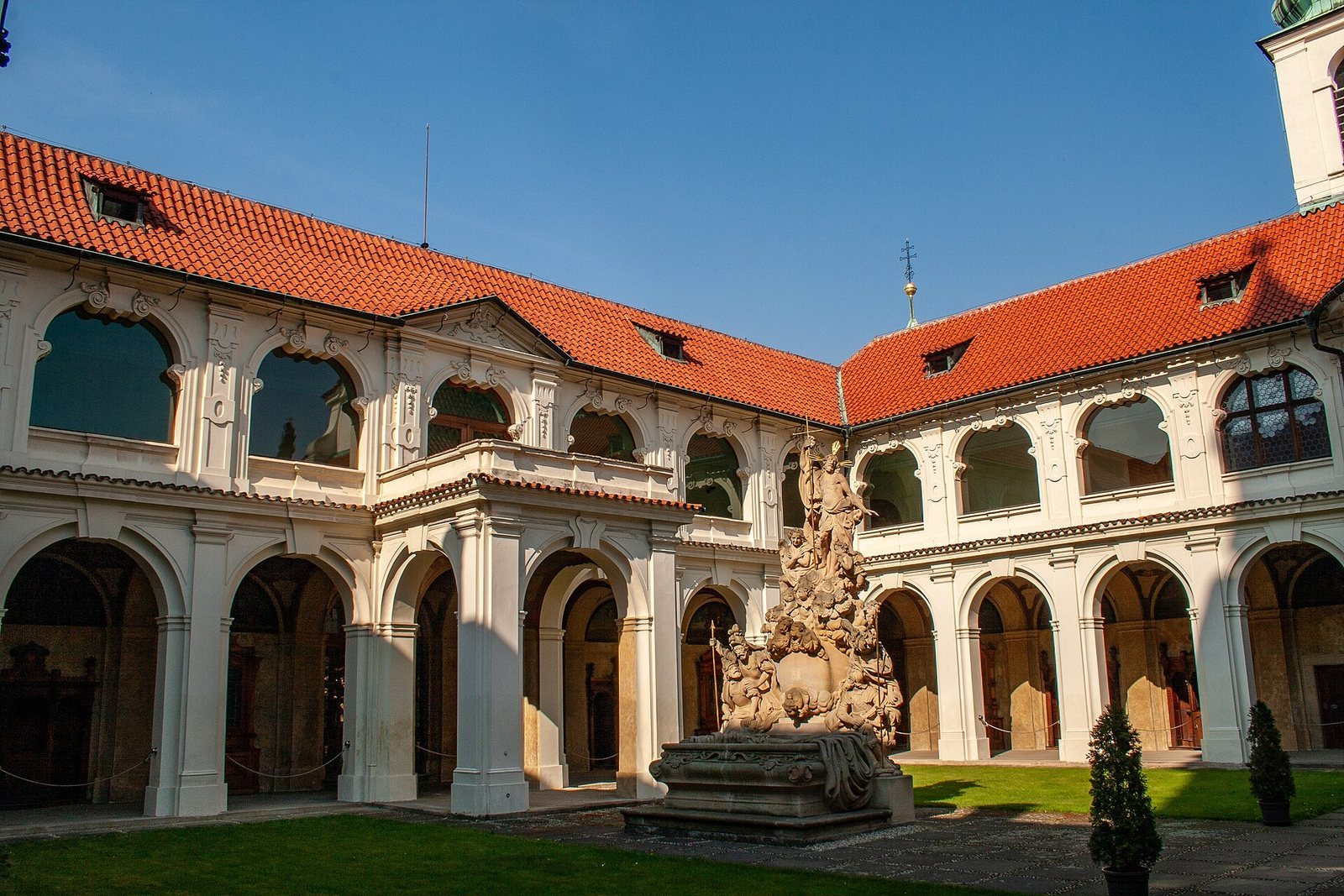
The quadrangular cloister surrounds the Holy House and courtyard. Its chapels include a central chapel and four at the corners, alongside other chapels and devotional stations with supports for kneeling worshippers. The Chapel of the Ecstasy of Saint Francis contains a painting by Petr Brandl. In the southwest, the Chapel of Our Lady of Sorrows holds a Baroque Spanish sculpture of Saint Wilgefortis, a legendary Christian saint traditionally shown as a crucified woman with a beard. The cloister frontage has a tower and an entrance with a stone railing.
Nativity church
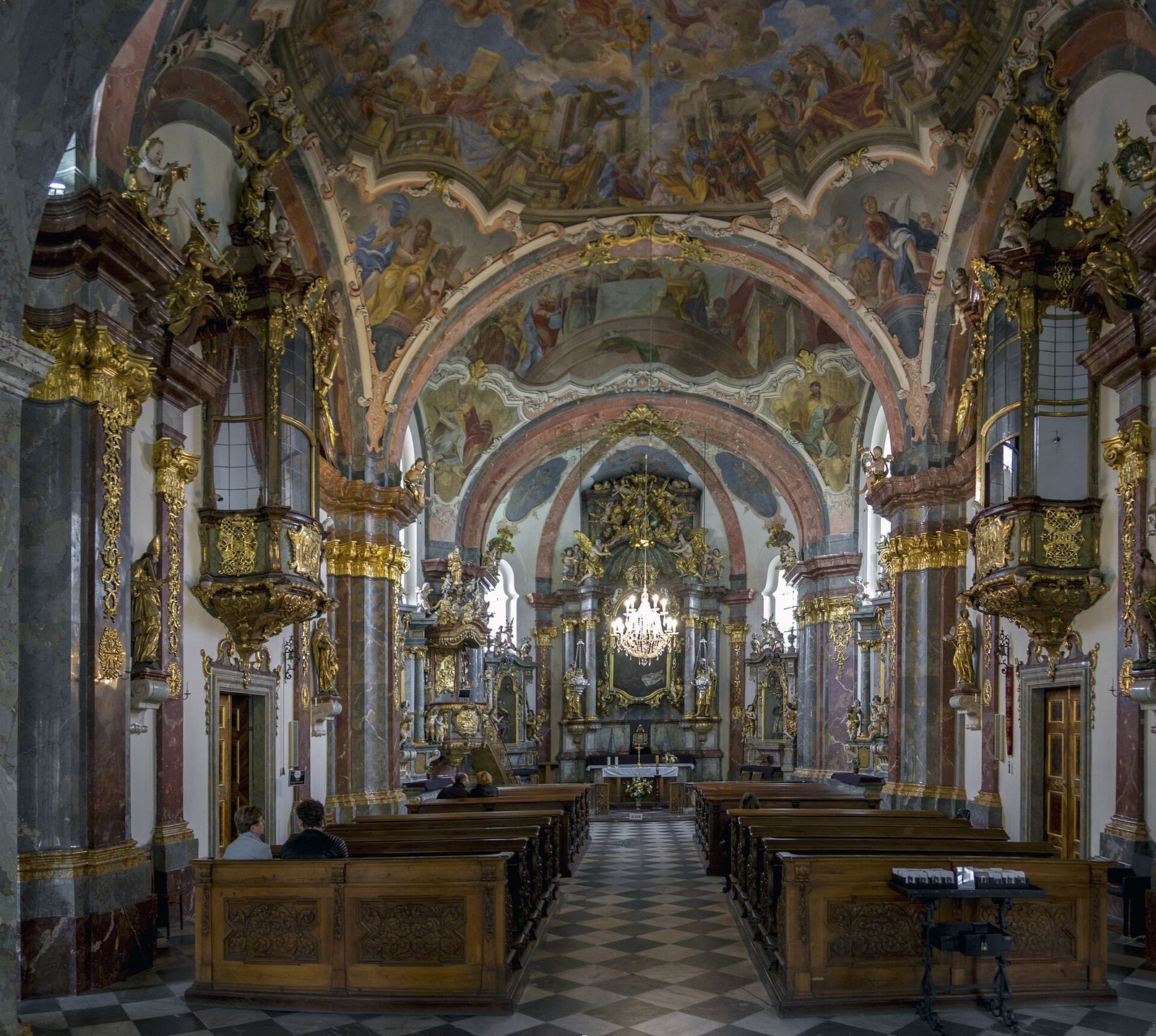
The church has a single nave, a semicircular apse, the rounded recess at the altar end, and two bell towers attached to its sides. Five altars stand within it. Curved sail vaults rise between supporting arches, with frescoes painted by Wenceslaus Lorenz Reiner. The main altar has a Renaissance painting of the Adoration of the Lord. Paintings of Saint Apollonia and Saint Odilia are on the side altars beside the area around the main altar.
Courtyard fountains
Two fountains stand in the grassy part of the courtyard. Their sculpted groups depict the Assumption of the Virgin and Christ with the apostles.
Bell tower and treasury
Clock tower and chime
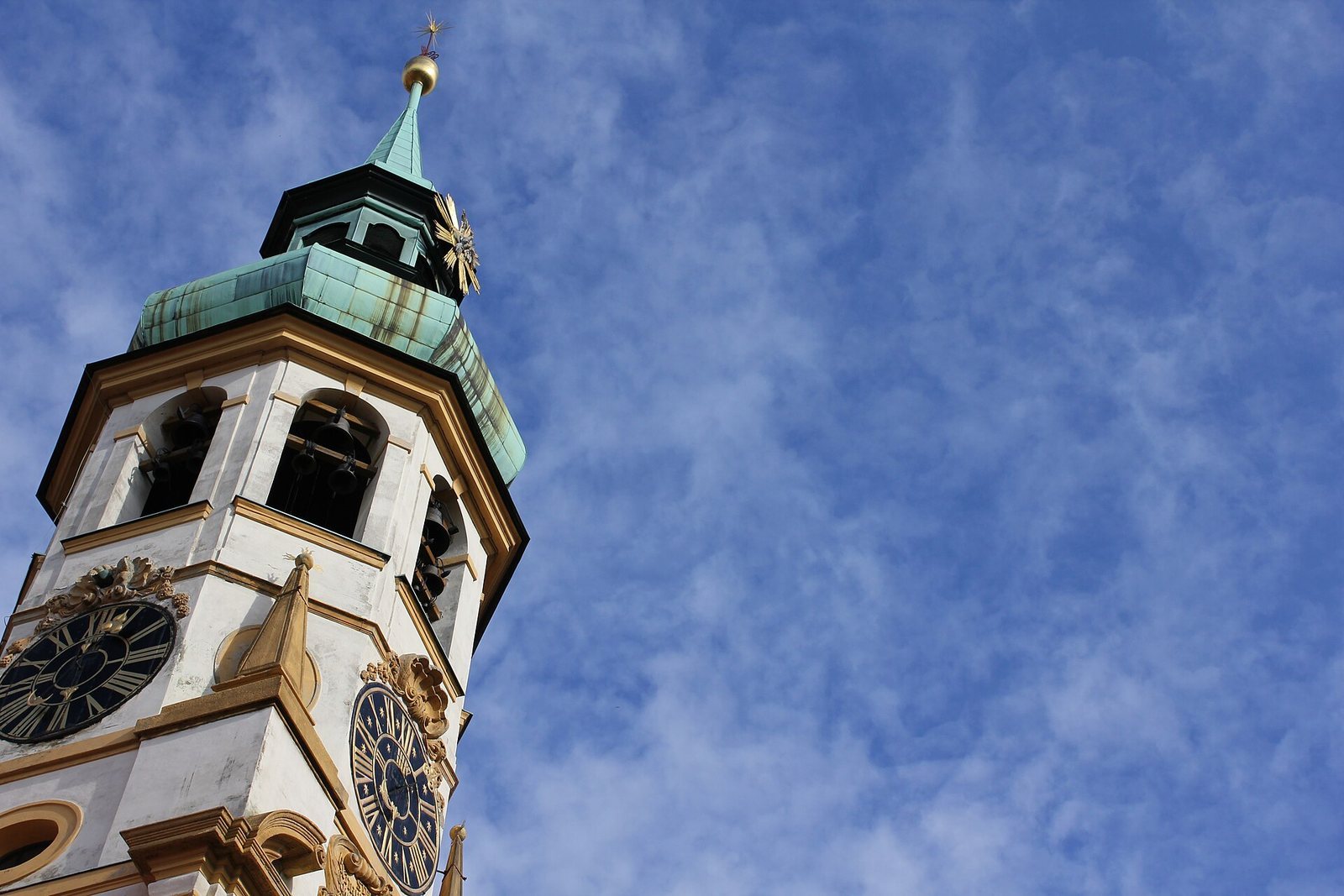
The clock tower above the main entrance has a square base, an octagonal upper section, and an onion-shaped roof. Loreta’s church chime is described as Europe’s largest. It consists of 30 bells and small bells arranged on two levels. Twenty-seven can be played; the three smallest are decorative and are not connected to the keyboard or pedalboard.
Treasury collection
The treasury contains devotional offerings, liturgical objects, and works from the Late Gothic, Renaissance, Baroque, and Historicist periods, an artistic approach that revives earlier styles. Its objects include reliquaries, containers for holy remains, chalices, monstrances, vessels used to display a consecrated host or a relic, crowns for the Loreto Madonna and the infant Jesus, and priestly vestments. A miniature Nativity is described as the oldest of its kind. The collection is regarded as the Czech Republic’s second most valuable church treasury, after that of the Metropolitan Chapter of Saint Vitus.
Among its named works is the Prague Sun, a gold-plated silver monstrance made in Vienna between 1696 and 1699. It is 89.5 centimetres high, 70 centimetres wide, weighs 12 kilograms, and contains approximately 6,000 diamonds. Goldsmith Johann Baptist Khünischbauer and jeweler Matthias Stegner, with their assistants, made it to a design by Austrian Baroque architect Johann Bernhard Fischer von Erlach. Václav Ferdinand, Count of Lobkowicz, commissioned the piece. Other named works include the Small and Great Pearl Monstrances and the Coral Monstrance.