Leshan Giant Buddha: A Tang-Dynasty Cliff-Carved Maitreya in China
Site at a Glance
- Rating
- 4.6
- Popularity
- Medium
- Country
- China
- Primary era
- Medieval
- External website
- Open
- Eras represented
- Medieval, Modern
- Civilizations
- Chinese
- Site type
- Religious
On this page14 sections
History
The Leshan Giant Buddha is a 71-metre Tang-dynasty Buddhist statue in Leshan, Sichuan, China, carved at the confluence of the Min, Qingyi, and Dadu rivers. Construction began around the start of the Kaiyuan era, conventionally dated to 713, and the work was completed in 803. The image represents Maitreya, the future Buddha in Buddhist tradition, and follows the calm, formal style of Tang-period sculpture. At its completion, it was regarded as the world’s tallest giant Buddha and the largest seated image of Maitreya.
Foundation and Tang-dynasty construction
The project was initiated by the Buddhist monk Hai Tong at Qifeng Peak on Lingyun Mountain, south of Lingyun Temple. He intended the enormous image to calm the dangerous currents where the three rivers meet and to protect vessels passing below. The undertaking also promoted Buddhism. The stone removed from the cliff during carving was traditionally believed to have fallen into the river and reduced the force of the currents.
The statue is formally known as the Great Maitreya Stone Image of Lingyun Temple at Jiazhou and is also called the Lingyun Giant Buddha. Tradition says that a local official tried to seize donations gathered for the project. Hai Tong refused, and, to demonstrate his resolve, was said to have gouged out one of his own eyes and presented it to the official. The demand was then abandoned.
Work paused after Hai Tong’s death. In 739, the military governor Zhangchou Jianqiong donated 200,000 units of currency and restarted construction. After his transfer to the central government in 746, the project stalled again, with the statue reaching approximately the knees. In 785, the military governor Wei Gao contributed a further 500,000 units of currency and began the third major phase. Successive overseers directed the work until its completion in 803, about ninety years after it began.
Temple use and medieval repairs
The finished statue belonged to Lingyun Temple. It was originally painted, decorated with gemstones, and partly covered with gold leaf. A wooden pavilion about thirteen storeys high sheltered the carving from the weather. That structure was later destroyed, apparently during warfare at the end of the Yuan dynasty.
By the beginning of the Northern Song dynasty, moss covered the statue and the wooden pavilion had collapsed. During the reign of Emperor Renzong, the statue received major repairs and the pavilion was rebuilt. Lingyun Temple itself suffered repeated damage during warfare, affecting the setting in which the Buddha was preserved and worshipped.
Damage and twentieth-century reconstruction
In 1898, the statue and its surrounding scenic area were badly neglected. Extensive moss growth covered the carving, and the pavilion was completely damaged. Monks of Lingyun Temple undertook maintenance in 1914.
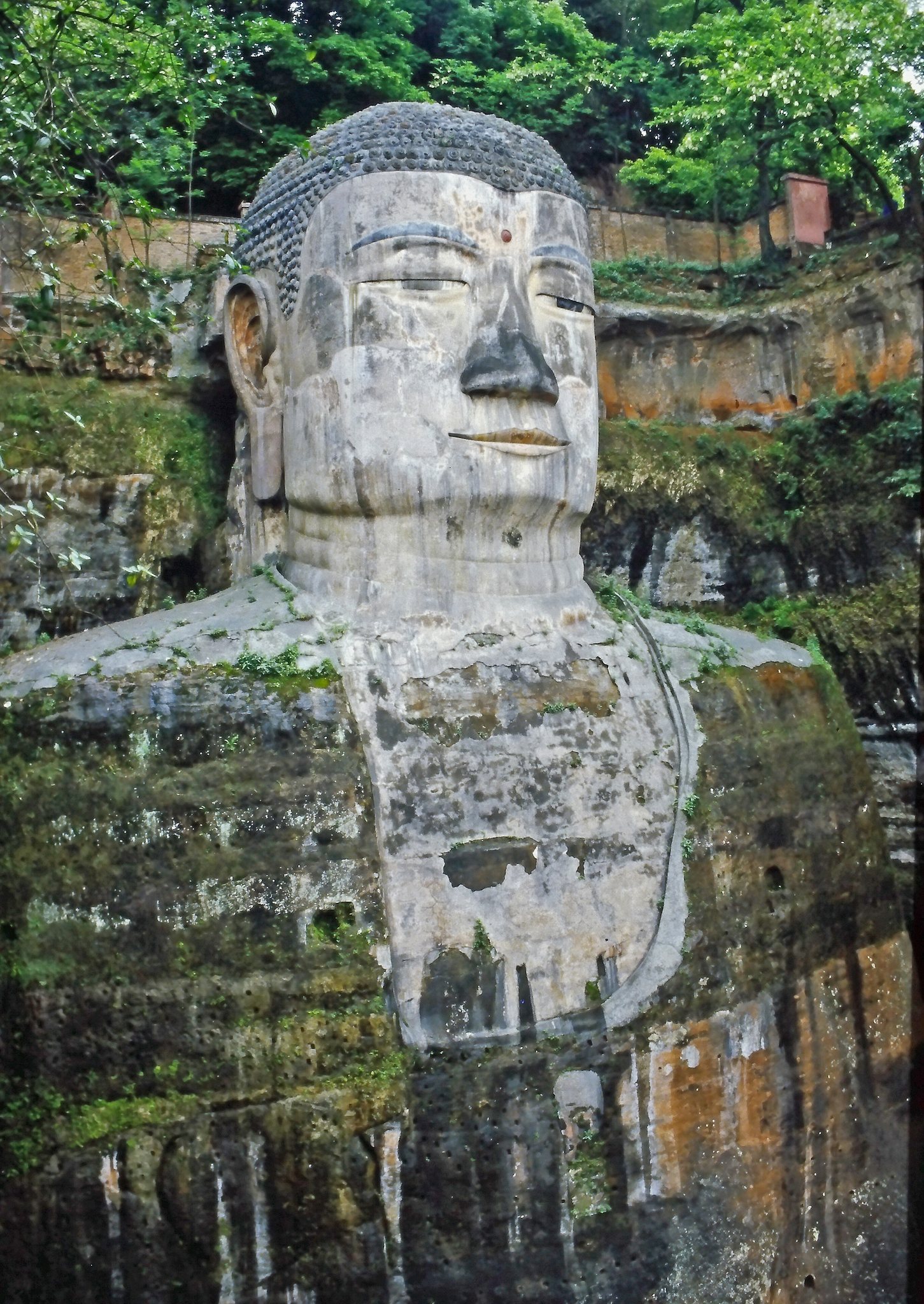
In 1925, a large rectangular cavity appeared beside the right eye, while the nose and right ear were missing. The local military commander Chen Hongfan financed repairs. Red sandstone slabs were attached to the face, and the features were painted red because effective repair methods were unavailable. That same year, troops under Yang Sen used the scenic area for artillery training. Their activities created a large hole in the red covering over the left eye. A local lay Buddhist paid for its repair in 1927.
Major repairs from 1930 to 1933 removed the red covering from the face and reconstructed the severely damaged nose around a wooden framework. The right ear and nose were later repaired with wooden structures covered in plaster or grey finishing material. These interventions form part of the statue’s modern physical history rather than its original Tang-dynasty construction.
Modern protection and conservation
After the establishment of the People’s Republic of China, the statue received formal protection. It was designated a Sichuan provincial historical and revolutionary cultural relic in 1956, reconfirmed as a provincial cultural relic in 1980, and designated a national key cultural relic in 1982. The Mount Emei Scenic Area, including the Leshan Giant Buddha Scenic Area, was inscribed on the UNESCO World Heritage List in 1996 as a cultural and natural heritage property under criteria (iv), (vi), and (x).
A comprehensive survey by seven institutions in 1989 to 1991 found serious damage to the head, loosened hair elements, water penetration in several parts of the body, and severe damage to the right hand. Before 1992, soldiers of the People’s Liberation Army cleared vegetation from the statue. Management staff later continued this work several times each year.
A management committee was established in 1998 to oversee protection and development within a 17.88-square-kilometre area containing 44 scenic sites. A separate Mount Emei and Leshan Giant Buddha Scenic Area management committee followed in 2008. In 2014, formal protection and construction-control boundaries were defined around the statue and its associated landscape, extending from the scenic area’s northern gate and riverside cliff carvings to the foothills near Lower Guanyin Temple, Lingbao Pagoda, and the surrounding riverbanks and peaks.
A two-phase conservation project began in 2002 in response to wind, water staining, river erosion, weathering, and the vulnerability of the red sandstone. The first phase repaired the statue from the head to the chest and secured two dangerous Tang-period rock sections. The second strengthened the rock beneath the feet, repaired eroded stone below the waterline, built a sloping waterproof barrier, and reinforced the foot foundation. In October 2018, emergency research and surveying addressed weathering, water penetration, cracking and bulging in the chest and abdomen, and unstable rock. About 180 days of survey and repair work were completed in April 2019.
A magnitude-5.0 earthquake struck Leshan on 14 January 2015. Local cultural-relic authorities investigated its effects and found no destructive damage to the statue.
Remains
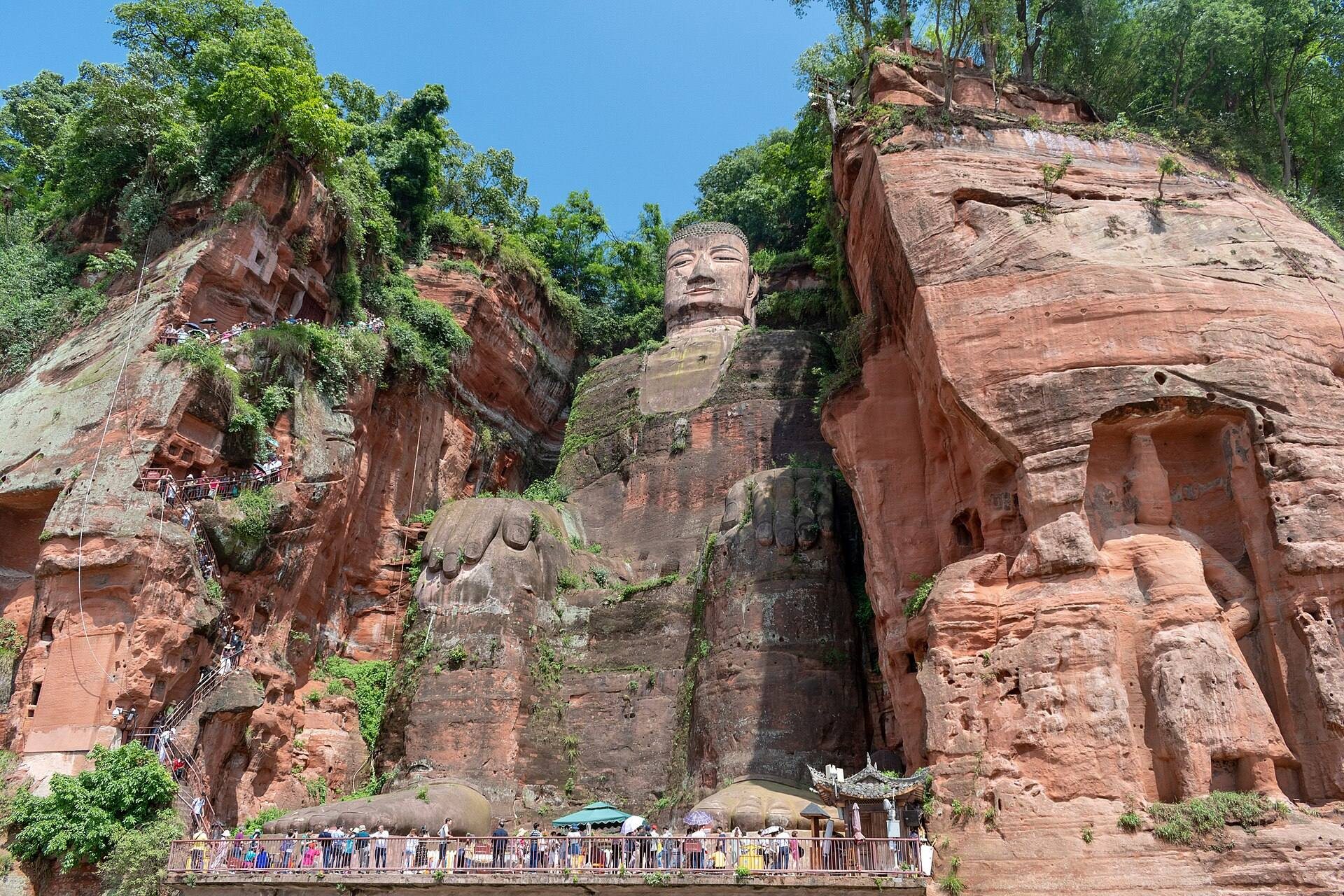
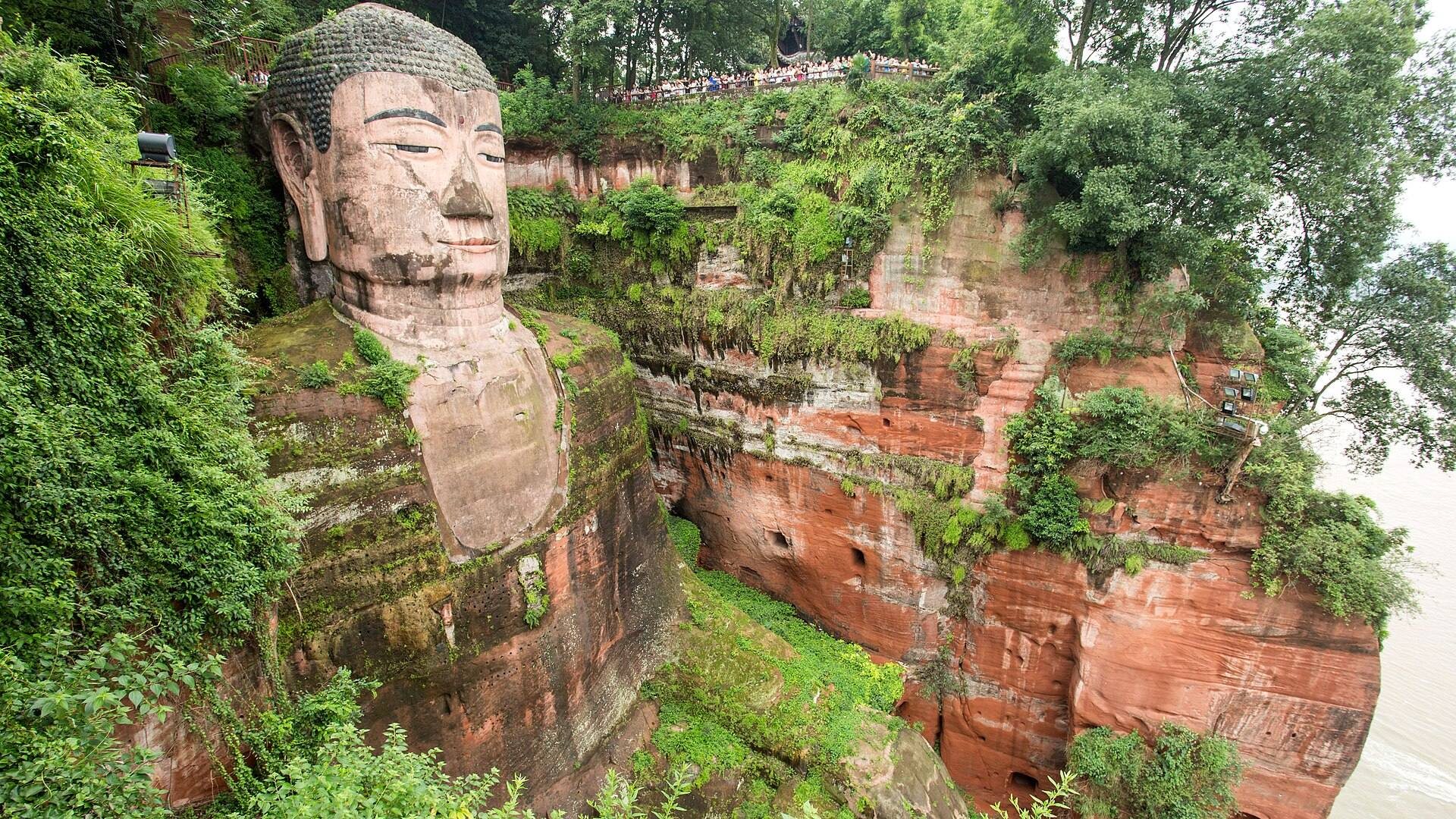
The Leshan Giant Buddha is carved directly into a red-sandstone cliff at the river confluence and faces Mount Emei, with the rivers flowing below its feet. The seated figure leans slightly forward and rests both hands on its knees. Its proportions follow the Buddhist treatise known in English as the Sutra on the Measurement of Images. The surrounding protected landscape includes riverside rock formations, cliff sculptures, Lingbao Pagoda, and numerous Buddhist niches and carvings.
The seated Buddha
Scale and form
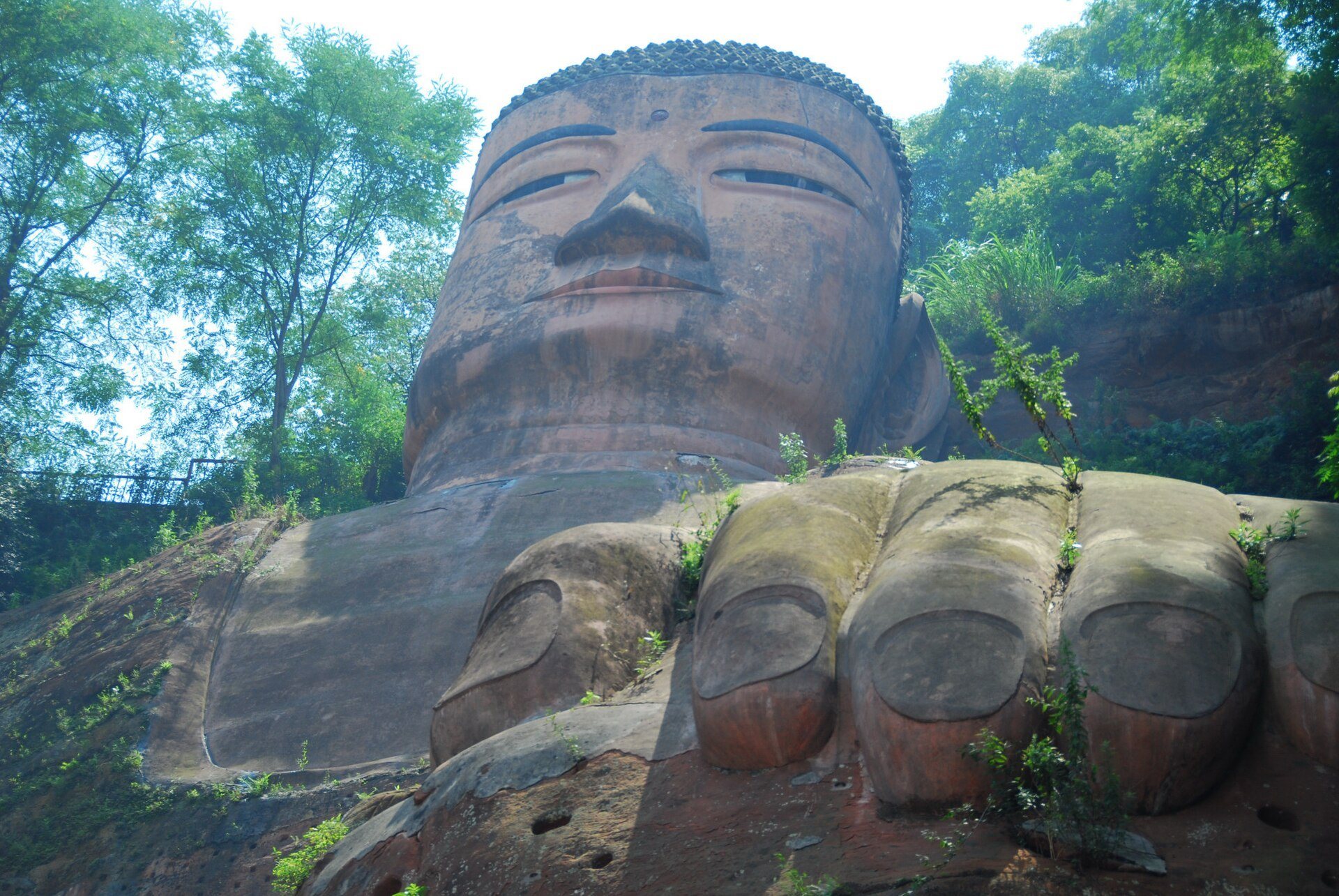
The head measures 14.7 metres in height and 10 metres in width. The ears are 7 metres long, while the eyes and mouth each measure 3.3 metres across. The nose is 5.6 metres long, the neck is 3 metres long, and the shoulders extend approximately 24 metres. The middle finger is about 24 metres long. The feet measure approximately 9 metres across and 11 metres from front to back, and the smallest toenail is large enough to accommodate a seated person.
Hair, drainage, and repairs
The head contains 1,021 spiral hair elements. These were added later rather than carved directly from the mountain. The statue was designed with an integrated drainage system to limit water erosion and weathering. Horizontal channels occur at the fourth, ninth, and eighteenth levels of the hair elements, while further gutters and openings run around the chest, collar, ears, and rear of the body.
A channel on the left side of the front chest connects with another behind the right arm. Openings behind the two ears connect through the adjacent rock, while two openings at the rear sides of the chest remain separate. Conservation work has repaired drainage channels, treated the surface, secured surrounding rock, and reduced direct erosion from the river.
Chest cavity and foot foundation
A sealed reliquary cavity lies within the chest. Its sealing stone is a fragment of a Song-period commemorative stele that recorded the reconstruction of Tianning Pavilion. The cavity contains scrap iron, pieces of lead, bricks, and other debris. The stele fragment was damaged again during the Cultural Revolution.
The rock beneath the feet has been reinforced and partly protected by a constructed waterproof barrier. Eroded rock below the waterline was repaired, and the platform beneath the feet was enlarged during the 2002 conservation work to approximately 160 square metres. The barrier also provides structural support for the expanded platform.
Cliff sculptures and access structures
Heavenly Kings
Two Heavenly Kings, protective Buddhist guardians traditionally associated with the four directions, are carved into the mountain on either side of the Buddha. Each figure wears armour, carries a weapon, and measures approximately 16 metres high and 6 metres wide.
Walkway and cliff carvings
A wooden plank walkway beside the Buddha runs from the head to the feet. Two Buddhist niches on the adjacent cliff wall are among the best-preserved of the hundreds of niches in the surrounding area. At the first switchback of the walkway, a finely carved representation of the Western Pure Land includes Buddhist figures and pavilion-like architectural forms.
Lost wooden pavilion
The statue was originally protected by a wooden pavilion about thirteen storeys high. The pavilion no longer survives. Its former role is reflected in the history of the statue’s exposure to weathering, water penetration, vegetation, lichens, ferns, and other organisms.