Las Haldas: An Ancient Coastal Settlement and Ceremonial Complex in Peru
Site at a Glance
- Popularity
- Medium
- Country
- Peru
- Primary era
- Bronze Age
- Eras represented
- Bronze Age
- Civilizations
- Unclassified
- Site type
- Religious
- Remains
- Sanctuary
On this page12 sections
History
Occupation and monumental phases
Las Haldas is an ancient coastal settlement associated with the Casma–Sechin culture, on Peru’s Pacific coast. Construction of the complex is dated to about 2200 BCE. Occupation extended across the Late Preceramic (about 3000–1800 BCE), Initial Ceramic (1800–1000 BCE), and Early Horizon (1000–200 BCE), successive periods of early Andean history.
Monumental building proceeded in at least two phases. The first began around 2000 BCE and continued for roughly 300 to 400 years. A shorter phase started around 1400 BCE, when the settlement reached its peak. Architecture from this later phase appears to have taken Sechin Alto, a major complex in the Casma River valley, as a model. Las Haldas’s architectural influence reached north toward Sechin Alto and nearby coastal settlements, though it weakened farther away. Political influence may also have extended from the site.
Coastal economy and abandonment
The coastal inhabitants relied heavily on marine resources and practiced little or no agriculture. They lived alongside agricultural communities in the Casma River valley and probably exchanged marine products for crops and other goods from inland. After the monumental phases, later occupation intruded on the abandoned temple. From about 1000 BCE, irrigated farming became more important and coastal settlements increasingly served smaller, subsidiary roles in relation to inland agricultural communities. Las Haldas was abandoned by about 300 BCE.
The site became central to discussion of whether early Peruvian civilization depended chiefly on intensive farming or could also develop through the use of marine resources. Anthropologist Michael E. Moseley advanced the maritime-based interpretation in the 1970s and continued to support it in 2004. Radiocarbon dating, which estimates the age of organic material from its radioactive carbon, appeared to place Las Haldas earlier than many nearby inland farming settlements. Later investigations at Sechin Bajo challenged that argument. The monumental complex has been interpreted as serving ceremonial, religious, and administrative purposes, including the management of marine resources; it has also been proposed as an ancient astronomical observatory.
Investigation and heritage
Swiss archaeologist Frédéric André Engel discovered Las Haldas in the mid-1950s and excavated there with Edward Lanning and Bernardino Ojeda, with support from the National Agrarian University of La Molina. Early findings appeared in publications in 1970 and 1987. A University of Tokyo expedition led by Eiichiro Ishida worked at the site in 1958 and 1969; Rosa Fung Pineda investigated it in 1965, and Terence Grieder worked there in 1967. During the 1980s, Shelia and Thomas Pozorski studied sites in the Casma Valley, including Las Haldas. In 2016, a research team surveyed the complex’s architectural features and divided it into sectors without excavating. Las Haldas is recognized as part of Peru’s cultural heritage.
Remains
Landscape and settlement plan
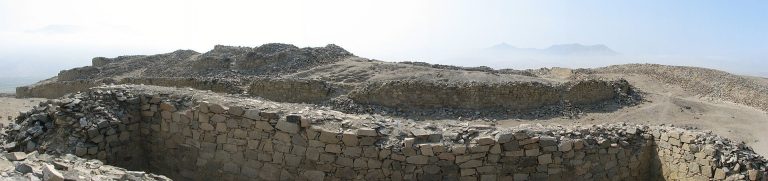
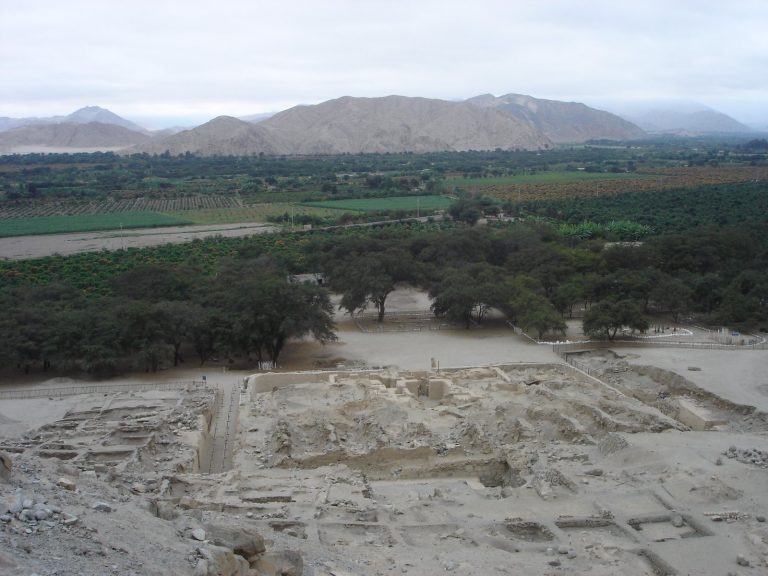
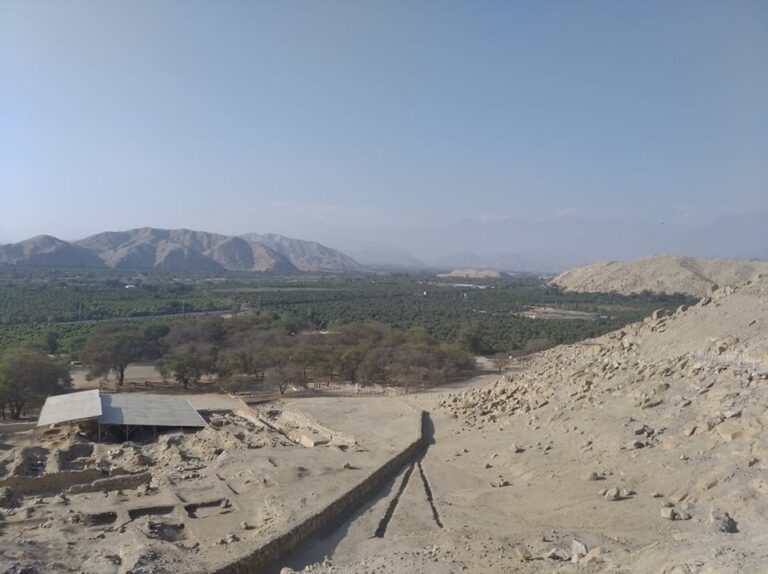
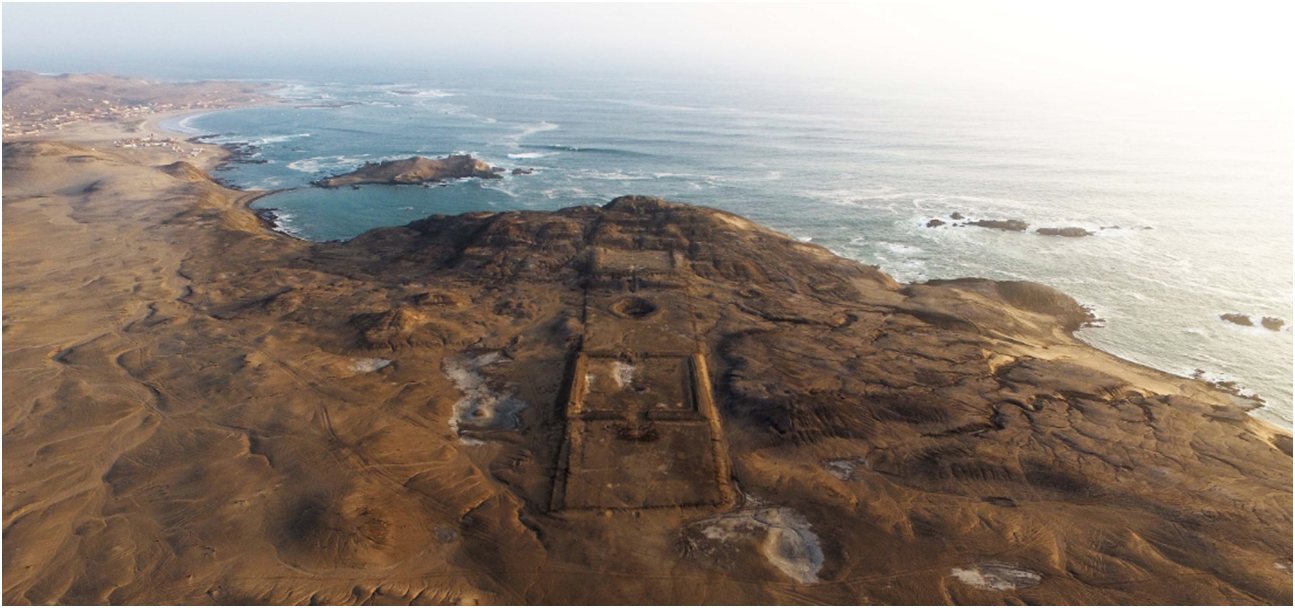
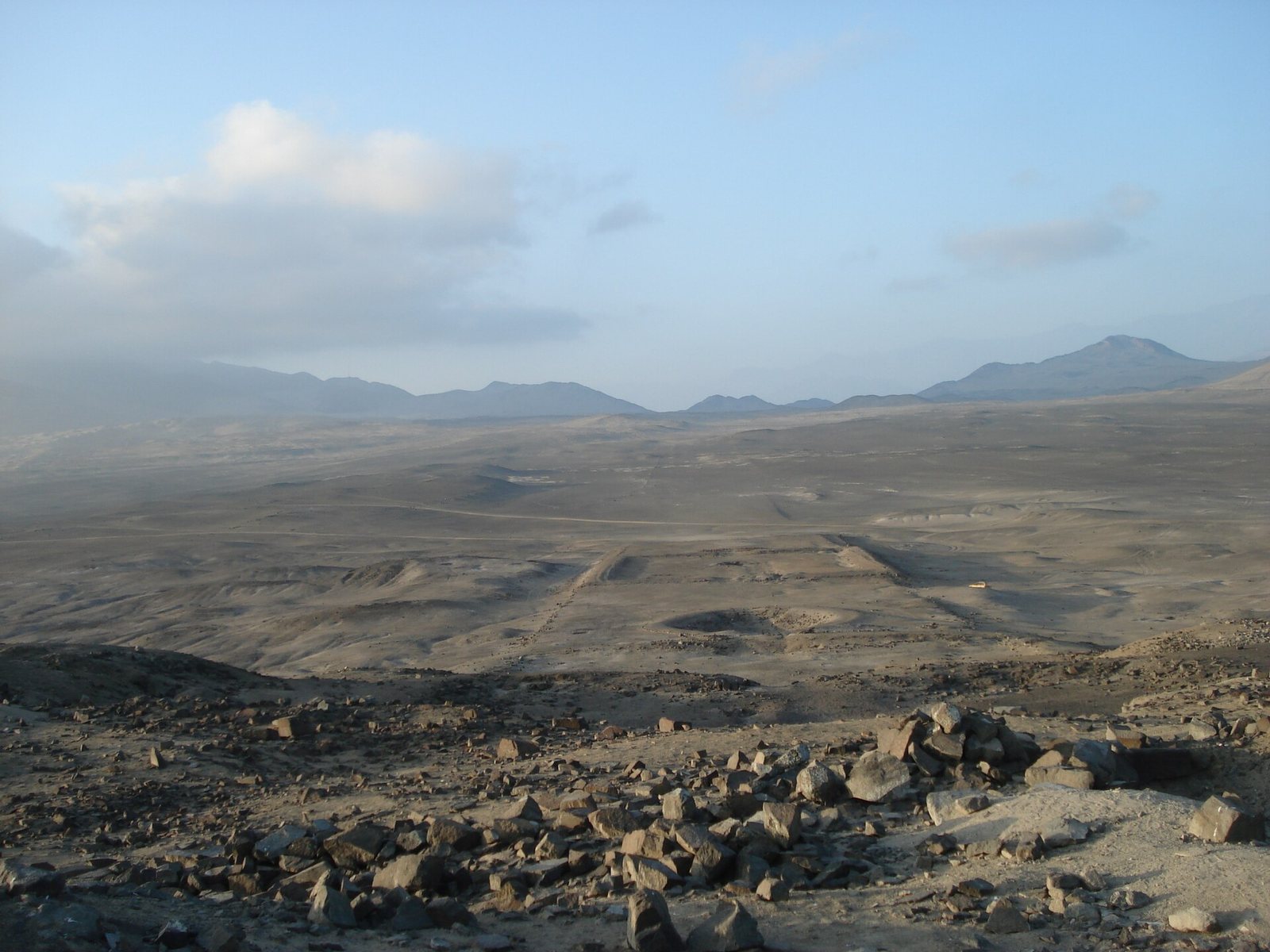
The complex occupies a terrace above a rocky shore, beside the coastal desert. It lies at an elevation of roughly 30 to 60 metres, with one estimate placing it at about 37 metres. The Casma River valley, the nearest source of fresh water, is about 19 to 30 kilometres to the north. The wider complex covers 124.5 hectares, while the ruins extend across about 40 hectares. The surrounding terrain has little vegetation and receives less than 25 millimetres of rain each year.
Monumental architecture
Central monumental group
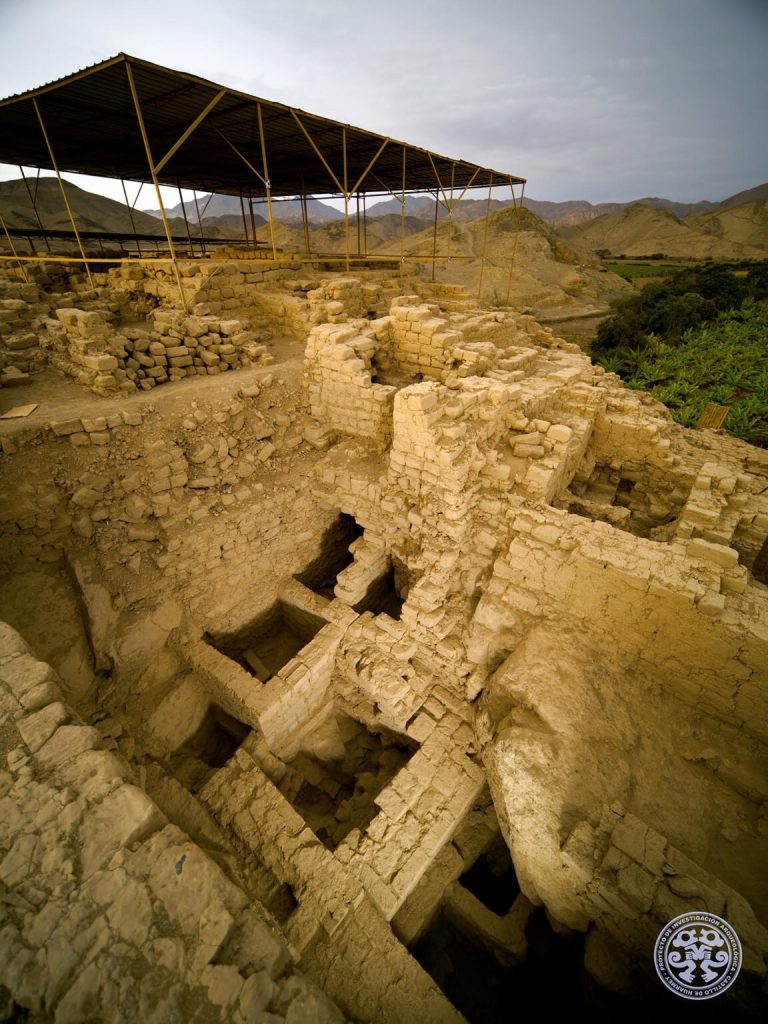
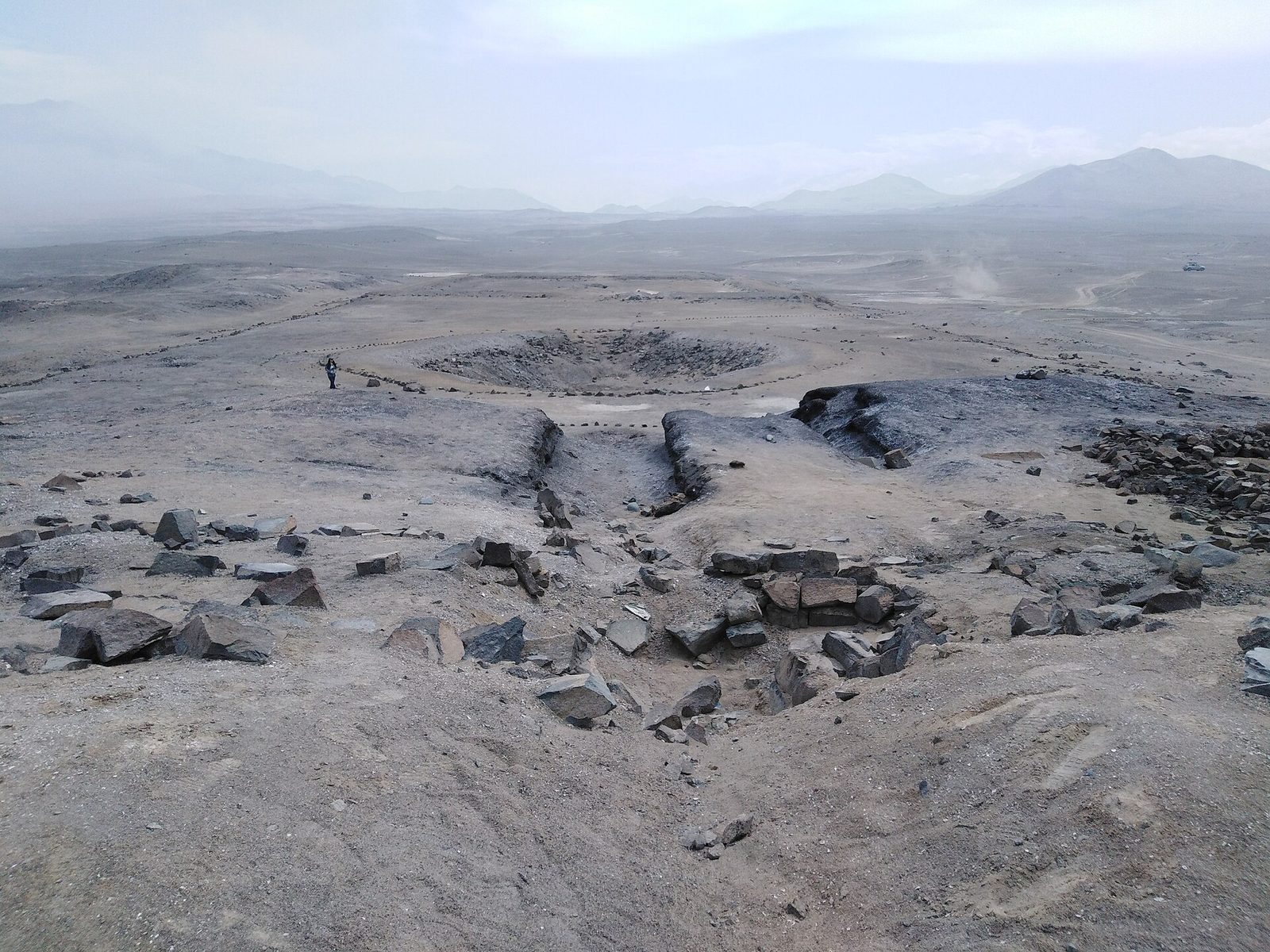
The main monumental building stands on a rocky slope beside the sea. Rectangular platforms create a truncated pyramid, a structure with a broad base and a smaller, flat top, and include a large sunken oval plaza. The central area extends about 370 metres in a U-shaped arrangement, with four slightly raised plazas. The largest plaza contains a circular court, and a large mound stands at one end of the central area.
Surrounding mounds and shared spaces
Eighteen smaller mounds with plazas are arranged around the central area. One of their plazas also has a circular court. Stairways, U-shaped enclosures, circulation spaces, and additional rooms form other shared architectural elements across the complex.
Residential and resource areas
Domestic zones
Residential areas lie on both sides of the monumental ruins. Separate domestic spaces may have served local inhabitants for everyday activities.
Refuse deposits, quarry, and plant remains
Refuse areas and shell middens, accumulated deposits of discarded shells often mixed with other food remains, occur across the settlement. They contain objects, food remains, and evidence of other exploited resources. A quarry may have supplied stone for buildings throughout the complex. Plant remains include cotton, beans, including lima beans, potatoes, chili peppers, and lúcuma. These products were probably brought from the Casma River valley.