Church of the Assumption of the Blessed Virgin Mary in Laski: A Roman Catholic Parish Church
Site at a Glance
- Popularity
- Very Low
- Country
- Poland
- Primary era
- Early Modern
- Eras represented
- Early Modern
- Civilizations
- Unclassified
- Site type
- Religious
- Remains
- Church
On this page7 sections
History
The Church of the Assumption of the Blessed Virgin Mary in Laski is a Roman Catholic parish church in Poland, built in 1627 with funds from Pauline monks from Częstochowa. The Paulines are a Roman Catholic monastic order also known as the Order of Saint Paul the First Hermit. The church’s dedication refers to the Catholic belief that Mary was taken body and soul into heaven; its feast is observed on August 15.
The church was enlarged in 1670, 1738, and 1780. The monks relinquished the estate in 1797. The church belongs to the parish of the same dedication in the Trzcinica deanery, a grouping of parishes within the Diocese of Kalisz, the bishop’s territorial jurisdiction.
Remains
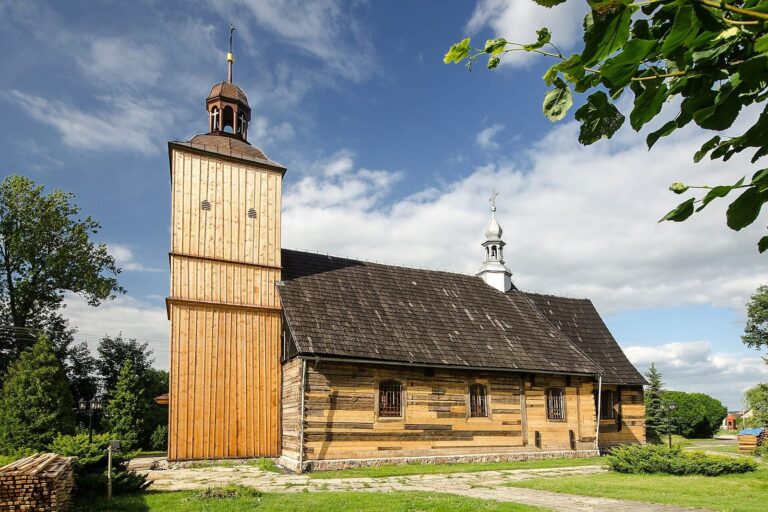
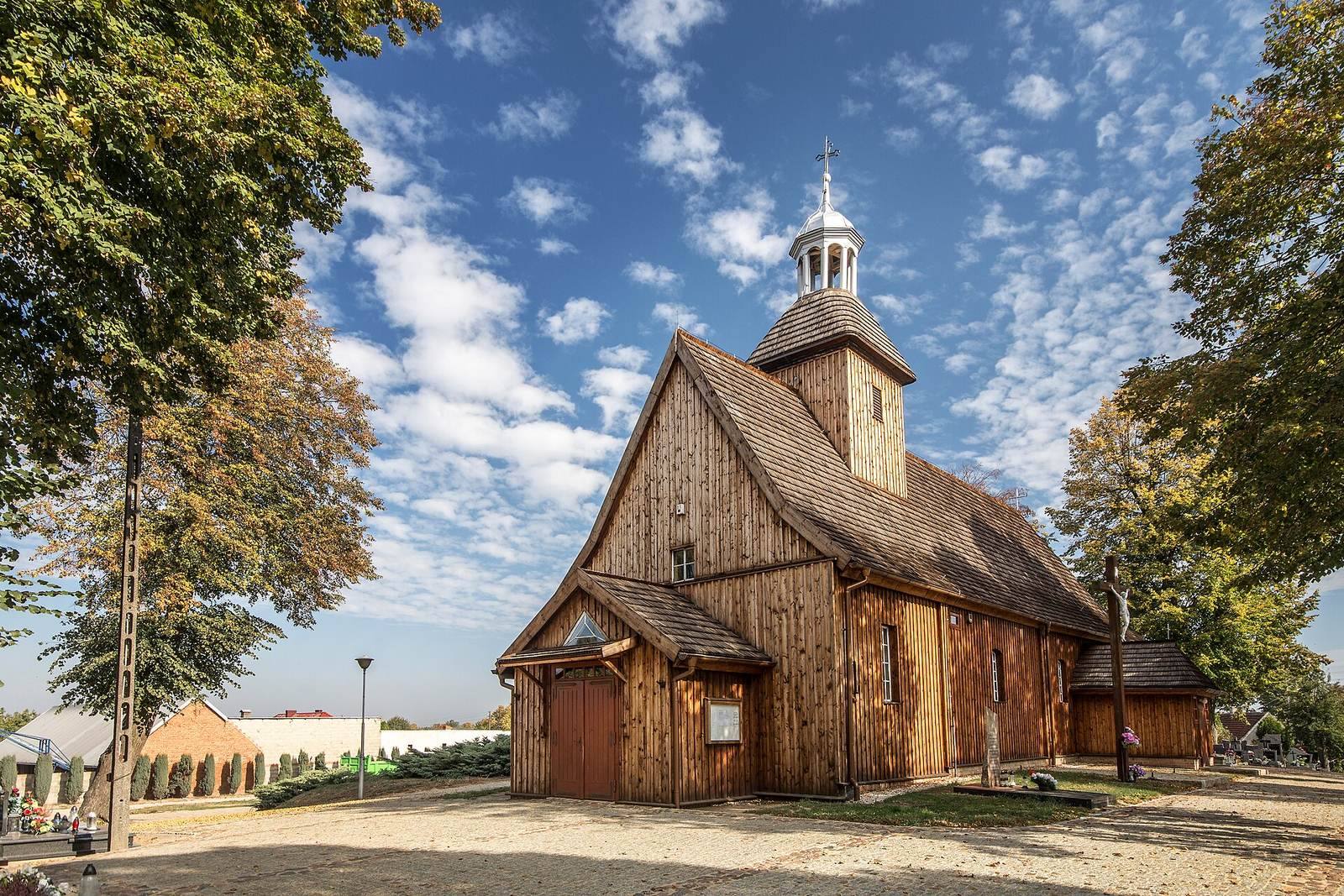
The church is a single-nave, east-oriented wooden building with a hall-like plan. Its horizontal logs interlock at the corners, and the altar end finishes in a straight wall. A masonry sacristy adjoins the church. Two porches, one at the side and one at the front, are attached to the nave. A square tower rises above the nave’s front and has a shingled tent roof. The church has a single-ridge shingle roof, as well as a metal-clad, helmet-shaped roof with a lantern.
Interior and furnishings
Ceiling and gallery
A flat ceiling spans the interior, and ten posts support the music gallery. Painted decoration from 1739 depicts the Assumption of the Blessed Virgin Mary, the Pauline emblem, and floral motifs. The ceiling also bears the Pauline coat of arms, a palm with two lion cubs.
Altars
The church contains three altars. Its main altar is in the early Baroque style and dates to the second half of the seventeenth century. A side altar dates to the eighteenth century.
Pulpit and baptismal font
Made in the first half of the seventeenth century, the pulpit is in the late Renaissance style and bears painted images of the four Evangelists. The baptismal font is Baroque.
Bell and organ
A bell cast in 1693 carries the Latin inscription Soli Deo Gloria, meaning “Glory to God alone.” The small pipe organ was probably built by Franciszek Majewski of Rychtal in the late eighteenth century. It has six stops, which select different sets of pipes, and one keyboard.