Konárovice Castle: A Fortified Manor Transformed into a Rococo Residence
Site at a Glance
- Popularity
- Medium
- Country
- Czechia
- Primary era
- Early Modern
- Eras represented
- Medieval, Early Modern, Modern
- Civilizations
- Habsburg, Habsburg Austria, Holy Roman Empire, Kingdom of Bohemia
- Site type
- Domestic
- Remains
- Castle
On this page10 sections
History
Konárovice Castle stands on the eastern edge of its namesake settlement in Czechia. Its origins lie in a fortified manor, a defended estate residence probably built in 1419 by Vaněk Sekerka of Choltice in the Gothic style of medieval Europe.
Gothic manor and early owners
Václav Háša of Újezd bought the manor in 1503 and enlarged it. In 1588, his son Jan Jiří Háša of Újezd sold it to Zikmund Freusichselbst of Freudenbach. From 1605 to 1614, brothers Albrecht Jiří and Jan Oldřich Klusák of Kostelec owned the property. After disputes with people from Kolín, they sold the manor and estate to Kryštof Nybšic of Altendorf.
War and rebuilding
During the Thirty Years’ War, a major Central European conflict fought from 1618 to 1648, Konárovice was plundered several times and the manor was burned. Nybšic’s debts led to the transfer of his property, including Konárovice, to his principal creditor, Humprecht Račín of Račín. Račín sold the damaged residence in 1661 to Jan Adam Schofmann of Hemmerles. Schofmann restored the village and converted the manor into an early Baroque castle, reflecting a later European architectural style.
Rococo transformation and nineteenth-century owners
The Schofmann family kept Konárovice until 1725. After the death of its last male member, Karel Ignác Vojtěch, the estate passed to his sister Kateřina. In 1772, Alžběta Quasco de Claviers, née Netolická of Eisenberg, became its owner. Three years later, she commissioned remodeling in the Rococo style, known for elaborate ornament.
Alžběta died without heirs in 1813 and left the castle to her niece, Apolonia Cavrani, née z Mitrovic. Subsequent owners included Jan of Schmiedgräben from 1822 to 1834, Karel Rummerskich from 1834 to 1842, Hugo Roth from 1842 to 1844, and Alžběta of Schmiedhals from 1844 to 1845. The wealthy burgher Jan Raška owned the property until 1856, when Karel Arnošt Harrach acquired it and placed it under the management of his son, Jan Nepomuk.
Jan Nepomuk moved to the castle with his wife, Marie Markéta, Princess of Lobkowicz, and ordered a refurbishment focused chiefly on the interiors. Their daughter, Maria Theresia Johanna Anna Carolina Edeltrud, was born there. After Marie Markéta died at the age of 34, Jan Nepomuk decided to sell the property.
Private estate and state uses
Prague factory owner Josef Götzl bought the castle in 1872. His son, Josef Götzl Jr., inherited it and sold it in autumn 1922 to Elvír Eisner, a wire-factory owner in Rokycany. A district administrative commission purchased the castle and estate in February 1923, intending to sell adjoining fields and establish a social institution in the building. The plan did not proceed. Götzl Jr. bought the property back in 1927 and owned it until the end of the Second World War.
On 24 May 1945, the castle was nationalized after local residents alleged that its owners had been friendly with Germans during the war. A court in Kolín confiscated all property belonging to Josef and Milena Götzl and sentenced them to imprisonment and forced labor. A local school council sought to use the castle for a school, teachers’ housing, and a cultural center. Instead, in 1947 it was assigned to United Pharmaceutical Works (SPOFA), a state-owned enterprise in Prague, which bred rabbits, mice, guinea pigs, rats, and pigeons for experiments.
At the beginning of 1957, the facility passed to the Research Institute of Medicinal Plants (VULERO) in Prague. The institute established a monkey-breeding operation to produce polio vaccine, with as many as 1,800 monkeys killed there each year. The castle has been protected as a cultural monument since 1958.
Recent ownership
Barbora Černá bought the castle in 1996 for 14 million crowns through a company that managed property for German businessman Theodor Stein. Černá disappeared in September 2001. It later emerged that she had sold the castle to Jiří Martinovský, who had emigrated to Germany. At the time, she faced prosecution for insurance fraud, and police sought her as both a fugitive and a missing person. Her brother alleged that the sale contract was forged and that someone had arranged her disappearance. An investigation confirmed his account eleven years later. The possibility that Černá had been murdered remained unproven; her body was never found, and Interpol sought her.
In 2004, It Incorporated, owned by American actor Crispin Glover, bought the castle for 20 million crowns. Glover chose it over Býchory Castle, citing its architecture, gardens, and condition. His grandparents had come from Czechoslovakia. The castle was gradually renovated and is used for private purposes.
Remains
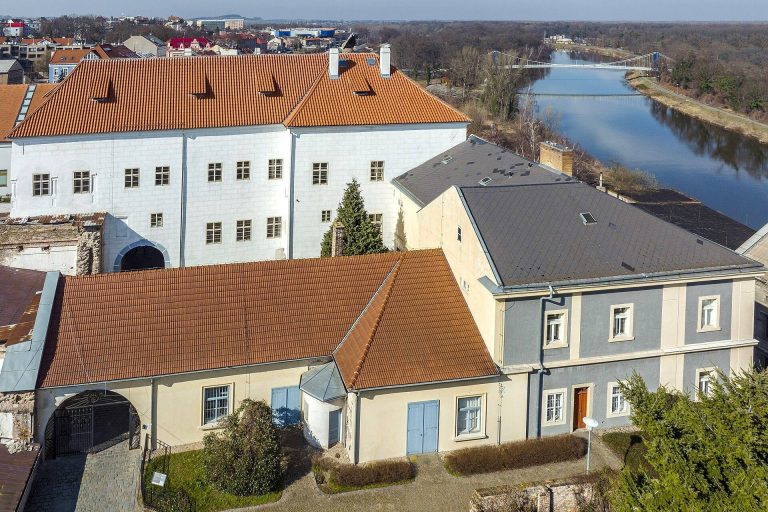
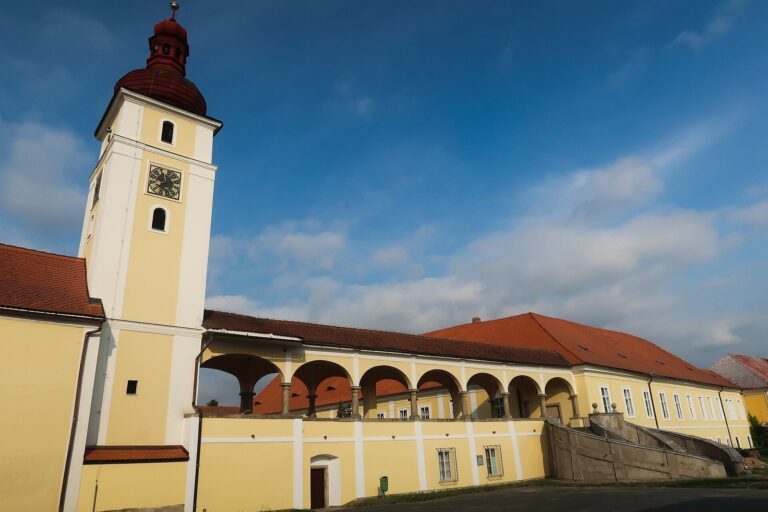
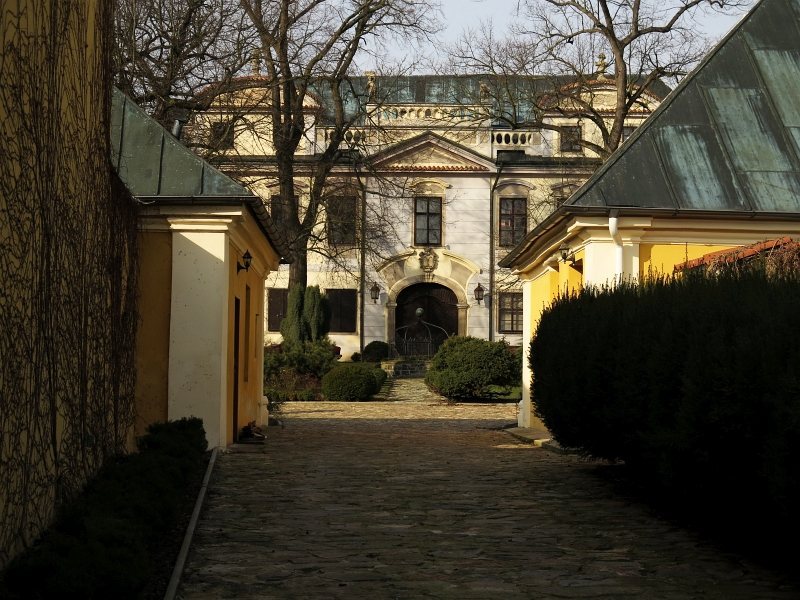
The complex has an irregular plan of four wings around a courtyard, and a wall encloses the grounds. The site brings together remnants of the Gothic manor and a castle shaped by later Baroque and Rococo changes.
Earlier fabric and grounds
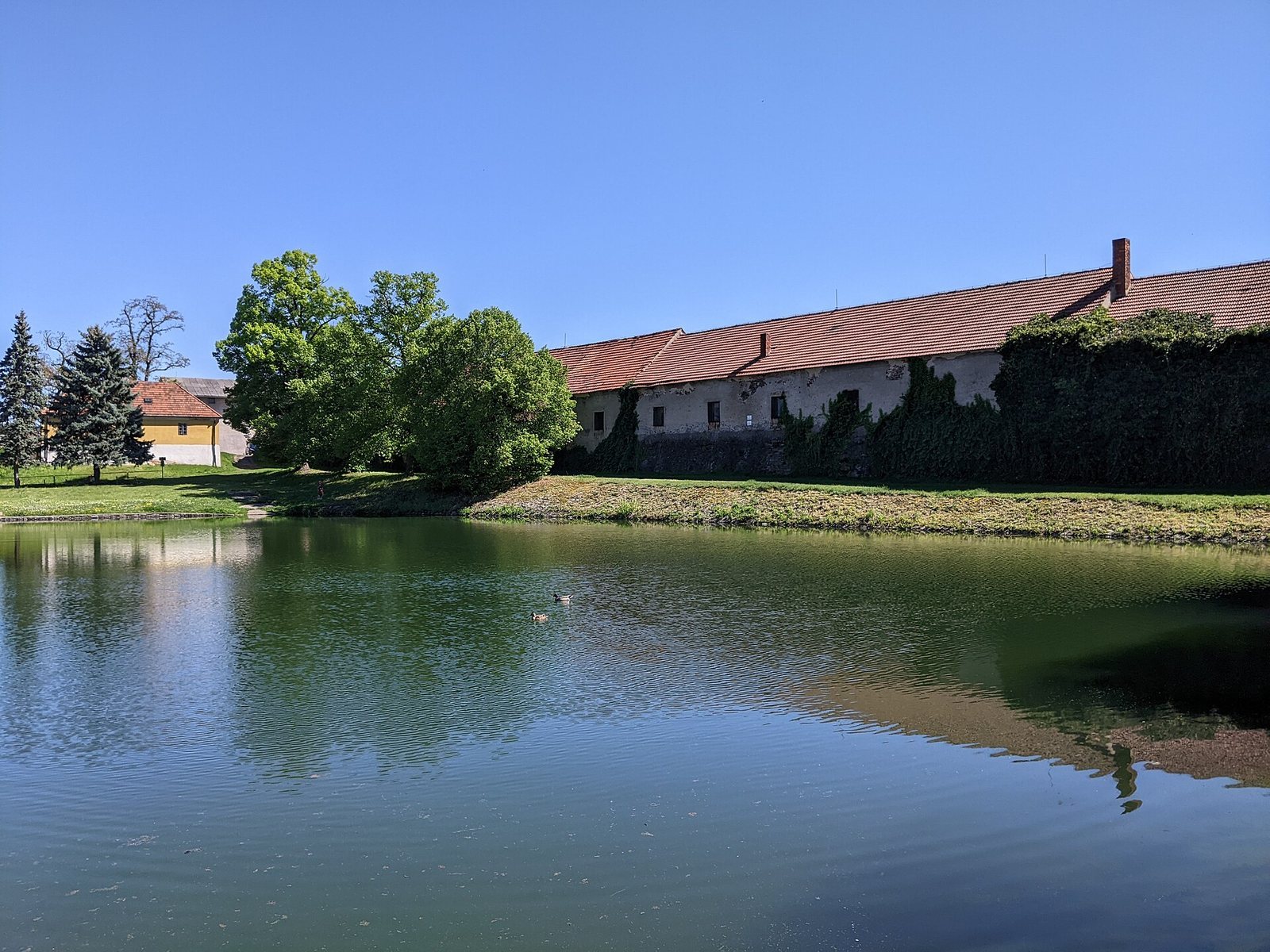
Remains of the Gothic manor lie in the southeastern corner of the castle. An extensive park surrounds the building, while service buildings stand on the eastern side. A terrace reached by a staircase connects to the south side of the castle.
Eastern wing and courtyard
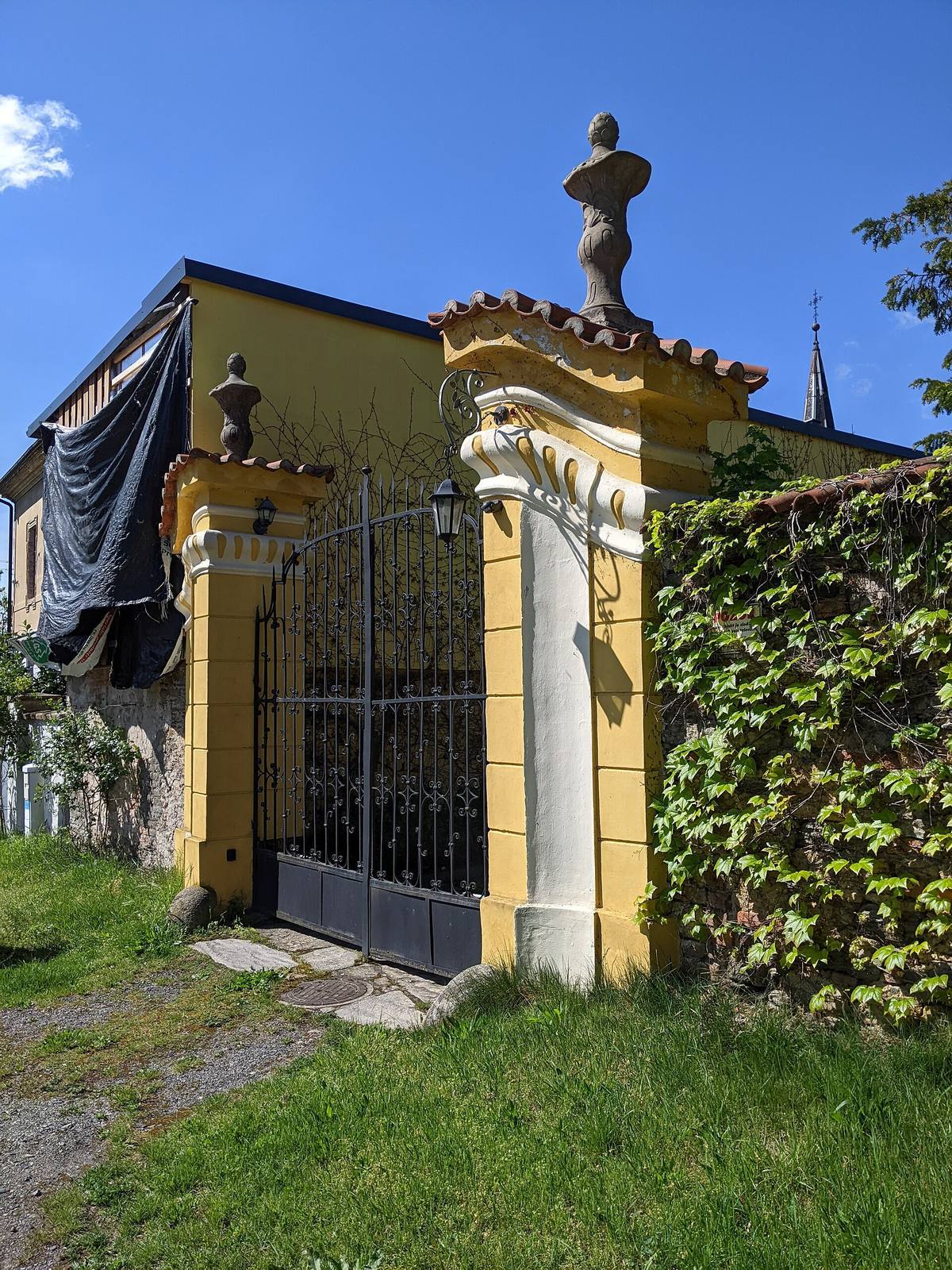
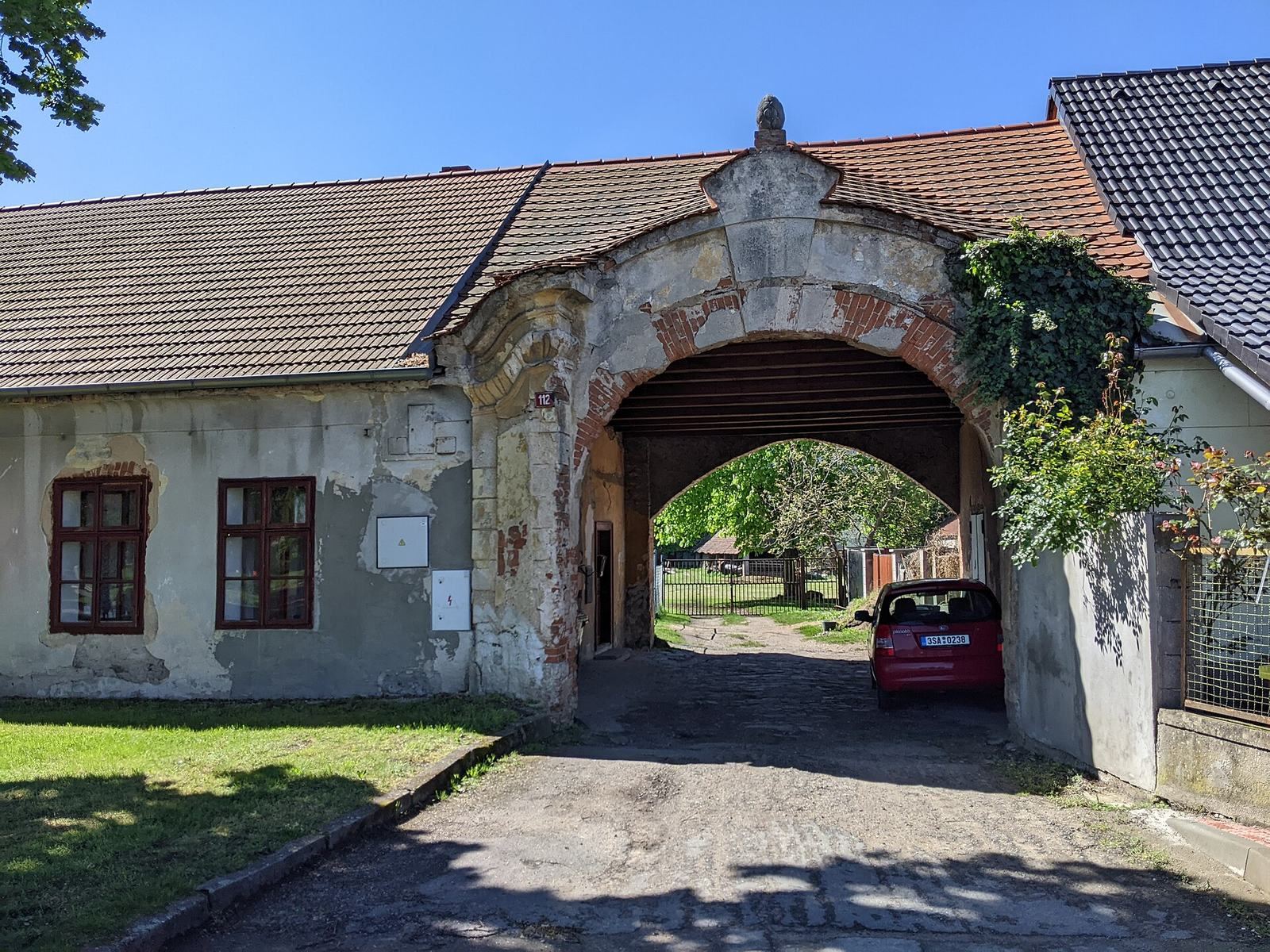
A well beside the eastern wing has an ornamental metal grille. In line with it, a gate is flanked by two gatehouses. The eastern façade bears the Harrach coat of arms, showing three ostrich feathers and a gold orb. A courtyard fountain with an ornamental grille was installed during Josef Götzl Jr.’s ownership.
Rococo decoration
The Rococo remodeling altered the façade, roof, and interiors. The interior spaces received stucco, a form of decorative plasterwork.