Konak: An Ottoman Governor’s Palace in Sarajevo
Site at a Glance
- Rating
- 3.4
- Popularity
- Very Low
- Country
- Bosnia and Herzegovina
- Primary era
- Modern
- Eras represented
- Modern
- Civilizations
- Austria-Hungary, Habsburg, Ottoman
- Site type
- Civic
- Remains
- Palace
On this page9 sections
History
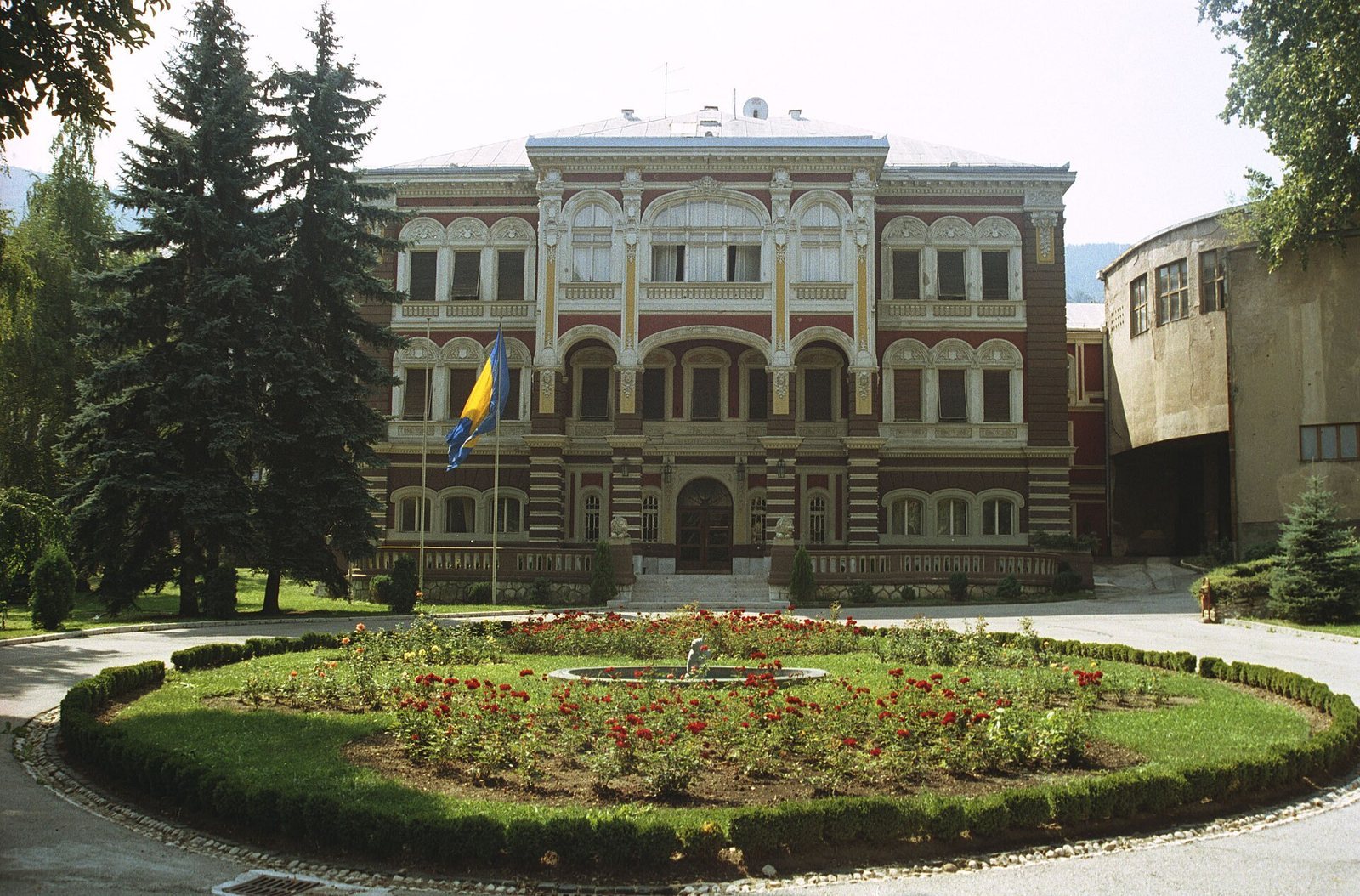
Konak is an Ottoman Baroque palace built in 1869 as the residence of Bosnia’s Ottoman governor in Sarajevo, Bosnia and Herzegovina. It also served as the seat of the vali (provincial governor) and the administration of the Bosnian vilayet (an Ottoman administrative province).
Ottoman administration and construction
Ottoman governors of Bosnia were based in Sarajevo from 1463 to 1553, then in Banja Luka until 1638, and again in Sarajevo until 1669. Their seat moved to Travnik until 1851, when it returned to Sarajevo. A separate governor’s residence stood at the site now occupied by Bistrik barracks. Built between 1453 and 1462, it was destroyed during the 1697 invasion by the army of European commander Eugene of Savoy. This earlier residence was not Konak.
Konak was built after the governor’s seat returned from Travnik, during the administration of Ottoman governor Šerif Topal Osman Pasha. Pasha was a high-ranking Ottoman title. The palace remained the seat of government until 1878. Audiences with the vizier and annual sessions of the provincial assembly were held there.
Austro-Hungarian rule and the 1914 assassination
Following the 1878 Congress of Berlin, a diplomatic conference that reshaped political arrangements in Europe, Bosnia and Herzegovina came under Austro-Hungarian administration. A People’s Government was formed at Konak. During the rule of the Austro-Hungarian dual monarchy, officials stayed at the palace. Emperor Franz Joseph I spent four days there during his visit to Sarajevo in May 1910.
After Franz Ferdinand, heir to the Austro-Hungarian throne, and his wife Sophie were assassinated on 28 June 1914, they were taken to Konak. They were reportedly alive on arrival but died soon afterward from their wounds. Franz Ferdinand had been wounded in the neck and Sophie in the abdomen. The doctor who examined them certified their deaths, and the certificates survive. Their autopsies were carried out at Konak, where their coffins were also displayed.
Yugoslav and postwar use
From 1918 to 1941, generals, grand prefects, and bans (high-ranking regional officials) stayed at Konak. During the Kingdom of Yugoslavia, the complex also served as a royal residence. Bosnia and Herzegovina’s first medical faculty opened in Sarajevo on 22 November 1944, housed at Konak and in nearby buildings.
After the Second World War, the palace returned to residential use. Josip Broz Tito, president of the Socialist Federal Republic of Yugoslavia, stayed there occasionally, as did senior foreign visitors on official visits.
Political meetings and recent history
Following Bosnia and Herzegovina’s independence referendum, negotiations over the country’s internal organization took place at Konak on 16 and 17 March 1992, during the dissolution of Yugoslavia. The European Community, a political and economic organization that preceded the European Union, sponsored the talks and was represented by Portuguese diplomat José Cutileiro.
Konak sustained minor damage during the Bosnian War. Partial repairs had been made by 2000. Important meetings continued there through 2013, and ambassadors stayed at the complex. On 15 July 2002, it hosted the first trilateral meeting of the heads of state of Bosnia and Herzegovina, Croatia, and the Federal Republic of Yugoslavia. Konak is a National Monument of Bosnia and Herzegovina, belongs to the country’s Presidency, and is used to receive foreign guests.
Remains
Palace and grounds
Layout and exterior
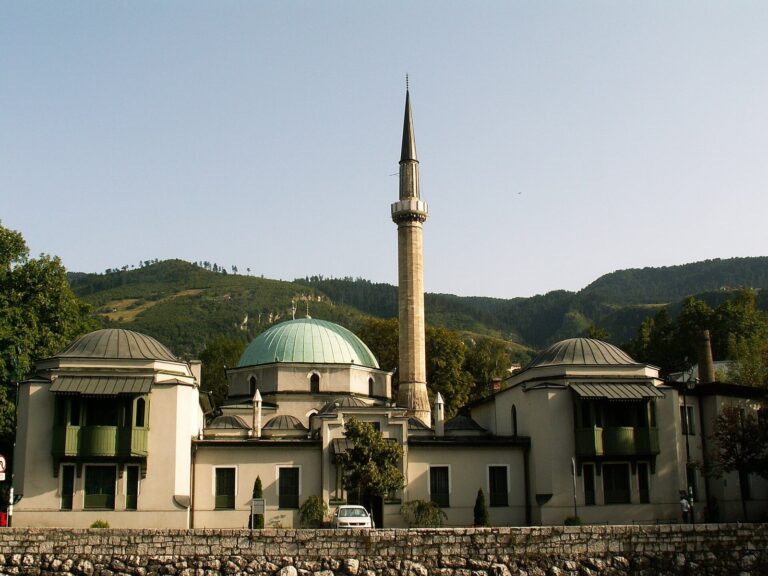
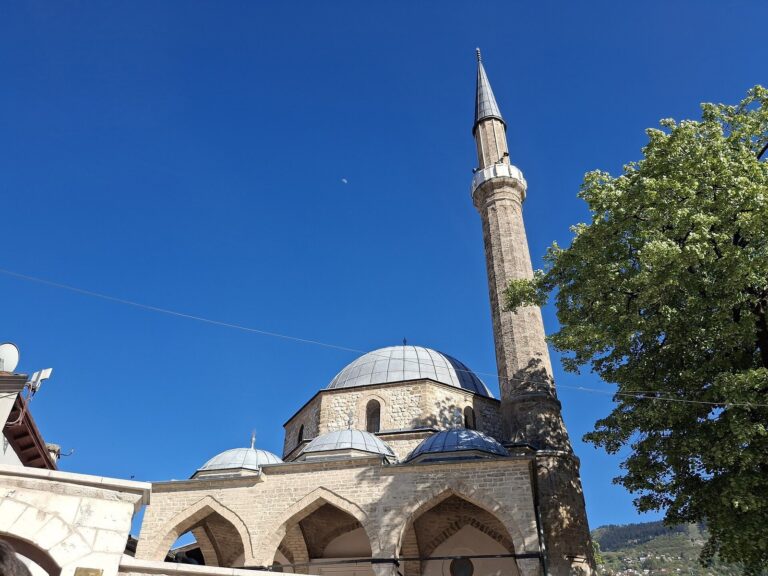
The three-storey palace stands in Sarajevo’s Bistrik neighborhood, in the Stari Grad municipality. It was the city’s only three-storey building when constructed. A high wall surrounds the complex, with an entrance through a large gate on the east and another entrance from Austria Square on the west. The site lies between the Academy of Sciences and Arts of Bosnia and Herzegovina to the west, the Emperor’s Mosque to the north, Konak Street to the east, and Franjevačka Street to the south. Split architects Franje Linardov and Franjo Moise designed the palace.
Interior and additions
The rooms have a functional arrangement and contain finely made furniture and artworks of high artistic value. A smaller neighboring building housed the vizier’s apartment. Work in 1906 added a courtyard and two stone-carved lion figures. Konak is the only surviving residence of a vizier in Bosnia and Herzegovina. It has never been fully restored and has deteriorated.