Kirklees Priory: A Cistercian Nunnery in West Yorkshire
Site at a Glance
- Popularity
- High
- Country
- United Kingdom
- Primary era
- Medieval
- Eras represented
- Medieval, Early Modern
- Civilizations
- British, English
- Site type
- Religious
- Remains
- Monastery
On this page10 sections
History
Kirklees Priory was a Cistercian nunnery at present-day Kirklees Park, Clifton, near Brighouse, in West Yorkshire, United Kingdom. The Cistercians were a reforming order within Western monasticism. Reiner le Fleming, the landholding lord of Wath upon Dearne, founded the priory in 1155 during the reign of Henry II (1154–1189). Dedicated to the Virgin Mary and St James, it stood within the ancient ecclesiastical parish of Dewsbury. The wider area has a history reaching back to the Bronze and Iron Ages.
Foundation and medieval community
Between 1306 and 1315, William Greenfield, Archbishop of York, wrote to the prioress about rumors concerning nuns Alice Raggid, Elizabeth Hopton and Joan Heton. The allegations said that the women had met both religious and secular men at the nunnery, and their conduct led the house to be regarded as disreputable.
Kirklees is also associated with the medieval ballad Robin Hood’s Death. In the tale, the prioress treats Robin Hood by bloodletting, the deliberate withdrawal of blood, but takes too much and kills him.
Dissolution and later use
The priory remained open after the 1535 measure known as the Dissolution of the Lesser Monasteries, part of Henry VIII’s suppression of monasteries. It continued to provide worship and hospitality. Under prioress Cecilia Topcliffe, the nuns present on 4 February 1536 continued as they had before the measure.
In 1539, following the Second Act of Dissolution, Joan Kyppes surrendered the priory, which then had eight inmates. Its property was valued at £29 18s 9d and granted to John Tasburgh and Nicholas Savill. The church and priory buildings were demolished, and their stone was used to build Low Hall, later called Old Farm. Cecilia Topcliffe, Joan Leverthorpe and Katherine Grace took refuge at the priory guesthouse site and ran it as a hostelry. The Three Nuns inn was named after them.
Preservation and local identity
From the 16th century onward, the Armytage family preserved a collection of medieval buildings at Kirklees Park. In 1757, landscape gardener Francis Richardson surveyed the park’s landscape. The priory later gave its name to Kirklees metropolitan district, established in 1974 and including Huddersfield, Dewsbury and Batley. The priory itself lies just outside the district, in neighboring Calderdale.
The surviving buildings are Grade I listed, England’s highest category of listed-building protection. The gatehouse was added to Historic England’s Heritage at Risk Register and removed after extensive repairs.
Remains
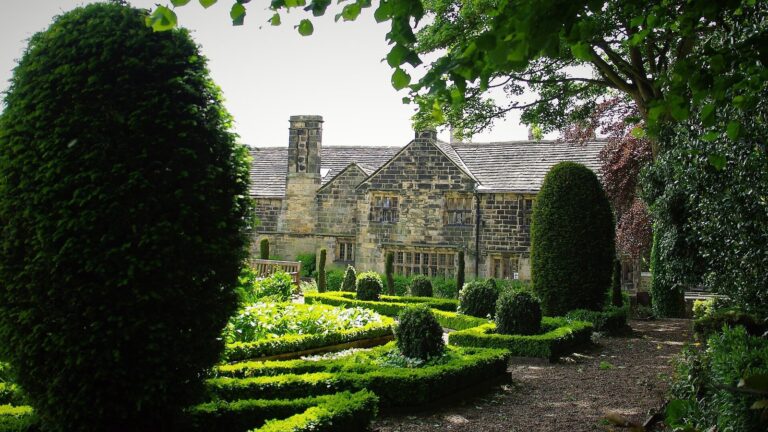
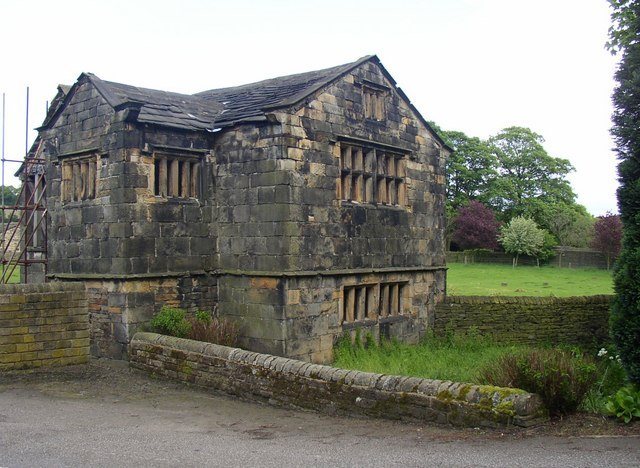
The surviving buildings are grouped at Old Farm within the wider Kirklees Park landscape. Woodland, gardens and ponds extend across the park, while archaeological features and the Robin Hood monument lie in the surrounding landscape.
Buildings at Old Farm
The remains at Old Farm include a long barn with a central space flanked by two side aisles, along with parts of Old Farm House, a calf house and the gatehouse. Low Hall, now known as Old Farm, was enlarged in the 18th century by Scottish architect Robert Adam and English architect John Carr.
Guesthouse site and inn
The site of the priory guesthouse lies beneath a car park. The present Three Nuns inn was built in 1939.
Parkland
Kirklees Park includes ancient woodland, rhododendrons and camellias, ponds, and ornamental gardens.
Roman archaeological remains
Archaeological investigation in the area found pottery indicating a Roman village and fragments of marble statues dating to the fourth century. The remains of a Roman fortification are still visible.
Robin Hood monument
A monument in woodland near the River Calder claims to mark Robin Hood’s grave.