Kaiyuan Temple (Chaozhou): A Buddhist Temple of the Linji School
Site at a Glance
- Rating
- 4.2
- Popularity
- Low
- Country
- China
- Primary era
- Medieval
- Eras represented
- Medieval, Early Modern, Modern
- Civilizations
- Unclassified
- Site type
- Religious
- Remains
- Monastery
On this page21 sections
History
Kaiyuan Temple (Chaozhou) is a Buddhist temple of the Linji school in Chaozhou, Guangdong, China. The Linji school is a major Chan, or Chinese Zen Buddhist, lineage known for its distinctive teaching tradition and institutional continuity. The temple was established in 738 under the Tang emperor Xuanzong, as part of an imperial network of Kaiyuan Temples founded across the empire during the Kaiyuan era. Its surviving buildings and objects represent successive periods of Chinese history beginning with the Tang dynasty.
Origins and Tang development
The temple’s origins are associated with 548, 685, and 738. The foundation in 738 is linked to Xuanzong’s establishment of Kaiyuan Temples, and the institution was also known by the names Dayun and Longxing. Lifeng Temple is another name recorded for it in that year. By 902, the monastery housed 3,000 monks, indicating the scale of its religious community during the Tang period.
The temple is also associated with Kūkai, a Japanese Buddhist monk and religious founder connected with the Shingon tradition, who stayed there. This association places Kaiyuan Temple within the wider movement of Buddhist learning and travel across East Asia.
Later dynasties and rebuilding
The monastery’s name changed during later imperial periods. In the Yuan dynasty it became Kaiyuan Wanshou Chan Temple, and during the Ming dynasty it was called Kaiyuan Zhenguo Chan Temple. The Qing-period name, Kaiyuan Temple, remains in use. The complex was burned several times and repaired in 1797, while surviving structures and objects preserve material from the Tang, Song, Yuan, Ming, and Qing dynasties.
Twentieth-century transformation
In 1950, the Buddhist monk Chunxin became abbot and directed the refurbishment and redecoration of the temple. During the Cultural Revolution, the resident monks were forced to leave religious life, and Chunxin died in the countryside. After the Third Plenary Session of the 11th Central Committee of the Chinese Communist Party, the Buddhist monk Huiyuan became abbot and led a six-year reconstruction project.
In 1983, Kaiyuan Temple was designated a National Key Buddhist Temple in the Han Chinese Area. It had already been designated a provincial-level protected cultural heritage site in 1962, and in 2001 it was included in the fifth group of Major National Historical and Cultural Sites in Guangdong. The temple is also counted among China’s principal Buddhist monasteries.
Recent religious institution
Dingran became abbot in 1991. During his tenure, the Thai Chinese lay Buddhist Xie Huiru donated property for the establishment of the Thai-style Buddhist Hall. The temple is listed as owned by the Chinese Buddhist Association and contains a Buddhist Studies Institute regarded as the most influential such institute in southeastern China. Kaiyuan Temple is Chaozhou’s largest temple, although its present area is about one-tenth of its original size.
Remains
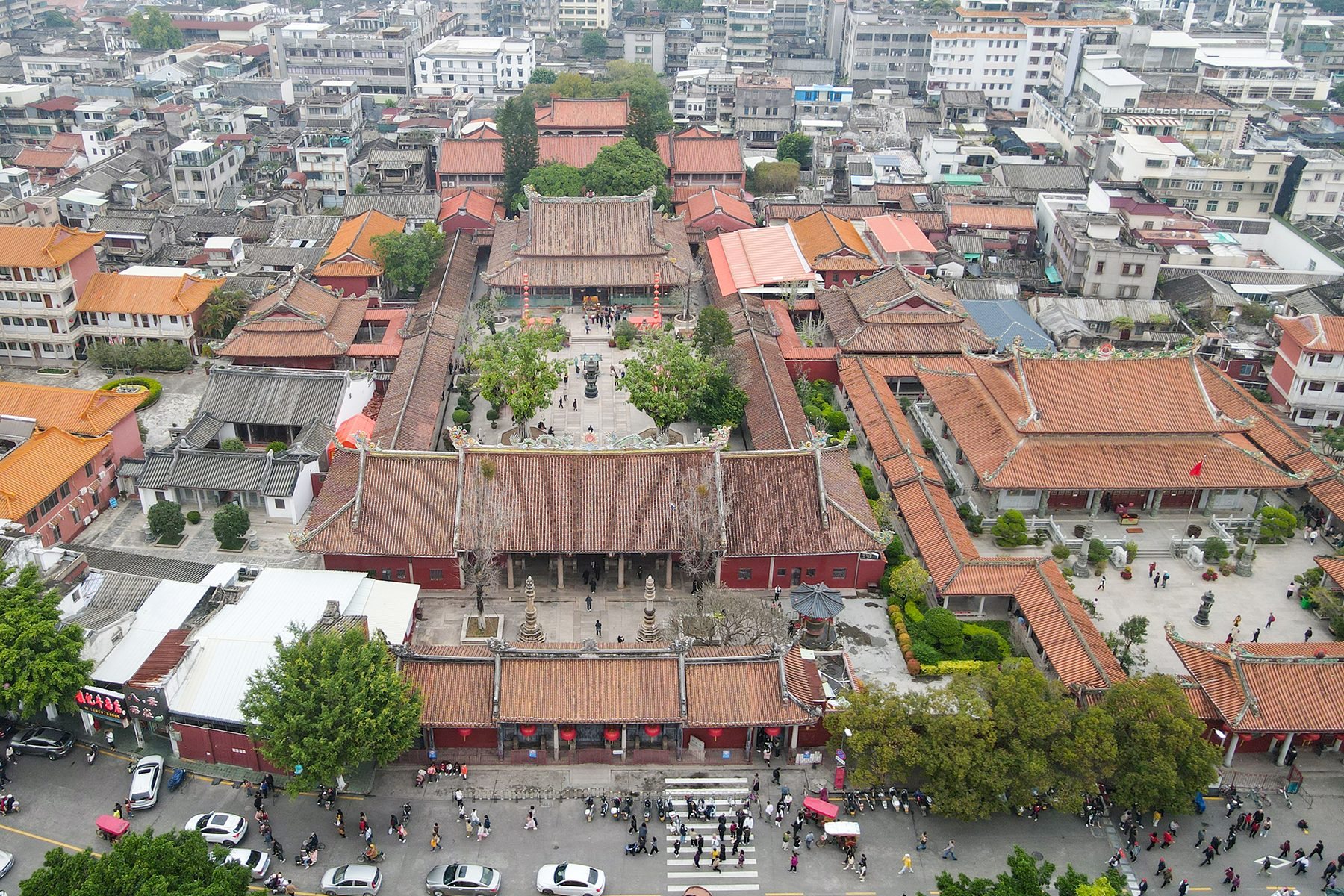
The temple complex occupies approximately 20,000 square metres and is organized around a main axis running through the Shanmen, or temple gate, the Four Heavenly Kings Hall, the Mahavira Hall, and the Buddhist Texts Library. Other buildings and features extend around this sequence, including halls, libraries, pavilions, memorial structures, gardens, living quarters, and objects from several dynastic periods.
Main axis and principal halls
Shanmen and Four Heavenly Kings Hall
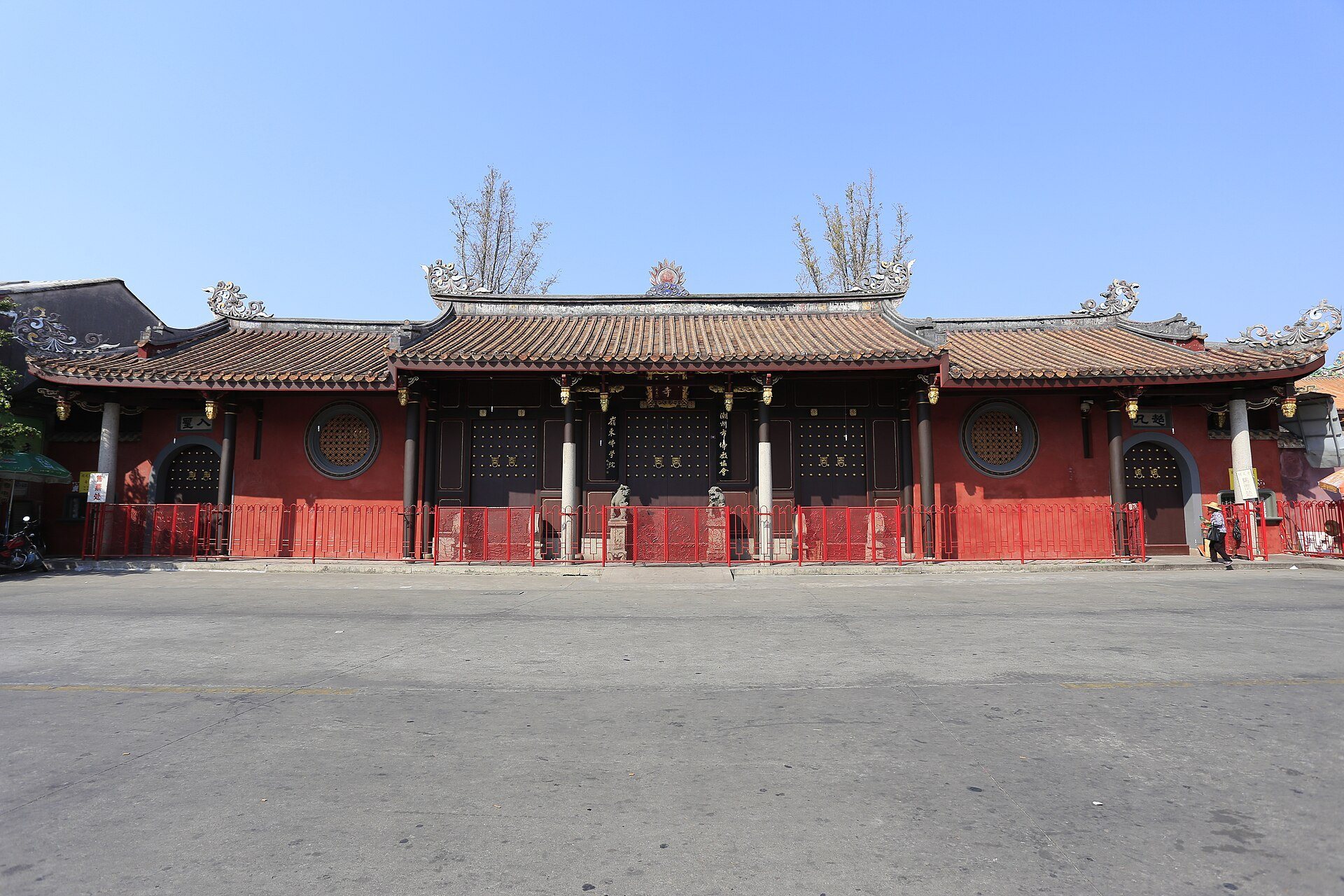
The main approach begins at the Shanmen and continues to the Four Heavenly Kings Hall. The complex also includes an Outer Mountain Gate and an Inner Mountain Gate, forming additional named entrances within the temple grounds.
Mahavira Hall
The Mahavira Hall, the principal hall traditionally dedicated to the Buddha, contains Sakyamuni at the center, Amitabha to the west, and Bhaisajyaguru to the east. Sakyamuni is the historical Buddha, Amitabha is associated with the Pure Land tradition, and Bhaisajyaguru is associated with healing. Statues of the Eighteen Arhats, Buddhist disciples regarded as having attained spiritual liberation, stand on both sides. The hall’s banisters carry Tang-period carvings showing Sakyamuni becoming a monk alongside other decorative patterns.
Da Bei Hall
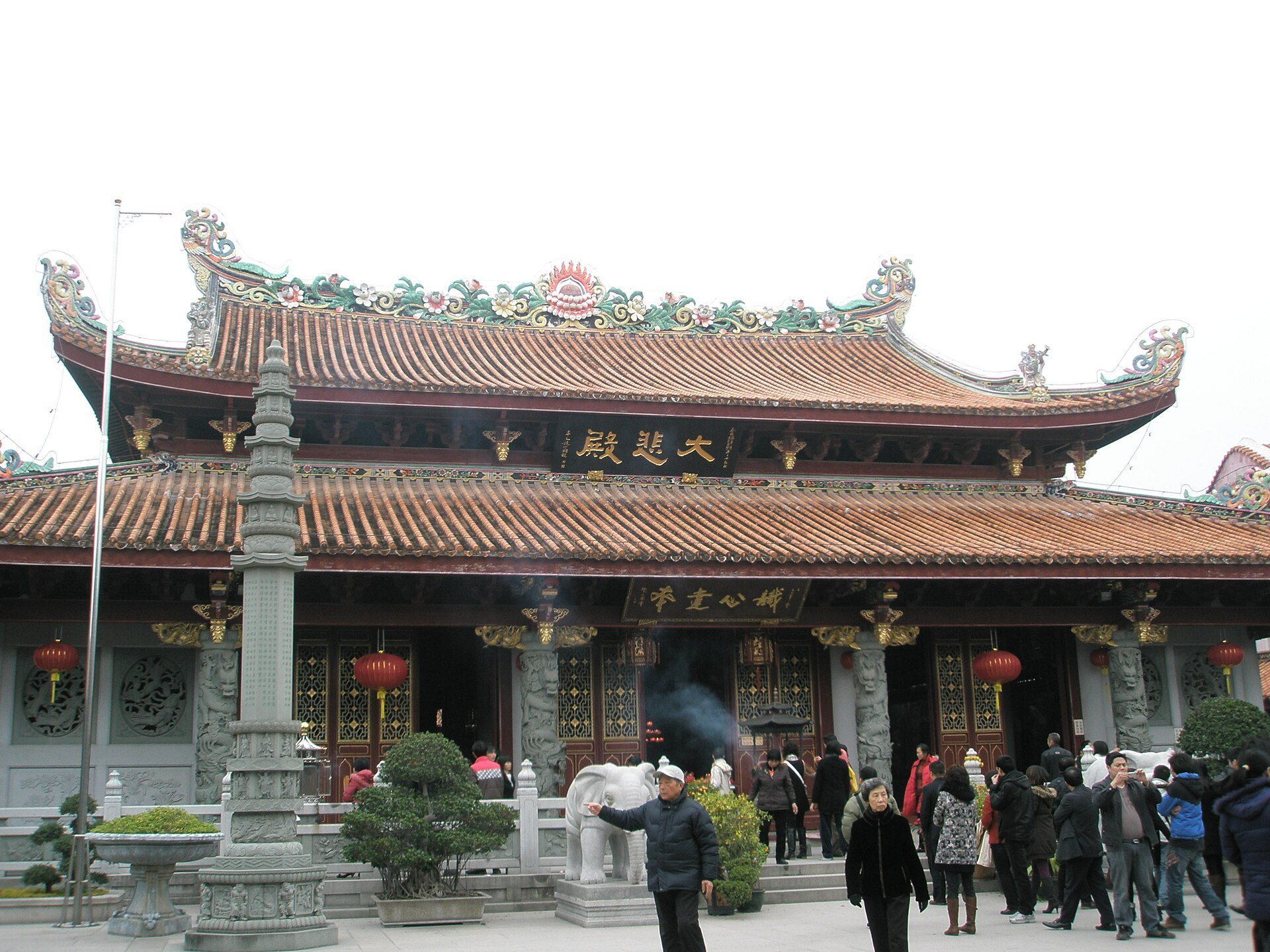
Da Bei Hall was constructed between 2000 and 2005. It measures 30 metres across, 25 metres in depth, and 12.85 metres in height. Its building area is given as 1,600 square metres, while its total area is given as 3,800 square metres. A plaque beneath the eaves bears the words “Da Bei Hall,” written by the Hong Kong scholar and calligrapher Jao Tsung-I. The hall enshrines 86 statues of Guanyin, the bodhisattva associated with compassion.
Taifo Hall
Taifo Hall contains a three-metre-high bronze statue of Gautama Buddha seated in the Maravijaya posture. This posture represents the Buddha’s victory over Mara, the personification of obstruction and temptation, at the time of enlightenment. The statue weighs 1,500 kilograms. Wall paintings present stories of Prince Siddhartha’s attainment of enlightenment in a Thai artistic style, and a statue of Phra Phrom, the Thai form of Brahma, stands on the eastern side.
Buddhist Texts Library and associated buildings
The Buddhist Texts Library forms the final named building on the main axis. The wider complex also contains the abbot’s hall, dining hall, wing rooms, Lingyuan Pavilion, Tiefodian, Bilucangjingge, Guanyin Pavilion, Four-faced Buddha Pavilion, Mingyang Library, the Guanyin Garden, Chanyuezai, and Cengliao.
Pavilions, pagoda, and commemorative structures
Thousand Buddha Pagoda
A seven-storey wooden Thousand Buddha Pagoda stands on a hexagonal base. It dates from the Ming period and is two metres high. Its body is carved with figures of the Eighteen Arhats and the Twenty-four Gods and Kings.
Memorial pavilions and Buddhist images
The temple includes memorial pavilions for the monks Baosong and Tiruna, a 108 Arhat Hall, and a Guanyin Pavilion. It also preserves a thousand-armed image of Guanyin, linking the temple’s sculptural collection with the bodhisattva’s association with compassion.
Stone stupas and cisterns
Two Ming-period stone stupas stand within the complex. Each is 4.2 metres high and is decorated with quotations from Buddhist sutras. The temple also has three stone cisterns, including one dated to 1108.
Historic objects and inscriptions
Iron Buddha and bronze bell
An iron Buddha cast in 1083 is described as 5.3 metres high and four metres wide, and as the largest iron Buddha in China. The temple’s bronze bell was cast in 1114, during the reign of Emperor Huizong of the Northern Song. It is 1.7 metres high, has a circumference of 1.05 metres, and weighs more than 1,500 kilograms.
Tang stone pillars and plaque
Four stone pillars from the Tang period carry reliefs of the Buddha, lotus petals, Hercules, Buddhist texts, and other designs. A Tang-period plaque bearing the temple’s name is attributed to a renowned calligrapher.
Incense burner and Yunban
A red-copper incense burner in the main hall bears an inscription dedicating it to the Chan Hall, a space associated with Chan meditation and practice. The inscription names Ren Guozuo as a disciple of the Three Han. Tradition holds that a Korean monk who came to the temple to study during the Tang period presented the burner. A Yunban, a suspended Buddhist percussion instrument used to mark times for communal activities, survives from 1346.
Scriptures
The temple preserves a set of Dragon-store Buddhist Canon scriptures printed by the imperial government during the Qing period. Only 100 copies were produced, making the surviving set part of the temple’s historical collection of Buddhist texts.